A DUI conviction in California is generally the worse outcome, but a wet reckless plea is not the clean escape many defendants hope for. Both carry a 10-year priorable status, both can trigger SR-22 insurance requirements, and both show up on your DMV record as alcohol-related offenses. The real differences come down to court penalties, probation length, and how quickly you can petition for expungement.
The single most time-sensitive action after any DUI arrest: request a DMV hearing within 10 days. The criminal plea negotiation and the DMV’s Administrative Per Se (APS) suspension run on completely separate tracks. Miss that 10-day window and you automatically lose your right to contest the administrative suspension, regardless of what happens in court.
The two biggest practical differences between a DUI and a wet reckless:
- Probation and expungement: A DUI typically carries three to five years of probation; a wet reckless often runs one to two years, which means you can petition to expunge the conviction sooner.
- Alcohol education program: A first-offense DUI usually requires a three-, six-, or nine-month DUI school. A wet reckless often triggers a shorter program, sometimes as brief as six weeks.
Neither outcome is trivial. What follows is a California-specific breakdown of every dimension that matters before you or your attorney decide whether to accept a reduction.
Table of Contents
- What does a California DUI mean under Vehicle Code §23152?
- What is a “wet reckless” in California, and how does it work?
- How do DUI and wet reckless charges compare side by side?
- Why do prosecutors reduce a DUI to a wet reckless?
- What are the real-world consequences beyond the courtroom?
- What should you ask your attorney before accepting a wet reckless plea?
- Key Takeaways
- Getting out fast matters more than most people realize
- Arrested after a DUI? Badabingbail gets you out fast
- Authoritative sources and where to read more
What does a California DUI mean under Vehicle Code §23152?
Under California Vehicle Code §23152, a DUI charge can rest on two separate theories. Section 23152(a) covers driving while impaired by alcohol, drugs, or a combination, regardless of BAC. Section 23152(b) covers driving with a BAC of 0.08% or higher. Prosecutors often charge both counts simultaneously and proceed on whichever is easier to prove at trial.
Proving a DUI requires the state to establish that you were driving and that you were either impaired or over the legal limit at the time of driving, not just at the time of the blood or breath test. That timing distinction matters enormously for plea negotiations, as you will see in the section on how prosecutors decide.
Typical first-offense misdemeanor DUI penalties
For a standard first-offense misdemeanor DUI in California, expect:
- Fines: Roughly in the low thousands with penalty assessments, though total out-of-pocket costs often run higher once court fees are added.
- Jail: Up to several months in county jail, though first offenders with no aggravating factors often serve little or no actual custody time.
- Probation: Three to five years of summary (informal) probation.
- DUI school: A three-, six-, or nine-month licensed program depending on BAC level and case circumstances.
- Ignition interlock device (IID): Frequently required, especially when BAC is elevated.
- Criminal record: A misdemeanor conviction; expungement is possible after probation is completed.
The DMV’s separate administrative action
The DMV’s APS process is triggered by the arrest and the BAC reading, not by what happens in criminal court. When you are arrested for DUI, the officer typically confiscates your license and issues a temporary driving permit. You have 10 days from the arrest date to contact the DMV and request an APS hearing. Winning that hearing can eliminate the administrative suspension entirely, even if you are later convicted in court. Losing it, or failing to request one, results in an automatic suspension that runs independently of any criminal sentence.
| Penalty Element | First-Offense DUI |
|---|---|
| Maximum jail | 6 months county jail |
| Typical fines (with assessments) | $2,000–$2,500 |
| Probation | 3–5 years |
| DUI school | 3-, 6-, or 9-month |
| IID requirement | Frequently required |
| DMV APS suspension | Automatic if hearing not requested or lost |
| Criminal record | Misdemeanor; expungement after probation |
What is a “wet reckless” in California, and how does it work?
A wet reckless is not something you can be arrested for. No officer writes a wet reckless citation at the roadside. It exists only as a negotiated plea reduction from a DUI charge.
Specifically, it means pleading guilty to reckless driving under Vehicle Code §23103, with an alcohol or drug notation added pursuant to §23103.5. That notation is what makes it “wet.” Without it, you would simply have a standard reckless driving conviction with no alcohol connection. With it, the conviction can be used as a prior DUI offense if you are arrested again within 10 years.
A wet reckless is a real conviction, not a dismissal. It appears on your criminal record as a misdemeanor, it shows on your DMV record as an alcohol-related offense for 10 years, and it adds two DMV points that remain for three years. Treating it as a clean slate is a mistake.
How court penalties differ in practice
The immediate court consequences of a wet reckless are meaningfully lighter than a DUI:
- Maximum jail: Up to a short jail term, though jail is rarely imposed on first-time offenders with competent counsel.
- Probation: Often one to two years, compared to three to five for a DUI.
- Fines: Generally lower base fines and reduced penalty assessments, though specific amounts vary by case and county.
- Alcohol program: Often a shorter program, sometimes as brief as six weeks, versus the multi-month DUI school a DUI conviction demands.
- Expungement timing: Because probation is shorter, you can petition to expunge the conviction sooner, often after one year rather than waiting three or more.
Pro Tip: When a prosecutor offers a wet reckless, ask specifically what alcohol program length the court will order in your county. Program length varies by county and judge, and a “shorter program” in one courthouse may still run several months in another.
When prosecutors typically offer a wet reckless
The classic wet reckless scenario involves a first-time offender with a borderline BAC (often just above 0.08%), no accident, no injury, and no prior record. Add in any weakness in the prosecution’s evidence, such as a questionable traffic stop, a gap between driving time and test time, or equipment reliability concerns, and the offer becomes more likely. Prosecutors are not doing defendants a favor out of generosity. They are managing trial risk.

How do DUI and wet reckless charges compare side by side?
The table below covers every dimension that typically drives the plea decision.
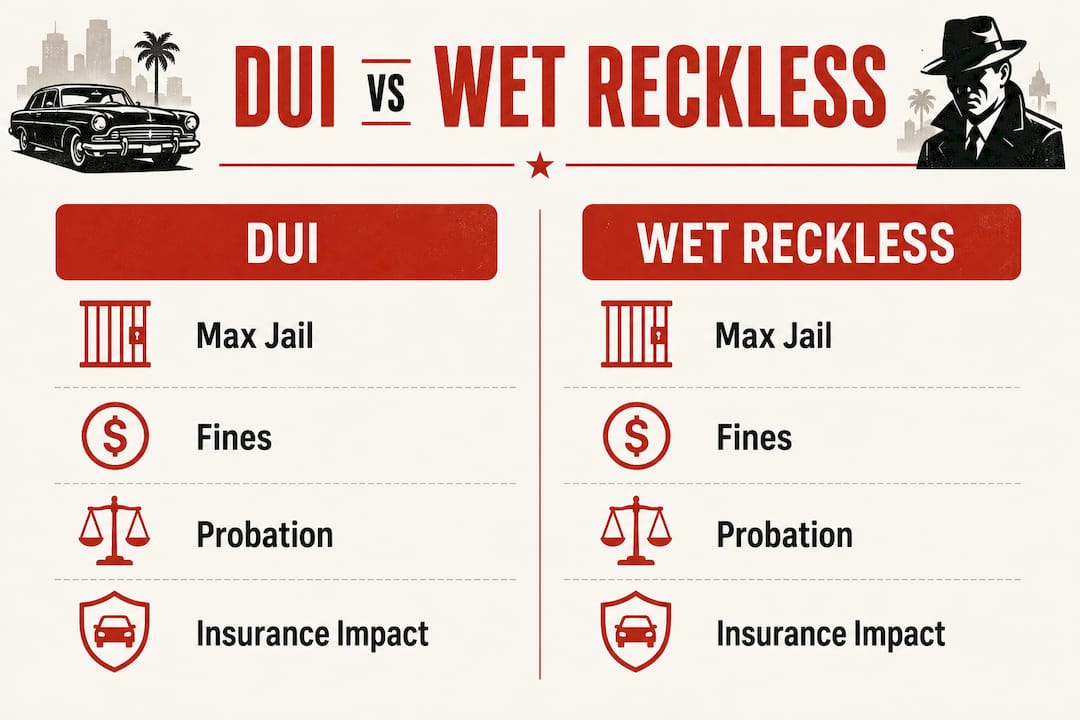
| Factor | DUI (VC §23152) | Wet Reckless (VC §23103/23103.5) |
|---|---|---|
| Maximum jail | 6 months | 90 days |
| Typical fines | $2,000–$2,500 with assessments | Lower base fines and assessments |
| Probation | 3–5 years | Often 1–2 years |
| Alcohol program | 3-, 6-, or 9-month | Often shorter (e.g., 6 weeks) |
| IID requirement | Frequently required | Often not mandatory |
| DMV APS suspension | Applies from arrest; hearing required | Same APS exposure from arrest |
| Court-triggered license suspension | Yes, upon conviction | No mandatory court suspension in many cases |
| Counts as prior DUI (10-year lookback) | Yes | Yes |
| DMV record | Alcohol-related for 10 years | Alcohol-related for 10 years |
| Insurance impact | Major premium increases; SR-22 usually required | Similar increases; SR-22 may still apply |
| Expungement eligibility | After probation (3–5 years) | Often after 1 year of probation |
| Criminal record | Misdemeanor (or felony if aggravated) | Misdemeanor |
The 10-year priorable rule is the most important thing to understand about a wet reckless. Under California law, a wet reckless conviction counts as a prior DUI for sentencing purposes if you are arrested for another DUI within that window. A second DUI within 10 years of a wet reckless carries the same enhanced penalties as a second DUI after a first DUI conviction.
Where the differences are material:
- Court penalties: significantly lighter with a wet reckless (jail exposure, fines, probation, program length)
- Expungement timeline: meaningfully faster with a wet reckless
- IID requirement: often avoided with a wet reckless
Where the differences are largely similar:
- DMV APS exposure: identical, because it flows from the arrest, not the plea
- 10-year priorable status: the same for both
- Insurance impact: most insurers treat a wet reckless nearly the same as a DUI when setting premiums, because the alcohol notation triggers their underwriting flags
Why do prosecutors reduce a DUI to a wet reckless?
Prosecutors offer wet reckless reductions when they are not confident they can win at trial. Understanding what shakes that confidence helps you understand what your attorney should be looking for.
The “3-hour rule” and why timing matters
California law allows BAC testing within three hours of driving and creates a rebuttable presumption that the test result reflects BAC at the time of driving. But that presumption can be challenged. If significant time passed between when you were driving and when you were tested, alcohol may still have been absorbing into your bloodstream, meaning your BAC at the wheel could have been lower than the test showed. When prosecutors cannot reliably tie BAC at test time to BAC while driving, the evidentiary foundation of the §23152(b) count weakens. A wet reckless offer often follows.
Factors that make a wet reckless offer more likely
- Borderline BAC: A result just above 0.08% leaves room to argue measurement error or absorption timing.
- No accident or injury: Cases without a victim are easier to negotiate.
- First offense: Prosecutors are generally more willing to offer reductions to defendants with no prior record.
- Questionable traffic stop: If the officer lacked reasonable suspicion to pull you over, the entire case may be suppressed.
- Field sobriety test problems: Improperly administered tests or conditions that affect performance (medical issues, uneven pavement, poor lighting) can undermine the impairment theory.
- Chemical testing issues: Breathalyzer calibration records, blood sample handling, and lab chain-of-custody problems all create doubt.
- County practices: Some California counties are more willing to offer wet reckless reductions than others. What is routine in one courthouse may be rare in another.
A wet reckless is not a gift from the prosecutor. It is the result of documented legal pressure. Defense attorneys who identify and present specific evidentiary weaknesses in writing, before trial, are the ones who get these offers. Walking into a negotiation without that preparation rarely produces a reduction.
What are the real-world consequences beyond the courtroom?
Court penalties are only part of the picture. The day-to-day consequences of both a DUI and a wet reckless extend well beyond sentencing.

Insurance: the cost that surprises most people
Insurance companies look for the alcohol notation on your DMV record, not just the criminal charge label. Because a wet reckless carries that notation under §23103.5, many carriers treat it similarly to a DUI when calculating premiums. Rate relief after a wet reckless is usually smaller than defendants expect. Some carriers code reckless-driving-with-alcohol differently from a DUI, which can produce a smaller surcharge, but the difference is carrier-specific and not guaranteed.
SR-22 requirements can also follow a wet reckless if the DMV suspends your license through the APS process. The SR-22 obligation, and the high-risk insurance status it signals, is one of the costliest long-term consequences of either conviction. Over a multi-year horizon, the insurance differential between a DUI and a wet reckless can amount to thousands of dollars, but the savings are not guaranteed.
Pro Tip: Before accepting any plea, call your insurance carrier and ask how they code a VC §23103.5 conviction versus a VC §23152 conviction. The answer varies by insurer and can significantly change your cost calculus.
Employment, professional licensing, and regulated professions
A wet reckless carries less stigma than a DUI on a background check, and it does not read as a DUI on its face. For most private employers, that distinction matters. For regulated professionals, it often does not.
CDL holders, healthcare workers, attorneys, nurses, teachers, and others in licensed trades frequently face mandatory self-reporting requirements to their licensing boards. The alcohol notation on a wet reckless conviction triggers licensing board reviews in many regulated professions, even when the criminal charge is technically reckless driving. For these professionals, the 10-year priorable status can be the decisive factor making a wet reckless a poor tradeoff despite lighter court penalties.
Immigration and child custody
A DUI conviction can have serious immigration consequences, including potential grounds for deportation or inadmissibility depending on the specific charge and circumstances. A wet reckless, as a reckless driving conviction with an alcohol notation, may carry different immigration implications, but this is a highly fact-specific analysis. Anyone with immigration concerns should consult an immigration attorney before entering any plea. Similarly, either conviction can be raised in child custody proceedings as evidence of parenting fitness, though courts weigh these matters case by case.
The 10-year priorable effect in practice
If you accept a wet reckless today and are arrested for DUI within the next 10 years, you face second-offense DUI penalties: mandatory minimum jail time, longer license suspension, a longer DUI school, and higher fines. The wet reckless does not disappear from the sentencing calculus just because it carried a lighter label.
What should you ask your attorney before accepting a wet reckless plea?
A wet reckless offer can be the right call or the wrong one depending entirely on your specific facts. Here is a checklist to work through with your attorney before signing anything.
Questions to ask:
- How will this conviction appear on my DMV record, and for how long?
- Will I need to file an SR-22, and if so, for how long?
- What alcohol education program will the court order, and how long does it run in this county?
- How soon after completing probation can I petition for expungement?
- Does my employer, professional license, or security clearance require self-reporting of this conviction?
- Does my immigration status create any additional risk with this plea?
- What is the realistic trial outcome if we reject this offer?
- Are there grounds to suppress evidence or challenge the stop?
Red flags that suggest you should fight rather than accept:
- BAC was significantly above 0.08% with no timing or equipment issues to challenge
- An accident or injury was involved
- You hold a CDL, professional license, or security clearance where any alcohol conviction triggers review
- You have a prior DUI or wet reckless within the past 10 years (a second offense carries mandatory minimums that a wet reckless does not avoid)
- The prosecutor’s offer is a wet reckless but the evidence against you is actually weak enough to win at trial
Immediate steps after a DUI arrest:
- Request your DMV APS hearing within 10 days of arrest. This is non-negotiable.
- Preserve all evidence: dashcam footage, receipts showing when and what you consumed, witness contact information.
- Document anything unusual about the stop, the field sobriety tests, or the testing process.
- Read the post-arrest steps guide before your first attorney meeting so you arrive prepared.
Pro Tip: The DMV hearing and the criminal case are separate proceedings with separate deadlines. Winning the DMV hearing does not guarantee a favorable criminal outcome, and vice versa. You need a strategy for both tracks simultaneously.
Key Takeaways
A wet reckless is meaningfully better than a DUI in court, but it still counts as a prior DUI for 10 years and carries near-identical DMV and insurance consequences.
| Point | Details |
|---|---|
| DUI is worse in court | A DUI carries up to 6 months jail, 3–5 years probation, and longer DUI school versus up to 90 days jail, 1–2 years probation, and a shorter program for a wet reckless. |
| 10-year priorable status is identical | Both a DUI and a wet reckless count as a prior DUI for sentencing if you are arrested again within 10 years. |
| DMV deadline is non-negotiable | You must request an APS hearing within 10 days of arrest; missing it means automatic suspension regardless of the criminal plea. |
| Insurance impact is often similar | Most insurers treat the alcohol notation on a wet reckless nearly the same as a DUI when setting premiums and SR-22 requirements. |
| Badabingbail can help you act fast | Fast release through Badabingbail preserves your ability to meet the 10-day DMV deadline and consult counsel before critical decisions are made. |
Getting out fast matters more than most people realize
Here is something the legal guides rarely mention: the first 10 days after a DUI arrest are the most consequential of the entire case, and you cannot use them effectively from inside a jail cell.
The DMV hearing deadline, the evidence preservation window, the first attorney consultation, the decision about whether to challenge the stop or the chemical test results — all of it happens in that narrow window. Defendants who secure fast release are consistently better positioned to participate in their own defense than those who wait days or weeks for arraignment.
From Badabingbail’s perspective, the bail step is not separate from the legal strategy. It is the first move in it. Families who call within hours of an arrest give their loved one the best chance of being present, informed, and ready when the attorney needs them. Those who wait, hoping the situation resolves itself, often find that the DMV deadline has passed before anyone even thought to request a hearing.
The 24/7 availability and local county knowledge that Badabingbail brings to Ventura, Santa Barbara, and Orange County cases means the release process moves quickly, even on weekends and holidays when most agencies are slow. That speed is not a convenience. In a DUI case, it is a legal asset.
Arrested after a DUI? Badabingbail gets you out fast
When someone you care about is arrested for DUI in Ventura, Santa Barbara, or Orange County, the clock starts immediately. The 10-day DMV hearing deadline does not pause for paperwork, and neither does the evidence preservation window.

Badabingbail has spent over 15 years helping California families move through the bail process quickly, with clear communication and flexible financing options that make fast release possible even when finances are tight. Low down payment options are available for qualifying clients, and the team is available around the clock, every day of the year.
Getting out fast is how you protect your legal options from day one. Here is what to do right now:
- Call Badabingbail at any hour to start the release process for Ventura, Santa Barbara, or Orange County.
- Ask about financing: Low down payments and payment plans are available for qualifying clients.
- Bring: The arrested person’s full legal name, the jail or facility name, and the booking number if you have it.
Bada Bing Bail also offers bail bond financing options for families who need help covering the bond premium. Spanish-language support is available.
Authoritative sources and where to read more
The following primary sources and legal references support the claims in this article and are the best starting points for deeper research or attorney preparation:
- California Vehicle Code §23152 (DUI statutory basis): leginfo.legislature.ca.gov
- California Vehicle Code §23103 / §23103.5 (reckless driving / wet reckless statutory basis): California Legislative Information, same portal
- Superior Court of California, County of Humboldt — Waiver and Plea to Reckless Driving (Alcohol Related): Official court form showing procedural mechanics and penalty disclosures for a wet reckless plea
- California DMV — Administrative Per Se (APS) suspension process: California DMV official site for hearing request procedures and timelines
- NHTSA — Drunk Driving: nhtsa.gov for national impaired driving data and context
- Nolo — DUI Versus Wet Reckless Charges and Penalties: Nolo legal encyclopedia for plain-language overview of plea availability and county variation
- Randhawa Law Firm — How to get a DUI reduced to reckless driving in California: Detailed breakdown of the evidentiary factors and the 3-hour timing issue
- Confianza Legal — The Wet Reckless Plea in California: Analysis of insurance, licensing, and professional consequences
- Joel Brand, Esq. (dui.guru) — Wet Reckless vs. DUI: A Practical Side-by-Side Comparison: Comprehensive penalty comparison with statutory citations
- Legal Beagle — California DUI Laws: The Difference Between a ‘Wet Reckless’ and a DUI: Consumer-facing insurance and SR-22 commentary
This article is general legal information for California readers, not legal advice. Laws change and individual circumstances vary. Confirm current rules with the California DMV, the relevant Vehicle Code sections, or a licensed California criminal defense attorney before making any plea decision.