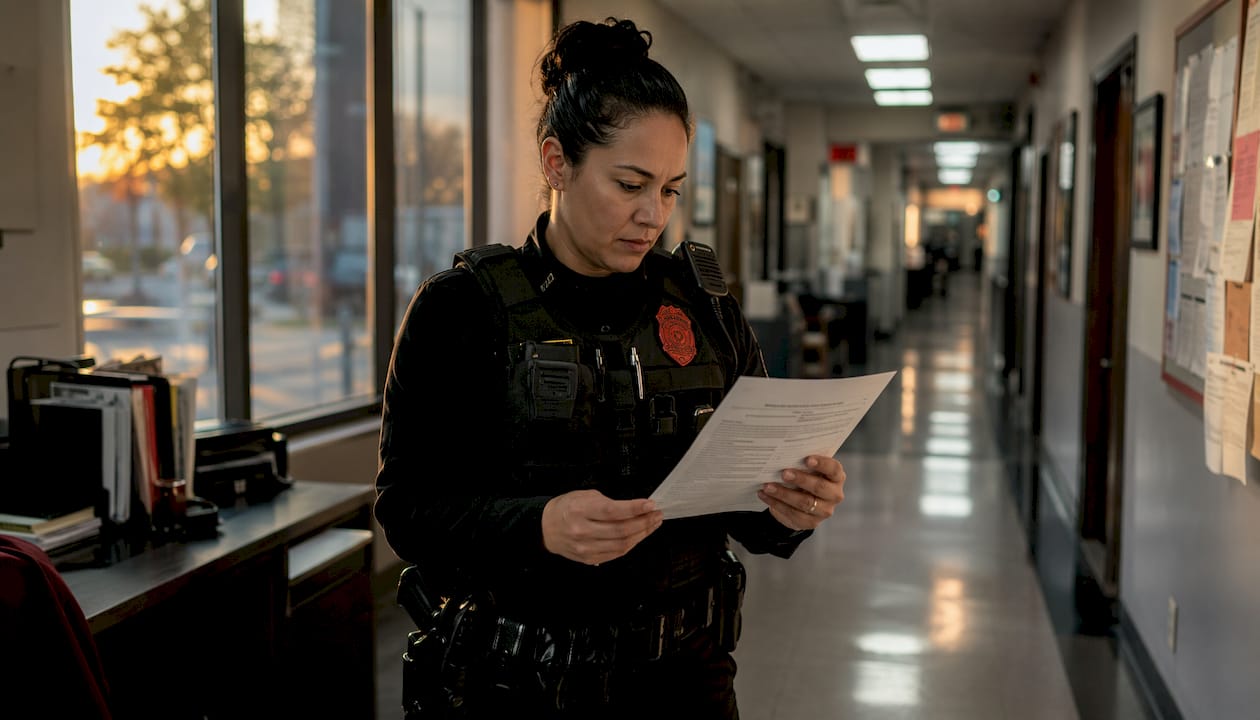
An emergency protective order (EPO) in California is a short-term, judge-issued restraining order that law enforcement can request 24/7 to provide immediate safety, typically lasting until the close of business on the 5th court day or the 7th calendar day after issuance, whichever comes first, and it takes effect the moment it is issued. The Judicial Council of California authorizes these orders as ex parte, meaning the restrained person has no prior notice or chance to contest before the order is in place. Once issued, the EPO is entered into the California Restraining and Protective Order System (CARPOS), making it enforceable by any officer statewide.
For families, the timing matters enormously. EPOs frequently arise during the arrest and booking window, which means the person you are trying to help may already be in custody when the order is served. That short window is your decision window for posting bail, gathering documents, and filing for longer protection if needed.
Key facts at a glance:
- EPOs are available around the clock, every day of the year
- A standard EPO expires at the close of business on the 5th court day or the 7th calendar day after issuance, whichever comes first
- Violations can trigger immediate arrest and criminal charges under California Penal Code Section 166
- Only law enforcement can request an EPO; a victim cannot go directly to a court to obtain one
Table of Contents
- What exactly is an emergency protective order in California?
- When and how is an EPO issued in California?
- What can an EPO require, and what happens if it is violated?
- How long does an EPO last, and how do you get longer protection?
- How EPOs are enforced statewide through CARPOS
- What families should do immediately when a loved one is arrested and an EPO may apply
- What to expect at the respondent’s next court appearances
- Key Takeaways
- What Badabingbail sees families go through every time
- Badabingbail is ready to help right now
- Useful sources and further reading
What exactly is an emergency protective order in California?
An EPO is not a full restraining order. It is a rapid, low-evidence stop-gap designed to protect someone at a volatile moment, before a court hearing can be scheduled. The evidentiary threshold is intentionally low: the Judicial Council and legal practitioners both emphasize that speed and immediate safety take priority over a formal evidentiary process.

Officers use Judicial Council forms EPO-001 (for domestic violence and related situations) or EPO-002 (for stalking) to document the order. The officer contacts an on-call judicial officer by phone, asserts the grounds, and the judge issues the order orally. The officer then reduces it to writing and signs it. The restrained person may first learn of the order while being booked at the jail, with no prior opportunity to respond.
Who can request an EPO? Sheriffs, police officers, probation and parole officers, and school peace officers are all authorized. Situations that qualify include domestic violence, child abuse or abduction risk, stalking, and elder or dependent adult abuse.
Pro Tip: If your loved one is arrested and you suspect an EPO was issued, ask the jail or booking officer for a copy of the order number and the CARPOS confirmation. Keep that document. You will need it when speaking with a bail agent and when preparing for court.
When and how is an EPO issued in California?
The process moves fast. A responding officer who believes someone faces immediate and present danger contacts the on-call judicial officer, who is available 24 hours a day to review and sign off on emergency orders. The standard is “reasonable grounds,” which is deliberately lower than probable cause for an arrest.
Once the judge issues the order orally, the officer’s duties kick in immediately:
- Serve the order on the restrained person if they can reasonably be located
- Give a copy to the protected person
- File the order with the court as soon as practicable
- Enter proof of service into CARPOS within one business day
The order can be issued whether or not the suspect has been arrested. That means someone could be served at the scene, during booking, or even later at a traffic stop if they were not immediately located.
The 5–7 day window is not a grace period. It is the entire time a petitioner has to file for a Temporary Restraining Order (TRO) at the superior court if they want continued protection. For families, it is also the window to post bail, consult an attorney, and understand the exact terms of the order before the next court date.
What can an EPO require, and what happens if it is violated?
An EPO can include a range of specific orders depending on the circumstances:
- No-contact order: The restrained person cannot call, text, email, or contact the protected party through third parties
- Stay-away order: A specified distance must be maintained from the protected person’s home, workplace, school, or vehicle
- Move-out order: The restrained person must vacate a shared residence
- Child custody instructions: Temporary custody of minor children may be assigned to the protected party
- Firearm, ammunition, and body armor prohibition: Possession is barred for the duration of the order
The firearm rules carry serious weight. Under California law, a restrained person may be required to surrender firearms and ammunition within 24 hours of service and file proof of surrender within 48 hours. Possessing a firearm while subject to a restraining order is a separate criminal offense.
Violating any term of an EPO, including indirect contact through a mutual friend, can result in immediate arrest and criminal charges under California Penal Code Section 166. Law enforcement officers are required to use every reasonable means to enforce these orders, and the protected person’s own actions cannot waive the order’s terms. If the protected party invites the restrained person back into the home, the order is still legally in effect.
For context on local firearm surrender enforcement, see gun safety enforcement in LA County.
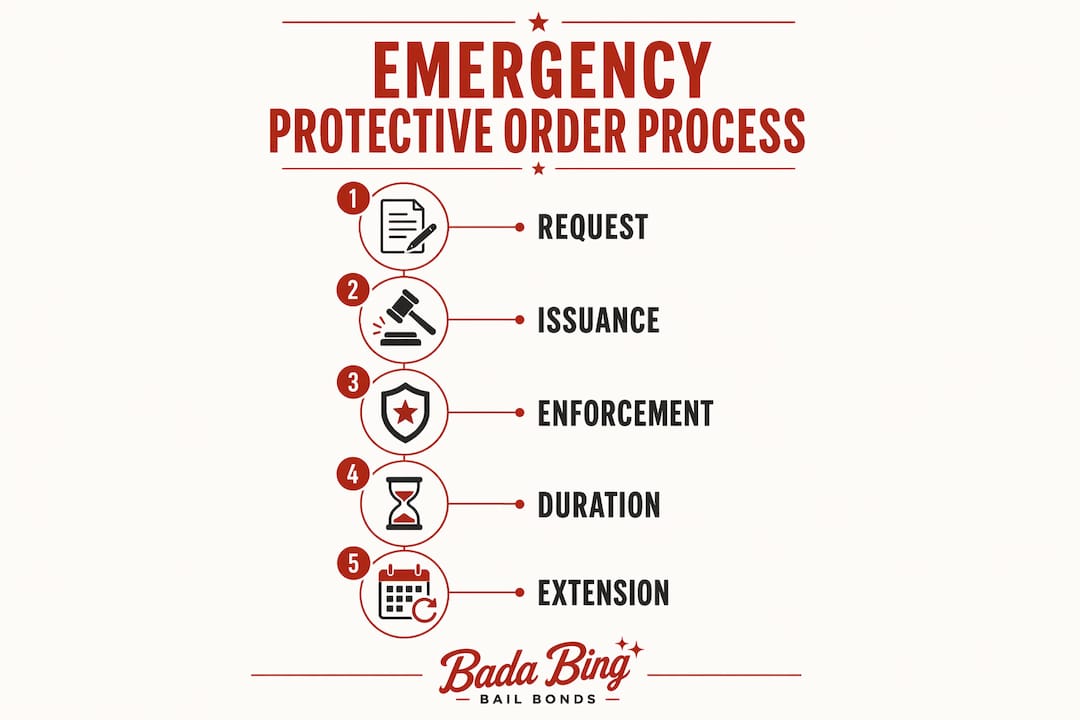
How long does an EPO last, and how do you get longer protection?
Standard EPO duration under California Family Code Section 6256: the order expires at whichever comes first, the close of business on the 5th court day or the 7th calendar day after issuance. Gun-related EPOs last 21 calendar days, with a hearing scheduled within that period.
For petitioners who need protection beyond that window, here is the path:
- Go to the superior court clerk’s office in the county where you live, ideally within the first day or two of the EPO being issued.
- Complete the TRO packet, which includes Judicial Council forms DV-100 and DV-109 for domestic violence situations. California Courts’ self-help pages walk through each form and local self-help centers can assist.
- File the forms and request an emergency hearing. A judge can issue a Temporary Restraining Order the same day.
- Attend the TRO hearing, typically scheduled within 21 days. Both parties can appear and be heard.
- At the hearing, the court decides whether to issue a longer Domestic Violence Restraining Order (DVRO), which can last up to five years and is renewable.
Only law enforcement can request an EPO. Once that window closes, the protected party must take the next step themselves.
How EPOs are enforced statewide through CARPOS
Once an EPO is entered into CARPOS and the California Law Enforcement Telecommunications System (CLETS), it is enforceable by any peace officer anywhere in California. A traffic stop in a different county, a later arrest on an unrelated charge, or a jail intake check can all surface the order.
Key enforcement mechanics families should know:
- Courts and agencies must transmit orders and proofs of service into CARPOS within one business day
- An EPO is legally valid even if the restrained person has not yet been personally served, as long as it is entered in CLETS/CARPOS
- If an EPO is more restrictive than an existing order between the same parties, the EPO takes precedence for its duration
- Officers responding to any call must check for active protective orders before making contact
Pro Tip: Call the jail or the issuing law enforcement agency to confirm the EPO has been entered into CARPOS. Ask for the case or order number. If proof of service has not been filed yet, the order is still valid, but confirming entry helps you and your attorney track the exact terms and expiration date.
What families should do immediately when a loved one is arrested and an EPO may apply
Time is short. Here is what to do in order:
- Find out where your loved one is held. Call the arresting agency or check the county jail’s online inmate locator for Ventura, Santa Barbara, or Orange County.
- Get the booking number and bail amount. Jail staff can confirm whether a bail amount has been set and whether any holds or EPOs are attached to the case.
- Ask whether an EPO was issued. Request the order number and a copy if possible, or ask for CARPOS confirmation.
- Gather your documents before calling a bail agent: full legal name, booking number, bail amount, your relationship to the arrested person, a valid ID, payment method, and any collateral information you may need.
- Call a licensed bail agent. Badabingbail is available 24/7 and serves Ventura, Santa Barbara, and Orange Counties. Explain the situation, including the EPO, so the agent can advise on any release conditions.
- Understand the cost. A bail bond typically costs 10% of the total bail amount as a non-refundable premium. Badabingbail offers flexible financing and low down payment options for qualifying clients.
Pro Tip: Posting bail does not erase an EPO. The moment your loved one is released, the order’s terms are still fully in effect. Violating the EPO after release is a separate criminal matter and can result in re-arrest and bond forfeiture. Consult a criminal defense attorney before any contact with the protected party.
If an EPO affects child custody arrangements, reviewing a California custody schedule can help families understand what temporary changes may look like during the order period.
What to expect at the respondent’s next court appearances
The respondent does not get a hearing before an EPO is issued, but they do have the right to be heard at subsequent proceedings. Here is what the near-term calendar typically looks like:
- Arraignment: Usually within 48–72 hours of arrest for felonies, or the next court day for misdemeanors. The respondent enters a plea and bail conditions are reviewed.
- TRO/DVRO hearing: If the petitioner files for a TRO, a hearing is typically set within 21 days. The respondent receives notice and can appear to contest the order.
- Gun EPO hearing: Set within the 21-day EPO period; the respondent must appear or risk a default order.
Practical steps for families during this phase:
- Document every instance of compliance with the EPO terms, including dates and times
- Retain a criminal defense attorney as soon as possible, ideally before arraignment
- Understand that missing a court date after posting bail can result in bond forfeiture and a bench warrant
Pro Tip: Tell your bail agent upfront about the EPO and any related charges. Bond conditions may include geographic restrictions or no-contact requirements that overlap with the EPO. A bail agent who knows the full picture can help set accurate expectations and avoid surprises at arraignment.
Key Takeaways
An emergency protective order in California is a judge-issued, immediately enforceable stop-gap that lasts until the close of business on the 5th court day or the 7th calendar day after issuance, whichever comes first, and families must act within that window to post bail, file for longer protection, and prepare for court.
| Point | Details |
|---|---|
| EPO duration is short | Standard EPOs expire on the 5th court day or 7th calendar day; gun EPOs last 21 days with a hearing. |
| Violations trigger arrest | Any breach, including indirect contact, can lead to immediate arrest and criminal charges under Penal Code 166. |
| CARPOS makes it statewide | Once entered, the order is enforceable by any California officer, even across county lines. |
| File for a TRO fast | Petitioners must go to the superior court during the EPO window to apply for a Temporary Restraining Order. |
| Badabingbail is available now | Badabingbail serves Ventura, Santa Barbara, and Orange Counties 24/7 with flexible financing and fast release support. |
What Badabingbail sees families go through every time
When a call comes in at 2 AM about a loved one arrested on a domestic violence charge, the EPO question is almost always the first thing that complicates the conversation. Families often do not know the order exists until they are already at the jail asking about bail. That gap, between the arrest and understanding what the EPO actually restricts, is where things go wrong.
Badabingbail has been working through exactly these situations in Ventura, Santa Barbara, and Orange Counties for over 15 years. The counties are different, the jails are different, and the booking timelines vary. What does not change is that the 5–7 day window moves fast, and families who call early get more options. The ones who wait, hoping the situation resolves itself, often find the EPO has already shaped the bail conditions and the court schedule before they have had a chance to respond.
The most overlooked piece of advice: get the EPO document in hand before you do anything else. Know the exact terms. Then call a bail agent and an attorney, in that order, on the same day.
Bada Bing Bail is ready to help right now
When a loved one is arrested and an EPO is in the picture, every hour counts. Badabingbail offers fast bail assistance across Ventura, Santa Barbara, and Orange Counties, with agents available 24 hours a day, seven days a week.

Before you call, have these ready: the arrested person’s full legal name, booking number, the bail amount if you know it, your ID, a payment method, and any collateral details. The standard bail bond premium is 10% of the total bail amount, and Badabingbail offers low down payment options and payment plans for qualifying clients. Everything is handled with discretion and clear communication, so you understand exactly what you are signing and what happens next. Call now or visit badabingbail.com to get the release process started.
Useful sources and further reading
- Emergency Protective Orders Bench Guide, Judicial Council of California: The primary authority on EPO issuance standards, duration rules, CARPOS entry requirements, and officer duties. Start here for the official procedural framework.
- EPO-001 Form, Judicial Council of California: The actual form officers complete when requesting an EPO. Useful for understanding what information is captured and what the restrained person will receive.
- Guide to Protective Orders, California Courts Self-Help: Plain-language walkthrough of all protective order types, including how to apply for a TRO and where to find local self-help centers.
- Emergency Protective Orders, Orange County Superior Court: County-specific guidance for Orange County residents, including the Lamoreaux Justice Center location and the Domestic Violence Hotline number.
- California Family Code Sections 6240–6275: The statutory text governing EPO issuance, terms, and expiration in California.
- Bada Bing Bail, 24/7 Bail Bond Assistance: Contact page for immediate bail help in Ventura, Santa Barbara, and Orange Counties.