
A California false imprisonment charge under Penal Code 236 is the unlawful violation of another person’s personal liberty, and it can become a felony under PC 237(a) when it’s carried out by violence, menace, fraud, or deceit. In the kind of Ventura County arrest that sends a family member racing to the phone at 2 a.m., that difference can decide whether the case looks like a short county-jail matter or something much more serious.
If someone you care about was booked in Ventura, Oxnard, or Santa Barbara after an argument, a doorway block, or a domestic dispute, the first question is usually simple: what counts as false imprisonment PC, and how fast can bail move?
Table of Contents
- What False Imprisonment PC Means in California
- The Four Elements Prosecutors Must Prove
- Misdemeanor Versus Felony False Imprisonment Under PC 237
- Common Real World Scenarios That Lead to a Charge
- How False Imprisonment Differs From Kidnapping, Assault, and Domestic Violence
- Defenses a California Defense Attorney Is Likely to Raise
- Bail, Release, and What Happens Right After the Arrest
- Practical Next Steps for Defendants and Victims in Ventura County
What False Imprisonment PC Means in California
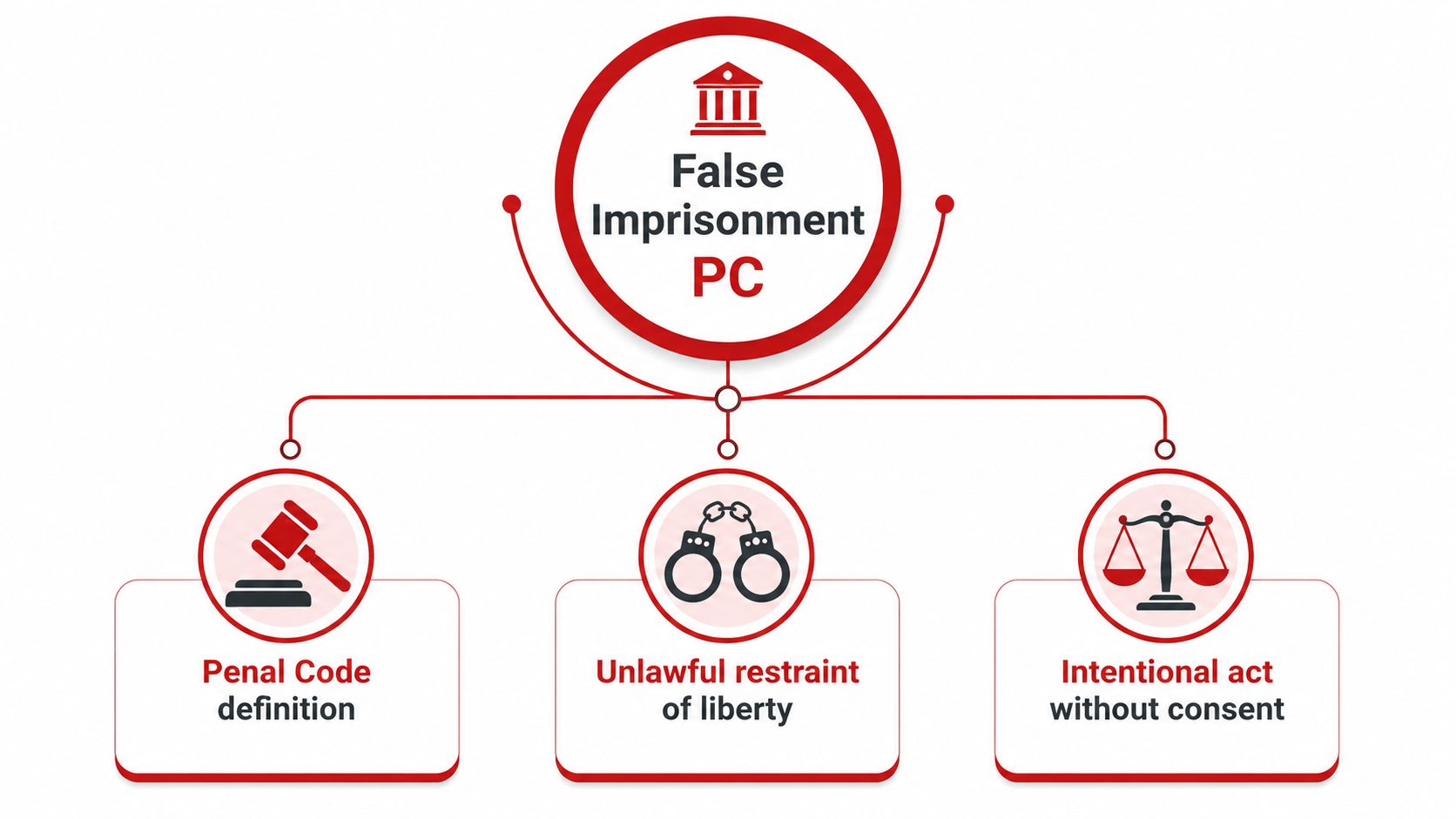
A worried family member usually does not need a lecture when the jail call comes in. They need the plain version first, the one that makes sense before the paperwork starts showing up from court. California false imprisonment means someone intentionally kept another person from leaving without consent or lawful authority, and it does not take a locked cell to make that happen. The law is broad enough to reach a blocked doorway, a grabbed wrist, or an assertion of authority that makes a person believe they cannot leave, even for a short time. That is the core idea behind false imprisonment PC in everyday language, and it is why people are often surprised when an ordinary argument turns into a criminal case. The California definition is the unlawful violation of another person’s personal liberty, and county guidance recognizes that the restraint can happen through violence, menace, fraud, or deceit. California Penal Code 236
Why the location matters less than the restraint
A lot of people picture false imprisonment as a person locked in a room. Real cases are usually messier. The restraint can happen in a car, at a doorway, in a hallway, or in any bounded space where the person is kept from leaving. Courts also treat short confinement seriously because the issue is the unlawful restraint itself, not whether it lasted long enough to feel dramatic. A five-minute hold can matter just as much as a longer one if the legal elements are met.
A judge and prosecutor will care more about what stopped the person from leaving than about the setting alone. A door blocked by a body, a phone taken away in the middle of an argument, or repeated threats that make someone stay put can all raise the same basic question, did the other person have a real choice to walk away. That is why families in Ventura County hear so many different fact patterns described as false imprisonment, even when none of them look like a scene from a movie. For a local overview of how a case can move through the Ventura County court system, the booking and court process usually starts long before anyone has sorted out the details.
Practical rule: if someone’s freedom to leave was intentionally blocked without permission or legal justification, the length of time matters less than the restraint.
The question is not only whether the person was inside a room. It is whether someone used force, fear, trickery, or authority to keep another person from going where they were otherwise free to go. That is why a brief scuffle, a door held shut, or a phone taken in the middle of an argument can become more serious than the people involved expected.
The Four Elements Prosecutors Must Prove
In a Ventura County case, the prosecutor has to show four specific things, not just that someone was held in place. The detention must be intentional, without consent, within a bounded area, and without lawful authority. If one of those pieces is missing, the defense has a real opening.
Willful act and detention
First, there has to be a willful act. That means the restraint was deliberate, not an accident. A person who intentionally blocks a car door or stands in front of a doorway is doing something very different from someone who brushes past another person in a crowded room. The question is whether the conduct was aimed at keeping the other person within bounded limits. FindLaw’s tort explanation of false imprisonment
Lack of consent and no lawful authority
Second, the detention has to happen without consent and without lawful authority. If someone agreed to stay, that is a different situation from being kept there against their will. The same point comes up when the law gives someone limited authority, such as a lawful merchant detention or a parent’s authority over a child. Text messages, video, and witness statements often matter here because consent is usually argued after the fact, when everyone tells the story in a different way.
Awareness and the bounded area
Third, the person must be detained within a bounded area, and awareness can matter. Courts and legal references recognize that confinement can still count even if the person was unconscious or otherwise unable to fully register it at the time, because the restraint itself is what matters. A short hold inside a room, vehicle, or hallway can still satisfy the test if the person was not realistically free to leave.
A quick restraint can still be enough if the person could not walk away freely.
The fourth point is the absence of lawful privilege. That is the part jurors and judges often focus on, because it separates a bad decision from a criminal one. The evidence usually looks concrete, surveillance footage, body-cam video, phone records, or witness statements, not just the length of the encounter. Cornell Law’s false imprisonment overview
Misdemeanor Versus Felony False Imprisonment Under PC 237
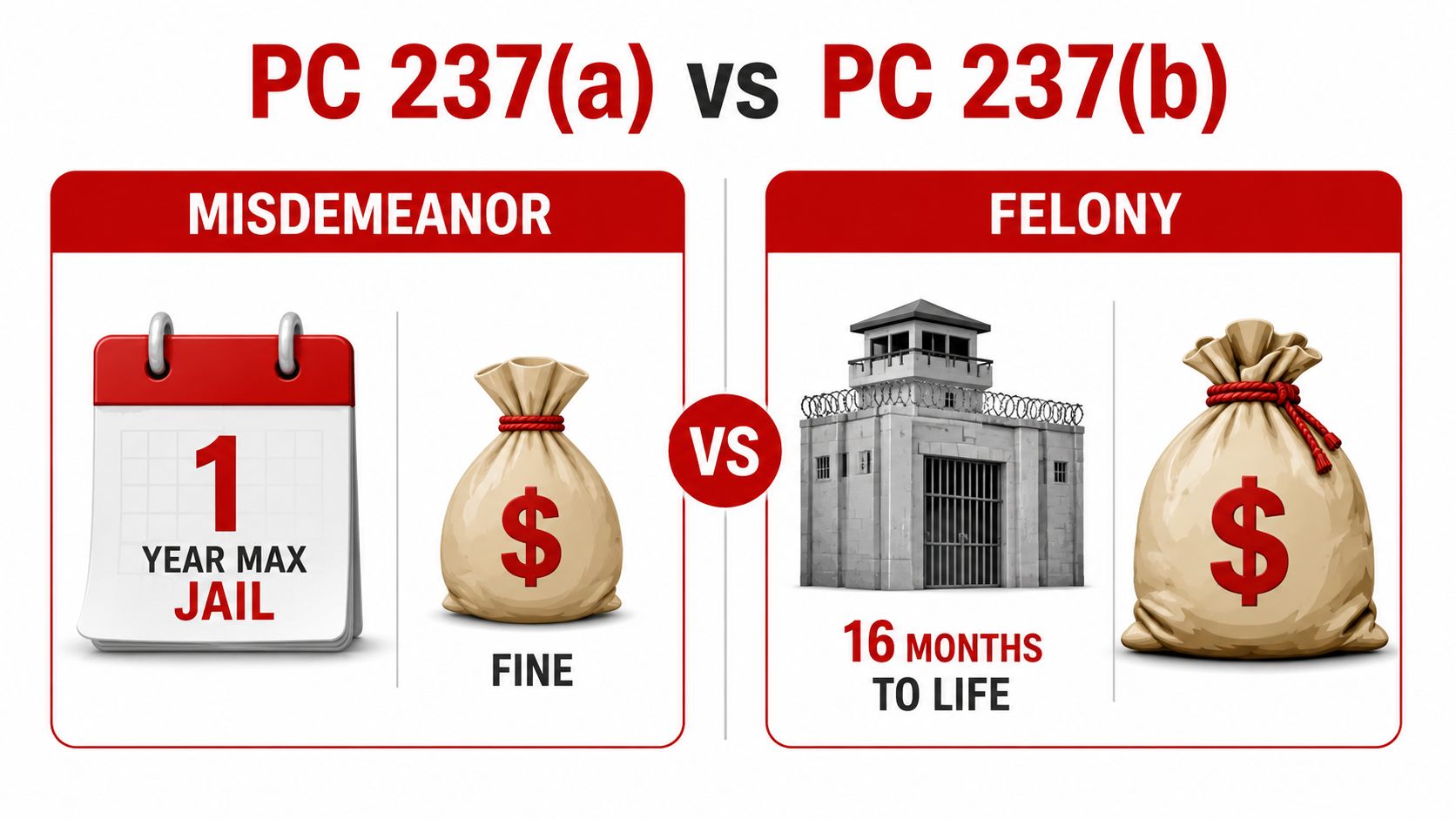
This is the fork in the road that changes the rest of the case. California uses a two-tier structure for false imprisonment, and the method of restraint matters more than how long the incident lasted. Under PC 237(a), misdemeanor false imprisonment is the baseline. When the detention is accomplished by violence or menace, the conduct falls into the felony side of the statute under PC 236, and public-sector guidance also recognizes that fraud or deceit can be part of the analysis. California false imprisonment guidance
What the aggravators mean in practice
Violence means actual physical force. A push, a grab, or wrestling someone back into a room can push the case harder than a purely verbal dispute.
Menace means a credible threat of harm. It doesn’t have to be a weapon in hand. The question is whether the threat would make a reasonable person believe leaving wasn’t safe.
Fraud means tricking someone into staying or going somewhere under false pretenses.
Deceit means false statements about authority, consequences, or facts that strip away real consent.
That’s why attorneys in Ventura County focus so heavily on how the restraint happened. The same basic confinement can land in different charging lanes depending on whether the evidence shows force, threats, deception, or simple blocking. A person who shut a door during an argument may be facing a different filing decision than someone who used violence to stop an exit.
Why the charging lane matters fast
Once the case is filed, the misdemeanor-versus-felony label affects court posture, negotiation strategy, and bail expectations. Families often hear the charge name before they hear the details, but the details are what move the case. In real life, prosecutors, defense counsel, and bail agents all start with the same question, what kind of restraint does the evidence show? That answer usually controls the early risk picture far more than the emotional temperature of the incident.
Common Real World Scenarios That Lead to a Charge
The late-night calls I hear usually start with plain facts, not legal labels. “He blocked the door.” “She took my keys.” “It was only a few minutes.” Those are the kinds of details that bring this charge into Ventura, Oxnard, Camarillo, and Santa Barbara courtrooms. The law does not require a jail cell. It looks at whether someone’s movement was restrained.
Doorways, cars, and short confrontations
A doorway can become the whole case. If one person stands in the only exit during an argument and the other person cannot leave freely, prosecutors may treat that as false imprisonment. A blocked car door can work the same way, especially when the person inside reasonably understands they are being kept there.
A brief scuffle can still matter if it intentionally kept someone from leaving. In court, the question is whether liberty was restrained, not how dramatic the clip looks on a phone. I have seen cases turn on that one fact, because a short physical hold can be enough to change a simple fight into a booking decision.
Phones, keys, and the “you’re not leaving” moment
Taking or hiding someone’s phone or car keys is another fact pattern families see all the time. If the point is to stop the person from leaving, the restraint becomes much more serious. People often say, “I only held the keys for a minute,” but the law does not treat a minute as harmless when the effect is to trap someone in place.
That is the detail defense counsel and prosecutors both focus on. The length of the moment matters less than the intent behind it. A short hold can still support a charge if it was used to keep someone from walking out, calling for help, or driving away.
Domestic disputes and workplace detentions
Domestic cases get complicated fast because emotion, property, and close contact all pile together. A person may be held in a room, a vehicle, or a home during a breakup or cohabitation dispute, and the charge can grow quickly if force or threat language shows up. If there is also a protective order or no-contact issue, release conditions can shift right away, and families often need plain-English guidance on how a protective order differs from a restraining order.
Workplace and store detentions bring a different kind of problem. A guard or employee who goes past lawful limits and keeps someone from leaving without proper authority can trigger accusations too. The common thread is simple. Once a person is intentionally held in place, the case can move from an argument to a criminal filing very quickly.
How False Imprisonment Differs From Kidnapping, Assault, and Domestic Violence
Families often hear several charges at once and assume they all mean the same thing. They do not. False imprisonment, kidnapping, assault, and domestic violence can grow out of the same heated moment, but each one asks the court to prove a different harm. That difference matters right away, especially once bail gets set and someone is trying to figure out what the arrest means.
Kidnapping adds movement
Kidnapping requires movement of the person, not just restraint. False imprisonment focuses on whether someone was prevented from leaving where they already were. That is the key divide prosecutors look at if they are trying to push the case into the more serious kidnapping category. If the facts show someone was kept in place, boxed in, or blocked from walking out, the charge often stays on the false-imprisonment side of the line.
Assault is about threatened or attempted force
Assault centers on the threat of immediate harmful contact, or an attempt to apply that force. False imprisonment centers on liberty, meaning whether a person was free to go. A person can face assault without being locked in, and a person can be locked in without any assault happening at all. The two charges can show up in the same file, but they describe different conduct, one about feared contact, the other about restricted movement.
Domestic violence cases often stack with detention facts
Domestic violence cases add another layer because protective orders, no-contact terms, and related conduct can shape what happens after arrest. False imprisonment charges can appear alongside domestic violence allegations when the facts involve blocking a partner from leaving, taking a phone, or restricting movement inside a home or car. Those combinations can change how bail is handled and how quickly the court sets release conditions. Families also need to sort out the order issues early, especially the difference between a protective order versus restraining order.
A common mistake is treating every confinement as kidnapping, or every argument as only assault. That shortcut leads to bad expectations at court and at the jail window. A better read is simple. Ask whether the person was moved, trapped, threatened, or just caught in a heated exchange. If the case involves a domestic dispute in Southern California, the order issues still matter, and so does the way the arrest affects release conditions.
Defenses a California Defense Attorney Is Likely to Raise
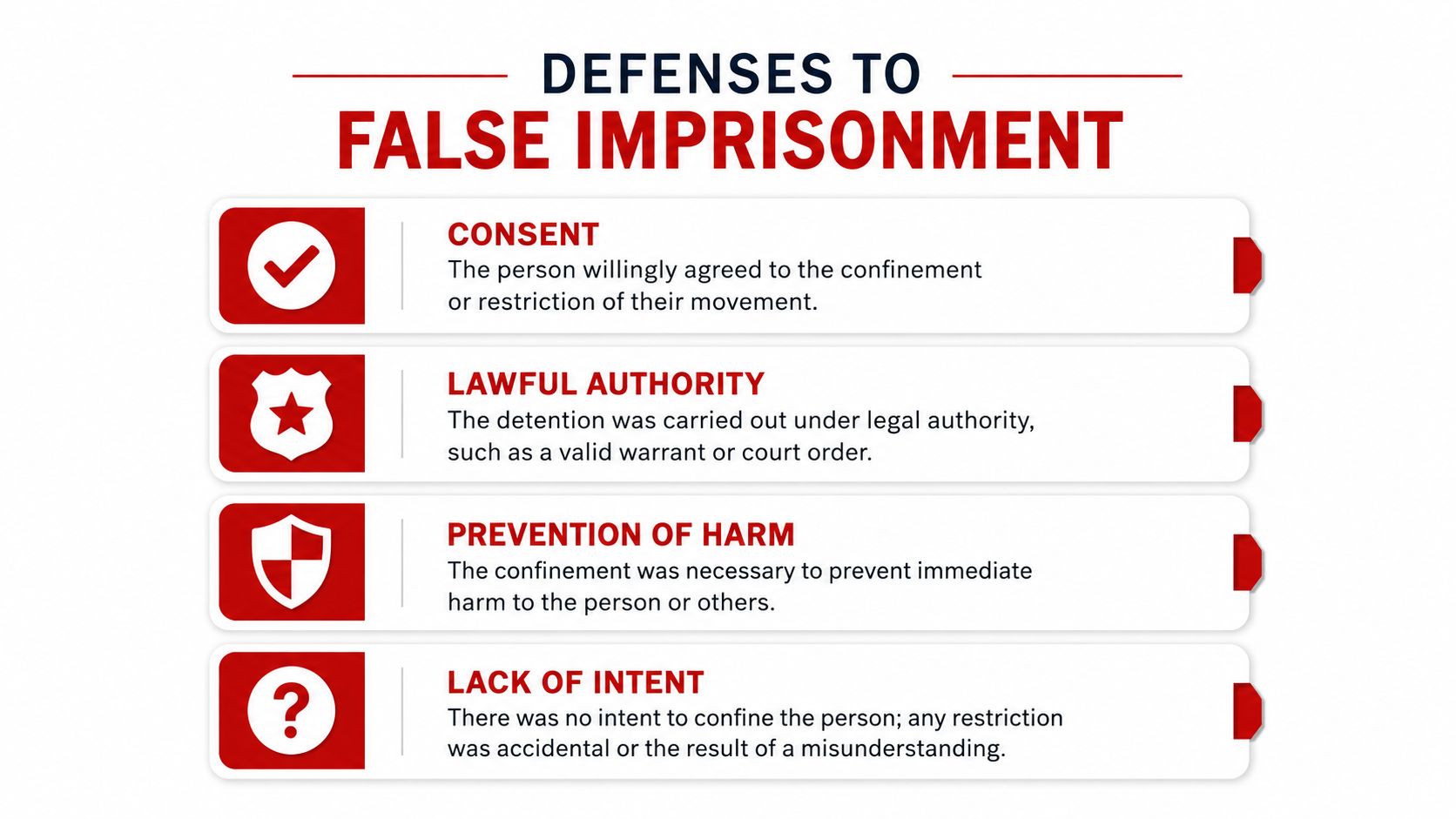
In a false imprisonment case, the defense often hinges on a single text message or a gap in the video footage, not a broad narrative. A lawyer will start by asking whether the other person agreed to stay, whether there was lawful authority, and whether the restraint was deliberate. Those details matter because a short, messy exchange can look very different once the facts are pinned down.
Consent and lawful authority
If the alleged victim agreed to stay, that can weaken the charge. The same is true if the restraint fell within lawful authority, such as a merchant’s privilege, a parent’s authority in a family setting, or a security hold that stayed within the law. A text message saying “I’ll wait here” can matter. So can a policy document showing who had authority and who did not.
Consent is often where families get confused. Someone may have stayed because they wanted to sort out an argument, and that is different from being forced to remain against their will. A defense lawyer will look for that line carefully, especially when the only evidence is a private conversation or a disputed phone call.
Lack of intent and insufficient restraint
A momentary misunderstanding is different from a deliberate confinement. If someone reached out during a heated exchange but did not mean to trap the other person, intent becomes a real issue. The same is true when there was no real bounded area, no barrier, or no threat that would keep a reasonable person from leaving. A one-second grab during confusion is not the same thing as a planned detention.
The defense also looks at the setting itself. Blocking a doorway for a few seconds, taking a phone, or standing in front of someone can matter, but the facts still have to show a real restraint, not just a tense argument. That is why a gap in the recording, a missed angle, or a witness who saw only the end of the exchange can change how the case is read.
Evidence wins these arguments. Video, messages, and neutral witnesses often matter more than anyone’s memory after the fact.
What counsel usually checks first
Here is the short list defense lawyers tend to pull apart right away.
- Texts and calls: Did either person say they could leave, wait, or come back later?
- Video footage: Does the recording show a lock, a block, or only a fast argument?
- Witness statements: Do bystanders describe restraint, or just noise and tension?
- Location details: Was there a bounded area, or only a temporary crowding?
A defense attorney will also check whether the prosecution has filed within the applicable statute of limitations. Understanding the statute of limitations for misdemeanors and felonies in California can help frame that issue in plain terms. That deadline question does not decide every case, but it can decide whether the case should move at all.
An infographic titled Defenses to False Imprisonment, listing four legal defenses including consent, lawful authority, prevention of harm, and lack of intent.
Bail, Release, and What Happens Right After the Arrest
Once the arrest happens, the family question changes fast. It’s no longer just, “What is the charge?” It becomes, “How do we get them out?” Ventura County and Santa Barbara County use bail schedules that help set the starting point, and the filing level matters. A misdemeanor false-imprisonment case usually sits on a lower schedule than a felony filing, and domestic-related conditions can complicate release even when the underlying charge looks minor. For a family standing outside the jail, that difference can feel huge. What happens after you get arrested
What a local bondsman does first
A licensed local agent verifies the booking, checks the charge, and reads the case in plain English. Then the bond paperwork gets prepared, the 10 percent premium required by California law is explained, and any larger bond gets reviewed for payment plans or collateral. That process is how Ventura bail bonds, Ventura County bail bonds, 24-hour bail bonds Ventura, bail bonds Oxnard, Ventura County Jail bail bonds, and fast bail bonds Ventura become real, practical options instead of stressful search terms.
Why the timeline matters
Release can move within hours when the facility, the paperwork, and the bond all line up. If the booking information is incomplete, the clock slows down. If there’s a no-contact order, a protective-order issue, or a felony hold, the release path may be different from a straightforward misdemeanor posting. That’s why families shouldn’t assume “we’ll just wait until morning.” The earlier the bond gets started, the sooner the facility can process it.
One thing people often ask is whether the premium is refundable. In California, the premium is the cost of the bond, so it isn’t treated like a deposit waiting to come back after the case ends. Collateral, if used, is handled separately and is released after the bond conditions are satisfied and the case is resolved. For anyone comparing choices late at night, speed and clarity matter as much as the number on the schedule.
Practical Next Steps for Defendants and Victims in Ventura County
When the case is fresh, keep the next move simple. For families trying to post bail, gather the full legal name, date of birth, booking number if you have it, the charges exactly as listed, and the jail or facility where the person is being held. Have those ready before you call, because it shortens the back-and-forth and helps the agent confirm the booking faster. Then ask three direct questions, what’s the premium total, what are the payment plan terms, and whether collateral is required.
What victims should save right away
If you’re on the other side of the case, document everything while it’s still fresh. Save photos, screenshots, call logs, witness names, and medical records if anything physical happened. If there’s a protective order issue or a no-contact concern, keep those papers together too. The more specific the record, the easier it is for attorneys, law enforcement, and victim-services professionals to sort out what happened.
Keep the timeline clean. Write down who was there, what was said, and when the person was prevented from leaving.
Late-night questions families ask most
How long does release take from Ventura County Jail? It depends on the booking, the paperwork, and whether the bond can be processed right away, but a prepared bond file can move much faster than a wait-and-see approach. Is the 10 percent premium refundable? No, that premium is the cost of the bond. What happens to collateral? It’s generally returned after the case ends and the bond conditions are satisfied, assuming there isn’t any unresolved issue tied to the agreement.
| Quick Reference for False Imprisonment PC in California | Tier | Penal Code Section | Triggering Facts | Maximum Penalty | Bail Impact |
|---|---|---|---|---|---|
| False imprisonment, basic form | Misdemeanor | PC 237(a) | Unlawful restraint without violence or menace | County jail exposure, usually lower than felony filing | Lower schedule amount in many cases |
| False imprisonment, aggravated form | Felony | PC 236 | Detention by violence, menace, fraud, or deceit | State prison exposure | Higher bail and tighter release conditions |
The most useful thing families can do is stay factual and move fast. If you’re trying to bail someone out after a false imprisonment arrest in Ventura, Oxnard, Santa Barbara, or a nearby court area, keep the booking details ready, ask direct questions, and don’t wait for the day to get started. For a straight explanation of the process, see how to bail someone out of jail.
If you need a calm voice on the phone and a local team that understands Ventura County bail bonds, Bada Bing Bail Bonds can help you sort out the charge, the schedule, and the next step without wasting time. Visit Bada Bing Bail Bonds and get a licensed agent working on the release as soon as you’re ready.