
In Ventura County, getting out of jail usually means posting bail based on the county's presumptive schedule, and for many misdemeanors and some felonies, a licensed bail bonds agent can help secure release within hours by arranging payment of just 10% of the total bail amount. That can happen fast, but only if the booking details, charges, holds, and court conditions are clear from the start.
A frantic call usually starts the same way. Someone's been booked in Ventura, Oxnard, Camarillo, or Thousand Oaks, the phone line is bad, the family doesn't know where the person is, and every minute feels longer than the last. The fastest way through that panic is to focus on the right facts, not the rumor that “bail is already set” or the assumption that money alone controls release.
Table of Contents
- Understanding Your Immediate Options After an Arrest in Ventura County
- Cash Bail, Surety Bonds, and Own Recognizance Release Compared
- How to Work With a 24-Hour Bail Bonds Agency in Ventura County
- Ventura County Bail Schedules, Emergency Exceptions, and Real Costs
- Release Timelines, Post-Release Compliance, and Court Reminders
- Local Jail Procedures Across Ventura, Oxnard, Camarillo, and Thousand Oaks
- Why Local Expertise Matters When Every Hour Counts
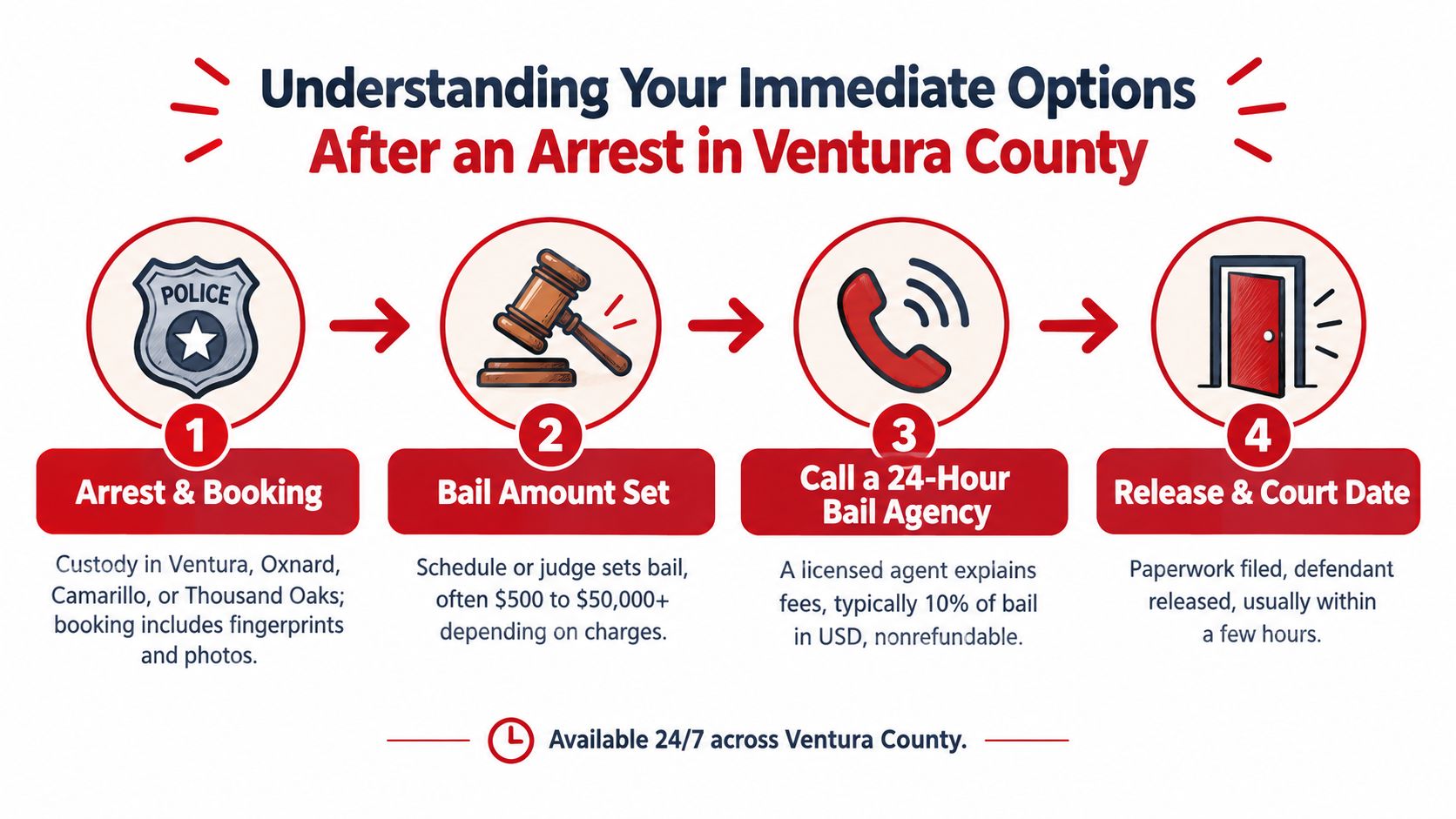
Understanding Your Immediate Options After an Arrest in Ventura County
The first move is to locate the booking site and confirm exactly who has custody. Start with the arresting agency, the jail or station where the person was taken, the booking number, and the full list of charges. Without those details, families waste time calling the wrong place or quoting the wrong amount.
What to gather before you make the first call
Practical rule: If you have the booking number, exact charges, and facility name, you've already removed most of the guesswork.
The next step is to find out whether the person may qualify for citation release, book-and-release, a scheduled bail amount, or a judge's review. California court materials treat those as different pathways, and the difference matters because a published bail schedule doesn't always mean immediate freedom. Some cases move quickly, but others pause for a magistrate, additional screening, or a hold that has nothing to do with the bail amount itself.
Use the first hour to collect facts that can move the release process forward. That means noting any probation status, prior warrants, protective or no-contact orders, and whether the charge is one that often triggers extra review. Families who skip those details often end up redoing the intake conversation later, which only slows things down.
A good starting point is this local guide on what to do when someone gets arrested. It helps you organize the call before you speak with a licensed agent.
Cash Bail, Surety Bonds, and Own Recognizance Release Compared
People often hear “bail” and think it means one thing. It doesn't. In California, the release path can be cash bail, a surety bond, or release on one's own recognizance when the court allows it, and California courts also recognize conditional release and detention as separate outcomes.
How the three main paths differ
Cash bail is the most direct route, but it can tie up the full amount until the case ends. A surety bond lets a licensed agent post a bond with the court or jail while the family pays the premium and, in some cases, arranges collateral or a payment structure. Own recognizance release is different again, because the judge allows the person out based on a promise to return and comply with conditions instead of paying money up front.
Release speed is often about eligibility and paperwork, not just how fast someone can pay.
California's Department of Insurance says county bail schedules are set locally, and a commercial surety bond commonly costs the consumer 10% of the bond amount plus actual, necessary, and reasonable transaction expenses. That's why families comparing Ventura County bail bonds, bail bonds Oxnard, or bail bonds Thousand Oaks should ask first what the court has set and whether the person may qualify for a release that doesn't require a bond at all. If the case qualifies for own recognizance release, paying a bond may be unnecessary.
For a plain-English walkthrough of bond structure, keep this local reference handy on how bail works in California. It's useful when you're deciding whether to pay cash, sign a bond, or wait for the court's release decision.
How to Work With a 24-Hour Bail Bonds Agency in Ventura County
The cleanest calls are the ones where the caller is ready. Have the booking number, the exact charges, the jail or station location, and the name and phone number of the person who can sign paperwork. If you're missing one of those pieces, a local agent can still help, but the process slows down.
What a good first call should accomplish
A licensed agent should confirm the booking, explain whether the case looks like a scheduled-bail matter or one that needs a judge's review, and tell you what documents or identification will be needed next. That saves you from repeating the same story to several people and helps the family avoid paying attention to the wrong detail, like the rumor that “the bond is ready” when the jail still hasn't finished processing.
If you're juggling calls after midnight, a virtual receptionist that can book appointments without extra staff can help keep your office lines from getting buried while families are still trying to reach you. In a release case, the point is speed and accuracy, not a long phone tree.
The actual paperwork can still take time even after the bond is posted. Facility processing, fingerprints, medical screening, transport, and internal release steps can stretch the wait, so it helps to have one person handling updates instead of a crowd making separate calls.
If you want a local overview of how a late-night release call usually works, this page on 24-hour bail bonds near me is the right place to start.
Ventura County Bail Schedules, Emergency Exceptions, and Real Costs
Ventura County does not use one statewide bail dollar amount. County schedules control the presumptive amount, and the court can still review or change bail at arraignment, so the number you hear after booking is not always the final word.
What the schedule actually does
Ventura Superior Court's bail schedule gives default amounts for offenses that aren't specifically listed. For offenses not listed, the schedule sets $10,000 for felonies, one-half of the felony amount for Penal Code section 17(b) misdemeanors, and $2,500 for other misdemeanors. It also adds $5,000 for each misdemeanor probation or diversion matter and $10,000 for each felony probation or diversion matter. For warrant arrests where the person is booked only on the warrant, the warrant amount generally controls unless a judge orders otherwise.
That matters because the charge label alone doesn't tell the whole story. A misdemeanor case with a probation hold can move very differently from a straightforward arrest on a new charge, and a “simple” bond quote can be wrong if the caller hasn't checked the supervision status first. Families in Ventura, Oxnard, Camarillo, Port Hueneme, Thousand Oaks, Santa Paula, Moorpark, Fillmore, Ojai, and Santa Barbara should verify the exact court file before assuming the first number they hear is the number they'll pay.
California also had an emergency bail schedule that set $0 bail for many misdemeanor and felony offenses except listed exceptions. Ventura Superior Court materials show that misdemeanor probation violations were also assigned $0 bail under that emergency framework, while felony probation, parole, post-release community supervision, and mandatory supervision cases followed different rules tied to the conviction offense and listed enhancements. If you're checking a Ventura County bail schedule page, always confirm whether the case is under an ordinary schedule or an exception.
A practical local reference for schedule issues is the Ventura County bail schedule, especially when the charge, warrant status, and supervision status all matter at once.
Release Timelines, Post-Release Compliance, and Court Reminders
Getting out is one step. Staying out clean is the part that saves families from a second crisis. The release window depends on the facility's own processing, and even after the door opens, the paperwork can still control what happens next.
What families should track after release
Federal judiciary data show that 86% of released defendants committed no new violation and did not fail to appear, while federal risk-assessment research found an average failure rate of about 7% among released defendants, with the lowest-risk group around 2% and higher-risk groups above 10%. Supervision research also found failure-to-appear rates of 7% for supervised defendants versus 11% for unsupervised defendants in one 3,925-person sample. Those numbers are benchmarks, not promises, but they make one point very clear, compliance matters just as much as posting the bond.
The release doesn't end the obligation. It starts the clock on every hearing, restriction, and check-in.
That's why the best post-release setup is simple and written down. Keep every court date in one calendar, use at least two reminder channels, confirm transportation in advance, and write down any no-contact, stay-away, weapons, substance-use, or geographic restrictions before the person leaves custody. If a hearing changes, the update needs to reach the defendant immediately, not sometime later through a rumor chain.
For a practical refresher on the period after paperwork is filed, use what happens after bail is posted. It helps families understand why one missed reminder can turn into a bigger problem.
Local Jail Procedures Across Ventura, Oxnard, Camarillo, and Thousand Oaks
A family can have the bond ready and still lose time if the jail is waiting on a hold, a screening issue, or the wrong release path. Ventura County Jail, Oxnard police holding, Camarillo Sheriff's Station, and Thousand Oaks Sheriff's Station each work with their own staffing, classification checks, and release routines.
Where delays usually come from
Domestic violence and DUI cases often take longer because deputies may need to confirm protective orders, no-contact terms, or other release restrictions before anyone walks out. A file that looks straightforward can still pause while the station verifies the conditions that control release.
A local agent who knows the facility can usually tell the difference between “still processing” and “needs a judge first.”
That is why families often call a Ventura County bail bonds office instead of trying to sort it out from home. The right call keeps the focus on the same release window, the same paperwork, and the same court date. It also lowers the chance that someone gives the wrong answer about a hold or sends a co-signer to the wrong station.
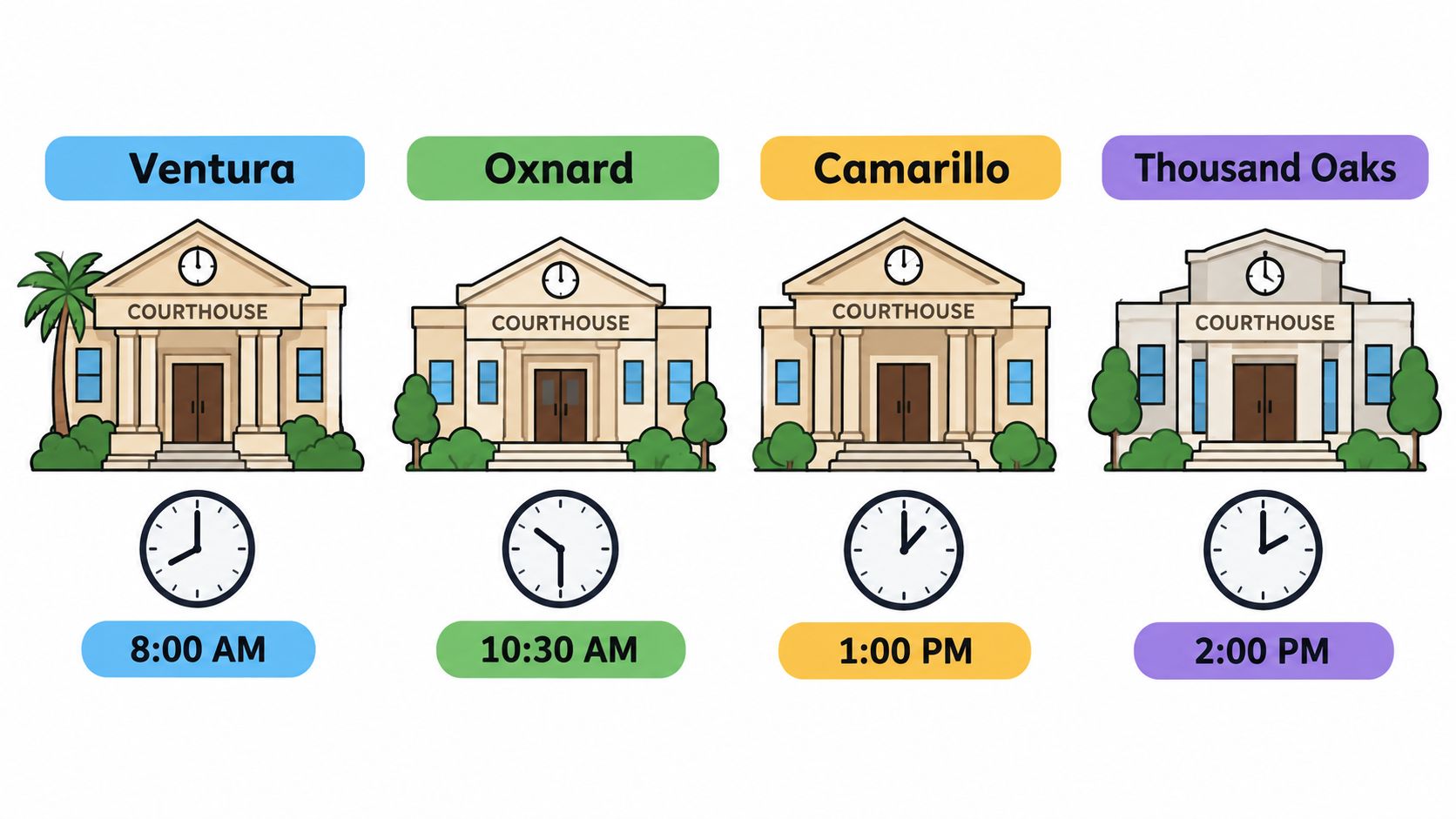
If the person is being held near Oxnard, a call about bail bonds Ventura can turn into a more specific conversation about station procedure, because release steps can differ by facility and by charge.
If you need a straight answer right now, visit bail bonds Ventura and get the process moving with a local team that handles these calls every day.
Why Local Expertise Matters When Every Hour Counts
A family can have cash ready and still wait outside the jail if one hold, one condition, or one court rule changes the release path. I've seen people assume payment was enough, then learn a warrant, probation issue, or protective order still controlled what happened next.
Local knowledge keeps the process moving. A Ventura County bail bonds agency that answers around the clock, understands the county schedule, and works directly with the jail can keep families informed while the paperwork gets handled. That matters in Ventura, Oxnard, Camarillo, Port Hueneme, Thousand Oaks, Santa Paula, Moorpark, Fillmore, Ojai, and Santa Barbara, because release steps and timing are not the same everywhere.
Cash is not always the only route out. California also allows own-recognizance release in some cases, and emergency bail schedules can shape what happens before a judge reviews the file. Post-release compliance matters just as much, because reminders, restrictions, and court dates become the true test once the person is out.
The families who do best stay organized, ask direct questions, and keep one point person in charge of updates. Bada Bing Bail Bonds can post surety bonds, explain bail schedules in plain English, help with payment plans or collateral options, and stay in contact through release and court reminders. If you need a straight answer right now, visit Bada Bing Bail Bonds and get the process moving with a local team that works these calls every day.
If you need help right now, Bada Bing Bail Bonds can walk you through the booking details, explain the release path, and get a bond started without wasting time on guesswork.