You’re probably reading this after a phone call you didn’t want, trying to figure out who can take money, how fast it can move, and why nobody can give you a clean answer about release time. In Ventura County, that gap between paying a bond and getting someone out is where families get stuck, especially after late-night arrests in Ventura, Oxnard, Camarillo, Port Hueneme, Thousand Oaks, Santa Paula, Moorpark, Fillmore, Ojai, or even when a case starts farther up the coast in Santa Barbara.
Table of Contents
- What Happens Right After an Arrest in Ventura County
- Cash Bail Versus a Bail Bond in California
- Who Can Pay the Bond and How to Start the Process
- Accepted Payment Methods and Timing at the Jail
- Payment Plans, Co-Signers, and Collateral for Larger Bonds
- Common Mistakes That Slow Release or Cost the Bond
- Fast-Track Checklist for Posting a Ventura County Bond
What Happens Right After an Arrest in Ventura County
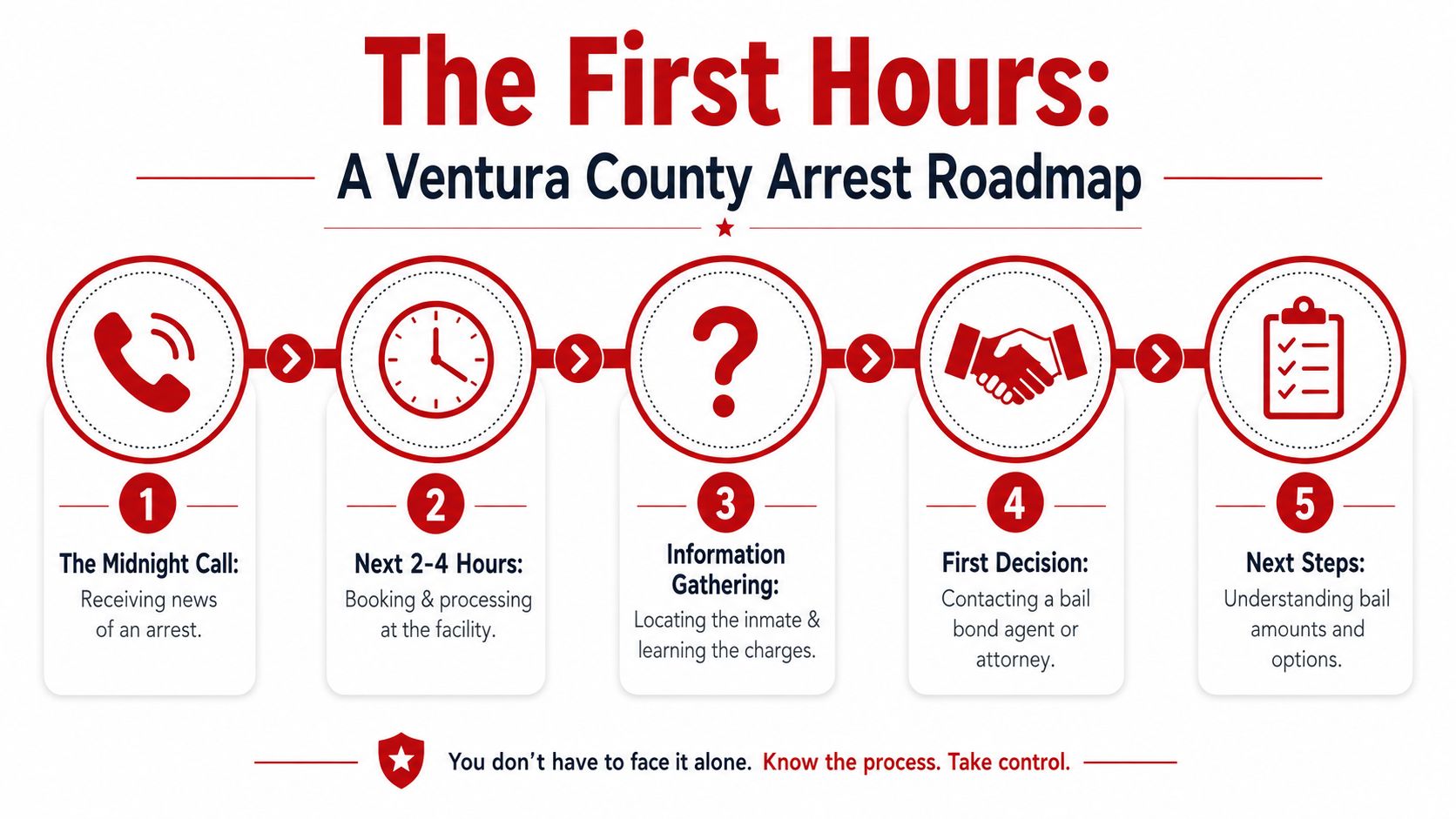
A 2 a.m. call from Oxnard changes everything fast. One minute you’re asleep, the next you’re trying to find out where your loved one is, whether they’ve been booked yet, and whether the number you’re hearing is a real bail amount or just a guess from someone at the station. The first hours are rarely calm, but they do follow a pattern.
At the jail or holding facility, the process usually starts with booking, fingerprinting, and classification. Medical screening can happen early too, because custody staff need to know if the person has an urgent health issue before anything else moves. Charges get entered, and from there the bail figure is set from the county’s bail schedule or a judge’s order. If there’s a hold, the bond may not be postable yet, which is why one case can be ready for release while another sits even though both sound similar from the outside.
The first calls matter
The smartest move is to gather facts before moving money. If you’re trying to work with a licensed agent, the basics are simple, the full legal name, date of birth, booking number if you have it, where the person is being held, and the charges as listed so far. Those details let someone confirm the case and avoid a payment error that wastes hours.
Practical rule: don’t send money until you know which facility has the person and whether the bond is actually available.
For local families, that usually means checking whether the arrest is tied to the Ventura County Jail or a city lockup like Oxnard PD or another outlying site. A case in a smaller city can move differently from a county booking, even if the arrest itself happened only a few miles apart. That’s why the first question isn’t “How much do I pay?”, it’s “Where is the person, and what status is the case in right now?”
If you want a plain-English walk-through of the early steps, this guide to what happens after an arrest is the right place to start.
Cash Bail Versus a Bail Bond in California
There are only two real ways money gets someone out of custody. You can pay the full cash bail amount yourself, or you can use a bail bond through a licensed agent, which is the route most families take when they don’t want to tie up the entire amount. In California, the bond premium is set by law at 10% of the total bail, so the math is straightforward even when the decision isn’t.
What the money actually does
If bail is high, cash bail can be painful because the court wants the entire amount up front. A surety bond changes the burden, because you pay the premium instead of depositing the whole bail figure, but that premium isn’t the same thing as a refund. Cash bail can come back when the case is resolved properly, while the bond premium is the price of the service.
That’s why families sometimes get confused when they hear “10%.” They assume it means the jail takes ten percent and returns the rest. It doesn’t work that way. The cash route ties up the full amount, while the bond route transfers the posting work to a licensed agent and keeps your out-of-pocket lower at the start.
A small bond with cash on hand can make sense to pay directly. A larger bond usually makes more sense through a surety bond, especially when the family can’t freeze the full amount without creating another problem at home.
For a simple breakdown of the cash side of the issue, this explanation of cash bond meaning helps separate jail payment from bond posting.
A quick decision check
- Pay cash directly if the bail is modest, the funds are ready, and you want to avoid involving a bond company.
- Use a bail bond if the full amount would strain savings, rent, payroll, or other family obligations.
- Think twice before paying cash if you’re not sure the case will move cleanly, because the jail still has to process the release.
- Choose the bond route when speed, flexibility, and lower front-end cost matter more than tying up the whole amount.
For families trying to decide fast, the question isn’t which option sounds cheaper. It’s which one keeps the household stable while still getting the person out.
Who Can Pay the Bond and How to Start the Process
The person paying the bond does not have to be the defendant. In real Ventura County cases, it’s often a parent, sibling, spouse, partner, or close friend who steps in first. That person becomes the obligor or co-signer, and the job comes with responsibility, not just a signature.
What the bondsman needs on the first call
A serious call saves time when it starts with the right information. Have the full legal name, date of birth, booking or case number, facility location, and the listed charges ready before anyone starts asking about payment. That matters because the agent has to match the person to the right file before bond paperwork can move.
The co-signer’s background also matters. In practice, licensed agents check whether the person has stable residency and enough financial footing to support the bond if something goes sideways. The point isn’t to make the process harder. It’s to confirm that the person signing is real, reachable, and able to stay in contact if the court date changes or a problem pops up.
Why families split the role
Sometimes one family member gathers the documents while another handles payment, and a third provides the ride after release. That’s normal. It’s also smart, because the person with the cleanest paperwork isn’t always the one with the best credit or the one who can leave work to drive across town. In a busy county, those jobs often get divided just so the bond can be posted without delay.
If you want a fuller breakdown of the early paperwork and call flow, this guide on how to bail someone out of jail fits right here.
Practical rule: the faster the agent can verify identity, facility, and charges, the faster the bond can be prepared.
That’s the main reason people who call prepared usually move faster than people who call upset but unprepared. Panic is normal. Missing the booking number is what slows everything down.
Accepted Payment Methods and Timing at the Jail
At the jail, timing matters as much as the money. ICE immigration bonds are a separate system, but the local lesson carries over clearly, payment method, processing window, and release timing are not the same thing. In the federal bond guide, ICE says the full bond amount must be paid, and the payment must be made with a money order or cashier’s check at the detention center or the nearest ICE office, after a sponsor, friend, or family member has the bond set. That’s a useful reminder that the front-end payment rule can be strict even when the family wants a fast answer. ICE bond guide
What families see in real life
At Ventura County Jail, a bond can be posted and the person still won’t walk out immediately. The hold-up is usually not the payment itself, it’s the internal release process. Records have to update, the bond has to be received correctly, and the jail has to finish its side before anyone can leave.
That’s why a family can do everything right and still spend time waiting. The mistake is assuming that the moment the money leaves your hand is the same moment the door opens. It usually isn’t. A payment may be accepted, then release follows after staff confirm the paperwork and the file updates.
What the accepted methods mean
Cash, cashier’s check, money order, and bond posting through a licensed agent all solve different problems. Cash can be the fastest in some local systems, but only where the facility accepts it for that case. Cashier’s checks and money orders are slower to prepare, but they can fit stricter payment rules. An agent posting a surety bond can help families avoid driving money around themselves, which matters when the booking happens after hours.
For a local breakdown of payment routes, this page on bail bond payment options is the next practical stop.
The strongest habit is simple. Confirm the payment path first, then move money. That keeps you from standing at a window with the wrong form of payment while your loved one sits in custody waiting on a process that’s already been delayed once.
Payment Plans, Co-Signers, and Collateral for Larger Bonds
Bigger bonds change the conversation. Once the amount starts feeling impossible to handle in one shot, families begin asking about payment plans, who can co-sign, and whether collateral is even necessary. That’s normal, and it’s also where honest underwriting matters more than sales talk.
How the structure usually works
A licensed California bondsman may ask for proof of employment, ID, and enough background information to decide whether a payment plan makes sense. A co-signer is different from a reference. A reference is just contact information. A co-signer is tied to the bond and needs to understand the obligation before signing.
Collateral comes into play when the bond is larger or the risk is higher. Real estate, a vehicle, or jewelry can all be used in the right situation if the parties agree and the paperwork supports it. What happens at the end depends on whether the defendant stays compliant and the case closes properly. If the bond is satisfied and the court obligations are met, collateral is released through the process set out in the agreement.
Practical rule: if the bond amount feels unmanageable, the best answer isn’t guessing. It’s asking what the agent can approve based on the case, the co-signer, and the paperwork already in hand.
This is also where smaller bonds and larger felony or domestic-violence cases split. Smaller bonds can sometimes be handled with no collateral at all. Higher-risk matters often need more structure, because the court set the bond higher for a reason and the posting side has to account for that reality.
For a plain explanation of property and asset options, this page on what can be used as collateral keeps it practical.
The best local answer isn’t always the fanciest one. Sometimes it’s a short payment plan with a dependable co-signer. Sometimes it’s collateral. Sometimes it’s straight cash if the amount is low enough to keep the family from getting squeezed twice.
Common Mistakes That Slow Release or Cost the Bond
Three mistakes cause most of the damage: bad contact information, missed court dates, and lying on the application. Each one sounds small at the moment it happens, and each one can become expensive later.
The easy errors that create real problems
If you give the bondsman the wrong phone number for the defendant, the contact chain breaks when a court date changes or a release issue comes up. If the defendant misses a court date in the first 30 days, the case can go sideways fast. If someone already has a no-bond hold in the system, posting money won’t fix that problem, because the hold has to clear before release can move.
Misrepresenting employment or address on the application is just as bad. The paperwork is part of the risk decision, not a formality. If the facts don’t match, the bond can become a problem later, especially when the court or the agent checks the file after release.
A Ventura County DUI case is the kind of example families remember. A missed court date led to a bench warrant, the bond was forfeited, and the family had to pay the premium again to get the person back out. That’s a hard lesson, but it’s a common one. The bond didn’t fail because the payment method was wrong. It failed because the court obligation was ignored.
How to defend against each one
- Use one reliable phone number. Put it in writing, and make sure the defendant can receive calls or texts.
- Track the first court date immediately. Don’t assume the jail or court will remind you in time.
- Tell the truth on every line. If the job changed, say so. If the address is temporary, say that too.
- Check for holds before posting. A bond isn’t magic if the system already has a separate block in place.
The hard truth is that the most expensive mistake usually happens after the money leaves the family’s hands. Careful paperwork protects the release far better than panic does.
Fast-Track Checklist for Posting a Ventura County Bond
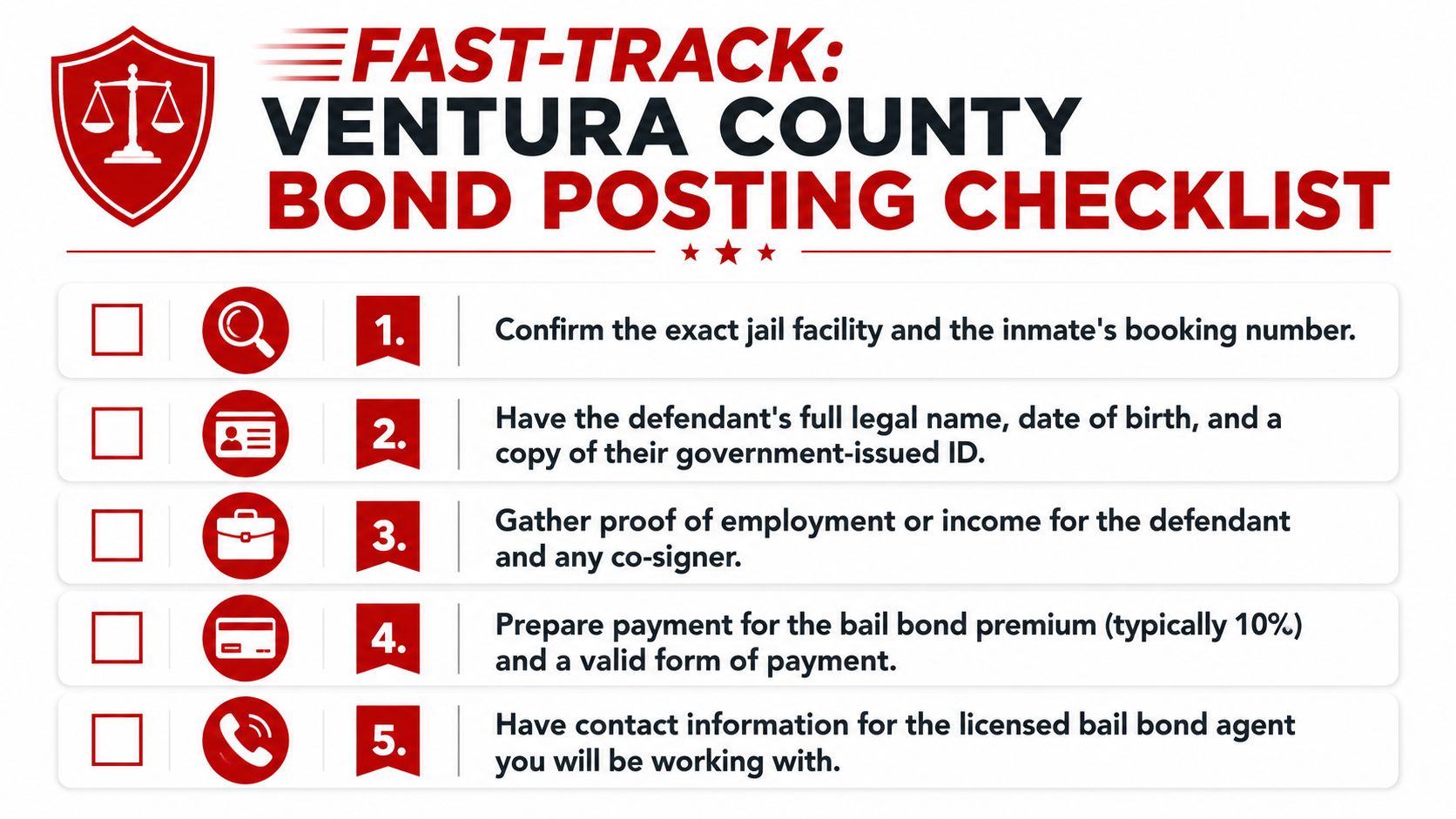
If someone is driving to the jail at 3 a.m., this is the checklist they need in front of them. Keep it simple, keep it accurate, and don’t guess on details that the jail or agent can verify.
Fast-track steps
- Confirm the exact facility and booking number. If the location is wrong, the bond work starts in the wrong file.
- Gather the defendant’s full legal name, date of birth, and ID. That keeps identity mistakes from slowing the release.
- Collect proof of employment or income for the defendant and any co-signer. Underwriting needs real information, not guesses.
- Decide on cash or bond before you leave the house. Don’t make that call in the parking lot with everyone tired and frustrated.
- Send paperwork to the agent before driving to the jail. A prepared file moves faster than a half-finished one.
- Arrange a ride after release. A defendant won’t always have access to a personal vehicle when they walk out.
Speed matters, but accuracy and court-date compliance matter more.
If you’re handling a bond in Ventura County tonight, Bada Bing Bail Bonds can walk you through the payment path, help verify the booking details, and explain the options in plain English. Visit Bada Bing Bail Bonds and get the release process moving with less confusion and fewer mistakes.