
Police generally must bring a person arrested without a warrant before a magistrate for a probable-cause review within 48 hours, and formal charging or release typically follows shortly after. That does not mean everyone walks out at the 48-hour mark, because bail, court scheduling, warrants, and other holds can affect what happens next.
At 2 a.m., a family member in Oxnard may know only three things: someone was arrested, the person was taken somewhere, and nobody can explain when they’ll come home. The booking may have followed a DUI stop on Ventura Boulevard, a domestic call in Simi Valley, or an investigation in Ventura, Camarillo, Port Hueneme, Thousand Oaks, Santa Paula, Moorpark, Fillmore, Ojai, or Santa Barbara. The immediate question is usually, “How long can police hold you without charges?”
In California, the practical answer centers on the 48-hour probable-cause rule, but the jail clock and the court clock don’t move in a simple straight line. A person can be booked, medically screened, placed in a holding unit, reviewed by prosecutors, brought before a judge, and then wait again while the jail processes a release. A Ventura County family needs to know which stage has been reached before deciding whether to call a defense lawyer, request information from the jail, or arrange Ventura County bail bonds.
Table of Contents
- The First Night After an Arrest in Ventura County
- The 48-Hour Probable Cause Rule in California
- How California Compares to Other States
- From Booking to Formal Charges in Ventura County
- Where a Bail Bondsman Fits in the Clock
- Common Misconceptions About Holding and Release
- A Family Checklist for the First 48 Hours
The First Night After an Arrest in Ventura County
At 2 a.m. in Oxnard, the arrest may feel finished when the patrol car leaves. For the person in custody, the process is only beginning. Officers typically transport the arrestee to Ventura County Jail in Ventura, where jail staff take control of intake.
The first steps are administrative but important. Staff identify the person, collect and inventory personal property, conduct a pat-down search, and complete a more extensive search when jail criteria require it. The person is photographed and fingerprinted, then sent through medical screening that can include questions about medications, injuries, mental health, and immediate medical needs.
What happens before a court appearance
After screening, jail staff assign the person to an appropriate holding area, general population, or a specialized unit. The placement depends on safety, classification, health information, the alleged offense, and available space. None of those steps is the same as a formal court hearing, and none guarantees that a prosecutor has filed charges.
A booking that begins after the last court transport may sit until the next working day. The arrestee will likely not see a magistrate in the middle of the night, and a weekend or holiday can make the wait feel longer even though the constitutional rules still apply. Families often receive only a brief call, sometimes just long enough to identify the jail or ask someone to arrange bail.
Practical rule: Treat the first call as a request for verification, not a complete case update. Write down the booking location, booking number, arresting agency, alleged charges, and the time of arrest.
Family members can call the jail’s main line to confirm custody and ask what information is available. Calling the police station repeatedly usually isn’t productive for release planning, and those calls may not be logged in the jail’s release workflow. For a plain-language explanation of how facility schedules affect release, review these Ventura County jail release times.
The next question is not only whether charges have been filed. It’s whether the person has received the required judicial review, whether bail has been set, and whether another legal hold prevents release.
The 48-Hour Probable Cause Rule in California
The constitutional rule comes from County of Riverside v. McLaughlin. In plain English, when police make a warrantless arrest, the government generally must provide a judicial determination of probable cause within 48 hours. If that review doesn’t happen within the required period, the government must justify the delay with a genuine emergency or another extraordinary circumstance, rather than ordinary administrative inconvenience. The California detention explanation and probable-cause standard describes this constitutional framework.
This hearing isn’t a trial. The magistrate isn’t deciding guilt, weighing every defense, or conducting a full evidentiary proceeding. The purpose is to decide whether there is enough legal basis to continue the case and custody at that stage. If the case proceeds, the court commonly addresses release conditions and bail.
What the 48 hours does and does not mean
The 48-hour rule doesn’t promise that a person will be released automatically at the deadline. It creates a limit on the period of custody without the required judicial review. Once a complaint is filed and the court has acted, the person may remain in custody under the court’s order, subject to bail, release conditions, or another lawful hold.
California’s arrest and detention rules also involve Penal Code sections 825 and 849, along with court interpretations about how the period is calculated. Families shouldn’t try to calculate the deadline from a jail booking screen alone. The relevant time may depend on the arrest, transport, booking, court availability, and the legal basis for custody.
Extraordinary circumstances can matter when police or prosecutors need to address a remote arrest, verify identity, or process critical evidence. Those circumstances don’t turn the 48-hour rule into an open-ended license to delay a hearing. The government must be able to explain why the delay was necessary.
A family that believes the deadline has passed should preserve the arrest time, booking time, court-appearance information, and every conversation with the jail or arresting agency. A defense lawyer can evaluate whether a motion under Penal Code section 825 is appropriate. Families can also review what happens after an arrest to understand why booking and court review are separate events.
How California Compares to Other States
California sits near the middle of the national range for early judicial review. In the United States, many jurisdictions use a 24-to-72-hour period for charge-related or initial custody procedures, while the constitutional benchmark for a warrantless arrest is generally a probable-cause determination within 48 hours. The national overview of detention before charges explains why the exact charge-filing window varies by state.
That distinction matters. People often ask for one national number, but states define the relationship between arrest, probable-cause review, filing, arraignment, and release differently. California’s 48-hour constitutional baseline doesn’t mean every state uses the same procedure, and it doesn’t mean “no complaint filed” and “no judicial review” are interchangeable.
Probable-Cause Detention Limits Across the U.S.
| Jurisdiction | Standard Limit | Notes |
|---|---|---|
| California | 48 hours for probable-cause review | The constitutional rule applies to a person arrested without a warrant. |
| Many U.S. jurisdictions | 24 to 72 hours | State procedures differ, and charge timing can vary. |
| England and Wales | 24 hours generally | A magistrates’ court can authorize a total pre-charge period reaching 96 hours in serious cases. |
| England and Wales terrorism cases | Up to 14 days | Separate terrorism powers create a much longer exceptional detention window. |
California families experience the rule through local scheduling. A Friday-night arrest may not produce a courtroom appearance until the next available court day. A holiday period can create another scheduling gap, and a busy jail can add processing time after a judge has already made a decision. Those delays can feel like the law has stopped the clock, but the legal question remains whether the required review occurred within the applicable period.
England and Wales provide a useful contrast. Police generally can hold a person for 24 hours without charge, with extensions to 36 hours by a senior officer in serious cases and up to 96 hours with magistrates’ approval, according to the official custody time guidance. Terrorism arrests can reach 14 days without charge under separate national-security powers. The comparison shows why the offense and legal regime matter as much as the country.
From Booking to Formal Charges in Ventura County
Ventura County families often use “charges” to describe several different events. Booking is not charging. A police report is not a filed complaint. A warrant is not the same thing as an initial arraignment before a judge.
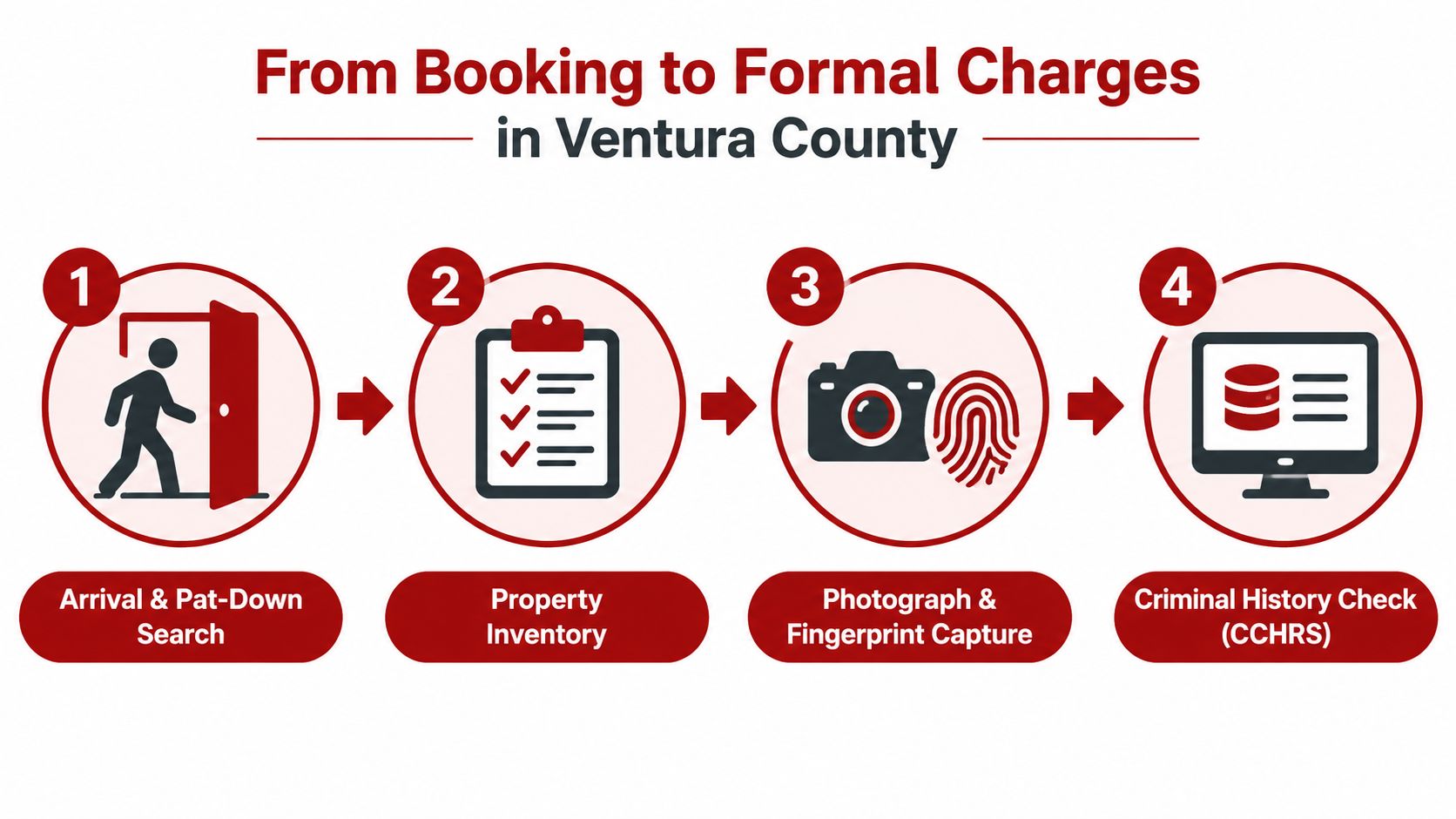
The intake sequence normally starts when the person arrives at the jail. Staff complete an arrival search, inventory property, capture photographs and fingerprints, check criminal-history information through the CCHRS process, and conduct medical and mental-health screening. Jail classification then determines whether the person enters general population or a specialized unit.
The agencies and decisions involved
The arresting agency sends the report and supporting materials through the process used for prosecutorial review. The Ventura County District Attorney’s Office evaluates whether the evidence supports filing, what offenses may be alleged, and whether the matter should proceed as a felony or misdemeanor. A filing decision can require review of witness statements, reports, records, and other evidence.
A complaint is the formal charging document filed with the court. A warrant authorizes an arrest or identifies a person the court wants brought before it, but a warrant’s existence doesn’t by itself explain the current bail or release status. At the initial arraignment, a Ventura County Superior Court judge reads or confirms the formal allegations, advises the defendant of rights, and addresses custody and bail.
Felony arraignments generally must occur within the applicable 48-hour framework under Penal Code section 825, subject to recognized legal exceptions and court scheduling rules. Weekends can move the appearance to the next court day, which is why the family should ask for the actual arraignment date and courtroom instead of relying on an informal estimate.
For a detailed explanation of the jail intake sequence, see the Ventura County booking process. The practical objective is to identify the current stage, confirm whether bail has been set, and determine whether a bond can be submitted or whether the defense must request a court review.
Where a Bail Bondsman Fits in the Clock
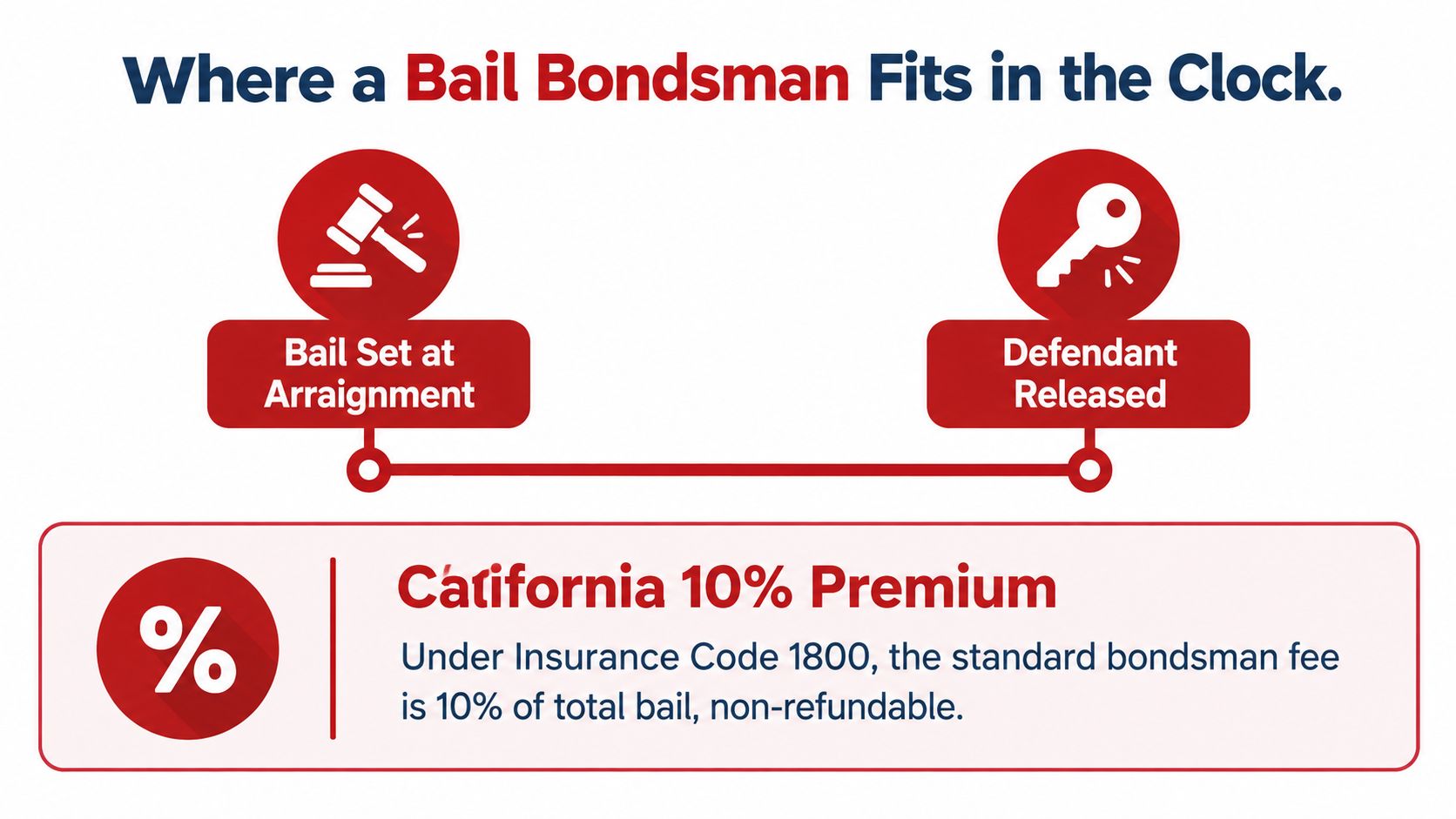
A bail bondsman becomes useful after the court sets bail and before the jail releases the defendant. Calling earlier can still save time because an agent can verify the facility, monitor booking information, explain the paperwork, and prepare the indemnity agreement while the family waits for arraignment. But a bondsman can’t set bail before the court or bypass a hold that legally prevents release.
California commercial bail commonly uses a 10% premium of the total bond amount. The California Department of Insurance explains that the court sets the bail amount and that surety companies must use filed rates approved under California insurance law, as described in its overview of California’s bail system. A review of California bail contracts also describes the industry-standard 10% nonrefundable premium, such as a $25,000 bail producing a $2,500 premium, subject to the contract and applicable rules. The California bail-contract review provides that example.
What the agent needs
A Ventura County agent will usually ask for:
- Booking details: The defendant’s name, booking number, facility, and arresting agency.
- Court information: The charges shown on the docket and the current bail amount.
- Indemnity paperwork: A signed agreement establishing the financial responsibility of the person arranging the bond.
- Qualified indemnitor: A responsible signer with proof of identity, California residence, and income or financial ability.
- Risk information: Details that may affect collateral, payment terms, or the court’s release conditions.
Payment plans can be available locally, including 0% and low-down structures, depending on approval and the specific bond. Larger or higher-risk bonds may require collateral. Families should ask what is refundable, what is nonrefundable, what collateral is required, and what obligations continue after release.
The process doesn’t end when documents are signed. The agent submits the bond to the jail, jail staff review and enter it, and release processing can still take several hours. Local bail work is therefore about reducing avoidable waiting, not promising that a facility will release someone instantly. The California bail process explains how court-set bail, the premium, and release processing fit together.
Ventura County bail amounts are tied to local court schedules. The Ventura Superior Court publishes a county-specific Bail Schedule, updated alongside statewide Judicial Council schedules, which makes the Ventura County court bail schedules an important reference when estimating what a bond may involve. A schedule is not a guarantee of the final amount, because a judge can address bail at arraignment and other holds may change the release path.
Common Misconceptions About Holding and Release
The first misconception is that police must release someone automatically after 24 hours without charges. California’s general constitutional benchmark is a 48-hour probable-cause review for a warrantless arrest, not an automatic 24-hour release. The court review and formal filing are related, but they aren’t identical.
The second is that a Friday or Saturday arrest guarantees release by Sunday. It doesn’t. The person may wait for the next available court day, and even after a judge acts, jail processing, bail submission, classification, and release procedures still have to occur.
What “no charges” actually tells you
“No charges yet” doesn’t necessarily mean the investigation is over. The person may be released while prosecutors continue reviewing the matter, or the case may later proceed through a summons or warrant. A person may also remain held because of a separate warrant, probation issue, parole matter, or another legal basis for custody.
The third misconception is that speaking with officers will speed the release. It usually doesn’t. The arrestee should remain calm, avoid discussing the facts without counsel, and clearly request a lawyer when questioning turns toward the alleged offense.
Silence protects the case better than a rushed explanation. A family member should focus on locating the person, confirming the court status, and contacting defense counsel.
The fourth misconception is that a bail agent can override every no-bail hold. A domestic-violence arrest, including an allegation under Penal Code section 273.5, may involve protective orders, no-contact restrictions, or a hold requiring court attention. A bond doesn’t erase those conditions.
The final misconception is that paying bail ends the criminal case. Bail addresses pretrial custody, not guilt, dismissal, or the eventual court result. After release, the defendant must attend court, follow every order, avoid prohibited contact, and work with defense counsel.
A Family Checklist for the First 48 Hours
Families make better decisions when they separate information gathering, legal review, and release planning. Start with the arrest time, not the time you received the phone call. That difference can affect how counsel evaluates the custody timeline.
The first two hours
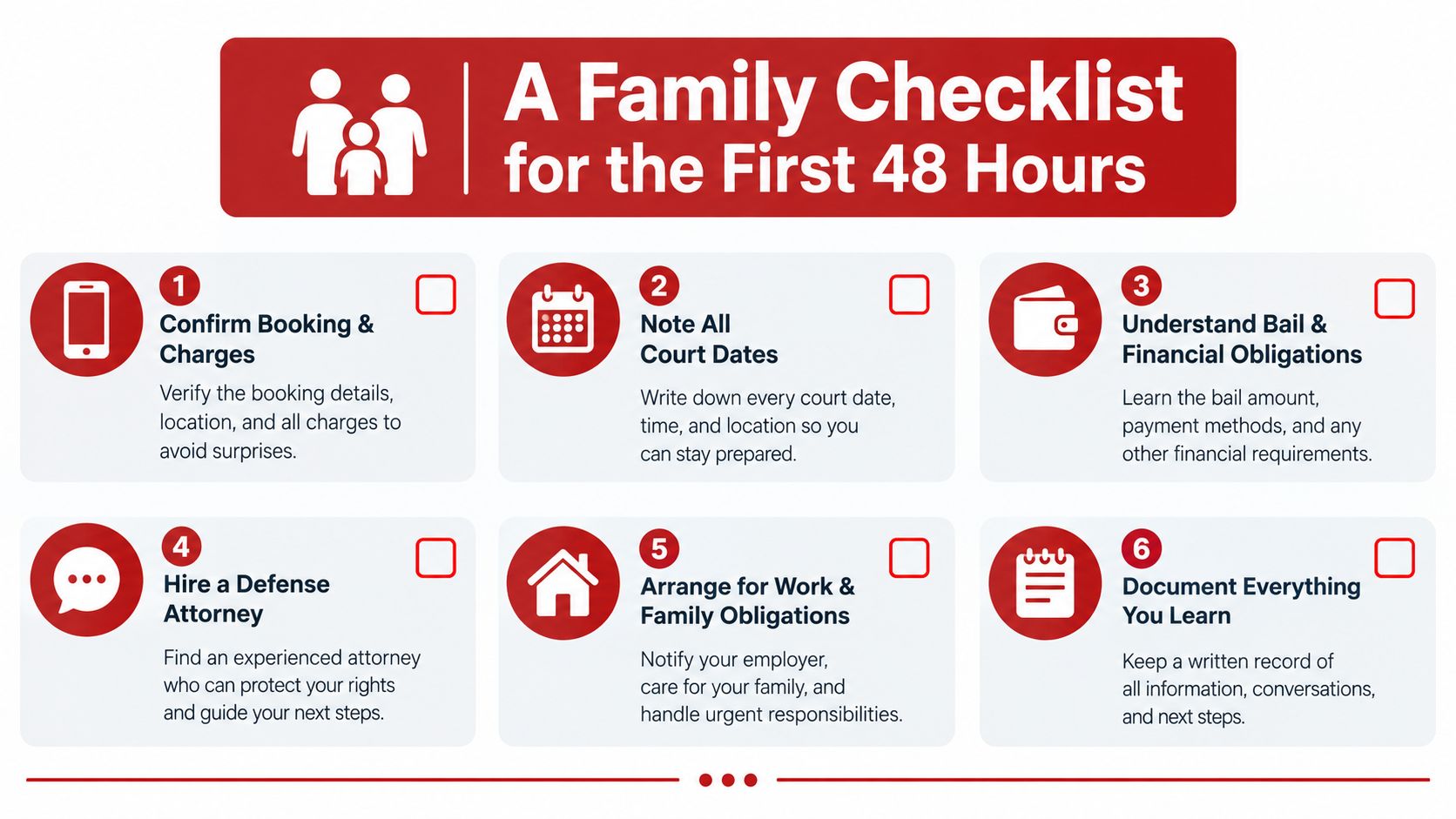
- Confirm booking: Call the jail and verify the defendant’s location, booking number, arresting agency, and listed charges.
- Call a bondsman early: A local agent can begin checking whether bail has been set and prepare paperwork while the case moves through intake.
- Write everything down: Record the arrest time if known, every call, every name provided, and every status update.
Before arraignment
- Gather identification: Prepare the indemnitor’s identification, address history, employment information, and references.
- Ask about court: Request the arraignment date, courtroom, and whether the matter is assigned to Ventura County Superior Court.
- Check release options: Ask whether the arrest may qualify for cite-and-release, release on recognizance, or a zero-bail provision under the current Ventura County schedule and court rules.
- Discuss the finances: Review the premium, any payment arrangement, and whether collateral may be required. California’s standard commercial premium is generally 10% of the bail amount, as covered earlier.
As the clock approaches 48 hours
- Arrange transportation: Prepare a safe ride from the jail. Pretrial Services may require a verified address and other release information.
- Contact defense counsel: A lawyer can address questioning, probable cause, bail conditions, protective orders, and filing decisions.
- Document delay: If the person has not received the required probable-cause review, preserve the timeline and give it to counsel for evaluation of a possible Penal Code section 825 motion.
- Prepare for denial: If bail is denied or a separate hold remains, ask about a bail review hearing in Ventura County Superior Court rather than assuming a bond will solve the problem.
The practical answer to how long can police hold you without charges is only the starting point. Families still need to identify the legal stage, protect the defendant’s rights, and move quickly once bail becomes available. For a broader action plan, use this guide on what to do when someone gets arrested.
Bada Bing Bail Bonds provides 24/7 help with Ventura County arrests, including booking verification, bail information, paperwork, payment plans, co-signer options, and coordination with the jail through release. If someone is in custody in Ventura, Oxnard, or a nearby community, visit Bada Bing Bail Bonds to start the verification and bail process now.