Aggravated assault bail in California is set by the county schedule and the Penal Code section, and it commonly falls between $15,000 and $100,000. On a $50,000 bail, a 10% bond premium is $5,000 before any financing arrangements or separately disclosed expenses.
At 2 a.m., that distinction matters. A family member in Ventura may hear that someone was arrested after a fight in Oxnard, call the jail, and get one question from every bondsman: What exact charge was booked, and what amount did the court set? Until those details are confirmed, any number is only a guess.
Table of Contents
- Why Aggravated Assault Bail Feels So Uncertain
- How California Defines Bail and Where Schedules Come From
- How Judges Set Bail Beyond the Printed Schedule
- County Bail Amounts Compared Across California
- Realistic Bail Scenarios and What a Family Would Pay
- The 10% California Bond Premium Explained
- Payment Plans Co-Signers and Collateral for Larger Bonds
- Ventura County Jail Facilities and How to Post Bail
- Release Conditions That Come With the Bond
- When to Ask for a Bail Review Instead of Paying
- First-Hour Checklist After an Aggravated Assault Arrest
Why Aggravated Assault Bail Feels So Uncertain
The call often starts with confusion. Someone at the Oxnard Police Department says the person was arrested for aggravated assault, but the family doesn't yet know whether the booking reflects Penal Code section 245(a)(1), assault with a deadly weapon, or another subsection involving force likely to cause great bodily injury. They may hear that another person arrested after a fight posted a much lower amount and walked out. That comparison usually doesn't help because the charge, county schedule, weapon allegation, victim, and prior record may be entirely different.
California doesn't use one universal statewide bail amount for aggravated assault. Each county applies its own schedule, and the presumptive figure can change based on the alleged weapon, the victim, the degree of force, domestic-violence history, warrant status, and the judge's later decision. Ventura County's schedule identifies assault with a deadly weapon under Penal Code section 245(a)(1), and it warns that the listed figure is presumptive for a warrantless arrest until a judge reviews bail. A warrant arrest may use the amount stated in the warrant instead. Ventura County's published bail schedule is the document to check, not a generic internet estimate.
The number on the jail record is only the beginning
Santa Barbara's felony schedule illustrates the spread. It lists $30,000 for assault with a deadly weapon other than a firearm, $50,000 for assault with a firearm, $30,000 for assault by force likely to produce great bodily injury, $75,000 for assault with a semiautomatic firearm, and $100,000 for assault with a firearm against a peace officer or firefighter. The Santa Barbara County schedule shows why the phrase “aggravated assault bail” is too broad to produce a reliable quote.
The family also needs to separate bail from the amount it may pay a licensed surety agent. The court sets the face amount. The agent's premium is calculated from that amount, commonly at 10%, before any permitted transaction expenses or financing arrangements. If the case involves another jurisdiction, a general explanation of aggravated assault Ontario consequences may provide legal context, but it doesn't replace the California booking charge or local schedule.
How California Defines Bail and Where Schedules Come From
Bail is a financial guarantee that a defendant will return to court. It isn't a fine, a conviction, or a punishment. A person may satisfy the court's bail requirement by depositing the full amount or by using a licensed surety bond, where an agent posts the court-required amount and charges a premium.
The county schedule gives jail staff and families a starting figure after booking. It classifies charges by Penal Code section and by aggravating facts such as a firearm, a protected victim, or serious alleged injury. In Ventura County, the schedule is presumptive for a person arrested without a warrant until a judge reviews bail. A warrant-related arrest generally follows the amount in the warrant unless a judge orders otherwise. This California bail process guide explains the difference between the court's bail amount and the commercial bond used to post it.
Read the booking charge before reading the price
The same incident can produce very different release questions depending on the charge classification. A simple assault allegation doesn't carry the same schedule entry as a felony allegation under Penal Code section 245. Within section 245, the alleged weapon, force, injury, and victim can move the amount substantially.
Families should ask the jail or arresting agency for:
- The exact Penal Code subsection: Don't rely on “aggravated assault” as a general label.
- The booking county: Ventura, Santa Barbara, Fresno, and other counties use their own schedules.
- The warrant status: A warrant amount may control instead of the ordinary warrantless-arrest figure.
- The alleged enhancement: Firearm allegations, domestic-violence history, and protected-victim allegations can change the calculation.
- The review status: A schedule amount may later be modified by a judge.
A schedule is therefore a starting point, not a promise of release. The court may change bail, impose conditions, or address a different release decision at a hearing.
How Judges Set Bail Beyond the Printed Schedule
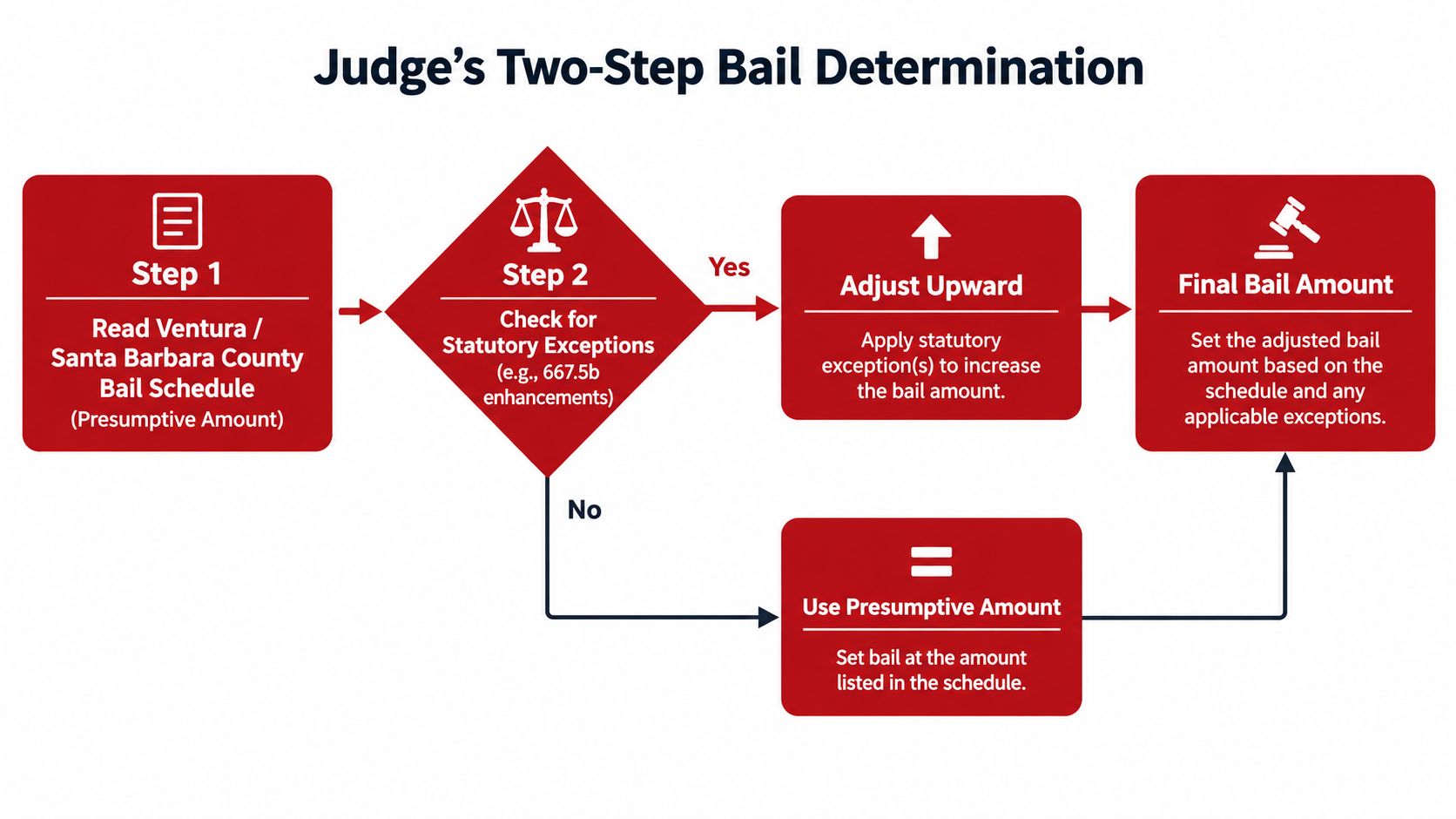
A judge doesn't just look at a county schedule and close the file. The schedule supplies the presumptive amount, but judicial review considers the individual case. Santa Clara County expressly describes its schedule as presumptive rather than mandatory and explains that a judicial officer may set a different amount after considering public protection, the seriousness of the offense, and the defendant's prior record. Santa Clara County's bail schedule explanation is a useful example of how local discretion works.
What changes the judge's decision
The judge may focus on the alleged conduct, the safety of the alleged victim, the defendant's criminal history, and the likelihood that the person will return to court. A firearm allegation or qualifying domestic-violence history can push the figure higher. A person with stable local ties, a documented residence, and a credible release plan may have stronger grounds to request a different amount or nonfinancial release, but families shouldn't assume those facts automatically lower bail.
California's framework also makes timing important for serious or violent charges. Pre-arraignment release generally cannot occur outside the applicable schedule or own-recognizance rules until an open-court hearing, typically arraignment. The California Law Revision Commission's discussion of pretrial release]
- Public protection: The court considers whether release creates a safety concern.
- Victim protection: The alleged victim's safety may affect conditions and the release decision.
- Case seriousness: Weapon and injury allegations matter.
- Prior record: Prior convictions and failures to appear can weigh against a reduction.
- Financial ability: The court must address the defendant's right to pretrial release rather than use unaffordable bail as a substitute for detention.
The practical rule is simple: the printed amount is not necessarily the final courtroom number. Before paying a premium, find out whether defense counsel intends to request a bail review.
County Bail Amounts Compared Across California
County schedules show why a family in Ventura shouldn't use a Santa Barbara or San Francisco number as though it were statewide law. The underlying Penal Code section may be similar, but the listed amount can differ by county and by the precise weapon or injury allegation.
The verified schedule figures below cover the categories identified in the published county materials. They don't create a universal PC 245 table, and a blank entry means the available verified data doesn't establish that specific category.
| County | PC 245(a)(1) Base | PC 245(a)(4) Base | Firearm Enhancement (PC 12022.5) |
|---|---|---|---|
| Ventura | Confirm the current county schedule and booking subsection | Confirm the current county schedule and booking subsection | Confirm the booking allegation and judicial order |
| Santa Barbara | $30,000 for assault with a deadly weapon other than a firearm | $30,000 for assault by force likely to produce great bodily injury | The verified schedule data identifies separate firearm amounts, including $50,000 for assault with a firearm and $75,000 for assault with a semiautomatic firearm |
| Fresno | $20,000 for assault with a deadly weapon other than a firearm | $15,000 for assault by means likely to cause great bodily injury | $35,000 for assault with a firearm and $50,000 for assault with a semiautomatic firearm |
| San Francisco | $50,000 for Penal Code section 245(a) aggravated assault | Confirm the exact subsection | $75,000 for assault with a deadly weapon or firearm under sections 245(a)(1) and 245(a)(2) |
| Orange County | $25,000 for assault with a deadly weapon | Confirm the exact subsection | $50,000 for assault with a firearm |
| San Luis Obispo | Confirm the exact subsection | $10,000 for assault with force likely to produce great bodily injury | Confirm the alleged firearm facts and current schedule |
The Fresno schedule also lists $100,000 for assault with a firearm against an officer or firefighter, while San Francisco's schedule includes substantially higher figures for certain machine-gun or assault-weapon allegations involving protected victims. Fresno County's criminal bail schedules show how weapon and victim allegations change the result.
Don't treat a booking number as the judge's final order. Use the county schedule as a reference, then confirm the exact booking charge, warrant status, and current court decision. The California bail schedule overview can help families understand the terminology before they call the jail or a licensed agent.
Realistic Bail Scenarios and What a Family Would Pay
The cleanest way to understand the process is to start with verified schedule figures and then calculate the bond premium. The following examples use published amounts from California county schedules. They show the relationship between court-set bail and the commercial bond cost, not predictions about what a judge will order in a particular case.
A Ventura booking requires confirmation first
Ventura's published schedule identifies Penal Code section 245(a)(1), but the verified schedule information here doesn't establish a single reliable Ventura dollar amount for every aggravated-assault booking. A family should obtain the exact charge and current amount from the Ventura County Sheriff's Office or Superior Court before signing anything.
If the court sets bail at $50,000, the California premium benchmark is $5,000 before permitted expenses or financing arrangements. The first call should be to the jail or court to confirm the amount, followed by a licensed California agent who can provide the premium in writing.
A Santa Barbara firearm allegation changes the math
Santa Barbara's schedule lists $50,000 for assault with a firearm. A 10% premium on that court-set amount is $5,000 before separately disclosed expenses. If the allegation instead involves a semiautomatic firearm, the listed figure is $75,000, producing a $7,500 premium at 10%.
The family shouldn't arrange payment from the charge label alone. Ask whether the firearm allegation is part of the booking charge, whether the person is being held under a warrant, and whether counsel plans to seek a different release decision.
A higher weapon or protected-victim allegation can exceed the ordinary range
Santa Barbara lists $100,000 for assault with a firearm against a peace officer or firefighter. At a 10% premium, that represents $10,000 before permitted expenses or financing. San Francisco's schedule also lists figures reaching $200,000 for assault with a machine gun and up to $500,000 for certain machine-gun or assault-weapon allegations against protected victims.
Practical rule: Calculate the premium only after the court amount is confirmed. Never calculate it from a rumor, a generic website range, or the arresting city's name.
A full cash deposit and a surety bond are different financial choices. A cash deposit may be subject to the court's rules for return, while the surety premium is the charge for having an agent post the bond and is not treated as a refundable deposit.
The 10% California Bond Premium Explained
Before anyone pays, confirm the court-set bail amount and calculate the bond premium from that figure. County schedules can produce different bail amounts for similar allegations, so the 10% premium changes with the court's number. A higher scheduled amount means more cash due to the agent.
California's Department of Insurance states that the consumer cost for a commercial surety bond is most commonly 10% of the total bond, plus actual, necessary, and reasonable transaction expenses. Agents representing the surety company must charge filed rates consistently. Use The Department of Insurance's bail bond consumer guidance and this guide to how California bond pricing works before signing paperwork.
The basic calculation is simple:
| Court-set bail | 10% premium |
|---|---|
| $25,000 | $2,500 |
| $50,000 | $5,000 |
| $100,000 | $10,000 |
These figures show the premium, not the bail a judge will ultimately set. A judge may change the amount, impose release conditions, or address detention at a hearing. Posting a bond also leaves court appearances, protective orders, weapons restrictions, and no-contact requirements in place.
Get every additional charge in writing
Ask for a written breakdown before signing. It should identify the premium, permitted transaction expenses, and any financing terms that affect the amount due immediately or over time.
Be cautious when an agent:
- Quotes an unexplained percentage: Ask why it differs from the filed rate.
- Demands payment without paperwork: Review premium, collateral, and surrender provisions first.
- Refuses to identify expenses: Require each separate cost to be listed.
- Uses pressure instead of explanation: Stress does not replace a clear contract.
The premium pays for posting the bond, not for the criminal case's outcome. A dismissal or acquittal does not make the surety premium a refundable deposit.
Payment Plans Co-Signers and Collateral for Larger Bonds
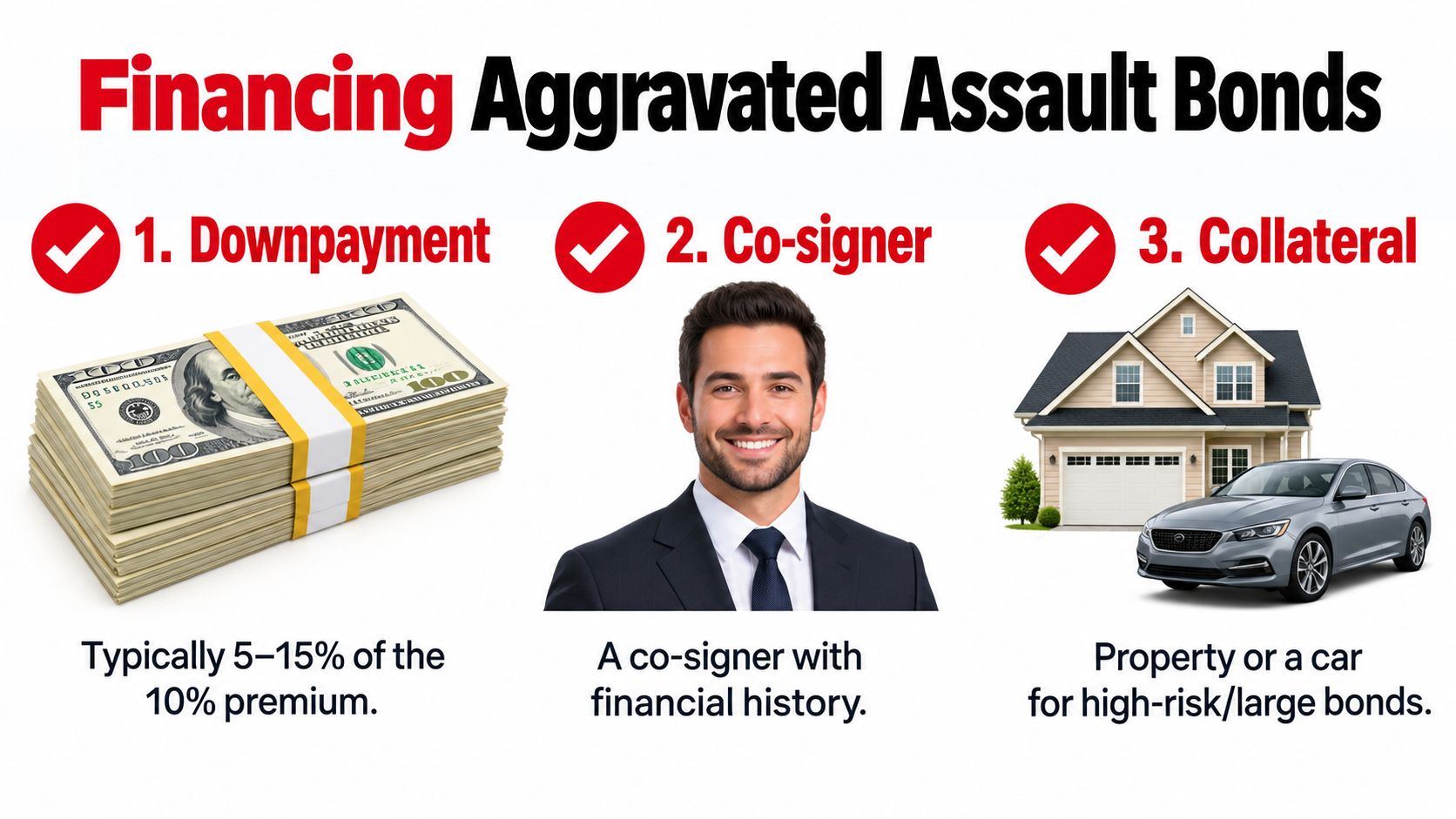
A $50,000 county bail schedule creates a $5,000 premium at California's 10% bond rate. A higher schedule creates a higher premium, so the payment plan becomes part of the family's real cost decision, not a detail to handle later. A licensed agent may offer installments, but the written contract controls the down payment, due dates, financing terms, and consequences of missed payments. Review bail bond payment options to compare those terms before pledging collateral. A payment plan can spread the obligation. It does not automatically reduce the total premium.
Prepare before signing
The agent may request financial information or collateral when the bond amount and allegations create greater forfeiture risk. A co-signer is accepting contractual responsibility, not merely helping with paperwork. If the defendant misses court or violates the agreement, the agent may seek surrender and enforce the obligations in the contract.
Have these items ready:
- Government identification: Valid identification for each signer.
- Income records: Pay stubs or other proof of income.
- Property records: Mortgage statements showing available equity.
- Vehicle titles: A clear title if a vehicle will secure the bond.
- Payment information: The agreed schedule, due dates, and financing costs.
Do not pledge a home, vehicle, savings, or jewelry until you understand the lien, appraisal, release, and return process. A non-family co-signer should obtain independent legal advice before accepting responsibility.
The lowest payment due tonight can create the most expensive agreement later. Confirm the total obligation first.
Ventura County Jail Facilities and How to Post Bail
A family can have the correct bail amount and still lose hours by sending paperwork to the wrong facility. Ventura County uses multiple detention locations, so verify the booking location before choosing a posting method.
The Sheriff's Office identifies the Main Jail at the government center in Ventura, Todd Road Jail west of Santa Paula, and East Valley Jail in Thousand Oaks. The East County Jail at 2101 East Olsen Road in Thousand Oaks operates 24 hours a day and accepts bail bonds and deposits for people in Sheriff's custody. Its listed phone number is 805-494-8242. The Sheriff's East County Jail information can help confirm whether that facility has custody.
An arrest in Ventura, Oxnard, Camarillo, Port Hueneme, Thousand Oaks, Santa Paula, Moorpark, Fillmore, or Ojai may result in booking at a county facility instead of release from the local police station. The booking location determines where the paperwork must go and how the release is coordinated.
The Sheriff's posting instructions identify the Pre-Trial Detention facility at 800 South Victoria Avenue in Ventura as a bail-posting location. Accepted options include cash for the exact amount, a cashier's check payable to the Ventura County Superior Court, a bail bond, or an approved credit or debit card service. The Sheriff's official posting-bail instructions direct families to provide identifying information, including the person's name and booking details. This how to post bail guide explains how to locate the booking, confirm the court amount, and send documents to the correct Ventura facility.
Before paying, verify these points:
- Booking: Confirm the person's name, booking details, charge, and facility.
- Amount: Ask whether the figure comes from a schedule, warrant, or judicial order.
- Method: Compare a full cash deposit with a licensed surety bond.
- Submission: Confirm that the arresting agency accepts no release paperwork unless instructed.
- Timing: Ask how protective orders, court dates, and monitoring requirements affect release.
For searches involving bail bonds Ventura, Ventura County Jail bail bonds, 24-hour bail bonds Ventura, bail bonds Oxnard, or bail bonds Thousand Oaks, begin with the same facts: the booking facility and exact charge.
Release Conditions That Come With the Bond
Posting a bond starts the release process. It does not cancel the rules set by the judge. Before anyone signs, obtain the written release order and read every condition with the defendant and co-signer. A violation can trigger a new arrest, a request to revoke release, or financial problems for the person who posted the bond.
A criminal protective order may impose no-contact or stay-away requirements. The order can prohibit calls, texts, social media messages, contact through relatives, or an approach in person. One message may be enough to create a new crisis, even if the protected person initiated the conversation.
Review the order for five points:
People covered: Confirm which alleged victims, witnesses, or co-defendants the defendant must avoid.
Restricted locations: Check whether the alleged victim's home, workplace, school, or the incident location is off-limits.
Weapons rules: Ask whether firearms or ammunition must be surrendered, removed from the home, or kept inaccessible.
Monitoring terms: Confirm whether GPS or another monitoring requirement applies, who supervises it, and what happens if equipment fails.
Court obligations: Record every appearance, check-in, assessment, or other required appointment.
The defendant should keep a stable residence, avoid new arrests, follow court instructions, and stay away from protected people. Social media needs strict control. A public post, shared image, or indirect message may count as contact under the order.
The family should treat compliance as part of the bond decision. The 10% premium is only the immediate financial cost. A bondsman can face exposure if the defendant fails to appear or violates the agreement, and the co-signer may bear the consequences. Confirm the release plan before agreeing to sign.
When to Ask for a Bail Review Instead of Paying
The scheduled amount is a starting position, not an automatic command to purchase a bond. Ask defense counsel about a bail review when the evidence suggests mistaken identification, self-defense, an unclear weapon allegation, or an exaggerated injury claim. A clean record, dependable local residence, employment, caregiving responsibilities, or a monitored release plan may support a request for lower bail or own-recognizance release.
The California Law Revision Commission reports that roughly half of people arrested in California obtain release before arraignment, while about 13% pay cash bail. The Commission also summarizes California Supreme Court precedent stating that judges can't use unaffordable bail as a substitute for detention. The Commission's pretrial release report]
Ask counsel these questions immediately
- Can the booking charge be challenged or clarified?
- Is the person eligible for release before arraignment?
- Would a nonfinancial release plan protect the alleged victim and the public?
- Can counsel request a different bail amount at the hearing?
- What conditions would apply if the judge lowers bail?
If a public defender is assigned, ask about review before paying a premium. A bond may still be the fastest practical route, but families shouldn't assume the first printed figure is the only available outcome.
First-Hour Checklist After an Aggravated Assault Arrest
The first hour should produce facts, not speculation.
- Within 15 minutes, locate the booking. Get the defendant's full name, date of birth, booking city, and arresting agency. Use the relevant county inmate information system or call the facility directly.
- Within 30 minutes, identify the charge. Ask for the exact Penal Code subsection, alleged weapon, injury allegation, warrant status, and whether the booking is a misdemeanor or felony.
- Within 60 minutes, obtain a written quote. Contact a licensed California bondsman, verify the Department of Insurance license information, and request the premium and any additional expenses in writing.
- Before posting, confirm conditions. Ask whether a protective order, no-contact term, weapons restriction, monitoring requirement, or special release procedure applies.
- Before signing, read surrender language. Check the collateral terms, payment schedule, missed-payment provisions, and defendant's court obligations.
Ventura families should confirm the booking location before sending anyone to the wrong facility. The Sheriff identifies facilities in Ventura, Santa Paula, and Thousand Oaks, and the person may be moved within the county system before release paperwork is completed.
Bada Bing Bail Bonds provides 24-hour assistance with Ventura County bail bonds, verifies booking details, explains the applicable charge and schedule, and discusses transparent premium, payment-plan, co-signer, and collateral options for larger bonds. Visit Bada Bing Bail Bonds now to request a written quote and coordinate the correct Ventura County facility before posting anything.