A late-night call from Oxnard or Ventura usually sounds the same. Someone has been arrested, booking is still underway, and the family has just learned that release depends on a bail amount they weren’t prepared to cover. Then the bail agent asks the question that creates a second wave of panic: What collateral can you provide?
The answer isn’t “find something valuable.” For Ventura County bail bonds, the useful asset is one that can be identified, legally pledged, and verified quickly enough to support posting at the Ventura County Pre-Trial Detention Facility. Cash may move fastest, while property can work when ownership and equity are clear. In some cases, collateral may not be necessary at all.
This guide explains how to get collateral, what agents typically need to verify, how California bail laws separate the premium from security, and what families in Ventura, Oxnard, Camarillo, Port Hueneme, Thousand Oaks, Santa Paula, Moorpark, Fillmore, Ojai, and Santa Barbara should prepare before calling for help.
Table of Contents
- When You Need Collateral to Secure a Bail Bond Fast
- How Collateral Works Under California Bail Laws
- What Counts as Acceptable Collateral for Ventura County Bail Bonds
- How to Prepare Valuation and Paperwork Without Delays
- How Collateral Is Held Returned and What to Do If You Are Short
- Getting Release Started Tonight With the Right Collateral Plan
When You Need Collateral to Secure a Bail Bond Fast
At two in the morning, a family member in Oxnard usually isn’t comparing abstract financial products. They’re trying to find out whether a loved one can leave custody, whether a bail bond can be posted before the next processing step, and whether the family has an asset an agent can accept without days of delay.
The first practical question is the court-set bail amount. Ventura County Superior Court maintains formal bail schedules, including a Ventura Superior Court Bail Schedule for 2024 and a current Uniform Bail and Penalty Schedules document for 2025, so bail amounts are grounded in official court materials rather than being selected casually by an agent. Families with questions about the county schedule can contact Court Administration at (805) 289-8521 through the court’s Fee and Bail Schedules information.
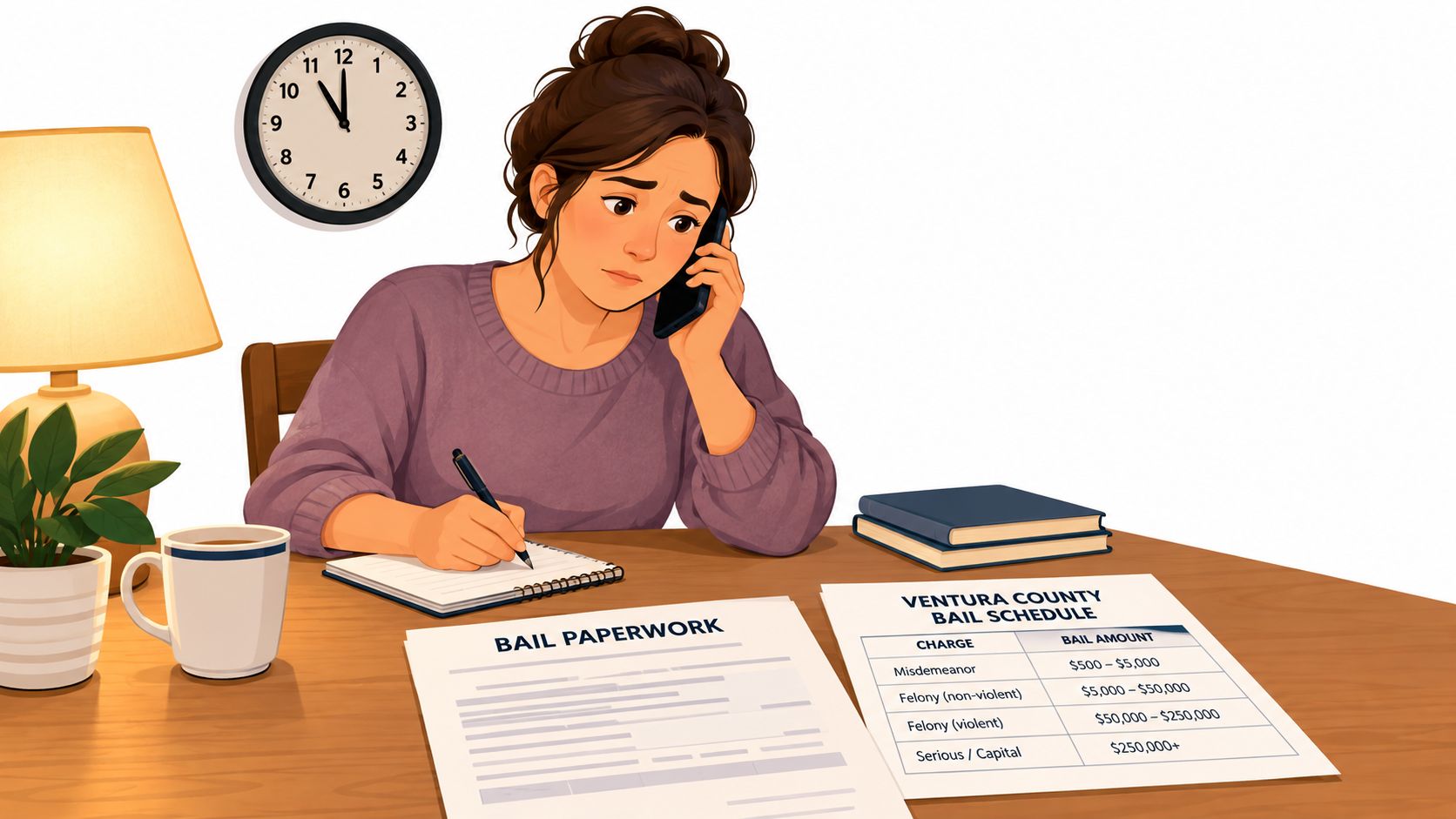
Why an agent may ask for security
Collateral is usually a risk-management decision, not a second version of the premium. An agent may request it when the bond is large, when the charges create additional forfeiture concerns, when the defendant has a history that increases appearance risk, or when the indemnitor’s financial position doesn’t provide enough confidence on its own.
The asset must have more than face value. It needs transferable or realizable value, identifiable ownership, and no unresolved claims that would prevent recovery. A vehicle with an unpaid loan, a home with little available equity, or an account controlled by someone who isn’t willing to sign the required paperwork may not help during a fast bail situation.
Practical rule: The fastest collateral is the asset you can prove belongs to the indemnitor and can be documented without a title or lien dispute.
The World Bank-linked analysis of secured credit found that collateral requirements are common across financial institutions, with collateral required for 77% of loans on average, and collateral value averaging about 167% of the loan amount when it is required. The same analysis found the highest collateral requirement rate in Sub-Saharan Africa at 85%. Those lending benchmarks aren’t a bail-bond rule, but they illustrate why a lender or surety may focus on enforceability and realizable value rather than an item’s advertised price. See the World Bank analysis of collateral requirements for the broader secured-lending context.
What to have ready before calling
Have the defendant’s full name, date of birth, arresting agency if known, and likely booking location available. If the person is being processed through the Ventura County Jail system, the relevant facility is the Pre-Trial Detention Facility at 800 South Victoria Avenue in Ventura.
A family member should also identify the likely collateral before calling. Gather a vehicle title, a recent mortgage statement, a deed, bank documentation, or other ownership records. Don’t wait to search through boxes after the agent has started the application. A provider explaining how to post bail can tell you which documents matter for the specific bond and whether another release option should be considered.
The goal isn’t to present every asset the family owns. It’s to present the cleanest, fastest-to-verify security that matches the bond’s risk and the jail’s posting process.
How Collateral Works Under California Bail Laws
Families often combine three separate obligations into one number. California bail becomes easier to understand when you separate the bail amount, the premium, and collateral.
The court sets the bail amount. The Ventura County Superior Court’s published schedules provide the local framework for many offenses and procedural situations, although the applicable amount can depend on the charge, case status, and court action. The bail agent doesn’t create the court’s scheduled figure.
The premium is the fee paid to the bail company for issuing the bond. California Department of Insurance consumer guidance says bail bond companies must charge the same filed rates, and the cost to the consumer is most commonly ten percent of the total bond, plus actual, necessary, and reasonable transaction expenses, as explained in the department’s consumer guidance on bail bonds.
Collateral is different. It’s security that supports the indemnity agreement if the bond is forfeited or the defendant fails to meet the obligations tied to the release. Paying the premium doesn’t automatically eliminate the agent’s separate underwriting decision about collateral.
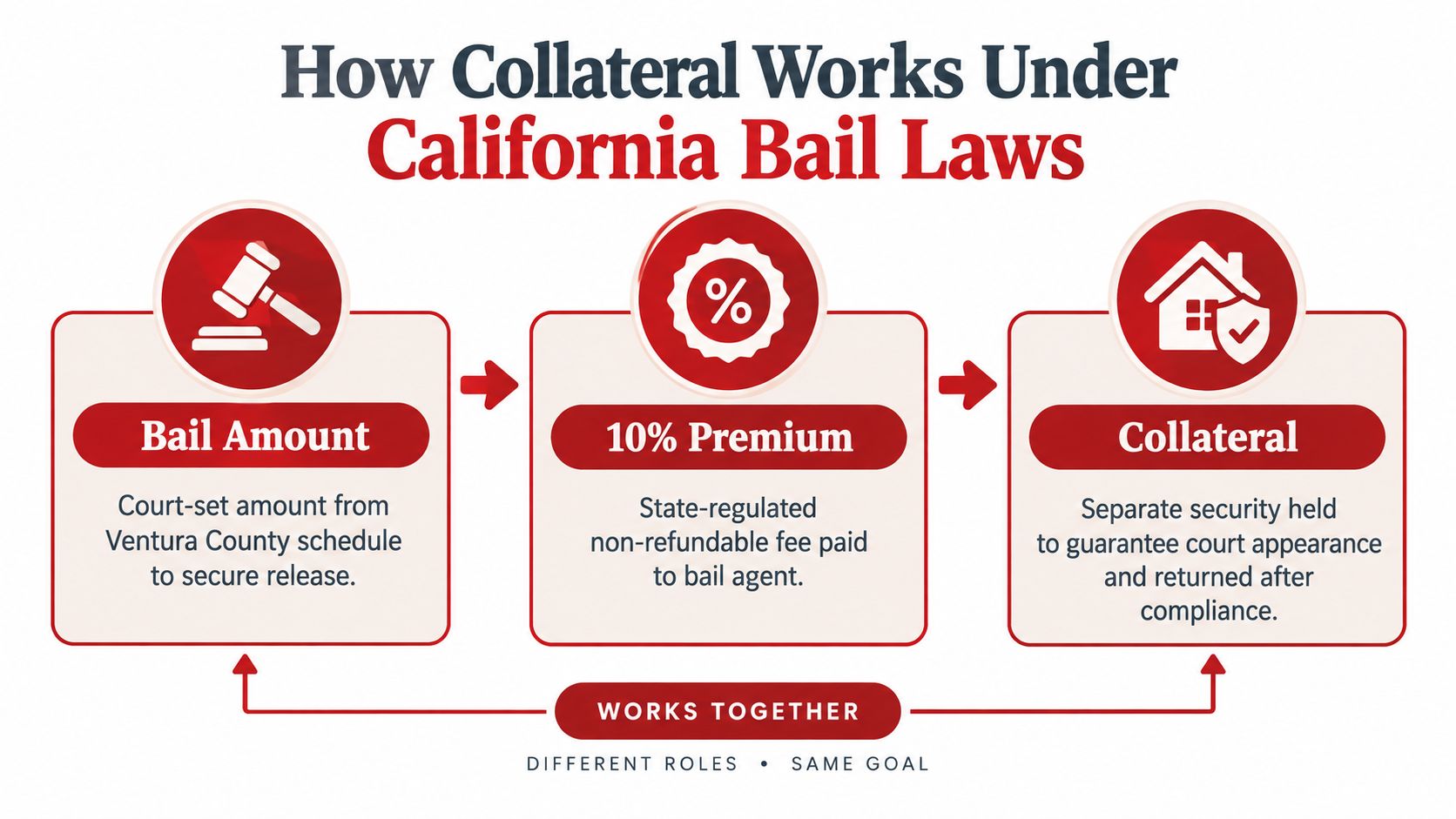
The three parts in plain English
Bail amount: This is the court-related obligation used to secure release. It can be posted directly through an approved method or covered through a surety bond.
Premium: This is the charge for obtaining the bond. It generally isn’t returned because the defendant later appears in court.
Collateral: This is separate security. If the defendant completes the required court process and the bond is exonerated, the collateral is released according to the written agreement and any outstanding obligations.
California’s commonly seen ten percent premium also has a historical origin. A UCLA-linked research paper explains that the familiar rate developed from a 1953 court case involving Groves v. City of Los Angeles, when insurers charged 2% and bail agents charged 8%. The paper also notes that California law doesn’t itself require every premium to be exactly 10%, which is why the safer explanation is that the rate is commonly used and governed through filed-rate rules rather than treating the number as a universal statutory command. The historical discussion appears in the UCLA-linked paper on California bail practices.
The practical distinction matters at midnight. A family may have enough money for the premium but still need collateral because the agent is evaluating the risk of guaranteeing the full bond. Conversely, a strong indemnitor, a lower-risk file, or another release arrangement may reduce or eliminate the need for pledged assets.
For a plain-English explanation of the underlying surety relationship, families can review the meaning of a surety bond. The agreement should identify who is responsible, what security is being held, what events affect release, and what happens if the bond is forfeited. Ask those questions before signing, especially if several family members are contributing money or property.
What Counts as Acceptable Collateral for Ventura County Bail Bonds
The asset that looks strongest on paper isn’t always the one that gets a person released fastest. In Ventura County, the practical choice depends on liquidity, ownership, equity, documentation, and timing.
Cash is generally the simplest security to verify because its value is direct and doesn’t require a property appraisal. A cashier’s check may also be useful, but the agent must distinguish between money being paid toward the transaction and money being pledged as collateral. Bank funds can work when the account holder is available, the institution’s documentation is clear, and the indemnitor can sign the required agreements.
Property is more complicated. A house in Ventura, Camarillo, Thousand Oaks, Santa Paula, Moorpark, Fillmore, Ojai, or Santa Barbara may have substantial market value, but the relevant figure is usable equity after mortgages, liens, and other senior claims. A deed alone doesn’t prove that enough equity is available.
Vehicles can provide an option when the title is clear and the vehicle’s condition and ownership are easy to establish. A financed car may have limited usable value, and an older vehicle may require additional valuation evidence. Jewelry and other valuables may be considered in some situations, but acceptance depends on authentication, appraisal quality, liquidity, and the agency’s underwriting standards.
Why cash appears so often
A large New York City bail-bond study found that cash collateral was required for 94% of bonds with collateral data, and cash was the only collateral type in 91% of bonds overall, according to the study’s analysis of bail-making practices. That research concerns New York City, not Ventura County, so it shouldn’t be treated as a local rule. It does show why families should ask about cash first instead of assuming that every valuable possession will be equally practical.
The Ventura County Sheriff’s posting guidance lists four ways bail may be posted at the Pre-Trial Detention Facility: cash in the exact amount, a cashier’s check payable to the Ventura County Superior Court, a bail bond, or a credit/debit card through GovPayNet by phone at 1-888-604-7888 using PLC 6404. The card option is a jail posting method, not automatically collateral for a surety bond. The agent still has to approve the bond arrangement and document any separate security.
Which asset fits the timeline
| Collateral Type | Acceptance and Speed | What You Must Prove |
|---|---|---|
| Cash | Usually the quickest asset to verify when the source and owner are clear | Identity, funds, authority to pledge, and signed agreements |
| Bank funds | Can move quickly if the account holder is available and records are clear | Account ownership, current balance, identity, and pledge authority |
| Real property equity | Useful for larger obligations, but title and lien review can slow approval | Deed, ownership, mortgage balance, lien status, valuation, and indemnitor signature |
| Vehicle | May work when the title is clear and value is supportable | Title, registration, identity, condition, loan status, and valuation |
| Jewelry or other valuables | Depends heavily on authentication and realizable value | Ownership, appraisal, authenticity, condition, and transfer documentation |
For someone searching bail bonds Oxnard or fast bail bonds Ventura, the right question is not “What is my most expensive item?” Ask instead, “Which asset can I prove, pledge, and document without a dispute tonight?”
How to Prepare Valuation and Paperwork Without Delays
Collateral approval usually slows down for three reasons: the person offering it can’t prove ownership, the valuation is outdated or unsupported, or another creditor already has a claim. The fix is a disciplined packet prepared in the right order.
Start with the person who owns the asset. That person must be identified, willing to sign, and legally able to pledge the property. If the name on the title, deed, or account doesn’t match the person offering collateral, explain the relationship immediately rather than presenting mismatched records at the end of the application.
The practical workflow used in secured lending is straightforward: verify ownership and lien status, obtain current valuation evidence, then document the pledge with signed security agreements and release conditions. The World Bank has reported that about 73% of loans from financial institutions require collateral, a benchmark that helps explain why formal verification is a normal part of risk-managed finance. The workflow is described in the World Bank collateral and secured-lending material.
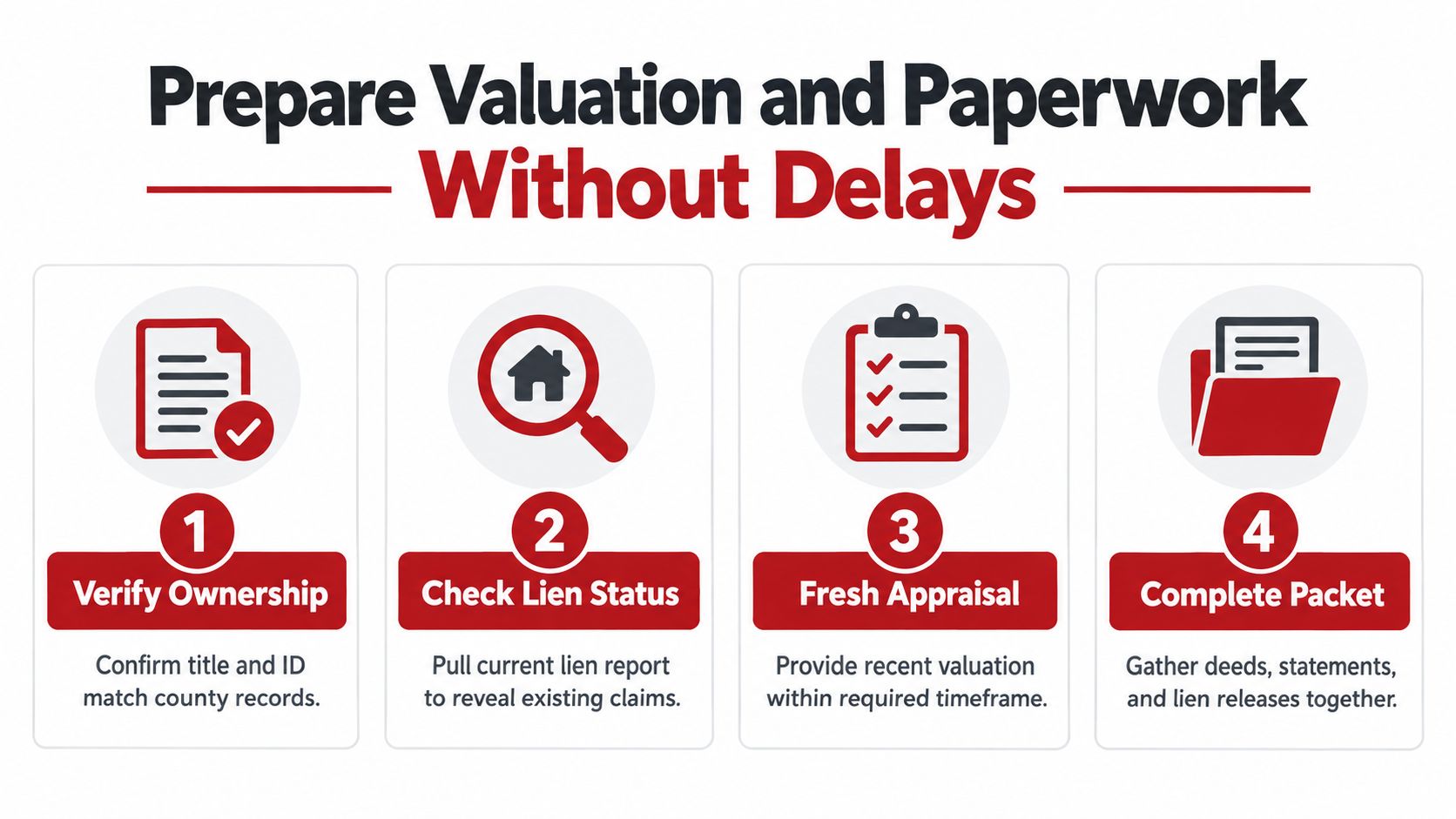
Build the packet in four passes
-
Confirm ownership. Collect government-issued identification, the vehicle title or deed, and account records where relevant. The legal owner should be the person signing the collateral documents.
-
Check existing claims. Provide current mortgage statements, vehicle loan information, lien releases, or other records showing what another creditor may already control. An asset’s market value isn’t the same as its available value.
-
Support the valuation. Use recent, credible evidence. A property valuation should reflect present condition and marketability, while a vehicle valuation should account for condition and any financing. For a broader explanation of real estate valuation methods, how to value fix-and-flip deals offers useful context on separating gross market value from costs and project-specific risk.
-
Complete the agreement. The indemnitor and owner should review the security agreement, indemnity forms, release conditions, and any required authorizations. Keep copies of everything signed.
A simple preparation checklist includes:
- Identification: Current ID for the defendant, indemnitor, and property owner where applicable.
- Ownership proof: Deed, title, registration, account statement, or purchase documentation.
- Lien evidence: Mortgage statement, loan balance, lien report, or release document.
- Valuation evidence: Recent appraisal or other accepted support for realizable value.
- Financial records: Bank documentation or statements that identify the account holder.
- Contact details: Reliable phone numbers for everyone who must sign.
- Case information: Booking details, charges if known, and the court or facility handling the release.
Protect the release timeline
Don’t order an expensive appraisal before speaking with the agent about what form and age of valuation will be accepted. A regulated-lender model emphasizes accurate and timely appraisals, reasonable advance rates, independent review, and documented exceptions, principles also reflected in supervisory guidance from the Farm Credit Administration. A bail agent may apply a similar caution because liquidation value can be lower than a family’s preferred estimate.
When Bada Bing Bail Bonds verifies the booking and coordinates paperwork with the Ventura County Pre-Trial Detention Facility, incomplete documents create avoidable back-and-forth. Families can also review what to do when someone gets arrested so they know which information to gather before the first call.
How Collateral Is Held Returned and What to Do If You Are Short
Presenting collateral doesn’t mean handing over an asset casually. The agent and indemnitor should document what is being pledged, who owns it, how its value was established, where the documentation is held, and what conditions trigger release. Read the written agreement carefully, especially the sections covering forfeiture, expenses, ownership disputes, and return procedures.
The process usually follows the life of the bond. First, the agent verifies and documents the security. The defendant then has to comply with court obligations, including appearances and any release conditions. When the bond is exonerated and the agreement’s conditions are satisfied, the agent processes the collateral release.
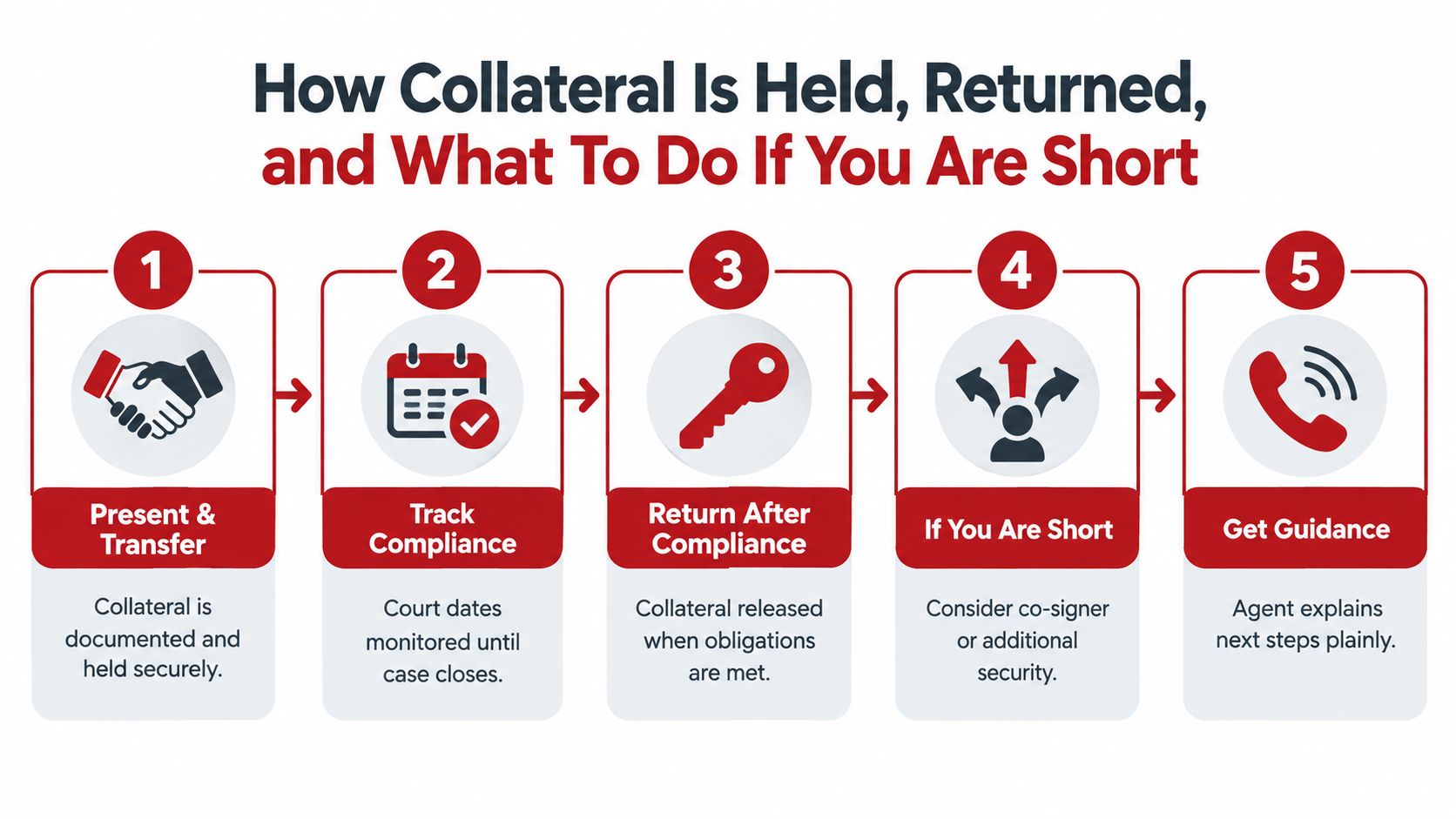
If the family doesn’t have enough security
A shortfall doesn’t always end the conversation. Ask whether a co-signer, additional indemnitor, different asset, or combination of assets can strengthen the application. A property owner may support the bond while another person handles the premium, but every participant needs to understand the obligations before signing.
Payment arrangements can address the premium without changing the collateral decision. In other words, a payment plan may help spread the bond fee, but it doesn’t automatically replace security when the agent’s underwriting requires it. Conversely, a co-signer with strong documentation may reduce the need for property in a case where the agent is comfortable with the overall risk.
Families should also ask whether secured bail is necessary. In Virginia, more than half of defendants were released on personal recognizance or unsecured bond each year, with the share moving from 59.1% in 2021 to 57.9% in 2023, according to the state’s 2025 report on pretrial release. Federal pretrial data also shows that courts regularly recommend release conditions other than secured money bail. Those figures aren’t Ventura County rules, but they reinforce an important question: Is collateral required in this case, or is another release mechanism available?
Where the agent fits
The Ventura County Sheriff lists cash, a cashier’s check payable to the Ventura County Superior Court, a bail bond, and GovPayNet card payment as posting methods at 800 South Victoria Avenue in Ventura. A bondsman uses the bail-bond route, while the family may be preparing separate collateral documents with the agent.
If you’re unsure how the return process works, ask for a written explanation and review how to get your bail money back. Keep the agreement, receipts, valuation records, and release notices together until the collateral is formally returned.
Getting Release Started Tonight With the Right Collateral Plan
The most effective plan is simple and local. Confirm the booking, identify the applicable bail amount, choose the fastest asset you can prove, and send ownership and valuation documents before the agent has to ask for them.
For a Ventura County Jail bail bonds request, remember the facility location at 800 South Victoria Avenue in Ventura and verify which posting method applies. Families in Ventura and Oxnard often need immediate coordination, while callers from Camarillo, Port Hueneme, Thousand Oaks, Santa Paula, Moorpark, Fillmore, Ojai, or Santa Barbara may need help arranging documents and transportation across the county.
Use this short checklist:
- Confirm the booking: Gather the defendant’s full name, birth date, and facility information.
- Ask whether collateral is required: Don’t assume the answer before the agent reviews the bond.
- Select the cleanest asset: Prefer clear ownership, available equity, and current records.
- Send proof promptly: Include ID, title or deed, lien information, and valuation support.
- Clarify every obligation: Ask about the premium, collateral, payment terms, court compliance, and release conditions.
- Use a co-signer when appropriate: Review how to get a co-signer before relying on another person’s support.
A 24-hour bail bonds Ventura provider should do more than quote a premium. The agent should verify the booking, explain the court-set amount, identify the quickest workable security, coordinate paperwork with the facility, and tell the indemnitor what happens after release. Bada Bing Bail Bonds handles Ventura County bail bonds for families needing support with larger or higher-risk bonds, including collateral review, co-signer options, payment arrangements, and communication through the release process.
Call Bada Bing Bail Bonds for a clear collateral review and help coordinating a bail bond in Ventura County, including Ventura, Oxnard, and nearby communities. A licensed agent can verify the booking, explain what documents are needed, and help you move from a late-night call toward release without guessing which asset will work.