At 2:14 a.m., a call from the Ventura County Main Jail can turn a quiet Camarillo kitchen into a command center. Someone is trying to write down a booking number, someone else is searching for a phone charger, and nobody yet knows whether the person in custody is at the Main Jail, Todd Road Jail, East County Jail, or still waiting for intake.
Learning how to post bail in Ventura County means understanding more than the payment. The actual process includes arrest transport, booking, charge verification, the county bail schedule or a judge’s decision, bond paperwork, jail approval, and release processing. The steps below explain where families lose time, what information matters, and when a Ventura County bail bonds agent can help coordinate the release.
Table of Contents
- The Phone Call Every Ventura County Family Dreads
- What Happens Between Arrest and Release
- How Ventura County Sets the Bail Amount
- Working With a Ventura County Bail Bondsman
- Real Costs, Payment Plans, and Collateral
- Common Obstacles That Hold Up Release
- What to Expect After Release
The Phone Call Every Ventura County Family Dreads
The deputy gives you a name, a booking number, and just enough information to confirm that your spouse was arrested. You reach for a pen while standing in the kitchen, still trying to separate the facts from the shock and anger. Then the emotions give way to logistics, because the person is in custody and the next call matters.
During the first ten minutes, write down the defendant’s full legal name and date of birth. Ask which facility currently has custody. In Ventura County, that may be the Main Jail, the Pre-Trial Detention Facility, Todd Road Jail, East County Jail, or an outside agency if the person hasn’t been transferred into the county system.
Ask for the exact charge and the arresting agency. The deputy may not quote a bail figure over the phone, and the jail generally won’t transfer you directly to the person in custody. Don’t argue about the arrest during this call. Your immediate objective is to preserve the information needed for the next step.
Write these three items together: the booking number, the charge, and the arresting agency.
The booking number follows the case through calls to a bondsman, the jail, the court, and the defense lawyer. If the family member was arrested in Oxnard, Thousand Oaks, Ventura, Santa Paula, Moorpark, Fillmore, Ojai, Port Hueneme, Camarillo, or Santa Barbara, the arresting agency can also help determine where the person started the booking process.
For a fuller first-response checklist, review what to do when someone gets arrested. Keep one person responsible for the notes so details don’t get scattered across several phones.
What Happens Between Arrest and Release
Posting bail doesn’t create an instant jail exit. The person must first move through the county’s intake and classification process, and the jail must receive and approve the payment or bond documents.
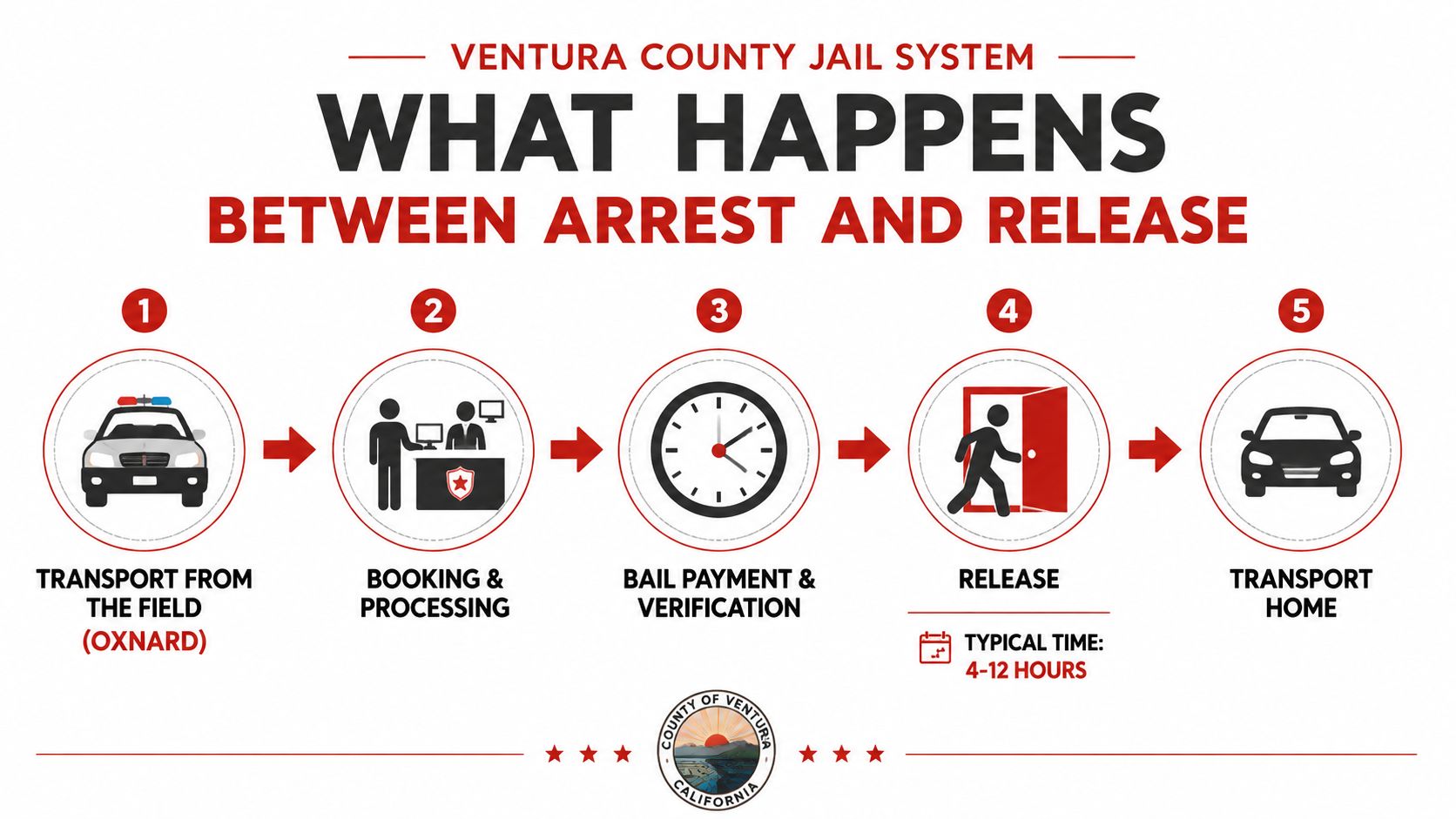
An arrest in Oxnard, Thousand Oaks, or another Ventura County community usually begins with transport from the field to the appropriate detention facility. The receiving facility completes booking, records the defendant’s property, takes photographs and fingerprints, conducts medical screening, and assigns housing based on classification information.
The jail may also need to address medical concerns, mental-health clearance, an immigration hold, or other custody information before release can move forward. A felony booking can involve required state DNA collection under California Penal Code 296. These steps can matter even when the family has already arranged payment.
The release chain
The operational sequence generally looks like this:
- Transport and intake: Officers deliver the arrested person to the assigned facility.
- Booking verification: Staff confirm identity, charges, fingerprints, photographs, property, and medical status.
- Release decision: The person may qualify for release on own recognizance, cite-and-release, cash bail, or a surety bond, depending on the charge and court direction.
- Payment or bond approval: The jail reviews the transaction and confirms that the required paperwork is complete.
- Final processing: Staff retrieve property, complete release documents, and direct the person out of custody.
The verified release guidance available to families says the delay usually comes from court approval, transmission of the release order, jail processing, and staffing rather than the payment itself. In ideal conditions, same-day release may take 2 to 6 hours, while 24 to 48 hours can occur when timing, weekends, or facility workflow slow the process. See the Ventura County inmate release process for the practical sequence.
How Ventura County Sets the Bail Amount
Ventura County families usually encounter one of two bail-setting paths. The first is a county bail schedule applied during booking. The second is a judge-set amount determined after the court reviews the case and the defendant’s circumstances.
The Ventura County Superior Court publishes a county bail schedule connected to California’s statewide framework, including a 2024 Ventura Superior Court Bail Schedule and separate fee and bail schedule resources. The court also identifies a statewide Judicial Council Uniform Bail and Penalty Schedule edition for 2026 on its resources page. Check the California bail schedule before assuming that a charge has a particular amount.
A scheduled amount is an administrative starting point tied to the charge category. A judge-set amount comes from a court hearing and may differ because the court is considering the facts in the declaration, criminal history, public-safety concerns, flight risk, prior court compliance, and other case-specific issues. A family shouldn’t treat a schedule amount as a guaranteed final figure.
The two paths at a glance
| Factor | Scheduled Bail (Booking) | Court-Set Bail (Arraignment) |
|---|---|---|
| When it appears | During booking or initial custody processing | After a judge or commissioner reviews the case |
| How it’s determined | Charge category and county schedule | Case facts, history, risk factors, and court findings |
| Can it change | Yes, a later court order can modify it | Yes, the court can raise, lower, or replace release terms |
| What the family should verify | Exact charge and current scheduled amount | Hearing result and written release conditions |
California’s bail system has also moved away from assuming that money must always be the route to release. Historically, the American colonies and early United States relied on surety pledges rather than upfront cash. The federal Bail Reform Act of 1966 preserved a presumption of release in noncapital cases and directed courts toward the least restrictive conditions needed to assure appearance. The federal law enacted in 1984 expanded authority to deny release when a defendant posed specified safety risks or faced serious charges. This history helps explain why modern release decisions can involve recognizance, supervision, conditions, detention hearings, or financial bail, depending on the jurisdiction and case.
A surety bond normally requires the family to pay a premium to a licensed bondsman, who guarantees the remaining obligation to the court. The California Department of Insurance says the consumer cost is most commonly 10% of the bond amount, plus only actual, necessary, and reasonable transaction expenses, as described in its consumer guide to California bail bonds. For a $25,000 bond, that commonly means a $2,500 premium at the filed rate.
Cash bail requires the full court-set amount upfront. For a $25,000 bail, the family must provide the entire $25,000, subject to the court’s accepted payment methods and procedures. That money remains tied up until the case reaches the point at which the court exonerates the bail, while a surety bond usually requires less money immediately but creates contractual obligations for the signer.
Cash can make sense when liquid funds are available and the family can leave them with the court. A bond is often more practical when speed matters or savings are tied up in a home, business, or other assets. Payment plans may be available for a bond premium, but families generally can’t pay the court’s cash bail in installments.
Working With a Ventura County Bail Bondsman
A professional Ventura bail bonds agent works from verified custody information, not a family member’s guess about the charge. The first task is confirming whether the defendant is at the Ventura County Main Jail, Todd Road Jail, or East County Jail through available inmate information.
Next, the agent checks the booking details and current bail requirement. The amount can depend on the exact offense, enhancements, warrants, and whether a judge has issued a new order.
The signer, often called the indemnitor, should be prepared to provide:
- Identification: A valid government-issued ID and full legal name.
- Contact information: Current address, telephone number, and reliable email.
- Employment details: Employer information or another explanation of financial responsibility.
- Payment information: The agreed premium and any written installment terms.
- Collateral details: Property or other security if the bond requires it.
The bondsman then explains the contract, premium, indemnitor responsibilities, and collateral terms. California contracts carry legal obligations, including provisions associated with California Civil Code Section 1995 and following sections. Read the paperwork before signing, and insist that the premium and any collateral receipt appear in writing.
After signing, the agent posts the surety bond with the jail or court and tracks acceptance. The bail bond agent process is coordination work as much as payment work. A local agent may dispatch paperwork to a county facility, respond when the jail requests clarification, and keep the family informed while release processing continues.
Real Costs, Payment Plans, and Collateral
California’s standard consumer premium is generally 10% of the bond amount, according to the California Department of Insurance bail-system report. The premium goes to the licensed bondsman, not to the court, and it’s generally non-refundable once the bond has been written, even if the criminal case later ends favorably.
The same report gives the practical example of a $25,000 bail producing a $2,500 fee. California guidance also says families should verify that quoted charges are actual, necessary, and reasonable transaction expenses. Since renewal premiums on California bail contracts are prohibited after January 1, 2022, ask whether a quoted charge is a one-time premium or an improper recurring renewal.
| Cost Item | Typical Amount | Notes |
|---|---|---|
| Surety premium | 10% of $25,000, or $2,500 | Common filed-rate premium described by California insurance guidance |
| Transaction expenses | Actual, necessary, and reasonable expenses | Ask for each charge in writing |
| Installment payment | Agency-specific | A payment plan changes timing, not the total premium |
| Collateral | Depends on the contract and risk | Terms should identify the security and return conditions |
Payment plans can help families spread the premium rather than produce the full amount immediately. The agent may require a down payment, a co-signer, or additional proof of financial responsibility. Those terms vary by agency and bond risk, so don’t rely on a verbal promise.
Collateral can include real estate interests, vehicle titles, jewelry, or other accepted property. The contract should state when the collateral will be released. It usually isn’t returned merely because the defendant walks out of jail. The bond must reach exoneration, required payments must clear, and the agency must complete its closing process.
Avoid any agent who pressures you to pay more than the lawful premium or attempts to charge interest on the premium itself. Ask for a written receipt, a copy of every signed document, and a clear explanation of what happens if the defendant misses court. Families comparing installment payment plans should compare the total obligation, not only the initial amount due.
Common Obstacles That Hold Up Release
Four problems repeatedly interrupt an otherwise complete bond package. The fastest solution depends on identifying the hold before assuming the jail has lost the paperwork.
An out-of-county or out-of-state warrant may trigger a separate decision by the originating agency. The Ventura County jail cannot ignore that flag because local bail was posted. The family or bondsman needs to ask the jail which agency placed the hold and whether that agency has issued a release decision or intends to seek extradition.
Probation, parole, immigration, or another pending felony can create a similar barrier. A surety bond may be accepted while the person remains in custody on the separate hold. Ask the jail’s records or classification staff what remains active, then have the defense lawyer address any court-related hold.
Protective orders and no-contact conditions also require care. A bondsman can’t rewrite a court order. If the defendant needs a change, the defense lawyer must seek the proper court modification, and questions about the source of bail funds may require a court review under Penal Code section 1275(a).
Medical screening, detoxification, and mental-health clearance can delay booking or release. If the defendant is at a medical facility or under a clearance requirement, ask the jail or medical staff whether the person has been returned to custody and whether the bond can be submitted yet.
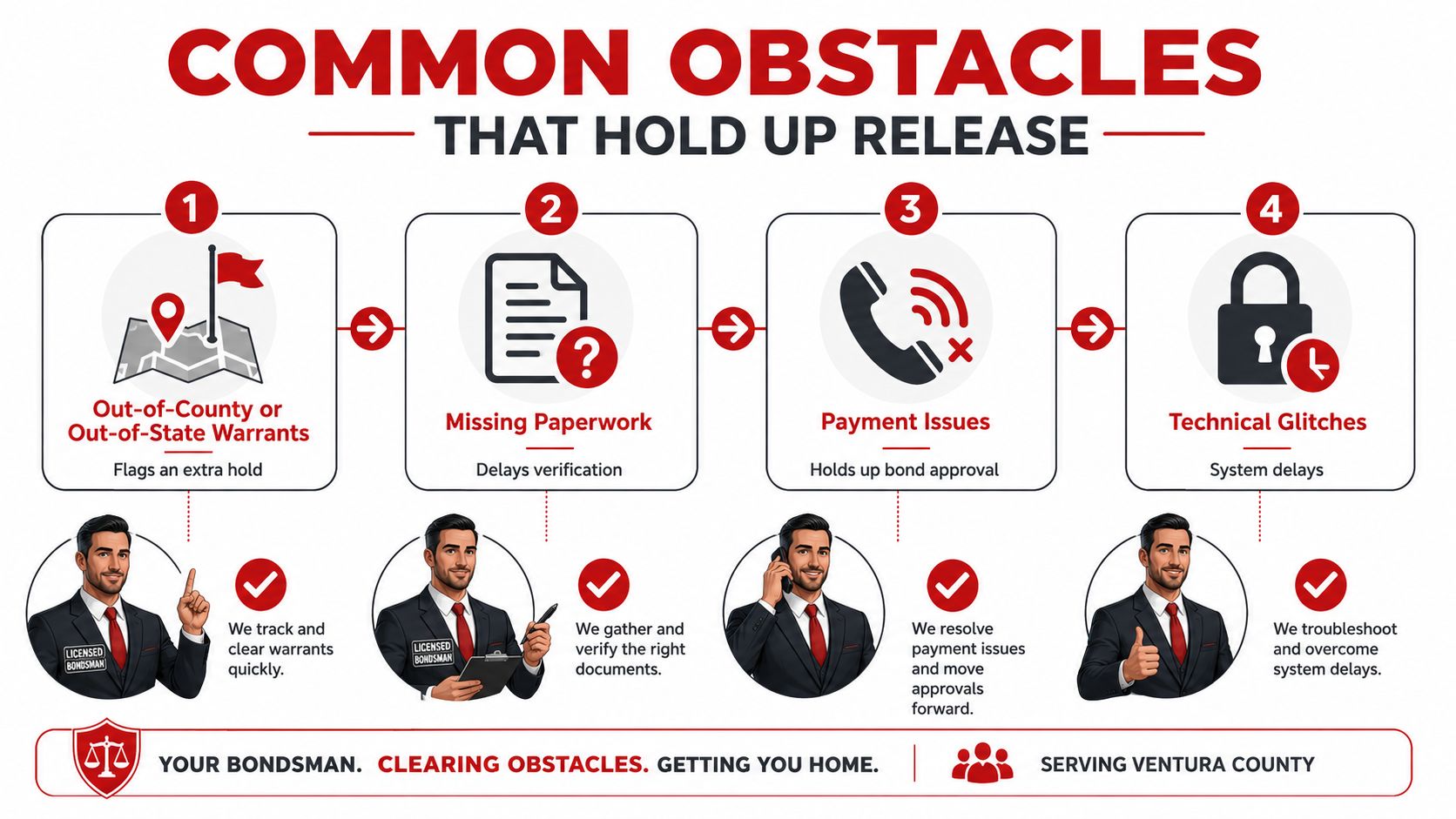
Ask one direct question: “Is the delay caused by booking, payment approval, or another hold?”
That answer tells the family who should act next. The jail handles custody processing, the court handles court orders, the originating agency handles its warrant, medical staff handle clearance, and the defense lawyer handles legal challenges or requests for modification. Resolution can be quick when the responsible party is identified, but timing depends on the agency and facility.
What to Expect After Release
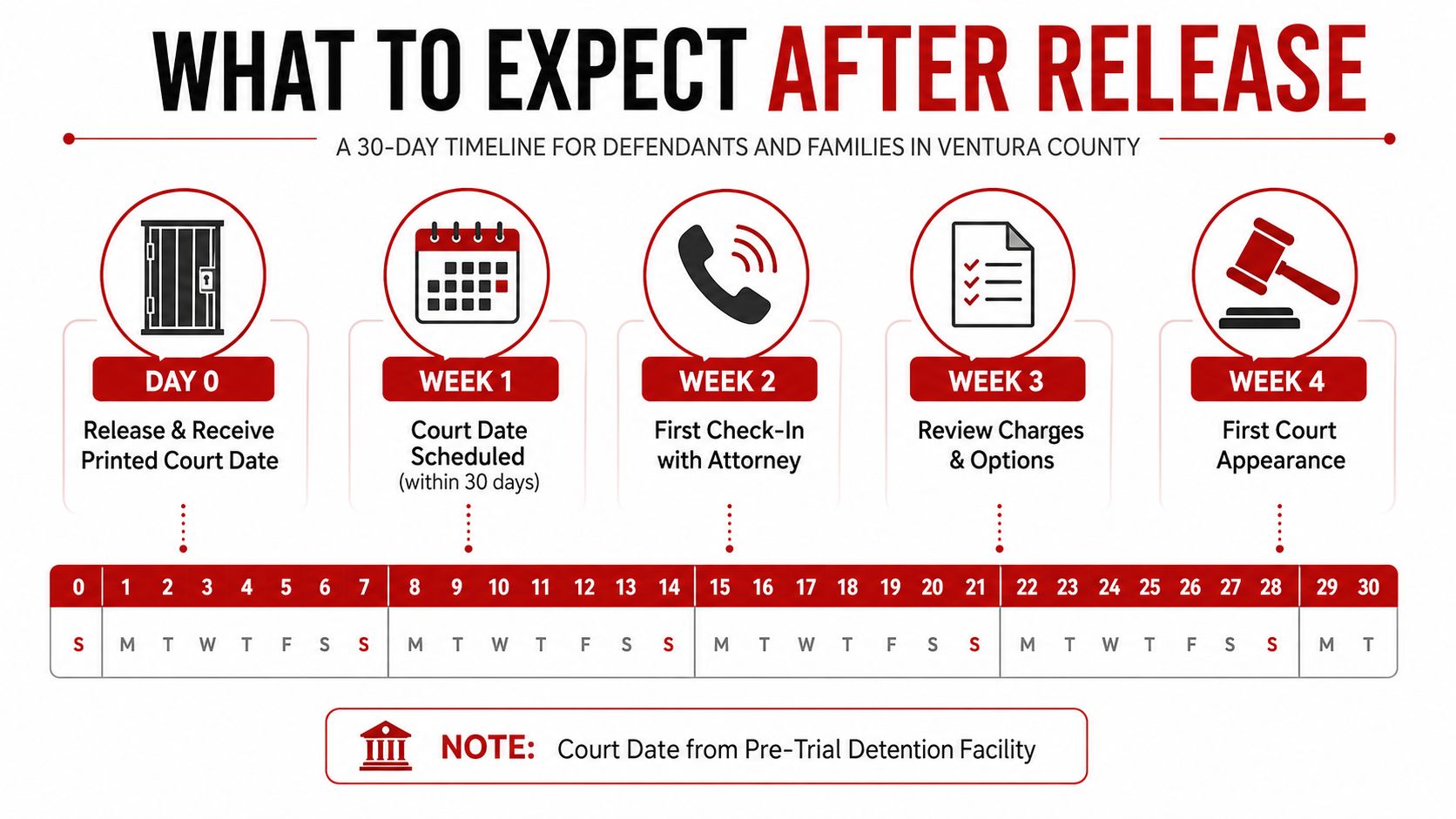
The release moment is important, but it isn’t the end of the bail obligation. The defendant leaves custody with court instructions, financial responsibilities, and a duty to remain reachable.
The Pre-Trial Detention Facility generally provides printed court information. Families should photograph that paperwork, place the date in more than one calendar, and give a copy to the defense lawyer. A missed appearance can lead to a warrant, bond problems, and additional legal consequences.
The bondsman may require check-ins and updated contact information. Keep the agent informed about a new address, phone number, employer, travel plans, or changes that could affect the defendant’s ability to appear. Don’t assume that a court date reminder replaces the defendant’s own responsibility.
The first-hour checklist
Print this list and keep it near the refrigerator:
- Locate the defendant: Use the Ventura County inmate locator and record the booking number.
- Confirm the case: Write down the exact charges, arresting agency, facility, and current bail status.
- Choose the funding path: Decide whether full cash bail or a surety bond is realistic.
- Prepare the signer: Gather identification, address, employer information, and proof of income if requested.
- Discuss security: Ask whether collateral is needed and document the return conditions.
- Keep counsel available: Have the defense attorney’s phone number ready for holds, protective orders, or release conditions.
- Track the release: Ask when the bond was accepted and whether the jail still needs a court order or clearance.
Compliance mistakes tend to happen after the family relaxes. Traveling out of state without permission, being arrested again, failing a required drug test, contacting a co-defendant, or violating a no-contact order can place the release and the bond at risk. Read every condition before leaving the jail.
Collateral returns after the bond is exonerated and the account is fully settled. That may occur when the case resolves or when the court otherwise releases the surety obligation. Keep copies of court paperwork and payment records until the bondsman confirms closure in writing.
Questions families ask at 2 a.m.
How long does release take after the bond posts?
The bond still needs jail acceptance, release-order transmission, property return, and final processing. The verified guidance says ideal same-day release can take 2 to 6 hours, while 24 to 48 hours can occur when weekends, timing, staffing, or facility workflow create delays. Local conditions control the actual window.
Can a bondsman lower the bail amount?
No. A bondsman can explain the current amount and post an accepted bond, but only the court can change bail or impose different release conditions. A defense lawyer can request a bail review or another form of release.
What happens if the defendant misses court?
The court may issue a warrant and the bond can enter a forfeiture process. Contact the bondsman and defense lawyer immediately rather than waiting for a notice or hoping the date will be rescheduled automatically.
Is the premium refundable?
Usually not. The premium pays for writing the bond and is generally earned under the contract. Ask for the agency’s written cancellation and refund terms before signing.
How do I handle an out-of-county pickup in Ventura?
Tell the jail and bondsman about the outside warrant immediately. Local release may remain blocked until the originating agency decides whether to release, transfer, or seek extradition.
Which payment methods does Bada Bing Bail Bonds accept?
Bada Bing Bail Bonds discusses payment options during the intake process, including arrangements handled remotely when appropriate. Call 805-256-4040 for a free consultation and confirm the available method for the specific bond.
If you need 24-hour bail bonds Ventura, bail bonds Oxnard, Ventura County Jail bail bonds, or bail bonds Thousand Oaks, gather the booking number and charge before calling. That information lets the agent begin with the correct facility and paperwork instead of making the family repeat the same details.
For help coordinating a Ventura County release, call 805-256-4040 for a free consultation with Bada Bing Bail Bonds, including assistance with booking verification, paperwork, payment plans, and jail coordination. Visit Bada Bing Bail Bonds to begin the process and get clear answers about the next step.