At 2 a.m., the phone rings. A family member has just been booked, nobody knows when court starts, and the paperwork in front of you looks like a collection of codes, case numbers, and unfamiliar legal terms. You’re not trying to become a legal expert. You’re trying to find out what happens next and keep one missed date from making the situation worse.
In Ventura County, scheduling a court date is tied directly to release compliance. The date on a citation, release form, or jail paperwork may be the first appearance, but it may not be the only hearing. You need to confirm every appearance, understand whether the date can be changed, and make sure the person released on bail has a reliable way to get there.
Table of Contents
- Why Scheduling a Court Date Starts Before the Court Calls
- Information You Need Ready Before You Pick Up the Phone
- How to Schedule a Court Date Through Ventura and Santa Barbara Courts
- Phone, Online Portal, or Clerk Window Which Path Fits Your Case
- How the County Bail Schedule Connects to Your First Court Date
- Rescheduling a Court Date Without Triggering a Failure to Appear
- Building a Reminder System That Actually Keeps You in Court
Why Scheduling a Court Date Starts Before the Court Calls
The first mistake families make is treating the court date like ordinary paperwork. It isn’t. A missed criminal court appearance can lead to a failure to appear, a bench warrant, and problems with the bail bond. The person who signed as cosigner may also have to deal with the bondsman while the court and jail sort out what happened.
The first appearance is a major procedural milestone. A federal court-process report defines the initial appearance as the defendant’s first court appearance on the charged offense and notes that bail is set at that time. That means the first scheduled date can affect release conditions and the next steps in the case, not just the calendar. The federal report on initial appearances and bail explains why this stage carries more weight than a routine administrative appointment.
For a practical overview of local locations, divisions, and case navigation, keep the Ventura County court system guide available. It’s easier to call the right office when you already know whether the matter belongs in Ventura, Simi Valley, Santa Paula, or another division.
The date you have may only be the beginning
A citation or release form may show an arraignment date. Later hearings can include pretrial conferences, readiness hearings, motions, sentencing, or probation-related appearances. The court controls those dates, and the assigned attorney may also need to coordinate with the clerk before a change is approved.
Practical rule: Never rely on memory, a family member’s recollection, or an old text message. Keep the written notice and verify the current date through the court.
The local court’s schedule matters because courts use formal calendars and case records to manage appearances. Some jurisdictions update calendars frequently and provide public lookup systems, while others require a phone confirmation. If the paperwork is unclear, call the court or the bondsman immediately. Waiting until the morning of the hearing is how small confusion turns into a serious compliance problem.
Information You Need Ready Before You Pick Up the Phone
Before calling a clerk, attorney, jail, or bail bonds office, put the original release paperwork on the table. Clerks often need the exact spelling and numbers printed on that document. A wrong name or date of birth can send the lookup to the wrong case and cost you another long stretch on hold.
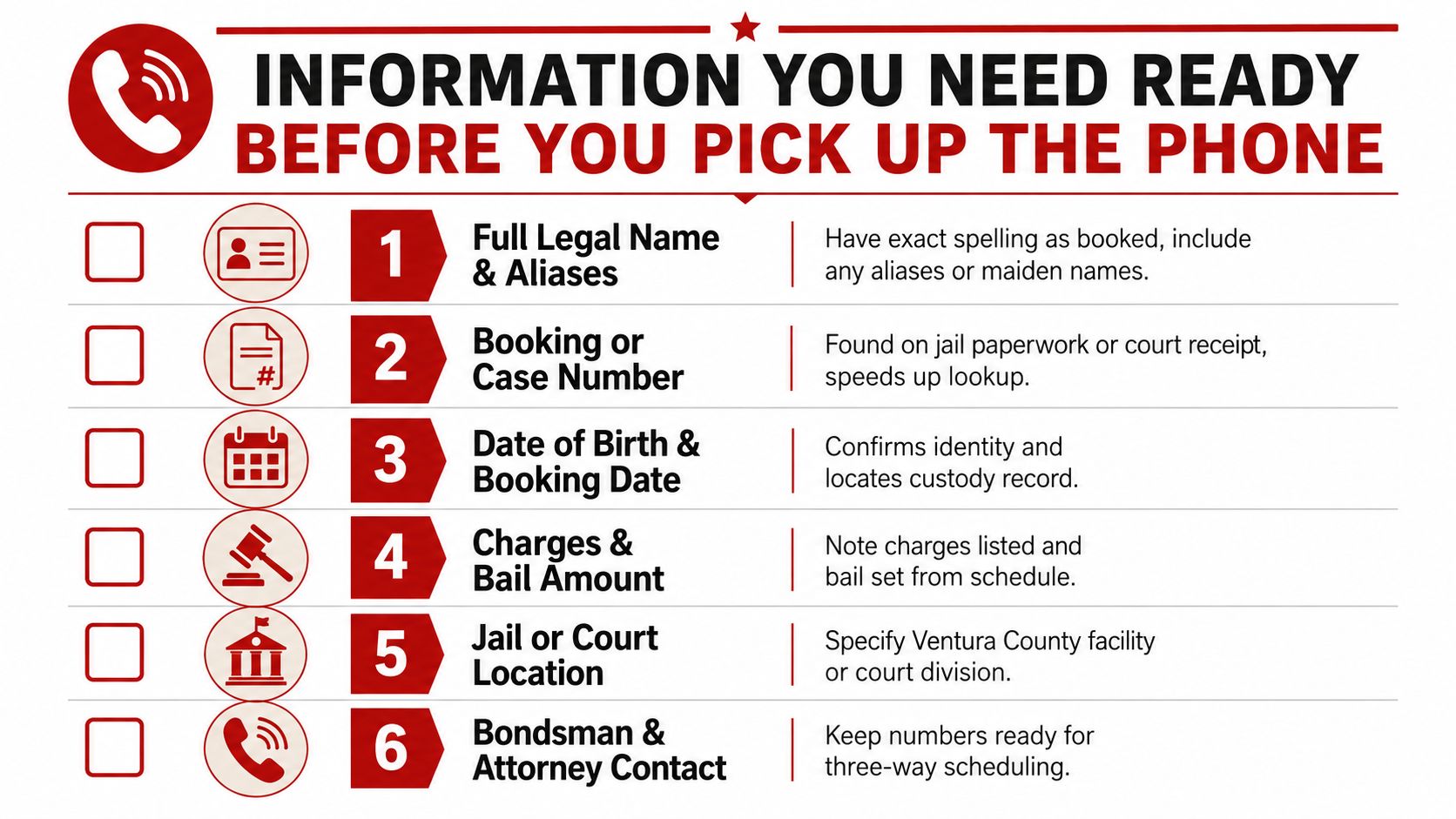
Build the file before you call
Use this checklist:
- Full legal name and aliases: Write the name exactly as booked, including aliases, maiden names, or alternate spellings. Courts use identity details to locate the correct docket.
- Booking or case number: This speeds up a clerk lookup and helps a bondsman identify the correct booking record.
- Date of birth and booking date: These details help distinguish people with similar names and connect the caller to the proper custody record.
- Charges and level: Note every listed charge and whether it’s a misdemeanor or felony. DUI, domestic violence, warrant, probation, and other matters may follow different scheduling paths.
- Custody and releasing agency: Record whether the person is still in custody, has been released, or is waiting for transport. Include the jail, police department, or agency involved.
- Bail amount and bonding company: The amount and company name matter when a reset, continuance, or release issue affects the bond.
- Mailing address and phone: The court needs usable contact information. Give the address where notices can be received.
- Employer and attorney information: Work details help explain a scheduling conflict. If there’s an attorney of record, keep the attorney’s name and phone number ready.
The person calling should also know the court location, division, current department if listed, and every date appearing on the paperwork. Don’t guess at a name or birthday. A small identity error can route the call to the wrong docket.
For readers who are also sorting through legal paperwork and unfamiliar terms, this explanation of what a subpoena looks like can help separate a court notice from other documents.
The video below offers another visual way to organize the information before making calls.
How to Schedule a Court Date Through Ventura and Santa Barbara Courts
Start with the official court record, not a search result or a message from someone who heard a date secondhand. Ventura County cases commonly connect readers to the Ventura Hall of Justice or the East County Courthouse in Simi Valley. Santa Barbara County matters may be handled through the Santa Maria Superior Court or another county division listed in the case record.
The basic lookup process
Pull up the case using the defendant’s exact legal name or case number. Then check four details together:
- Appearance type, such as arraignment, pretrial, readiness, or sentencing.
- Date and time, including whether the entry is a hearing date or a filing deadline.
- Department and courthouse, because the correct date at the wrong location still creates a problem.
- Current status or minute order, which may show that a hearing was continued, completed, or changed.
Ventura users can review case information through the court’s public case-lookup resources. Santa Barbara users can use the county’s court portal to review available case information, minute orders, and calendar entries. Save a copy of the confirmation or take a screenshot, but treat the official court record as the controlling source.
A portal is useful for checking an existing date. It may not be enough to move one. Motions, emergency resets, and some out-of-custody changes still require a clerk call, a filing, attorney involvement, or judicial approval.
Scheduling is different from continuing
Setting an appearance date through an available court process is an administrative step. Moving a date that already exists is a continuance, and a continuance usually requires a reason, proper notice, and approval. Don’t assume that submitting a request changes the original date.
If you’re used to online reservation systems in another court, the Los Angeles court reservation system overview illustrates why local procedures matter. Ventura and Santa Barbara may use different portals, departments, and filing practices.
When the record is unclear, call the clerk with the case number in front of you. Ask the clerk to confirm the courthouse, department, appearance type, date, and time. Then write down the name or identifying information of the person who provided the confirmation.
Phone, Online Portal, or Clerk Window Which Path Fits Your Case
There are three practical routes, and choosing the wrong one wastes time.
Phone scheduling is the right starting point for an arraignment issue, emergency reset, or a date that may conflict with custody, transportation, work, or medical needs. Ventura scheduling calls can be directed to 805-289-8888. Santa Barbara scheduling calls can be directed to 805-568-3959. Have the case number and original paperwork ready before calling.
Online portals work best for reviewing future dates, checking minute orders, and confirming the department after the court has entered the information. They’re convenient, but a portal record doesn’t automatically grant a continuance.
The clerk window is appropriate when a filing requires a signature, supporting declaration, or paper submission. A clerk window generally can’t set a criminal date without the required judicial involvement. Showing up without the correct form or knowing the assigned department can turn a simple filing into a wasted trip.
Scheduling path by case type
| Case Type | Phone | Online Portal | Clerk Window |
|---|---|---|---|
| Felony | Use for date confirmation, attorney coordination, or an urgent reset request | Review the entered hearing and minute order | Use when a required filing or signed motion must be submitted |
| Misdemeanor | Use for arraignment questions and possible continuance procedures | Confirm the current date, time, and department | Submit documents when the court requires a physical filing |
| DUI | Call before relying on a general calendar because charge-specific procedures may apply | Review the official case entry after filing | Use only when the court directs a filing or appearance |
| Traffic warrant | Call to identify the proper calendar and available resolution path | Check whether the case record shows a new date | File the required request or declaration if the court requires one |
For in-custody matters, the jail and court may control the first appearance differently than an out-of-custody traffic matter. Ask which office controls the next step instead of assuming the online calendar handles everything.
How the County Bail Schedule Connects to Your First Court Date
Bail and court scheduling are connected, but they aren’t the same process. California counties use formal bail schedules for applicable offenses, and Ventura Superior Court maintains a countywide bail schedule under Penal Code section 1269b. The court’s local schedule is separate from the statewide Judicial Council schedule, so the county, arresting agency, charge, and release status matter.
California’s Judicial Council publishes a 2026 Uniform Bail and Penalty Schedule with an effective date of January 1, 2026. That schedule provides a statewide reference point, while Ventura County uses its own adopted local schedule. The Judicial Council’s 2026 schedule is the proper place to check the statewide framework, and the Ventura County bail schedule provides local context for Ventura arrests.
Santa Barbara County also publishes a 2026 felony and misdemeanor bail schedule, confirming that nearby counties use their own court-published schedules rather than informal online guesses. Santa Barbara Superior Court’s bail-schedule page is the right reference for Santa Barbara matters.
What the schedule does and doesn’t tell you
A schedule can identify the formal bail amount for an eligible offense. It doesn’t guarantee the precise time of release, the exact courtroom process, or the date of every later hearing. The first appearance may be assigned through the release paperwork or court calendar, and the defendant must follow that document unless the court grants a change.
California bail schedules are used for people arrested without a warrant and for bailable offenses. They’re organized by offense categories and may include general, special, and enhancement amounts. The California court bail-schedule material illustrates that bail calculation depends on statutory authority and the applicable offense classification.
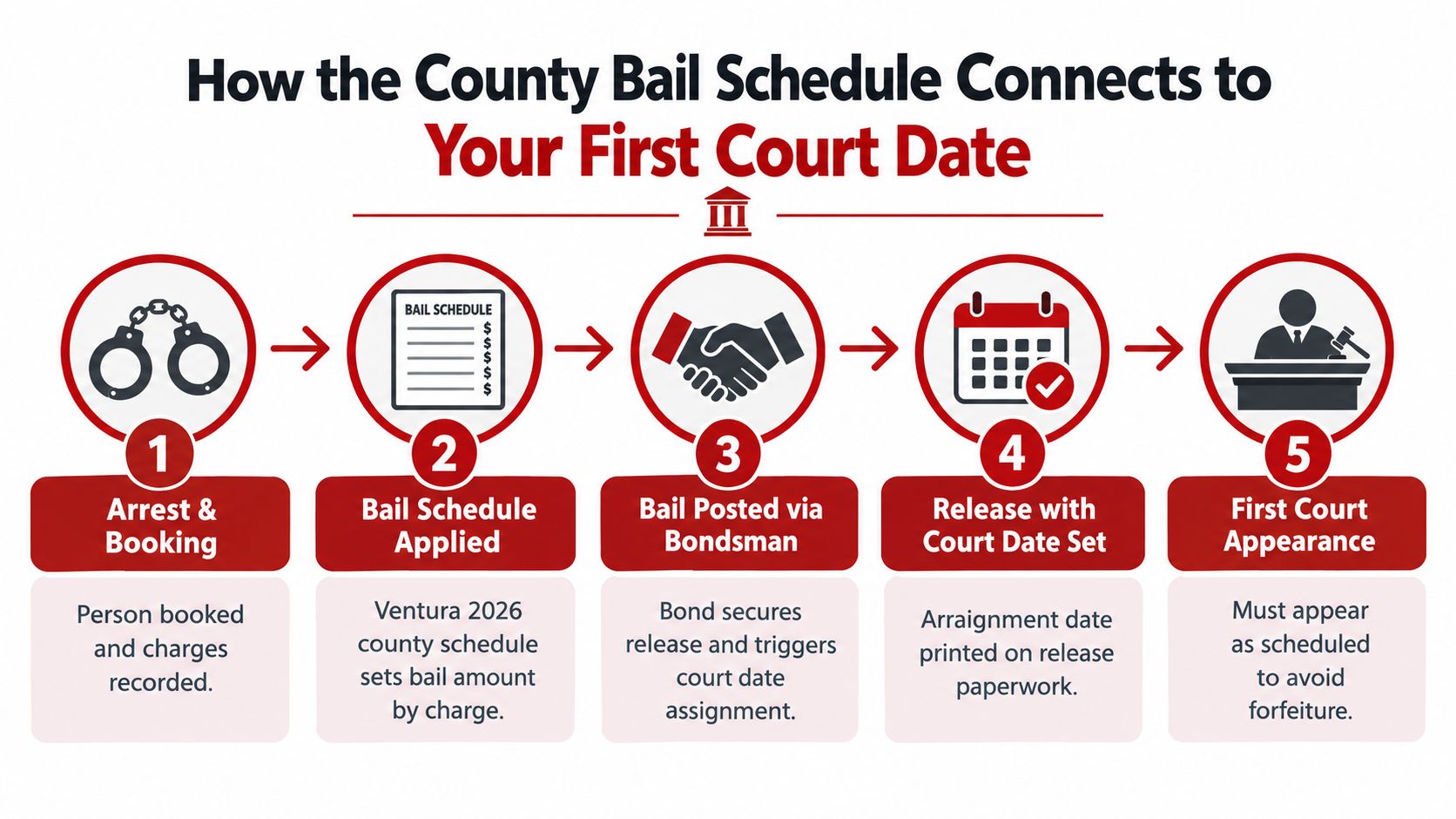
A bondsman can help coordinate paperwork and explain the release process, but posting a bond doesn’t replace the court date. Read the release paperwork before leaving custody, photograph it, and put the appearance details into a calendar immediately.
Rescheduling a Court Date Without Triggering a Failure to Appear
Don’t wait until after the hearing. The safest path is to start with the clerk, ask whether another date is available, and then contact the assigned attorney or bondsman so everyone knows the situation. The request must be approved before the original date passes.
Traffic matters may use a Declaration of Due Diligence and Request to Continue or another court-specific form. Criminal cases may require a written motion, notice, supporting declaration, and judicial approval. Felony cases can carry a pretrial motion deadline under Penal Code section 1003, so an attorney should confirm the applicable filing timing instead of relying on a general internet form.
A request isn’t an approved continuance
A pending motion doesn’t automatically excuse the appearance. Until the court grants the continuance, the original date remains active. If the defendant doesn’t appear, the court may issue a bench warrant or create a bail problem even though someone submitted paperwork.
Use a short, precise script at the clerk window:
“I’m requesting instructions to seek a continuance for case number [case number]. Please confirm whether the original date remains mandatory until a judge grants the request.”
That wording forces the important question. You’re not asking the clerk to promise an outcome. You’re asking what must happen before the existing date can safely change.
The guide to what happens if you miss court covers the consequences families should understand before taking a chance on an unapproved absence. If the hearing is close, contact the attorney immediately. If there’s no attorney, call the court and the bondsman, document every conversation, and follow the court’s filing instructions exactly.
Building a Reminder System That Actually Keeps You in Court
A reminder should do more than place one event on a phone. People miss court because they didn’t receive or understand the notice, forgot the date, couldn’t arrange transportation, or had work and caregiving conflicts. Research on court notification barriers identifies those practical problems as common reasons for failures to appear. The court-notification research supports a plain-language approach with reminders and backup plans.
Digital systems can help, but they can also exclude people who lack reliable internet access, stable contact information, or confidence using online portals. Research on barriers to court appearance describes those access problems, so use paper and human backup instead of relying on one app or one email address.
Use several reminders, not one
Set up the system as soon as the date is confirmed:
- Save the complete entry: Record the case number, courthouse, department, appearance type, date, and time.
- Add layered alerts: Set a calendar alert well before the hearing, another reminder close to the date, and a travel-planning alert for the preceding day.
- Post a paper copy: Put the notice where the household will see it, such as the refrigerator or a shared bulletin board.
- Confirm with a person: Have a family member, attorney, or bondsman repeat the date and location back to you.
- Solve transportation early: Arrange the ride, route, parking, childcare, and work notice before the hearing morning.
- Call the court if uncertain: Ventura’s court clerk can be reached at 805-289-8500, and Santa Barbara’s clerk can be reached at 805-882-4540. Verify the current details through the appropriate court office.
A reminder system also needs a technology backup. If you’re evaluating ways to make phone reminders more noticeable or consistent, this rewards guide for voice-based reminders offers ideas for reinforcing follow-through without depending on memory alone.
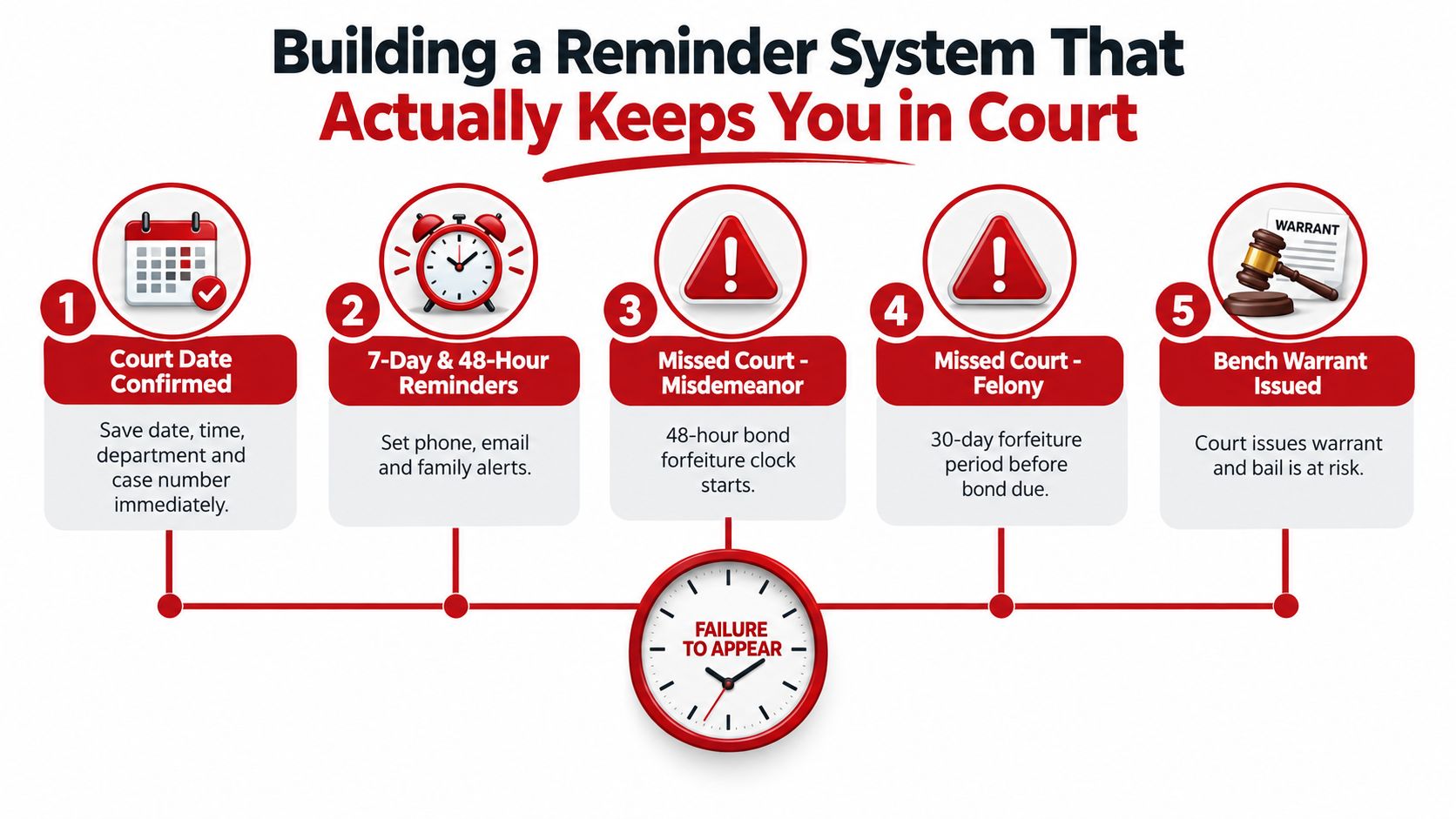
The consequences can move quickly. In the bail process, a missed appearance may start a forfeiture process, and the bondsman may contact the cosigner for immediate information. For a Ventura County Jail bail bonds matter, call as soon as the problem appears, not after several unanswered notices. Bada Bing Bail Bonds provides court-date reminders and post-release check-ins, which can give families another human point of contact while they track the case.
If you’re dealing with an arrest in Ventura, Oxnard, Camarillo, Port Hueneme, Thousand Oaks, Santa Paula, Moorpark, Fillmore, Ojai, or Santa Barbara, Bada Bing Bail Bonds can verify booking details, explain the applicable bail process, coordinate release paperwork, and help track the court date afterward. Call for 24-hour bail bonds Ventura support when you need clear answers, payment-plan information, or fast help protecting the release and court schedule.