At 2 a.m., a family member in Oxnard is sitting beside a phone, waiting for a booking number and wondering whether posting bail means the person will be home before sunrise. The answer depends on more than the bail amount. Booking status, identity checks, medical review, paperwork, jail workload, and the exact type of release all affect the inmate release process.
Ventura County has local rules that generic bail articles often miss. Arrests in Ventura, Oxnard, Camarillo, Port Hueneme, Thousand Oaks, Santa Paula, Moorpark, Fillmore, and Ojai may move through county systems, while nearby Santa Barbara matters can follow different procedures. This guide explains how quickly release can realistically happen and what a family should do during the first hour to prevent avoidable delays. For immediate guidance after an arrest, review this practical resource on what to do when arrested.
Table of Contents
- The First Call After an Arrest in Ventura County
- From Booking to a Bail Number
- Choosing Your Release Pathway in Ventura County
- Calling a Bondsman and What to Have Ready
- Paperwork, Premiums, and Payment Options
- Release Windows, Pickup, and the Delays That Stretch Them
- Post-Release Compliance and the First 48 Hours
The First Call After an Arrest in Ventura County
A 2 a.m. call rarely contains enough information. A relative may know only that someone was arrested near Oxnard, that the person was taken somewhere for booking, or that an officer mentioned bail. Before anyone can discuss a release plan, the family needs to identify the facility, confirm the booking, learn the charges, and determine whether a bail figure has been entered.
That first call matters because the inmate release process begins with accurate information, not with assumptions. A person arrested in Ventura may be at a county facility, while someone detained by a local agency may still be moving through a temporary holding or booking stage. The same applies to arrests connected to Camarillo, Port Hueneme, Thousand Oaks, Santa Paula, Moorpark, Fillmore, or Ojai. The city of arrest doesn’t always tell you where the release paperwork will be completed.
What the family should confirm first
Have one person take responsibility for collecting details. Write down the defendant’s full legal name, date of birth, arresting agency, possible booking location, listed charges, and any booking or case number. If the information is incomplete, a local agent can help determine what still needs to be verified, but nobody should promise a release time before the booking status is confirmed.
The two questions families usually need answered are straightforward:
- How fast can release happen? Ventura County Sheriff’s Office materials state that once release processing begins, release is generally completed as soon as possible and practicable, commonly within 1 to 4 hours. The timing still depends on the release pathway and whether downstream checks are complete.
- What should happen in the first hour? Confirm the booking, identify the bail amount or release type, choose the appropriate pathway, and prepare the signer and payment information before paperwork reaches the jail.
A call to Bada Bing Bail Bonds should produce a clear intake conversation, not more confusion. The agent should verify the booking details, explain the available path in plain English, outline the paperwork and premium, and tell the family what information is still missing. That preparation is often more useful than repeatedly calling the jail without a booking number.
From Booking to a Bail Number
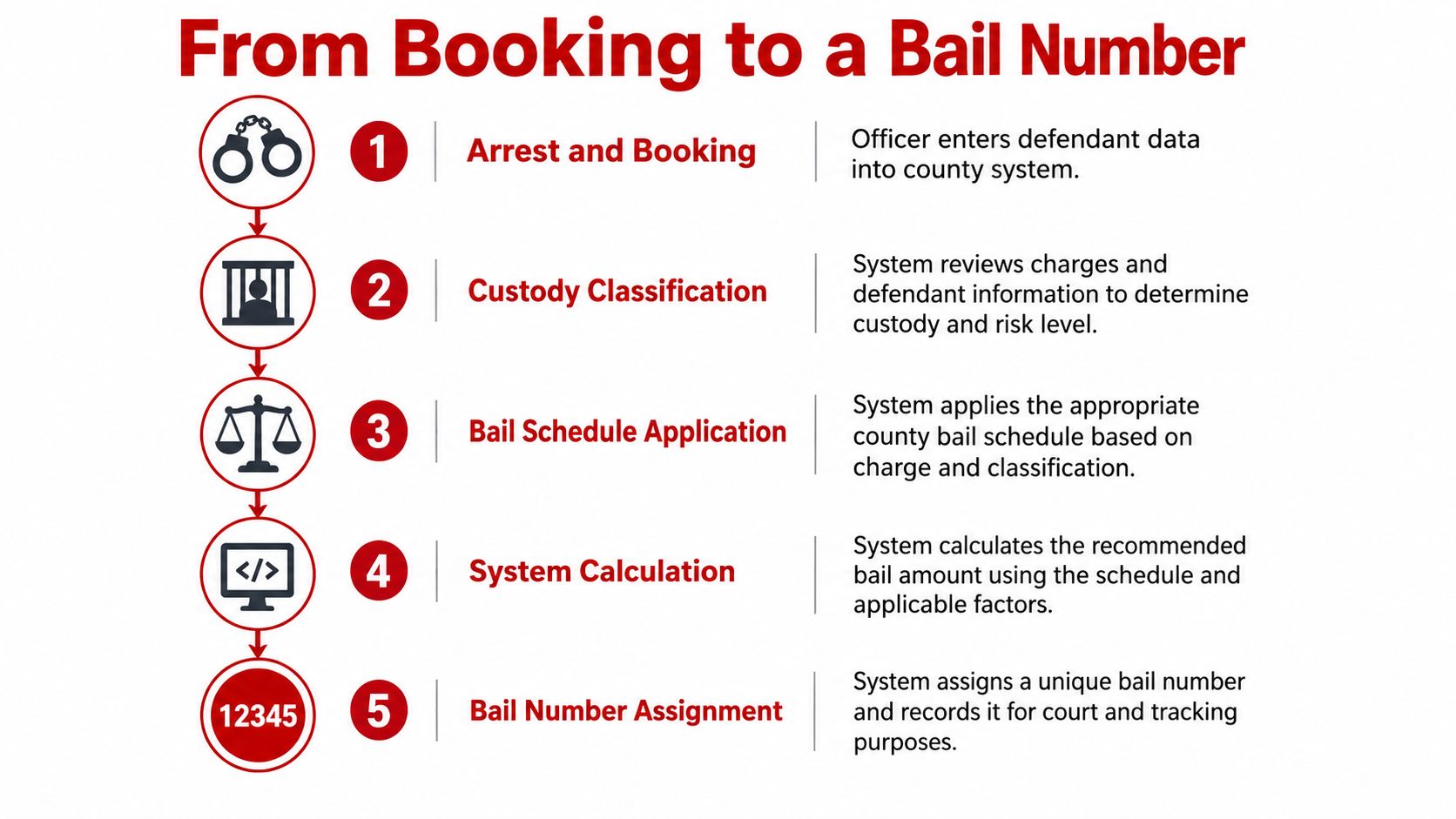
A bail number generally appears after the arresting agency and jail complete several intake tasks. The officer’s arrest information must be entered, fingerprints and identifying details must be processed, medical concerns must be screened, and the person must be classified for housing and custody purposes. These steps protect the facility and help ensure that the correct person is attached to the correct case.
Ventura Superior Court has adopted a uniform countywide bail schedule under Penal Code section 1269b, and its schedules page identifies the applicable Judicial Council and Ventura schedules. The initial figure is commonly tied to the booked charge and the applicable schedule, rather than being chosen independently by the jail clerk or by the family.
The working sequence
- Arrest and booking: The agency submits the arrest information, and the jail creates or confirms the custody record.
- Identity and classification: Staff process identifying information, fingerprints, medical screening, and housing classification.
- Schedule application: The booked charge is matched to the applicable county bail framework.
- System calculation: The amount and release conditions are entered into the relevant system.
- Bail number assignment: The family or licensed bail agent can act once the amount and release pathway are available.
Not every case reaches a bail number. California uses several pretrial release pathways. The Public Policy Institute of California reports that 41.5% of people booked on misdemeanors or felonies in California are released pretrial, with cite-and-release after booking at 46.6%, bail at 27.8%, and release on recognizance at 15.9% among the listed release pathways. The same analysis reports that about half of misdemeanor bookings end in pretrial release, compared with 29.8% of felony bookings. See the PPIC analysis of pretrial release in California for the underlying figures.
Those figures aren’t a prediction for a particular Ventura County arrest. They do show why a family shouldn’t assume every arrest requires a bond. A less serious booking may resolve through cite-and-release or another nonfinancial pathway, while a felony booking may require more review, a court decision, or a financial release arrangement.
For a local explanation of the intake sequence, the Ventura booking process provides a useful checklist of the information families should gather before calling.
Choosing Your Release Pathway in Ventura County
A person booked at Ventura County Jail can leave through several routes, but the legal release order is only the starting point. Identity checks, warrant reviews, medical clearance, and paperwork transfer can determine whether release takes about 90 minutes or stretches into another day. Families usually face four options: release after booking without a financial bond, release on recognizance, full cash bail, or a licensed surety bond.
The appropriate pathway depends on the charge, the court’s decision, available funds, and any release conditions. Cite-and-release and OR can avoid a premium, but the family cannot choose them independently. Eligibility and approval depend on the responsible agency or court.
California’s Department of Insurance explains that the court sets the bond amount and that the consumer cost is most commonly 10% of the total bond amount, plus actual, necessary, and reasonable transaction expenses. Surety companies file their rates with the Department of Insurance, and bail agents representing a surety must charge the filed rate. Review the state’s California bail bond consumer information before signing.
| Pathway | Out-of-Pocket Cost | Typical Speed | Best Fit |
|---|---|---|---|
| Cite-and-release after booking | No bail premium | Depends on agency processing and eligibility | Certain lower-level bookings that qualify |
| Release on recognizance | No bail premium | Depends on review or court action | A person the court approves for release without financial security |
| Full cash bail | The full court-set amount | Can move promptly once accepted, but jail processing still applies | Families able to place and manage the entire amount |
| Licensed bail bond | Commonly 10% of the bond amount, plus permitted expenses | Often practical once booking and paperwork are complete | Families who need to secure release without paying the full bail amount |
Full cash bail gives the family control over payment, but it ties up the entire court-set amount. It also does not bypass jail procedures. A surety bond is often the practical choice when the court has set bail and the family cannot or will not place the full amount. The agent posts the bond after completing the contract and required filings. Ventura County custody staff must still verify the paperwork, clear holds, and complete the release entry.
Practical rule: If the family is deciding between OR and a bond, ask first whether OR is available. If it is not, repeated requests for automatic OR release will not move the case forward.
Release conditions continue to matter after the person leaves. Confirm restrictions, court dates, no-contact orders, and supervision requirements, particularly in DUI and domestic violence cases. Families should also ask defense counsel which conditions require written acknowledgment and what could trigger a return to custody. A plain-language guide on how to protect your rights after arrest can help organize those questions.
Calling a Bondsman and What to Have Ready
The first call should be treated like an intake, not a general inquiry. A bondsman can’t start useful work from “my brother was arrested somewhere in Ventura County.” The faster the caller supplies identifying details, the faster the agent can verify the booking and determine what can happen next.
Keep this information beside the phone
- Full legal name: Include the defendant’s complete name as used during booking.
- Date of birth: This helps separate people with similar names.
- Facility information: Say whether the person is believed to be at Ventura County Jail, an Oxnard Police holding location, or another Southern California facility.
- Charges: Provide the charges as stated by the arresting agency, even if the description is incomplete.
- Bail amount: Give the amount if it has been confirmed. Don’t guess if it hasn’t.
- Co-signer details: Have the proposed signer ready to discuss identification, residence, employment, payment arrangements, and any collateral questions.
A useful opening script sounds like this:
“My family member is [full legal name], born [date of birth]. The arrest happened in [city], and we believe the person is at [facility]. The charges may be [charges]. We have a booking number, if available. Can you verify the booking, tell us whether bail has been set, and explain what you need from the co-signer?”
That script keeps the conversation focused. It also gives the agent permission to say that the person hasn’t appeared in the system yet, which is better than promising that paperwork can begin before the booking exists.
A local agency handling 24-hour bail bonds Ventura calls should be prepared to answer at night, verify booking details, explain the next step, and begin documents when the case is eligible. Families can also review bail bond requirements beforehand so the co-signer isn’t searching for basic documents during an overnight call.
Paperwork, Premiums, and Payment Options
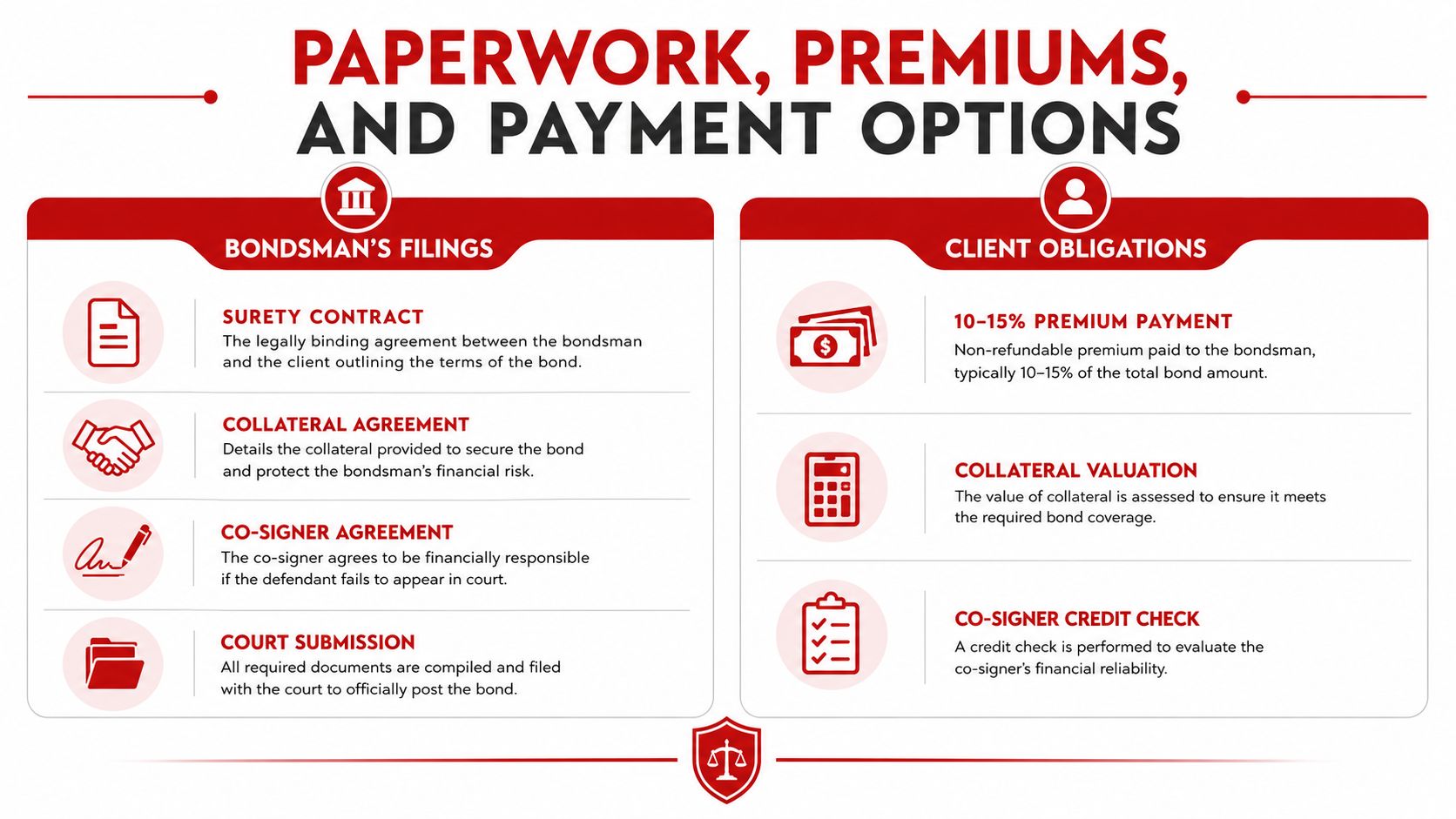
Once the release pathway is chosen, the paperwork becomes its own part of the process. A bond usually involves a surety contract, the agent’s filing with the jail, a co-signer agreement, and, where required, a collateral agreement. Each document assigns responsibilities, so a signer should understand what happens if the defendant misses court or violates the bond terms.
The regulated premium is only one part of the financial conversation. California’s common filed rate is 10% of the total bond amount, but families still need to ask how the premium will be paid, whether a payment plan is available, whether a co-signer is required, and how collateral will be valued and released. Those surrounding terms can differ even when the premium rate is governed by the same statewide rule.
What the agent and family each handle
The bondsman files the release documents. The agent prepares the surety paperwork, confirms the bond information, and submits the required materials to the jail or responsible office. The jail still has to accept the filing and place it into its release queue.
The co-signer accepts an obligation. The signer may be responsible for keeping the defendant informed about court dates, reporting changes in contact information, and responding if the defendant fails to comply. A co-signer should ask questions before signing, not after a missed appearance.
Collateral may apply. Larger or higher-risk bonds can require collateral. The agent and co-signer should document the asset, its value, the conditions for return, and the process for releasing it after the bond obligation ends.
Payment plans can address timing. A family may not have the entire premium available immediately. Ask directly about payment schedules and required initial funds. Never treat a verbal assumption as a contract term.
Before signing, gather:
- Government identification for the co-signer.
- The defendant’s booking and charge information.
- Proof of residence or contact information if requested.
- Employment or financial information relevant to the agreement.
- Ownership documents for any proposed collateral.
- A reliable phone number for court reminders and release updates.
Bada Bing Bail Bonds describes payment plans, co-signer options, collateral solutions, and court-compliance support as parts of its service. Families comparing bail bond payment options should ask for the complete financial terms in writing before authorizing a filing.
Release Windows, Pickup, and the Delays That Stretch Them
Ventura County’s jail orientation materials provide a concrete local expectation. Once an inmate enters release processing, the process is completed as soon as possible and practicable, and the person is generally released within 1 to 4 hours. The same materials state that, for safety reasons, ordinary releases don’t occur between midnight and 6:00 a.m., unless the person is bailing out or has a forthwith court release.
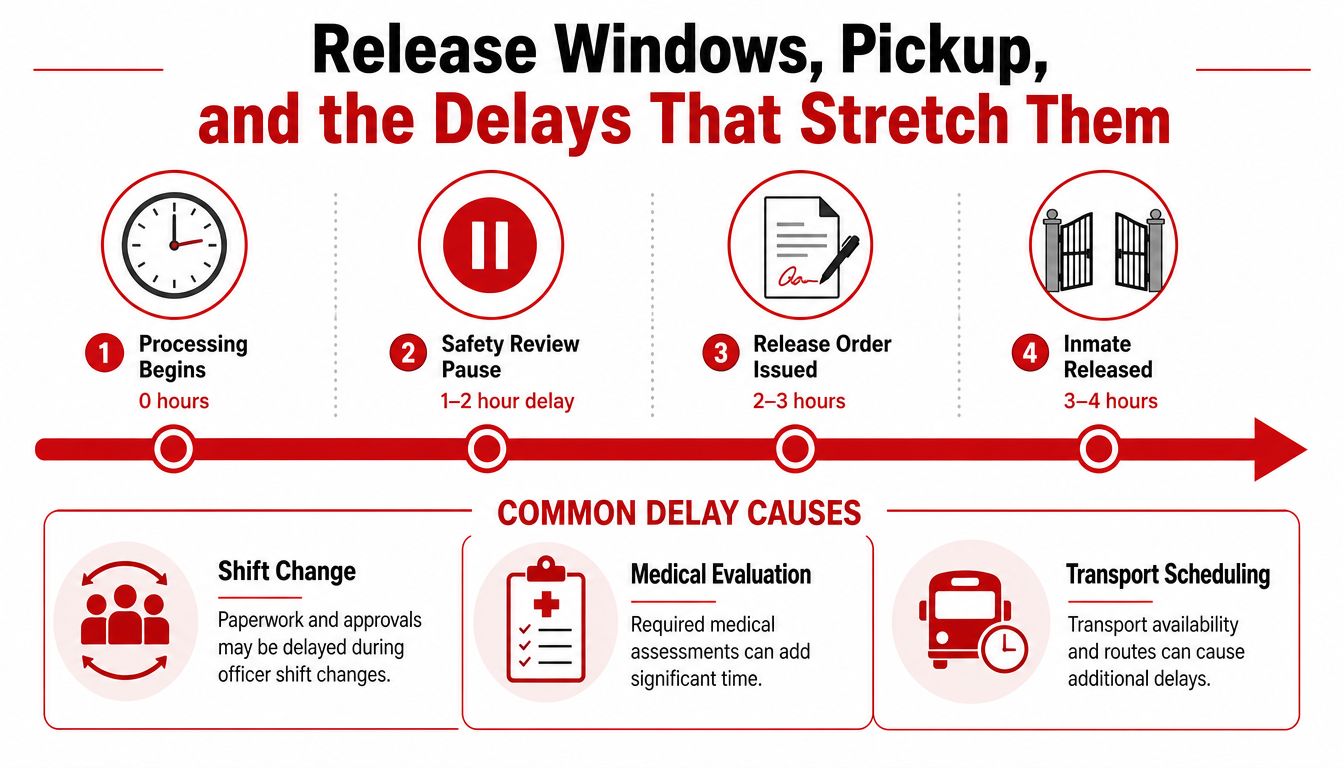
That rule explains why 24-hour bail bonds Ventura County searches can produce a different answer from a non-bail release request. Posting bail may activate a release pathway overnight, but the jail still has to complete its formal procedure. A court order, a bond acceptance, or an agent’s submission starts the process. It doesn’t bypass the checks that protect the jail from releasing the wrong person or releasing someone with another active hold.
Why approval doesn’t equal a walkout
The most common delay points are administrative:
- Identity verification: Staff must confirm that the person in custody matches the booking and release documents.
- Outstanding warrants or detainers: Another agency may have a reason to keep the person in custody.
- Medical review: A medical concern can require clearance or a change in release handling.
- Property and funds reconciliation: Jail staff may need to account for property before discharge.
- Victim notifications: Certain cases can involve required notifications or protective instructions.
- Court-to-jail paperwork: A release order or bond document has to reach the right staff member and be entered correctly.
National data shows why a local one-to-four-hour window shouldn’t be treated as a guaranteed stopwatch. The Bureau of Justice Statistics reports that people admitted to jails from July 1, 2021, through June 30, 2022, spent an average of 32 days in custody before release, compared with 23 days a decade earlier, as shown in its jail incarceration statistics. That broad average includes many kinds of custody and isn’t a Ventura County estimate, but it confirms that release timing can be measured in days when a case or facility develops complications.
A separate Bureau of Justice Statistics analysis found that, across large U.S. counties, about half of pretrial releases occurred within one day and roughly three-quarters within one week. It also reported that nonfinancial releases moved faster than financial releases, and that mean arrest-to-release time rose from 8 days for bail under $5,000 to 22 days for bail of $50,000 or more. See the BJS pretrial release timing report for the full context.
For a Ventura-specific explanation of the local release window, review how long release from Ventura County Jail can take. The practical response to a delay is to ask what stage is pending, whether another hold exists, and whether the jail has accepted the paperwork. Repeatedly asking for an exact minute rarely helps when the unresolved issue is a detainer or medical clearance.
Post-Release Compliance and the First 48 Hours
The person leaving Ventura County Jail may have nowhere to sleep, no transportation, limited money, missing identification, or medication waiting at home. A release plan that stops at the jail gate is incomplete. Reentry guidance identifies eight basic immediate needs: transportation, clothing and food, financial resources, identification and important documents, housing, employment and education, health care, and support systems. See the release planning guide for successful reentry for that framework.
Consider a representative Ventura County pickup. A relative arrives with a phone and clothing, but the released person has no ride to a safe address, no access to prescribed medication, and no written record of the next court date. In a DUI matter, transportation planning may be especially important if driving is restricted or an ignition interlock requirement applies. In a domestic violence case, the family must take protective orders and no-contact conditions seriously, even if everyone wants to resolve the conflict informally.
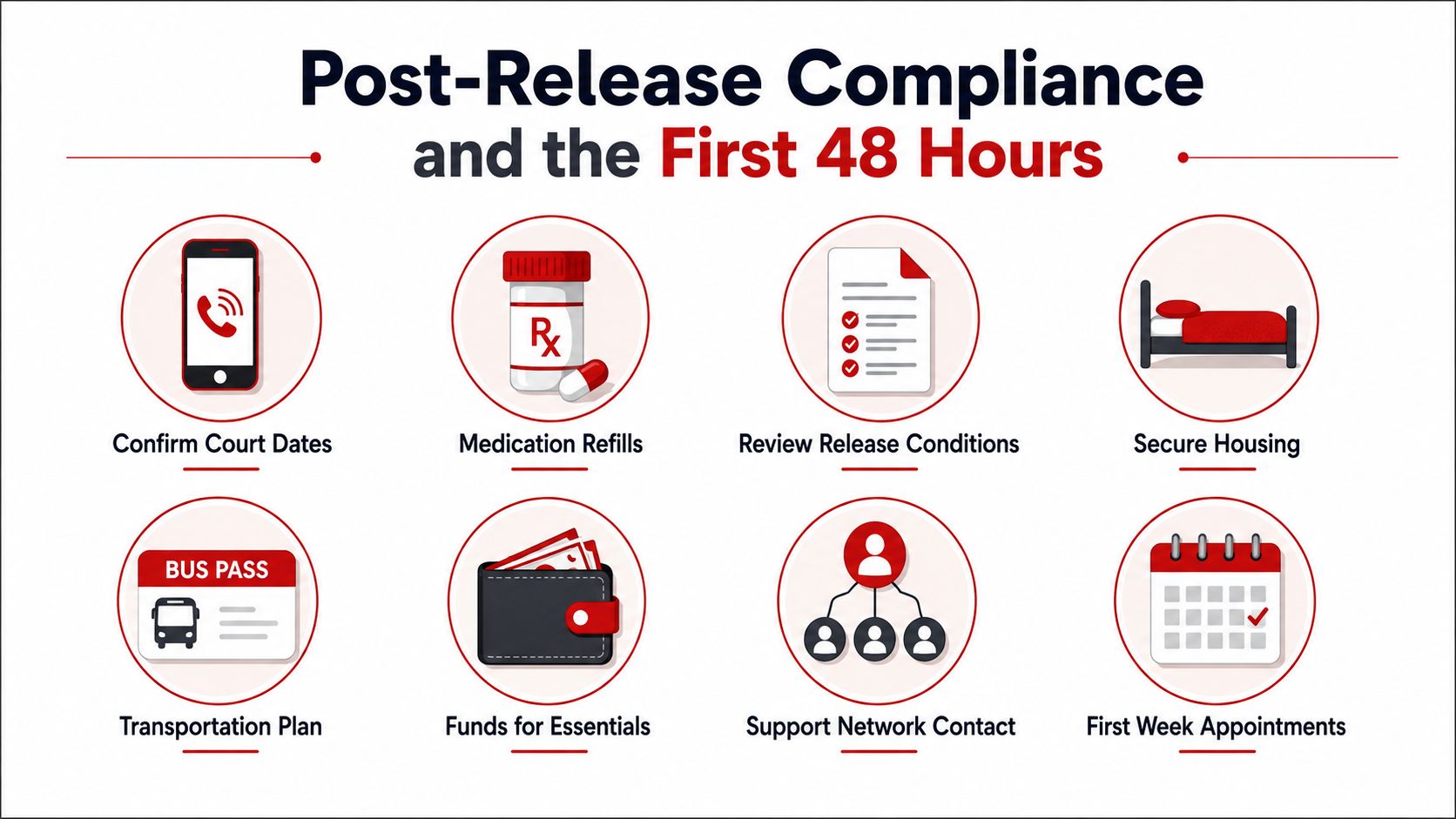
A practical first-48-hours checklist
- Confirm court dates: Save every date and set reminders.
- Review release conditions: Read the paperwork, including no-contact or travel restrictions.
- Arrange transportation: Plan the first trip home and any required appointment.
- Secure medication and health care: Identify prescriptions, refills, and urgent medical needs.
- Set up housing: Confirm a lawful, stable place to stay.
- Gather identification and documents: Protect release papers, identification, and court information.
- Provide essentials: Arrange food, clothing, phone access, and basic funds.
- Assign support: Choose one dependable person to track appointments and communication.
A bondsman may provide court-date reminders and agent check-ins, but those reminders don’t replace the defendant’s legal obligations or advice from counsel. Families should build the first two days around compliance, transportation, medication, housing, and documented conditions.
If someone has just been booked in Ventura, Oxnard, or elsewhere in the county, contact Bada Bing Bail Bonds for 24-hour booking verification, clear premium and payment information, and help moving the bond paperwork into the Ventura County Jail release process. Have the defendant’s full name, date of birth, facility, charges, and booking number ready so an agent can start with facts instead of guesswork.