

Your phone rings late, or you get a short text that makes your stomach drop. Someone you care about was arrested in Los Angeles County, and now you need answers fast. The first problem usually isn’t bail. It’s finding out where they are, whether they’ve been booked yet, and what the next move should be.
That panic is normal. Los Angeles County custody is a big, layered system, and a lot of families lose time because they search the wrong database, search too early, or assume a locator result means release is immediate. A practical inmate search Los Angeles County process has two parts: find the person correctly, then use that booking information to make smart release decisions.
Table of Contents
- The Urgent Search After an Arrest in Los Angeles
- How to Use the LASD Online Inmate Locator
- Alternative Search Methods When Online Fails
- Common Search Problems and How to Solve Them
- You Found Them in the System What Happens Now
- Securing Release with a Los Angeles Bail Bond
The Urgent Search After an Arrest in Los Angeles
You get a call late at night. Someone says your family member was taken by police, but no one can tell you where. The next hour usually goes the same way. People start guessing. They call the wrong jail, search the wrong database, or keep refreshing a locator that has not updated yet.
In Los Angeles County, that wastes time you may need for the next decision. The Los Angeles County Sheriff’s Department runs a large custody system, and Men’s Central Jail has a bed capacity of 5,640. In a system that size, small mistakes matter. A missing middle name, the wrong date of birth, or confusion about which agency made the arrest can send you in the wrong direction fast.

Start with the facts you can confirm right now. Get the person’s full legal name, date of birth, any middle name or alias, and the arresting agency if anyone knows it. If you have paperwork, a citation number, or a photo of the booking slip, keep it in front of you while you search.
First practical move: confirm identity details first, then check the official county records tool or call custody.
Families often lose time because they assume every arrest in the LA area shows up in one place right away. It does not always work that way. A person may be with a city agency first, in county custody later, or still waiting to be fully booked into the system. That gap is where panic usually takes over.
If you need a quick first-hours checklist, this guide offers a basic checklist for the first few hours after an arrest. For Los Angeles County, the search is only step one. The primary pressure starts after you find the record, because that is when families need to figure out bail, holds, release timing, and who to call next.
Why panic sends families in the wrong direction
Relatives and friends usually start with broad Google searches, social posts, or third-party inmate sites. Those tools can add confusion. Official custody systems usually need exact information, and booking status can change while you are still trying different spellings.
The better approach is simple. Stay with verified details, use official channels first, and keep notes as you go. Once the person appears in custody, the goal changes from finding them to figuring out the fastest realistic path to release.
How to Use the LASD Online Inmate Locator
The official locator is the first place to check when you’re doing an inmate search in Los Angeles County. Use it like a records tool, not like a search engine. The more exact you are, the better your odds of getting a clean result.
What to gather before you search
The LASD locator requires last name, first name, and date of birth, and for LAPD or LA County custody phone inquiries the public can also call 213-473-6100, according to the LASD custody population report. That same report notes an average daily population above 12,700 in early 2025, which is one reason exact search inputs matter.
Before you type anything, gather this:
| Information Needed | Why It’s Important |
|---|---|
| Full last name | This is the main search anchor and helps narrow records quickly. |
| Full first name | A partial or nickname can miss the booking. |
| Middle name, if known | It helps separate people with similar names. |
| Date of birth | This is one of the best ways to avoid matching the wrong person. |
| Arresting agency, if known | It helps you tell whether you should also check a city custody channel. |
| Any known alias | Some people are booked under alternate names or prior identifiers. |
How to run the search without wasting time
Start with the person’s full legal name and date of birth. If you know the middle name, use it. If the first search comes back empty, don’t panic yet. Double-check spelling first, then try common variations.
A practical order looks like this:
- Use the full legal name first. That’s the cleanest search.
- Add the date of birth carefully. One wrong digit can wipe out the result.
- Try the middle name if you have it. This helps with duplicate surnames.
- Check for alias issues. If the person commonly uses another first name, that may matter.
- Keep notes. Write down any booking number, facility, and custody status you find.
If the system returns a result, save the exact spelling and booking details exactly as shown. That information becomes your working file for every call after that.
Another point families miss is that the county’s online tool isn’t just a name lookup. County guidance has noted the system can search detailed booking-related fields, including clothing or property disposition, which tells you this is an operational database, not a simple public roster.
What works and what doesn’t
What works:
- Using complete information
- Checking dates of birth twice
- Searching calmly and documenting the result
- Calling when the online result seems incomplete
What doesn’t:
- Repeatedly searching every few minutes with the same bad spelling
- Assuming no result means no custody
- Relying on unofficial jail lookup websites
- Treating a search hit as proof the person can walk out immediately
If the online search gives you a booking record, you’ve cleared the first hurdle. You now know the person is in the system. That still leaves the practical questions families care about: where they are, whether bail applies, and what has to happen before release.
Alternative Search Methods When Online Fails
When the online locator doesn’t return anything, you don’t stop. You switch methods. In real cases, that’s often the difference between getting answers tonight and waiting until morning while stress gets worse.
What to do on the phone
For LA County and LAPD custody questions, call 213-473-6100. Keep the conversation tight. The person answering needs identifying information, not a long backstory.
Have this ready before you call:
- Full legal name as it appears on ID
- Date of birth
- Possible arrest location
- Arresting agency, if known
- Approximate time of arrest
Ask direct questions:
- Is this person in custody?
- If so, what facility are they in?
- Has the booking been completed?
- Is there a booking number available?
- If county custody isn’t confirmed, should I check a city jail or another agency?
A phone call is often the fastest way to clear up misspellings, recent bookings, and confusion about whether the person is still at a local station or already transferred.
The advantage of calling is that you can test assumptions in real time. If the operator doesn’t find the person, ask whether the arrest may still be in local processing or too recent to appear.
When showing up in person helps
Going in person can help in limited situations, but it’s not usually the first move. It takes time, parking can be a mess, public access may be limited, and some station windows don’t give you more information than a phone operator would.
Still, it can make sense when:
- You know the exact station involved
- Phone lines are jammed
- You need to confirm local custody before county transfer
- You need facility-specific instructions
If you’re trying to figure out which agency or station to contact first, a regional law enforcement contact reference can help you organize the calls instead of guessing.
The main trade-off is simple. Online is faster when the record is already in place. Phone is better when the data is messy. In-person can help when you already know the likely location and need direct confirmation.
Common Search Problems and How to Solve Them
The most common mistake in an inmate search Los Angeles County case is assuming the system is wrong when timing is the issue. Families search right after arrest, see nothing, and think the person vanished into the system.
The record may not be searchable yet
LASD states that inmate records are often not available for bookings made within the last 2 hours on the LASD inmate information application. That short delay causes a lot of unnecessary panic.
If the arrest was recent, the best move may be to wait a bit and then search again with the same verified identity details. Don’t keep changing the spelling every time unless you have a reason.
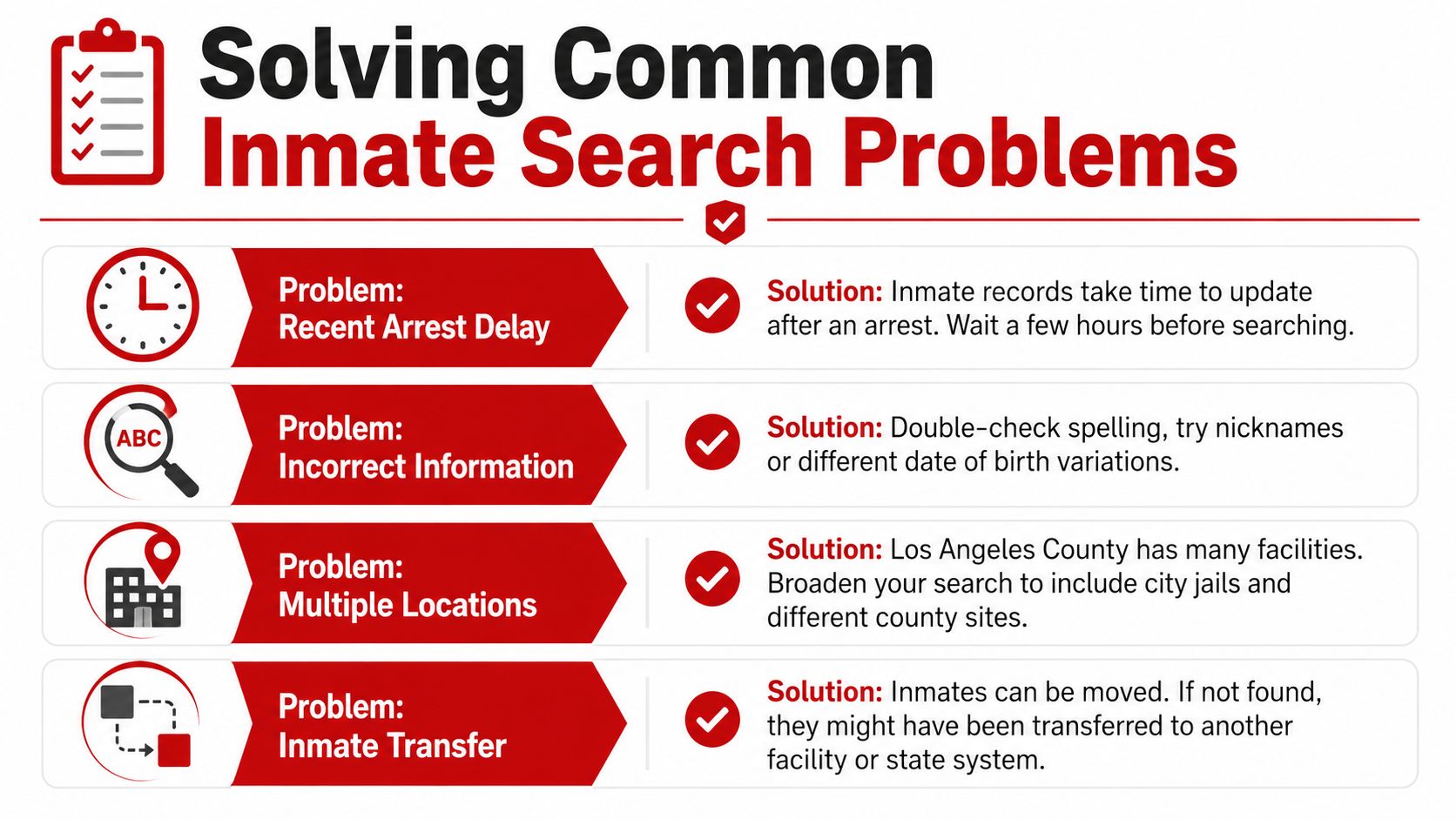
A practical troubleshooting checklist:
- Recent arrest: Wait, then rerun the search with the same legal name and date of birth.
- No exact DOB available: Get it from a family member or ID record before trying again.
- Possible local hold: Call to see whether the person is still at a city station.
- Possible transfer: Ask whether the person has moved from initial intake to another facility.
Fixing bad search inputs and custody mix-ups
The next big problem is bad data. People type a nickname, leave out a middle name, reverse the birth month and day, or use a married name when the booking used another legal name. Small errors kill searches.
Try this sequence if you’re stuck:
- Search with the exact legal name on ID.
- If that fails, verify the date of birth from a reliable source.
- Then test known aliases or alternate spellings.
- If the arrest happened under a city police agency, confirm whether the person is still in city custody or already moved.
A second source of confusion is the type of hold involved. Families hear “they’ve got a warrant” and assume all warrants work the same way. They don’t. This breakdown of bench, Ramey, and arrest warrants is useful if you’re trying to understand why a person may have been picked up and why release timing may not be straightforward.
Search problems usually come from one of four things: the booking is too recent, the identity data is wrong, the person is in a different custody channel, or the person has already been moved.
Don’t read too much into one failed result. Failed searches are common. The fix is usually procedural, not mysterious.
You Found Them in the System What Happens Now
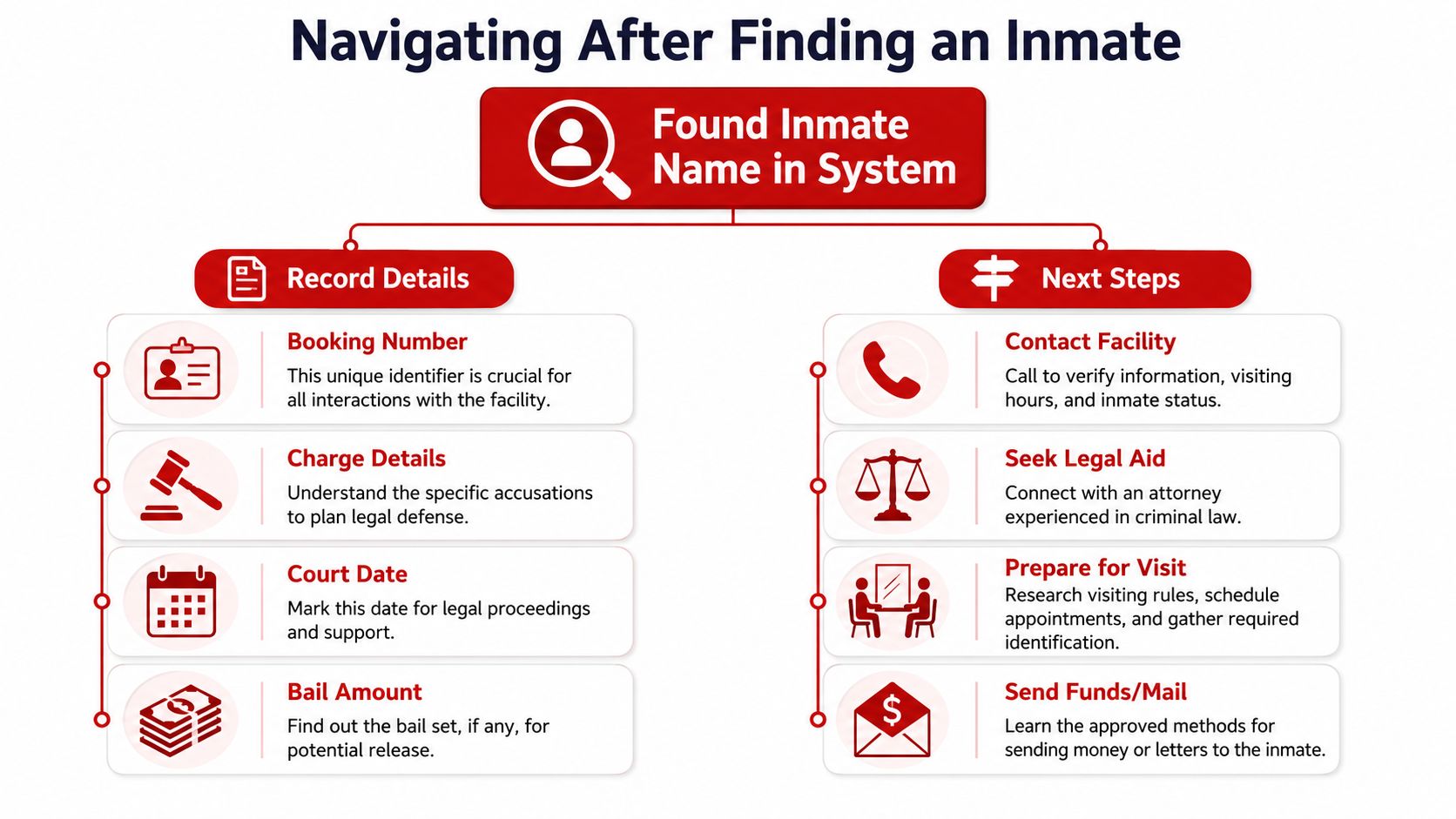
This is the moment where families often feel relief, then get confused again. You found the name. Good. But the locator result is only a snapshot. It tells you the person is in custody. It doesn’t answer every release question.
What the result actually tells you
The first item to keep is the booking number. That becomes the reference number for calls, jail communication, and bail work. If you don’t write down anything else, write down that.
The facility matters just as much. Release logistics depend on where the person is housed or processed. One location may have a different intake flow, different release timing, or different public access limits than another.
You’ll usually also see charge-related information or custody status. Treat that as a starting point. It gives you direction, but it isn’t the same as a full legal review of the case.
What can still slow release down
A lot of families think the hard part is over once the locator shows the person. That’s the biggest misconception. The official LASD guidance makes clear that locator tools confirm custody but don’t guarantee bail eligibility or immediate processing, which depends on the charge, court clearances, and the facility’s release window on the LASD official site.
That means any of these can affect what happens next:
- The charge may not be immediately bailable
- A court appearance may be pending
- Another hold may exist
- The facility may still be processing the booking
- Release staff may need more time even after bond is posted
Finding the person online means, “They are in custody.” It does not mean, “You can pick them up now.”
Families also need to avoid one expensive misunderstanding. A listed charge or facility doesn’t tell you the full release path by itself. You still need to confirm whether bail is set, whether there are holds, and where the bond must be posted.
If you’re trying to make sense of the basic release side, this explanation of how bail works in Ventura County is county-specific but still useful for understanding the general flow from booking to release. The LA County mechanics differ by facility, but the core question is the same: can this person be released now, and if so, what has to happen first?
Securing Release with a Los Angeles Bail Bond
A lot of calls change tone at this point. The first few minutes are about finding the person. The next question is the one that matters most to the family. How do we get them released?
In California, a licensed bail bond premium is generally 10% of the total bail amount. That gives you a starting point for cost, but price is only one part of the decision. A key consideration is whether bail is active, which facility will accept the bond, and whether anything in the booking is going to delay release after the paperwork is filed.
A bail bond helps when bail has been set and the family does not want, or is not able, to post the full amount directly with the jail. At that stage, the right agent should do more than quote a number. They should verify the booking, confirm the bail amount, explain the co-signer’s responsibility, and tell you plainly if a hold or court issue could stop an immediate release.
That last part matters. Families often hear “bail is set” and assume pickup will happen a few hours later. Sometimes it does. Sometimes it does not. As noted earlier, release planning in Los Angeles County can involve more moving parts than people expect, especially when medical, mental health, classification, or transfer issues affect processing.
If you are comparing options, Los Angeles County bail bond services should be judged on clear answers, not sales language. Ask direct questions:
- Is bail posted at the current facility or through another location?
- Has the jail confirmed the bail amount and booking number?
- Are there any holds, warrants, or court restrictions showing on the file?
- What does the co-signer need to provide tonight?
- What is a realistic release window based on this facility?
Those answers tell you whether you are dealing with someone who handles the process or someone who is just reading a rate sheet.
Bada Bing Bail Bonds states it verifies booking details, explains charges and bail schedules in plain English, and works with payment plans and co-signers where appropriate. No matter which agency you call, the goal is the same. Get accurate information, sign the right paperwork, and start the release process without losing hours to confusion.
If you need help right now, Bada Bing Bail Bonds is available 24/7 to verify booking details, explain the next step in plain English, and help you move from a Los Angeles County inmate search to an actual release plan.