It’s 2 a.m., the phone rings, and somebody you care about is sitting at the Irvine Police Department jail trying to get out. The kids are asleep, nobody’s thinking straight, and the first mistake is usually the same, people freeze, then waste time guessing instead of acting. Irvine bail bonds work best when the family treats the first call like a checklist, not a crisis.
A bail bond is not a shortcut around the case. It’s a financial guarantee that gets the court paid if the defendant doesn’t show, and in California the standard premium is usually 10% of the bail amount, which is why families often need a co-signer, payment plan, or collateral when bail is set high (California Department of Insurance). If you’re dealing with Irvine, the money question is only half the story, the other half is the local booking process and the release conditions attached to the arrest.
Table of Contents
- What Happens When Someone You Love Is Arrested in Irvine
- The First Hour After an Arrest
- How California Bail Costs Actually Work
- From the First Call to the Release Window
- Why DUI and Domestic Violence Cases Are Different
- Irvine Jail Logistics and the Pickup Moment
- After Release and Frequently Asked Questions
What Happens When Someone You Love Is Arrested in Irvine
The first move is plain, find out where the person is, what they were booked for, and whether bail is already set. Irvine uses a centralized local booking setup, and the city’s police department maintains a Crime Analysis and Real Time Crime Center; the jail and police facility sit at 1 Civic Center Plaza, Irvine, CA 92606-5207, with the main line at 949-724-7000. That matters because the first hour gets wasted fast if you are guessing about whether the person is still in Irvine or has already been moved elsewhere.
Bail, bond, premium, and booking
Bail is the amount the court says must be secured. A bond is what a licensed bail agent posts with the court. The premium is the fee the family pays for that service, and booking is the jail’s intake process, fingerprints, photos, property log, all of it.
Practical rule: If the call comes from jail, start with the booking details, not opinions about the case. Paperwork moves faster when you have facts, not panic.
Most California families cannot just walk in and pay the full bail amount in cash. The number is often too large for a household to cover on the spot, and that is the primary reason people call for help. The guide to finding someone arrested is useful here because the first step is always the same, confirm custody, then confirm the booking details.
A bond turns a huge upfront cash problem into a release process the family can manage. It does not erase the case, and it does not cancel release conditions, but it gets the person moving toward home instead of sitting in a cell while everyone scrambles.
The practical choice is cash or bond. Cash only works cleanly when the full amount is available right now and the family is comfortable tying up that money. Bond fits the situations where speed matters more than cash efficiency, which is most late-night arrests.
That also means you should expect the release process to depend on more than payment. If there is a no-contact order, a SCRAM condition, or a protective order issue, posting bail does not finish the job. Those conditions can hold release up even after the bond is in place.
The First Hour After an Arrest
The first hour decides whether release is smooth or messy. If you’ve got a live call from the jail, your job is to confirm the facts, catch the holds, and avoid saying anything that creates confusion later. Don’t give legal advice over the phone. Don’t promise what the court will do. Just collect the right information and keep it moving.
What to get from the person calling
You need the full legal name, date of birth, the booking number if they have it, and the exact charge or charges. If the person knows whether there’s a warrant, probation issue, or out-of-county hold, write that down too. Those details can change the release path fast.
The safest move is to verify that the person is at the Irvine facility and not somewhere else in the Orange County system. Arrests can move between holding locations, and a local bondsman who understands the booking workflow can save you from chasing the wrong door.
If you’re comparing cash versus bond, think in plain terms. Cash makes sense only if the full amount is available right now and the family understands the risk of tying up that money. A bond makes more sense when speed matters more than cash efficiency, which is most of the time in a late-night arrest.
If the call comes after hours, the question isn’t “Should we wait until morning?” The question is “Who can verify custody and start paperwork now?”
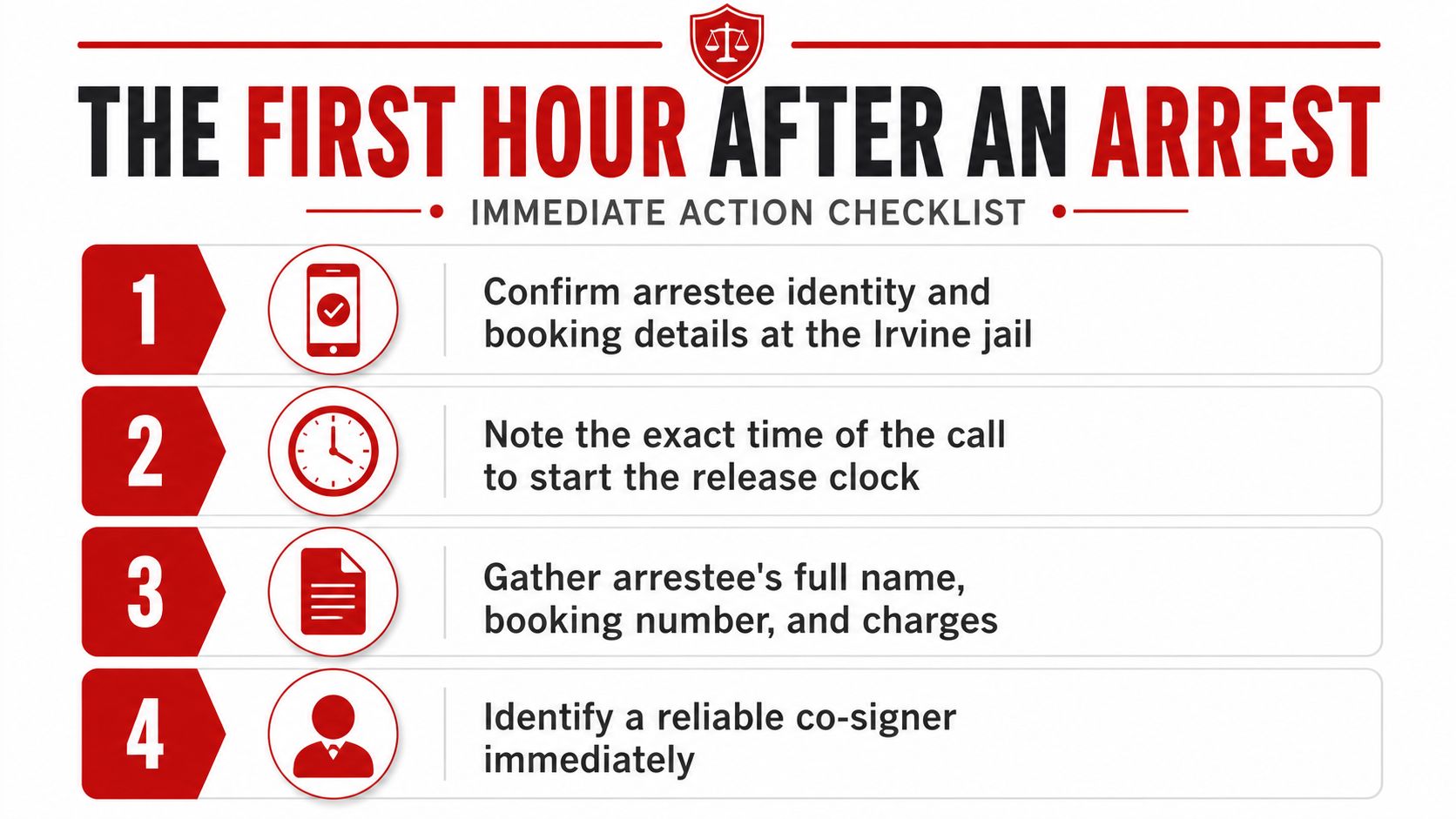
The first hour checklist should stay boring and disciplined. Confirm the booking details, note the time of the call, gather the identity information, and identify a reliable co-signer immediately. If you do those four things fast, you’ve already cut out most of the mistakes that slow families down.
A release decision also needs a quick financial reality check. A calm family can usually tell in minutes whether posting cash at the jail is realistic or whether a licensed agent is the only practical path. That decision should be made once, clearly, and then executed without second-guessing.
What happens after arrest guide
How California Bail Costs Actually Work
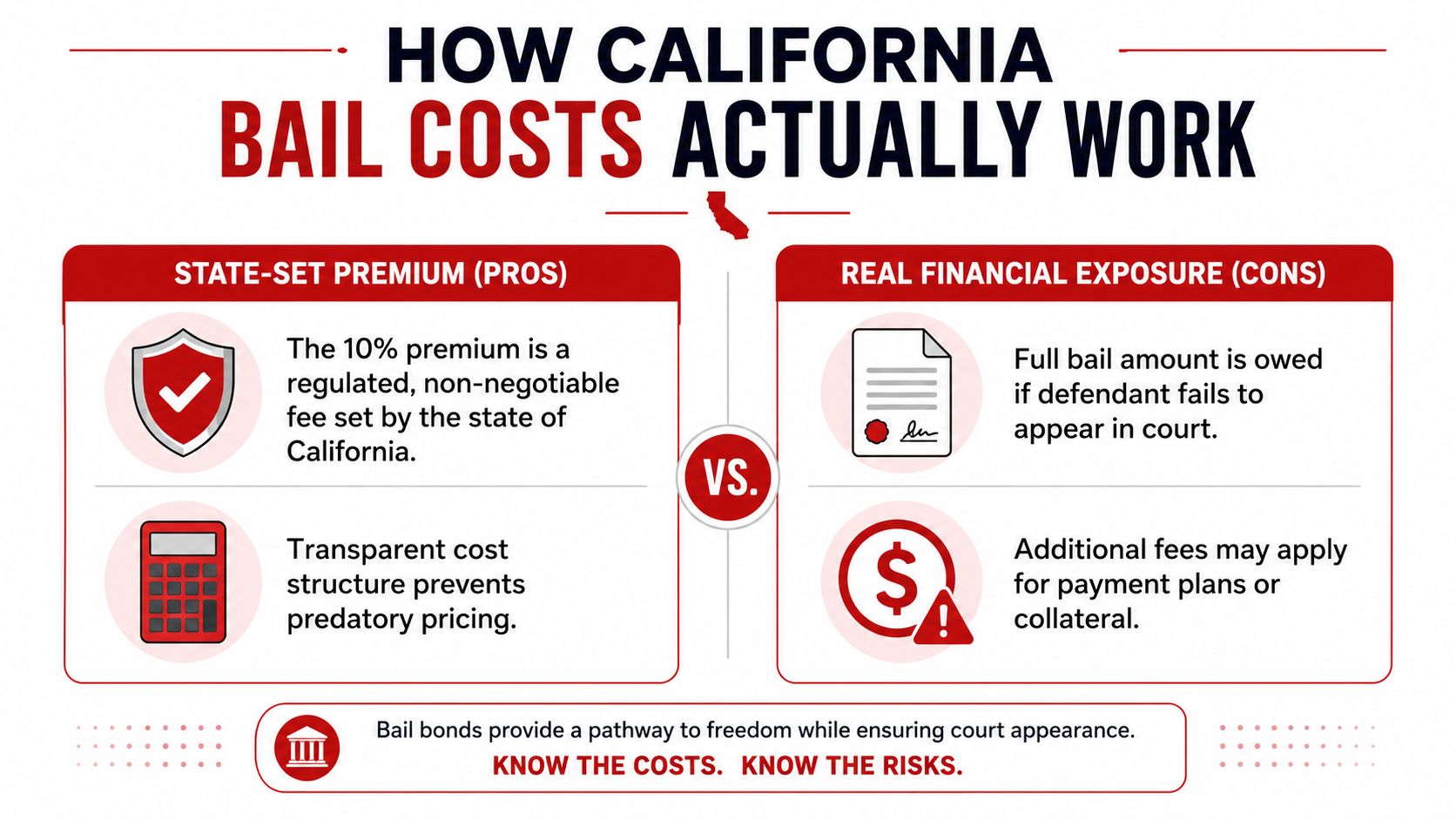
California bail has two numbers that matter. One is the court’s bail amount. The other is what the family pays to get the bond posted, which is usually the nonrefundable premium, plus any financing or collateral the agent requires.
The premium is the fee, not the full risk
California’s standard bail bond premium is 10% of the total bail, and that premium is nonrefundable even if the case later gets dismissed or the defendant is found not guilty (California Department of Insurance). Families need to be clear on that before they sign. The premium buys the surety service. It is not money that comes back later.
A policy analysis from the UCLA report also points out that payment plans can carry interest rates as high as 30% in some California contexts, and higher-risk bonds can still require collateral. That is where families get surprised. A low down payment can still leave them exposed to a larger total obligation if they do not read the paperwork.
The three payment paths
Most families end up in one of three lanes. They pay the full premium now. They use a payment plan. Or they pledge collateral.
- Full premium upfront: Cleanest option, least complicated, and easiest to keep track of.
- Payment plan: Useful when cash is tight, but the total cost can rise once financing is added.
- Collateral-backed bond: Common when the bond is larger or the risk profile is higher.
Property collateral follows a different rule. Under California guidance, property used as collateral must be worth twice the bail amount to secure the release, which is a much heavier commitment than a standard surety bond. If the defendant misses court, the bond can be forfeited and the collateral can be used to cover the obligation.
Bottom line: Stop focusing on the first number the agent quotes. Focus on what the co-signer could lose if the case goes sideways, because that is the number that actually matters.
For a clear cost conversation, start with the premium, then ask about payment terms, then ask whether collateral is required. If you want a plain-English breakdown of how those charges add up, start with how bail bond costs are calculated. That order matters. Families get burned when they focus on monthly comfort first and ignore the total exposure.
From the First Call to the Release Window
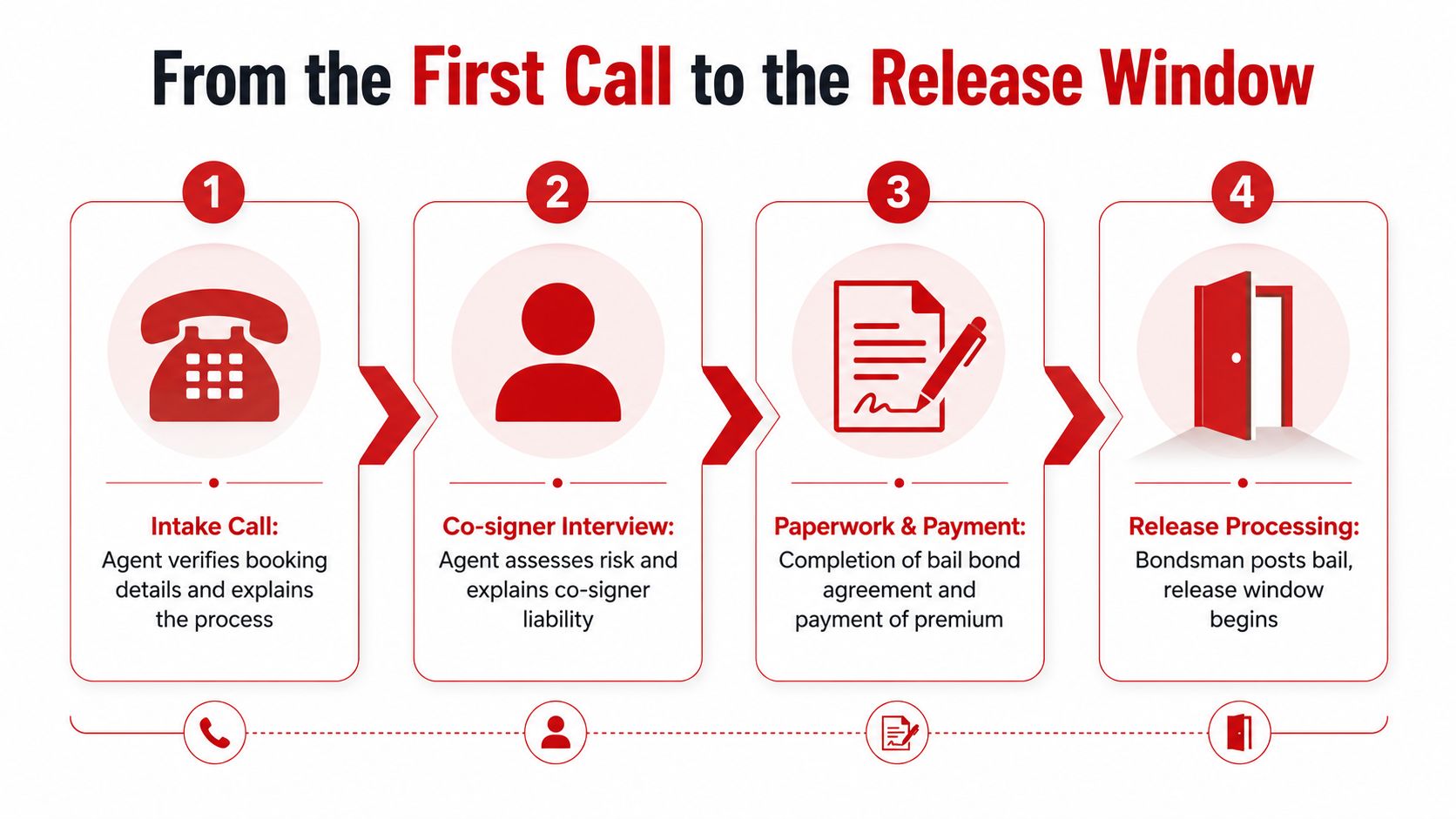
The release clock starts with a clean intake call. If the family is ready to use a bondsman, the first job is to sort out the booking details, the charge, the co-signer, and the payment method before anyone starts guessing about timing. A messy call leads to a slow release.
What the agent should ask
A serious agent wants the arrestee’s name, date of birth, booking information, and the jail location. The co-signer usually needs to show ID and proof of residence, and they will be asked to sign the indemnity agreement that spells out their responsibility. That is the legal structure that lets the bond get posted.
The agency then works with the facility and posts the bond once the paperwork is complete. Local jail knowledge matters in Irvine because release depends on the facility’s own booking and processing workflow, not on a generic public search tool. If the agent does not know how the jail handles release paperwork, the clock starts drifting.
The primary goal is simple. Get the documents signed, get the bond posted, and get the person into the release queue. A licensed 24/7 agency matters because arrests do not happen on a polite schedule.
Release still takes time after the bond is posted. Families should expect a wait while the jail finishes its process, and how long release takes after posting bond depends on the file, the facility, and any extra checks attached to the case.
What to ask before you sign: Who is the co-signer? What documents do you need tonight? What could delay release after the bond is posted?
Why DUI and Domestic Violence Cases Are Different
Some cases stall after the bond is posted because money isn’t the only issue. The court can attach release conditions that need to be satisfied before the jail will let the person go. That’s where families get surprised.
DUI cases can carry equipment and monitoring issues
A DUI arrest can bring extra release conditions if there are priors, injury allegations, refusal issues, or other aggravating facts. In practice, the problem is often not the premium, it’s whether the person has to comply with alcohol monitoring or related restrictions before release. If SCRAM, ignition interlock, or similar conditions are part of the order, the bond may be approved while release still waits on compliance steps.
That’s why an experienced bondsman doesn’t just ask, “Can you pay?” The central question is, “Can the jail clear the release conditions today?” When those conditions are in play, the bond is only one piece of the file.
Domestic violence cases add no-contact limits
Domestic violence cases bring a different kind of friction. Protective orders and no-contact terms don’t disappear because a bond was posted. If the alleged victim and the defendant live together or share a household, the release plan has to respect those orders immediately.
The safest approach is simple. Separate the money issue from the contact issue. A bond can secure release, but it doesn’t authorize contact, and it doesn’t cancel court restrictions. Families who ignore that point create fresh problems before the first court date even arrives.
A bond gets someone out. It does not rewrite the rules attached to the case.
A calm, local agent helps. The jail still controls the release window, but the agent can push through the paperwork while the family figures out where the defendant can legally go and who they can legally call. That’s the practical difference between a bond that gets posted and a release that happens.
Irvine Jail Logistics and the Pickup Moment
The Irvine Police Department facility at 1 Civic Center Plaza, Irvine, CA 92606-5207 is where the pickup plan starts. Bring valid ID for the person picking up, the release paperwork, and any proof of address the facility or agent asks for. If you show up without those basics, you can sit outside and burn time for nothing.
What families should expect outside the facility
Park with the expectation that you may wait. Stay close, stay reachable, and keep the phone on, because the handoff still takes time after the release is approved. Shift changes, workload, and simple processing delays can slow things down even when the bond side is already handled.
If the person was moved out of Irvine and landed at a larger Orange County facility, the pickup path changes right away. Verify the location first, then follow that jail’s release procedure instead of guessing.
The release window gets messier when families assume every jail works the same way. It doesn’t.
Assign one person to the phone and one person to the pickup. Too many people trying to help usually creates confusion, and confusion wastes time at the door.
The release paper trail also matters after the person is home. If collateral was used, families should keep records and know how the return process works. For a plain explanation, review the bail money return guide.
After Release and Frequently Asked Questions
The hard part does not end at release. The defendant still has to make every court date, follow no-contact orders, obey protective orders, and stay in touch with the bail agent if check-ins are part of the agreement. If they miss court, the bond can be forfeited, and the co-signer can be stuck with the financial hit.
Post-release checklist
- Calendar every court date: Miss one, and the warrant risk shows up fast.
- Follow all release conditions: No-contact, alcohol monitoring, classes, or any other order the court imposed.
- Stay reachable: The bondsman may need updates if the case runs long.
- Keep collateral records: Families should know what was pledged and what gets returned, if anything was pledged at all.
Collateral is a separate issue from the premium. If property or cash was used to secure the bond, keep every receipt and agreement in one place, because that paperwork controls what gets released later. For a plain explanation of how that return process works, review the bail money return guide. The defendant can be home while the refund or collateral return is still being processed in the background.
Fast answers to the questions families ask most
Is the premium refundable? No. In California, the premium is the fee for posting the bond, and it is generally nonrefundable even if the case ends later in the defendant’s favor. The fee is paid for the release service itself, while collateral, if any was used, follows a separate return process after the case is resolved (California Department of Insurance).
How long does release take at Irvine? It depends on the facility workload and whether the release conditions are clean. If there are hold-ups tied to booking, paperwork, or extra checks on the file, the handoff slows down, so direct verification early saves time.
What happens if the defendant misses court? The bond can be forfeited, a warrant can be issued, and the co-signer can be left carrying the financial exposure.
Can a bondsman help if the case gets transferred out of Orange County? Yes, but the process changes with the facility. That is why you want an agency that stays on the file after the bond is posted, not one that disappears once payment clears.
If you need Irvine bail bonds handled tonight, call a licensed 24/7 agency that will verify custody, explain the premium in plain English, and move the paperwork without drama. Bada Bing Bail Bonds can handle the booking details, the co-signer paperwork, and the release coordination, so you are not stuck trying to decode jail rules while the clock keeps running.