
No. If your family member is being held under Welfare and Institutions Code §5150, you cannot post bail to get them out. A 5150 hold is a civil, medical detention, not a criminal arrest, so there’s no bail schedule and no bond to pay. Bail only becomes part of the picture if separate criminal charges are filed against the person, which can happen if the events leading to the hold also involved police contact for a crime.
If that’s your situation right now, here’s what to do in the next hour:
- Call the facility and ask for the patients’ rights advocate assigned to the unit.
- Write down your loved one’s current medications, dosages, and psychiatric history to hand over to the treating clinician.
- Pick one family member as the single point of contact so staff aren’t fielding calls from five relatives at once.
- Ask directly: “Has my family member been arrested or booked, or is this strictly a mental health hold?” The answer changes everything about what happens next.
Key Takeaways
Bail never applies to a civil 5150 hold; it only becomes relevant when separate criminal charges and a jail booking are also in play.
| Point | Details |
|---|---|
| No bail during a 5150 | A 5150 is civil detention, not arrest, so there’s no bail schedule to post against. |
| Clinical staff control release | Only treating clinicians decide when a 5150 hold ends, not family payment or pressure. |
| Bail applies with criminal charges | If booking and criminal charges occur alongside a hold, a bail bond becomes relevant. |
| Advocate early and in writing | Contact the patients’ rights advocate immediately and log every conversation with staff. |
| Confirm discharge plan details | Verify filled prescriptions, a scheduled follow-up appointment, and transportation before release. |
| Call Bada Bing Bail for criminal bail | Badabingbail offers 24/7, licensed bail bond help across Ventura, Santa Barbara, and Orange Counties when criminal charges apply. |
Table of Contents
- What a Mental Health Hold Bail Question Actually Involves
- Why You Can’t “Check Someone Out” of a 5150
- What Families Should Do During the 72-Hour Window
- When Bail Actually Enters the Picture
- Hearings and Rights That Protect Your Loved One
- Getting Discharge Planning Right Before Release
- When Criminal Bail Becomes Necessary: What Bada Bing Bail Bonds Handles
- Why the Two-System Confusion Trips Up Even Careful Families
- Get Fast, Local Help if Criminal Bail Becomes Part of Your Case
- Sources
What a Mental Health Hold Bail Question Actually Involves
The phrase “mental health hold bail” trips people up because it mixes two systems that don’t overlap the way most people assume. A 5150 hold allows a peace officer, clinician, or designated county worker to detain someone for a limited period if a mental disorder makes them a danger to themselves, a danger to others, or unable to care for their own basic needs. That’s the entire legal standard: danger to self, danger to others, or “gravely disabled.” No crime has to occur.
During those 72 hours, one of several things happens:
- The person stabilizes and staff determine they no longer meet the criteria, so they’re released, sometimes well before the 72-hour mark ends.
- They agree to stay voluntarily for continued treatment.
- The facility files a 5250 certification for up to 14 additional days of intensive treatment because the danger criteria still apply.
- In rarer cases, staff refer the situation toward a conservatorship evaluation if the person can’t function safely long-term.
The 72-hour clock is a ceiling, not a promise. Some patients are discharged in a day. Others get held the full window while doctors adjust medication or wait for a bed at a psychiatric facility, and that variability is exactly why families should stay in close contact with the treatment team rather than assuming a fixed release date.
Why You Can’t “Check Someone Out” of a 5150
Clinical staff, not family, decide when a 5150 hold ends. Paying money doesn’t factor into that decision at all, because there’s no bail bond product tied to a civil hold. The Disability Rights California guide to the LPS Act confirms this is by design: a 5150 is explicitly not a criminal arrest, so the due process protections and release mechanisms look completely different from the county jail system.
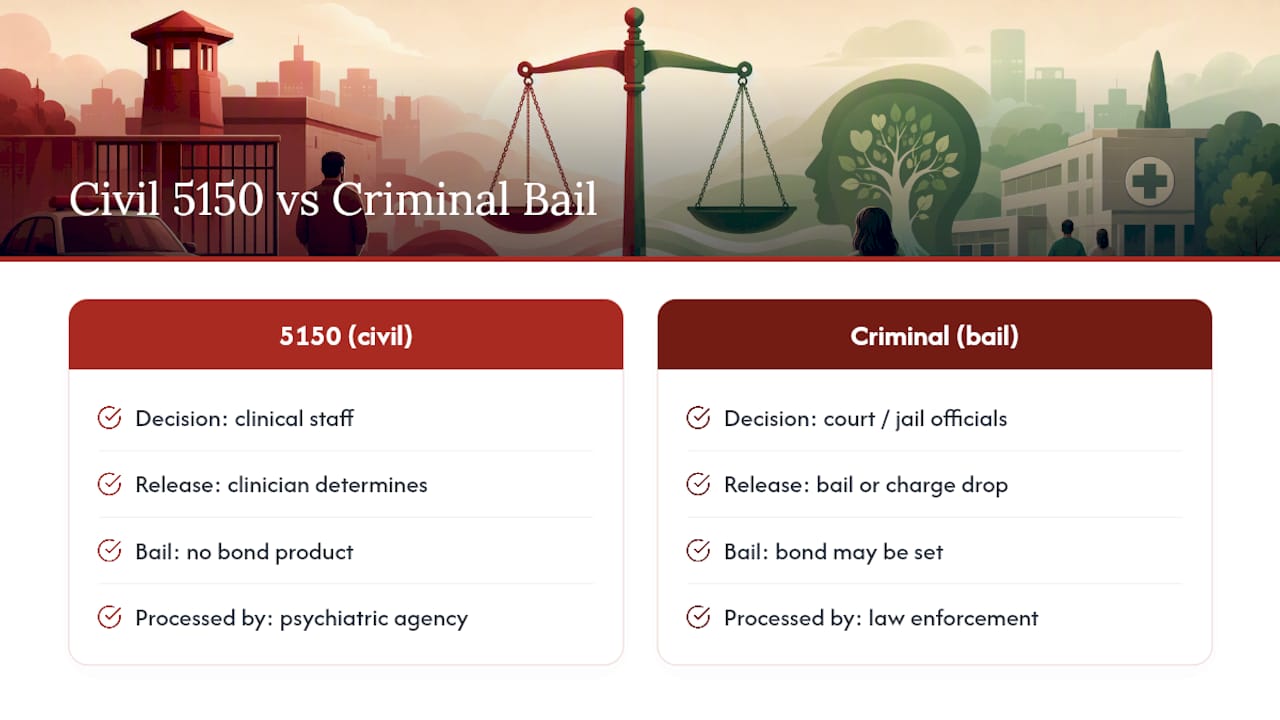
That changes the moment criminal charges enter the picture. If your family member was arrested for something like assault, vandalism, or a DUI before or during the mental health crisis, they may get booked into county jail separately from any psychiatric hold. That’s when a bail schedule applies and a bond becomes relevant.
Questions worth asking facility staff directly include whether the hold is solely a 5150 civil hold or if there are also criminal charges, which agency processed the 5150 form, and who the treating psychiatrist is along with when communication is possible.
Don’t assume silence means good news. Ask, and ask again if you don’t get a straight answer.
What Families Should Do During the 72-Hour Window
Advocacy during a hold works best when it’s organized, not frantic. Here’s a sequence that actually moves things forward:
- Contact the patients’ rights advocate at the county behavioral health department the same day. Every LPS-designated facility has one, and their job is specifically to explain rights, relay concerns to clinical staff, and flag procedural problems.
- Ask for the certification review hearing calendar if staff mention a 5250 filing. That hearing has to happen within four days of certification, and knowing the date lets you plan around it.
- Assemble a written history: current medications, past diagnoses, outpatient providers, and any recent stressors. Clinicians make faster, safer decisions with this in hand, and the Treatment Specialist’s family guide lists this as the single highest-leverage thing families can do.
- Designate one point of contact for the treatment team, and give staff that person’s name and number up front.
- Advocate calmly and in writing. Ask who the treating clinician is, when rounds happen, and request that key updates get noted in the chart.
- Call an attorney or mental health advocate if a 5250 is filed or criminal charges surface. These are the two triggers that change your options substantially.
Pro Tip: Keep a simple log: date, time, staff name, role, and what was discussed. Bring copies to any hearing or care team meeting. Facilities move fast, and a written record protects your loved one when memories get fuzzy under stress.
When Bail Actually Enters the Picture
Two scenarios show how differently these tracks run.
- Scenario A, hold only: Someone is detained under 5150 after a mental health crisis with no criminal conduct involved. They’re either released after evaluation or moved to a 5250. Bail never comes up because there’s no criminal case attached.
- Scenario B, arrest plus hold: Someone is arrested for a crime, booked into county jail, and also evaluated for a mental health hold, sometimes concurrently at a jail medical unit. Here, the criminal case triggers a bail schedule, and a bail bond can be posted against those charges even while mental health treatment continues.
Booking and transfer logistics between jail and county behavioral health can be slow, and notification to family sometimes lags behind what’s actually happening. If you haven’t heard from law enforcement or the jail directly, call the county sheriff’s inmate locator line yourself rather than waiting.
Hearings and Rights That Protect Your Loved One
A handful of procedural safeguards matter more than most families realize going in.
- Certification review hearing: If a 5250 is filed, the hospital has to justify the extended hold at a hearing within four days. The burden sits with the facility, not the patient, to prove continued danger.
- Habeas corpus: Patients (or someone on their behalf) can petition a court to review the legality of detention, though this remedy has real limits during the initial 72 hours since the clock usually runs out before a hearing gets scheduled.
- Riese hearing: This is a separate process specifically about the right to refuse psychiatric medication. It does not determine whether someone is released, so don’t confuse a Riese hearing with a path out of the hold.
- Written notice and interpreter rights: Facilities must explain, in writing and in the patient’s language, why they’re being held and what rights they have, including access to a patients’ rights advocate and, when applicable, appointed counsel.
Getting Discharge Planning Right Before Release
Release day isn’t the finish line. Under WIC §5152, the facility has to provide a care coordination plan and schedule a first outpatient follow-up appointment before discharge, and this single step predicts post-release stability better than almost anything else in the process.
Before your family member walks out the door, confirm:
- Prescriptions are filled, not just written, and someone understands dosing and side effects.
- A follow-up appointment date and provider name are on paper, not just mentioned verbally.
- Transportation home is arranged, since many patients leave without a car or a ride lined up.
- Outpatient support (therapy, case management, a peer support program) is actually scheduled, not just “recommended.”
If concerns persist after discharge, some families look into conservatorship or voluntary outpatient commitment programs. Document specific incidents, dates, and safety concerns now. That record matters if you need to pursue those options later.
When Criminal Bail Becomes Necessary: What Bada Bing Bail Bonds Handles
If your loved one’s situation crosses into criminal charges, whether from an incident tied to the mental health crisis or a separate arrest, Badabingbail handles the bail side so you can stay focused on their care.
Badabingbail is a licensed bail bond agency with over 15 years of experience serving Ventura, Santa Barbara, and Orange Counties, available 24/7 when a crisis doesn’t wait for business hours. The agency offers flexible financing, including low down payment options for qualifying clients, and Spanish-language support for families who need it.
Call once you know: the person’s full legal name, the booking number, and the county where they’re held. Badabingbail’s team explains the bail bond process plainly and works directly with local jails to move quickly.
Common situations where bail applies alongside a hold:
- An arrest for a public disturbance or property offense that occurred just before or during a mental health crisis.
- A pre-existing warrant discovered when police respond to a wellness check.
- Domestic incidents where both a hold and criminal charges get filed from the same event.
Pro Tip: Save the booking number the moment you learn it. Jails and bail agents move faster when that number is on hand, and it prevents delays caused by mismatched names or duplicate records.
If you’re navigating a case in Ventura or Santa Barbara County, Bada Bing Bail Bonds’ guide to 1275.1 PC bail bonds explains local procedures. Orange County families can check the county-specific bail schedule for typical timelines.
Why the Two-System Confusion Trips Up Even Careful Families
Most guidance on this topic treats “getting someone out” as one problem with one solution. It isn’t. The conventional advice, “just get a bail bond,” fails completely for a pure 5150 hold, and the opposite advice, “just wait for doctors to release them,” fails just as badly once criminal charges are on the table and a bail schedule is running.
What the research actually supports is a triage mindset: figure out which system you’re in before you act. Families who ask the right question early, “is this civil or criminal, or both?”, spend their energy on the advocacy steps that actually work, like contacting the patients’ rights advocate and prepping medical history, instead of chasing a bail bond that doesn’t apply yet.

The biggest blind spot is timing. Booking and hold paperwork don’t always move in sync, so a family can spend two days advocating clinically while a bail schedule is quietly running in the background. Ask directly, ask early, and don’t assume one department told the other department anything.
Get Fast, Local Help if Criminal Bail Becomes Part of Your Case
If your family’s situation has moved from a mental health hold into criminal booking, you need someone who knows the local jails, not a call center reading from a script. Bada Bing Bail is a licensed, family-run alternative to guessing your way through unfamiliar paperwork during a crisis. Bada Bing Bail Bonds has spent over 15 years working directly with jails across Ventura, Santa Barbara, and Orange Counties, which means less time explaining your situation and more time getting your loved one home. If you’re in Ventura specifically, our bail bonds Ventura team can walk you through exactly what to expect at your local jail before you even arrive.

Every case is different, and Badabingbail’s team walks you through the specific charges, the bail amount, and your financing options, including low down payment plans for qualifying clients, in plain language, in English or Spanish. The agency is reachable 24/7, because bookings don’t wait for office hours and neither should the answer to “what do I do now?”
If you’re facing this tonight, start the fast release process here and have the booking number and county ready when you call.
Sources
- California Code, WIC §5150
- How to Get Someone Released From a 5150 Hold in California – The Treatment Specialist