The phone rings at 2 a.m. A deputy says your son, husband, girlfriend, or brother is in custody in Ventura County. Then you hear a phrase that sounds simple but isn’t: non surety bond. Families hear that and make the same mistake every night. They think it means free release, no risk, no paperwork, no problem.
That’s not how this works in Ventura, Oxnard, Camarillo, Port Hueneme, Thousand Oaks, Santa Paula, Moorpark, Fillmore, Ojai, or Santa Barbara.
A non surety bond can be the fastest, cheapest way out of custody. It can also turn into a warrant, a revoked release, and a much worse bond situation if the defendant misses court or ignores conditions. If you’re sorting through Ventura County bail bonds options right now, you need the practical version, not the law-school version.
Table of Contents
- What a Non Surety Bond Is in Plain English
- Non Surety Bond vs Surety Bond vs Cash Bond
- Types of Non Surety Release in California Courts
- Pros and Cons of Choosing a Non Surety Bond
- How Bail Amounts Are Set in Ventura County
- When to Choose a Non Surety Bond and When to Call a Bondsman
- Local Questions Families Ask After an Arrest
What a Non Surety Bond Is in Plain English
A non surety bond means the court releases the defendant without requiring a licensed bail bondsman to guarantee the bond. The defendant signs a promise to come back to court, and the court deals directly with that defendant. No bondsman stands in the middle.
In real life, this usually shows up as own recognizance release, personal recognizance, or a signature bond. Families use those terms interchangeably, and that’s close enough for late-night jail calls. The key point is simple: the release does not depend on a commercial bail agent posting a surety bond.
Federal bail history moved in this direction a long time ago. The history of the Federal Bail Reform Act of 1966 made release on personal recognizance the default for many non-capital defendants unless that wasn’t enough to assure appearance. That reform also allowed a deposit-money option, and reform history tied to the Manhattan Bail Project reported a failure-to-appear rate of less than 0.7% for released defendants.
What the family needs to know first
If the defendant misses court, the defendant is the one on the hook first. The court can issue a warrant. The judge can pull the release back. The judge can also replace that easy release with a tougher one.
Practical rule: A non surety bond saves money up front, but it shifts the risk straight onto the defendant.
That matters because a lot of people hear “no money due tonight” and stop listening. Bad move. Read every line of the release paperwork. Curfew, no-contact order, check-ins, travel limits, testing, classes, or stay-away terms all matter.
What counts as non-surety
The cleanest way to understand it is this: if no bondsman is posting for you, you’re in non-surety territory. If you want the opposite model explained in plain terms, read this breakdown of surety bond meaning.
These releases usually go to people the court sees as lower flight risk, more stable, or manageable with conditions. That doesn’t always mean the case is minor. It means the judge or pretrial side thinks release can work without a paid surety standing behind it.
Non Surety Bond vs Surety Bond vs Cash Bond
Families dealing with bail bonds Ventura calls in the middle of the night need side-by-side answers. Here they are.
Release Options Compared at a Glance
| Release Type | Who Posts It | Cost to Family | Refundable? | Speed | Liability if FTA |
|---|---|---|---|---|---|
| Non-surety release | Defendant signs with the court | Usually no money paid up front | Not a standard refund situation because there may be no up-front payment | Often fast if approved | Defendant faces forfeiture risk and court action |
| Surety bond | Licensed bail agent posts bond | In California, the consumer cost is most commonly 10% of the total bond amount plus actual, necessary, and reasonable expenses tied to the transaction, according to the California Department of Insurance bail consumer guidance | Premium is generally not refundable | Often fast when the bond is approved and paperwork moves quickly | Surety seeks recovery from indemnitors if the bond is forfeited |
| Cash bond | Family or defendant deposits full amount with court or jail | Full bail amount | Often returned at case end if conditions are met, subject to court handling | Can be slower if family has to gather funds | Person who posted cash risks losing it |
| Property bond | Owner pledges real estate equity | No premium in the same way as a surety bond, but paperwork burden is high | Not a standard refund model | Usually slow | Property interest is at risk if conditions fail |
The money difference is where families feel it
With a surety bond, a licensed California bail agent posts the bond and charges a premium. California’s Department of Insurance says the fee is most commonly 10% of the total bond amount, and the state also gives a $25,000 example where the fee would be $2,500 in its California bail system overview.
With a cash bond, somebody comes up with the full amount. That’s why families asking about cash bond meaning are usually trying to figure out whether they need the whole number tonight or whether there’s another route.
The speed difference is what matters at 2 a.m.
A non surety bond can move faster because there’s no underwriting, premium payment, or collateral appraisal step. Legal guidance describing non-financial bonds treats them as a signature-only or recognizance-style release with no bail bondsman involved, which cuts friction but leaves forfeiture exposure directly on the defendant in the non-financial bond explanation.
If the court will release your person on signature terms, paying a bondsman anyway makes no sense.
But when the jail won’t release on non-surety terms, speed flips the other way. Then a bondsman often becomes the practical route for fast bail bonds Ventura families need, especially when the Ventura County Jail bail bonds process is already moving on a schedule amount.
Types of Non Surety Release in California Courts
California courts don’t use one single non-surety model. They use a few. Families should know the difference because the paperwork and risk aren’t the same.
Own recognizance release
This is the clean version. The defendant signs a promise to appear and walks out without paying a bondsman and without posting cash up front. Courts tend to reserve this for people who look dependable on paper. Stable residence, job history, local ties, and no ugly appearance history all help.
This is what is generally meant when they say OR release.
Personal recognizance with conditions
Judges get more realistic. They don’t fully trust the defendant, but they don’t want to hold the person on full money bail either. So they add conditions.
That can mean things like:
- Stay-away terms: Common in domestic violence and harassment cases.
- Check-ins: Pretrial reporting or compliance contacts.
- Behavior rules: Counseling, sobriety terms, or travel restrictions.
Families in Ventura and Santa Barbara usually care less about the label and more about the trap. The trap is forgetting that release conditions matter just as much as the promise to appear.
Unsecured appearance bond
This one gets ignored in most blog posts, but it matters. An unsecured bond means the defendant signs for a stated bond amount without paying it up front. If the defendant appears and follows the rules, no immediate cash changes hands. If not, the court can pursue the penalty.
Court materials summarizing large-county data noted that unsecured bond accounted for 4% of non-financial releases in the DOJ table, and later materials using data from the nation’s largest counties reported that failure-to-appear rates were 67% higher for unsecured release than for surety bond in that summary, as shown in the Supreme Court cited materials on pretrial release categories.
A signature release with no conditions is one thing. An unsecured bond with a number attached is another. Families should stop treating them as the same.
If you want a plain-English rundown of different release structures, this overview of bond types in jail is a useful starting point.
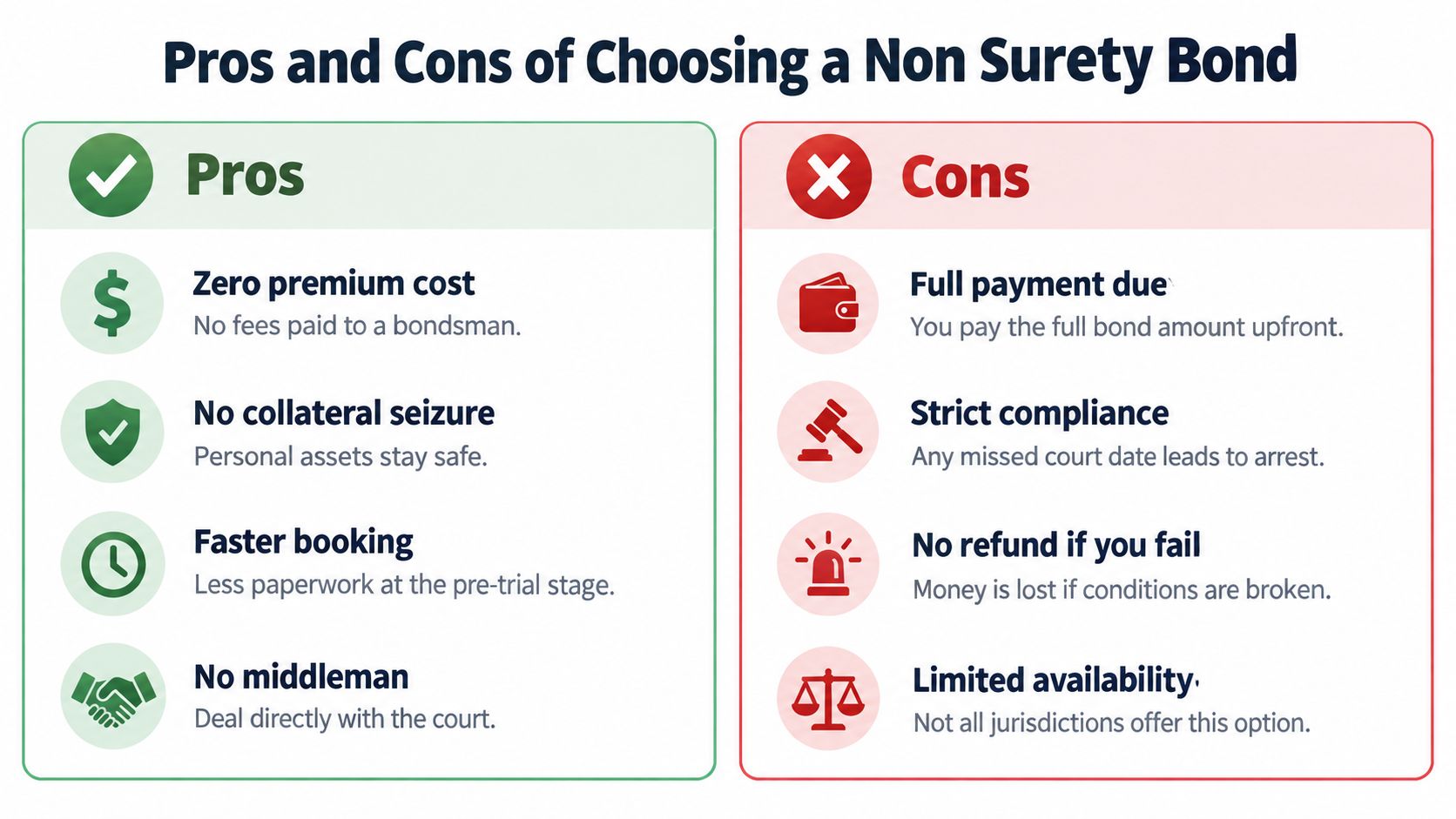
Pros and Cons of Choosing a Non Surety Bond
The upside is obvious. The downside is where people get burned.
Why families like it
A non surety bond usually means no premium to a bondsman, no scrambling for collateral, and less money tied up right when you may also need a lawyer. For lower-level cases in Ventura, Oxnard, Camarillo, and Santa Barbara, that can be the smartest outcome available.
It can also mean faster release because there isn’t a separate financial posting process through an agent. If the jail and court paperwork are lined up, the defendant may clear booking and release steps without a family member hunting down funds in the middle of the night.
Where families misunderstand the risk
The most common mistake is treating a non surety bond like a free pass. It isn’t. One practical legal discussion of non-surety release notes that a missed court date can lead to a rearrest warrant and a new failure-to-appear charge, while also pointing out the ugly disconnect that forfeiture is described as “rarely, if ever, enforced” in actual collection practice in that Connecticut example discussed in this analysis of what a non-surety bond actually means.
That disconnect matters because families hear “rarely collected” and get careless. That’s the wrong lesson. The pain usually hits first through the warrant, the arrest, the violation hearing, and the judge’s loss of patience.
My blunt take
Use the non surety route when it’s offered and when the defendant can follow rules.
Don’t use it casually if the defendant is flaky, has a history of missed dates, is likely to contact a protected person anyway, or won’t keep track of reporting terms. In those cases, the “cheap” option can become the expensive one fast.
- Best case: You keep your cash free for defense costs and the person appears every time.
- Worst case: The person misses court, gets picked up again, and the next judge sets a harder release.
- Hidden problem: Families often don’t even know the exact conditions because nobody reads the paperwork carefully before leaving the jail.
How Bail Amounts Are Set in Ventura County
In Ventura County, the first bail number usually comes from the county bail schedule, not from a dramatic courtroom speech. The jail checks the arrest charge, matches it to the schedule, and works from there unless the case has a hold, a no-bail issue, or a judicial override.
Ventura Superior Court publishes its bail schedules online, including the Judicial Council Uniform Bail and Penalty Schedules and the county’s own schedule, and the court lists a bail-schedule contact number at (805) 289-8521 on the Ventura Superior Court bail schedule page.
Where posting happens
Ventura County families also need the practical location answer. Ventura County Sheriff states that bail may be posted at the Pre-Trial Detention Facility at 800 South Victoria Avenue in Ventura, and card posting is available online or by phone through GovPayNet at 1-888-604-7888 using PLC #6404 on the Ventura Sheriff posting bail page.
That helps whether you’re dealing with bail bonds Oxnard questions, a Ventura booking, or a transfer from another local arresting agency into county custody.
Ventura County Bail Schedule Common Charges
| Charge | Typical Bail Amount | 10% Cash Option | Non-Surety Eligible? |
|---|---|---|---|
| DUI | Depends on the current county schedule and case details | Sometimes available depending on court rules and case posture | Sometimes |
| Domestic battery | Depends on the current county schedule and case details | Sometimes available depending on court rules and case posture | Sometimes, but protective orders often complicate it |
| Drug possession | Depends on the current county schedule and case details | Sometimes available depending on court rules and case posture | Often more possible than violence cases |
I won’t invent numbers for common charges just to make a chart look neat. The right move is to check the current Ventura County bail schedule and then confirm whether the jail is holding the person on the standard amount, a no-bail status, or a special condition.
What matters most: The schedule gives you the starting number. The judge decides whether that number stays put, drops, rises, or gets replaced by non-surety terms.
Families asking about Ventura County bail bonds often focus only on the dollar figure. That’s too narrow. The key issue is what kind of release is even available for that charge, with that history, in that courtroom.
When to Choose a Non Surety Bond and When to Call a Bondsman
This is the part families need. Not every release path deserves the same effort.
Non-Surety vs Bail Bondsman Decision Matrix
| Factor | Lean Non-Surety | Lean Bondsman |
|---|---|---|
| Charge type | Lower-level, non-violent, manageable conditions | Serious felony, violence, weapon issues, repeated conduct |
| Record | Minimal history, no pattern of missed court | Prior failures to appear, probation trouble, warrants |
| Community ties | Stable home, job, family support | Weak local ties or transient situation |
| Timing | Court likely to review quickly and release path looks realistic | Weekend, holiday, or delayed court review with money bail already active |
| Compliance risk | Defendant will follow every condition | Defendant is likely to violate orders or ignore check-ins |
| Other holds | No immigration or outside-county issues apparent | Holds, detainers, or overlapping warrants complicate release |
When non-surety is the smart play
Wait for non-surety release when the case is modest, the person is reliable, and the likely wait is reasonable. If the court is already leaning toward OR or conditional recognizance, paying a premium just because everyone’s panicking is wasted money.
This is especially true when the family needs funds for counsel, childcare, transportation, or keeping rent current.
When you should stop waiting
Call a bondsman when the person is sitting on scheduled bail and there are obvious red flags. Prior failures to appear. Protective-order trouble. Probation violations. Another county hold. A judge who’s likely to want financial skin in the game.
In those cases, waiting around for a magical OR release usually just burns hours.
One practical benefit of working with a local agency is booking verification and release coordination. For example, Bada Bing Bail Bonds handles those basics in Ventura and nearby counties, which is often what families need first before they can even decide between release paths.
My recommendation framework
Use this simple rule set:
- Wait for non-surety if the charge is limited, the defendant is steady, and jail staff or counsel indicate recognizance release is realistic.
- Move to a bondsman if the bail is already active and delay is costing the defendant work, safety, or case position.
- Don’t guess about court appearance history. Ask directly whether the defendant has ever missed before. Families get blindsided here.
If you’re a lawyer trying to make your local practice easier to find when families search for answers after an arrest, resources on local SEO software for lawyers can help explain how legal service pages get found in those urgent moments.
If you’re still unclear on the agent’s role, this page on what a bail bond agent does lays it out without fluff.
Local Questions Families Ask After an Arrest
Ventura County and Santa Barbara calls tend to sound the same. Panic first. Useful questions second. Here are the useful ones.
Does a protective order change release
Yes. A domestic violence arrest can lead to no-contact or stay-away terms that matter immediately. The defendant may get released and still be barred from going home, calling the alleged victim, or sending messages through relatives.
That means the family needs a pickup plan and a place for the defendant to go that doesn’t violate release terms.
Is 24-hour posting real
Yes, but families need to be precise about what “24-hour” means. Jails process bookings around the clock. Posting mechanisms may be available around the clock. Release itself still depends on booking completion, holds, warrant checks, and internal jail timing.
That’s why people searching for 24-hour bail bonds Ventura or bail bonds Thousand Oaks should focus on what can be done immediately: confirm booking, confirm charge, confirm bail status, confirm whether non-surety release is even on the table.
What if release is denied
If release is denied at booking, don’t keep calling the same desk hoping for a different answer. Find out why. It may be a hold, a warrant, a no-bail basis, or a wait for court review.
Then gather paperwork that helps when the case is reviewed:
- Photo ID: The family member handling release questions should have identification ready.
- Proof of residence: Useful when stable local ties matter.
- Employer information: Helpful when work stability supports release arguments.
Missing paperwork usually doesn’t kill a non-surety release. Missing accurate information does.
What mistakes slow things down
A few come up constantly in Ventura, Oxnard, Camarillo, Thousand Oaks, and Santa Barbara:
- Calling without booking details: Get the full legal name and date of birth right.
- Ignoring conditions after release: Check-ins and stay-away terms aren’t suggestions.
- Assuming all county facilities move the same way: They don’t. Intake, transfer, and release timing can differ.
First-hour checklist
Do these first:
- Confirm where the person is and whether they’re still in booking or already at county custody.
- Find out the release type being considered. OR, unsecured, scheduled bail, hold, or no bail.
- Start the backup plan in case non-surety falls apart. That means knowing who can co-sign, who can provide transportation, and who can keep the defendant away from any protected address.
If you’re dealing with Ventura County Jail bail bonds questions, bail bonds Ventura searches, or a late-night arrest in Oxnard, Santa Paula, Moorpark, Fillmore, Ojai, Port Hueneme, or Thousand Oaks, speed matters. So does accuracy. The families who get people out fastest usually aren’t the loudest. They’re the ones who get the facts straight and act on the right release path.
If your family is trying to sort out whether a non surety bond will work or whether you need a paid bond right now, Bada Bing Bail Bonds can help verify booking, explain the Ventura County or Santa Barbara release path in plain English, and move the paperwork if a surety bond is the only real option. When the jail answer is vague and the clock is running, get a straight answer fast so you don’t waste hours chasing the wrong release route.