
It’s after midnight, your phone rings once from an unfamiliar number, and now you’re sitting in a kitchen trying to work out when someone you care about will walk out of jail. You’ve found conflicting answers online, some promising fast release and others warning about long waits. The honest answer isn’t evasive, it’s structural. Release depends on where that person sits in a sequence of custody steps, what holds show up during checks, and how busy the system is that night.
Table of Contents
- Why Orange County Jail Release Time Is Not a Single Number
- The Processing Stages That Make Up the Release Window
- How Booking Volume Shapes Orange County Jail Release Time
- Charge Types and Holds That Extend the Release Window
- How to Check a Specific Inmate’s Release Window
- What a Bail Bondsman Changes About the Release Timeline
- A Practical Plan for Tonight and Tomorrow Morning
Why Orange County Jail Release Time Is Not a Single Number
At 2 a.m., an arrest in Anaheim, Santa Ana, or Irvine doesn’t end with a quick trip to a front desk. Officers transport the person to an Orange County Sheriff’s Department facility, staff start booking, and family members start calling before the record is even complete. That’s where confusion begins, because you’re ready to act while the system is still building the file that makes action possible.
The department’s guidance makes that gap clear. Bail or bond information generally becomes available approximately 6 hours after booking, and once a person is eligible, release-related processing averages approximately 4 hours, with a possible range of 2 to 6 hours, as explained in the Orange County Sheriff’s Department community FAQs. Those are separate clocks. Paying quickly doesn’t erase the time staff need before payment can even be accurately posted.
The pipeline behind the wait
Think of Orange County jail release time as layers stacked in order. Booking has to happen before classification. Classification, warrant checks, charge verification, and court status review have to happen before staff can confirm eligibility. Document review and release processing still sit between a posted bond and an open door.
You can’t shorten a stage your loved one hasn’t reached yet, and calling repeatedly during that stage won’t move the file forward.
Bail may be posted 24 hours a day, 7 days a week at the Intake Release Center cashier’s office for inmates housed at any Orange County Sheriff’s Department jail facility, according to the same department guidance. That availability helps families act at night, but it doesn’t guarantee immediate release. The person must first complete booking or appear in court and be remanded to Sheriff custody, and staff must finish release procedures.
That distinction also matters for families comparing counties. A search for bail bonds Ventura or Ventura County bail bonds leads to a different jail system, different facilities, and different posting mechanics, even though California bail law frames both processes. In Orange County tonight, your useful question isn’t “how long does release take” in the abstract. It’s which stage is finished, which stage is underway, and whether anything has paused the file.
The Processing Stages That Make Up the Release Window
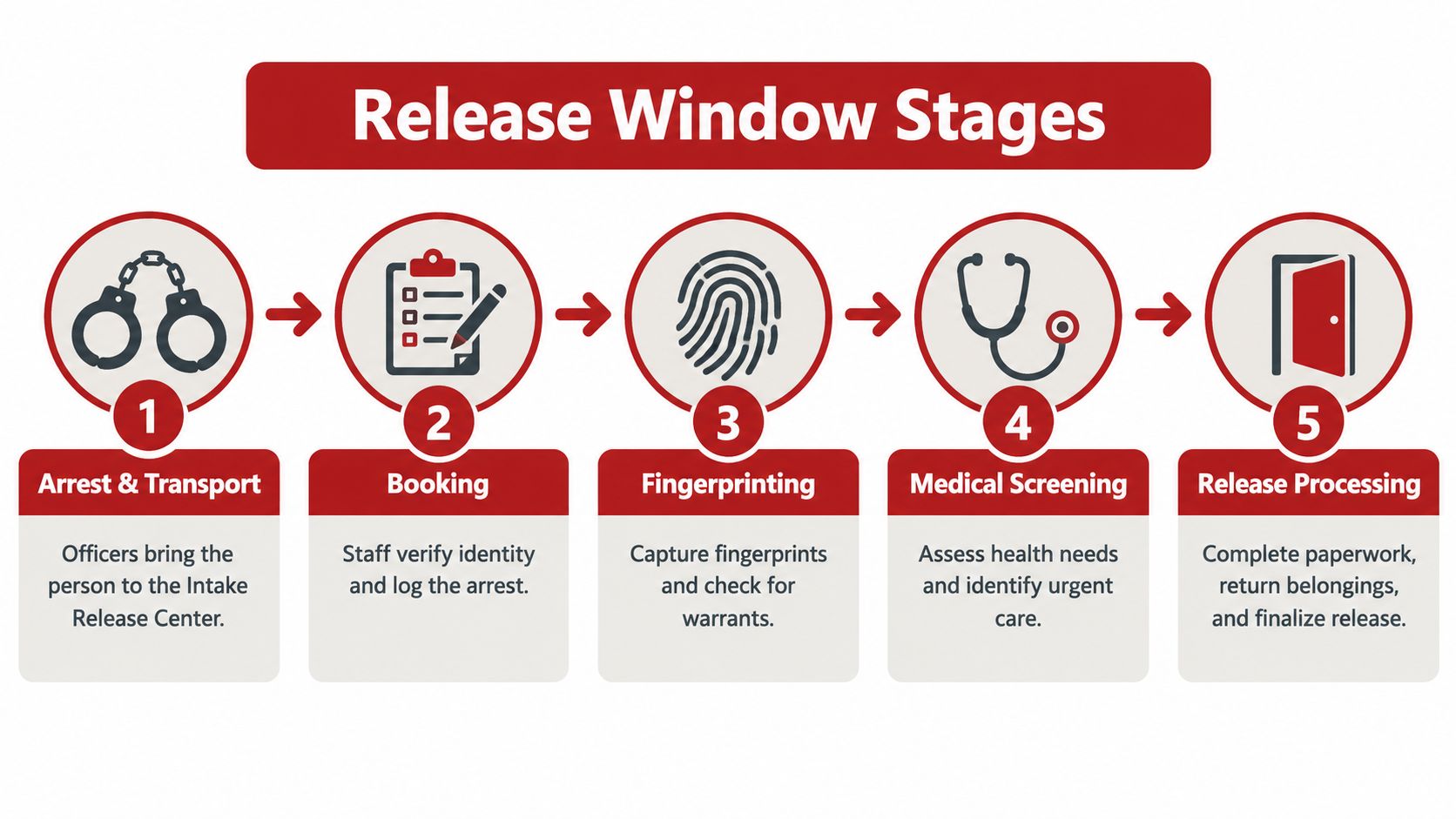
The flow below maps the main checkpoints between arrest and physical release at the Intake Release Center.
Intake comes first
Staff start with arrest and transport, then move into booking. They verify identity, record personal and arrest information, inventory property, and create the custody record that every later decision depends on. If names, birth dates, or arrest details don’t match across systems, staff have to resolve that before moving forward.
Fingerprinting and identification follow. Prints support identity confirmation and record checks, and they’re not a formality. A poor print, a possible alias, or a record hit can require another look before clearance.
Screening and verification
Medical and classification screening helps staff decide housing and supervision needs. Staff ask health questions, assess immediate risks, and classify the person for safe placement inside the facility. Even someone who will post bail quickly may need to clear basic screening first.
Next come warrant and charge verification and a court status check. Staff confirm the charges are entered correctly, look for warrants or holds, and check whether a court appearance or remand status affects release. The facility’s own guidance describes a typical booking-to-bail-information interval of about four hours, with a range of roughly two to six hours, in its Orange County custody FAQs.
- Bail calculation: Staff confirm the applicable amount from the charge and custody status.
- Payment or bond posting: A family pays cash bail or a licensed agent posts a bond at the cashier’s office.
- Release queue: Records and custody staff review documents, clear the person for release, return property, and complete exit steps.
Trying to post before booking is complete and bail is computed can create its own delay, because the inmate may not yet be eligible for release processing. Families who want the sequence in plain English before calling anyone can review the Orange County booking process step by step and then match the inmate search status to the stage it reflects.
How Booking Volume Shapes Orange County Jail Release Time
Volume is the part families can’t see from the parking lot. The figures in this display show why identical paperwork can move at different speeds on different days.
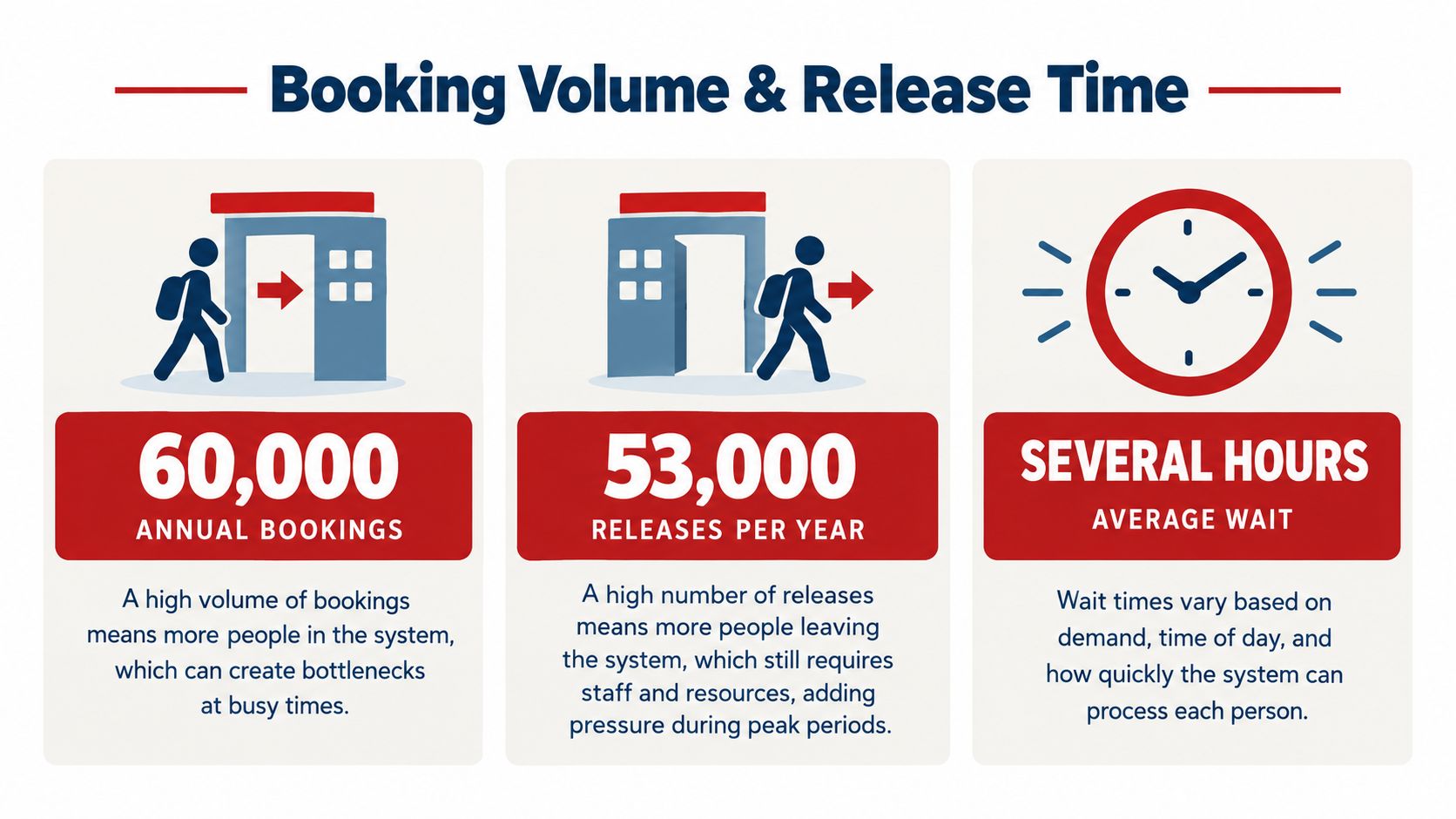
Orange County’s Inmate Records operation runs 24 hours a day, 7 days a week and handles booking, tracking, and releasing inmates. Current department information reports approximately 60,000 bookings and more than 53,000 releases annually, equivalent to roughly 164 bookings and 145 releases per day averaged across a year, according to the Orange County Sheriff’s Inmate Records overview.
On an average court day, more than 400 inmates require processing for sentence calculations or future court-date updates. That’s staff time pulled into the same records system that supports releases. Court returns, new arrests, transfers, and sentence updates all compete for review.
Why timing of day matters
A bond posted during a heavy court afternoon enters a queue already loaded with court-related updates and new bookings. The same bond posted during a quieter early morning period may move through fewer competing tasks, even though the bond itself is identical. Weekends can bring arrest surges, while weekdays bring court volume. Different pressure, similar effect.
Practical rule: Ask not only whether the bond was accepted, but where the release sits in the records queue and whether court updates are still pending.
Historical population figures reinforce the scale. A California Board of State and Community Corrections dataset recorded Orange County average daily populations of 6,251.7 in 2011, 6,877.5 in 2012, 7,249.8 in 2013, 7,035.9 in 2014, and 5,975.5 in 2015. Those older numbers don’t predict tonight’s wait, but they show a consistently large custody system. In that environment, staffing, intake levels, and case complexity bend every family’s timeline.
Charge Types and Holds That Extend the Release Window
A straightforward misdemeanor with a preset bail amount and no other flags is the cleanest path. Booking finishes, bail is computed, payment or a bond is posted, and the file enters release processing. Many cases don’t stay that simple, and the extra steps usually come from the charge or the person’s record, not from the cashier.
Cases that add steps
A DUI arrest can involve chemical testing, observation, and paperwork tied to the arrest before release decisions settle. Families also need to think beyond the jail door, because court conditions and driving restrictions follow quickly. Readers dealing with an out-of-state comparison may find this guide for Georgia drivers facing DUI court useful context, but California conditions and the Orange County court file control an Orange County case.
Domestic violence arrests often bring protective order paperwork and no-contact conditions that must be clear before release. That affects pickup planning too. The person picking up the inmate, where the inmate can go afterward, and who they can contact may all be restricted, so a family shouldn’t assume a standard ride home solves it.
- Active warrants: A warrant found during checks may require separate clearance or its own bail before release on the new case matters.
- Probation or parole violations: A supervising agency may place a hold that keeps the person in custody even after bail is posted on the new charge.
- Felony charges requiring a judge: Some cases can’t move on a schedule alone, and bail or release conditions may need court review.
Before estimating time, verify the actual charge against the Orange County bail schedule and how amounts are set. A generic internet estimate can’t account for enhancements, prior record issues, or a hold entered after booking.
The same caution applies across county lines. Someone searching bail bonds Oxnard or Ventura County Jail bail bonds for a Ventura County arrest should verify that county’s charge and schedule rather than borrowing an Orange County figure. The county of custody drives the paperwork, even when the family lives elsewhere in Southern California.
How to Check a Specific Inmate’s Release Window
Start with the official inmate search, and read it as a status board rather than a name lookup. The screenshot below shows the Sheriff’s Department site where families begin that check.

Read the fields in order
Confirm the full legal name and date of birth first, because similar names can pull up the wrong person. Then look at booking status, housing location, charges, bail amount if shown, and court information. A record that exists but shows no bail amount usually signals that booking or bail calculation isn’t finished yet, not that bail is denied.
Watch what changes between refreshes. A housing assignment suggests classification has progressed. A bail amount appearing suggests charge verification has advanced enough for staff to compute it. Court date information tells you whether an appearance is driving the next step.
- Note the booking time: Use it as your anchor, not the arrest time you heard from a friend.
- Check for a bail amount: No amount often means staff can’t accept an accurate posting yet.
- Look for holds or court status clues: A pending court item can explain a pause.
- Record the last update: Repeated calls before the record changes rarely produce new information.
Calling too early is the most common mistake. During early booking, staff may have nothing to release because identity, charges, and bail aren’t confirmed. You’ll get a more useful answer after the search shows a completed booking and a bail amount, or after a bond has been accepted and you need queue status.
If you’re coordinating from Ventura, Camarillo, Thousand Oaks, or Santa Barbara for someone held in Orange County, keep the custody county straight. The search and release queue belong to the holding facility, not your home city. A step-by-step walkthrough of the Orange County inmate locator and status fields can help you interpret changes without guessing.
What a Bail Bondsman Changes About the Release Timeline
A bail bond changes how bail is posted, not whether custody stages apply. The image below reflects the family side of that process, where paperwork and identity details are gathered before an agent goes to the jail.
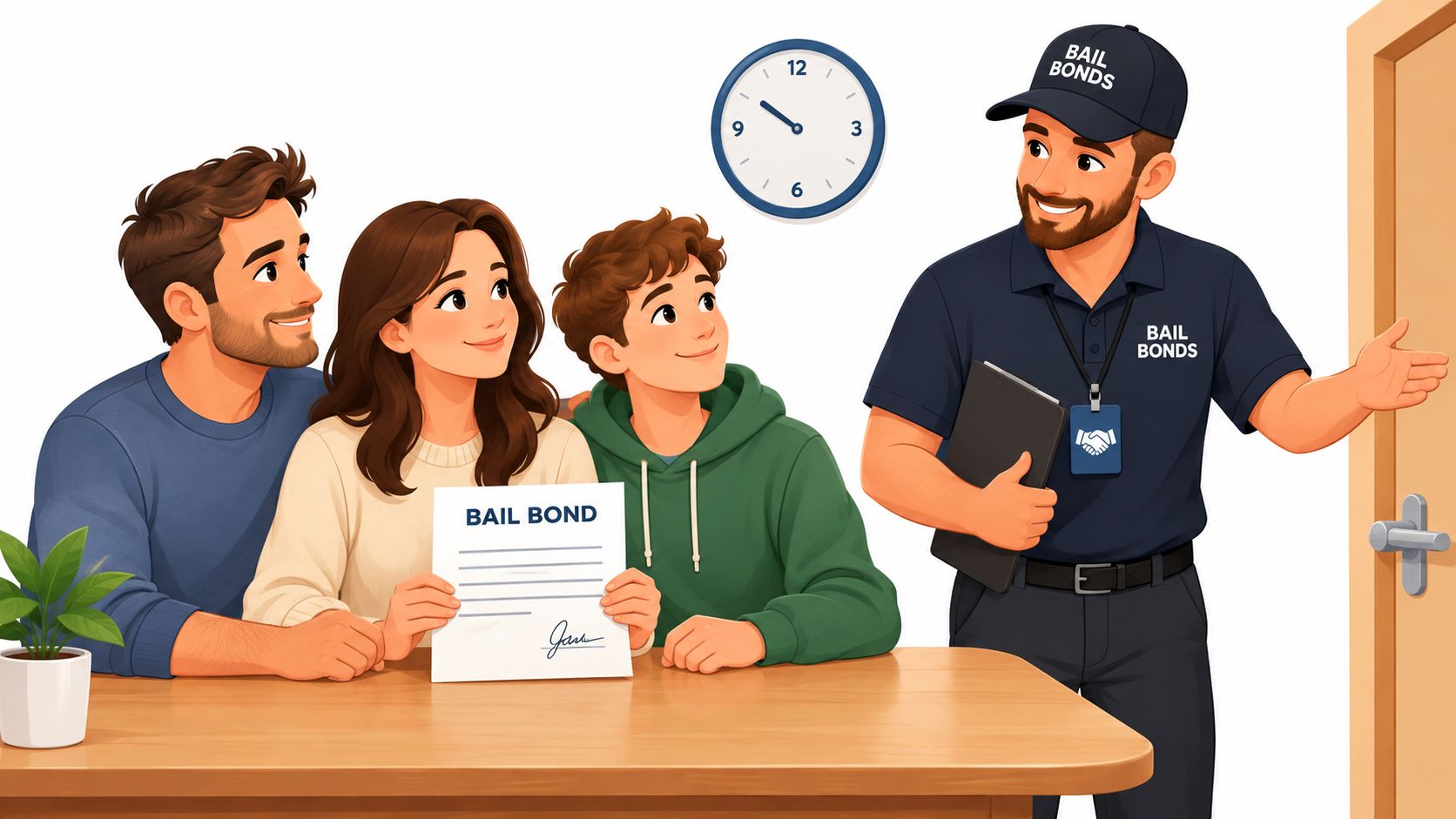
Under California bail law, a licensed agent posts a bond that guarantees the full bail amount to the court, instead of the family delivering that full amount in cash. That can remove a major financial delay, especially at night when gathering cash isn’t realistic. It doesn’t remove booking, classification, warrant checks, or release processing.
What an agent can and can’t do
An agent can verify booking details, confirm the bail amount and charges, prepare paperwork correctly, coordinate with the cashier’s office, and track whether the bond was accepted. Good information at the first call speeds that work. Have the person’s full legal name, date of birth, arresting city if known, and any charge information from the inmate search.
An agent can’t order staff to skip classification, clear another agency’s hold, or move one inmate ahead of a queue unfairly. Anyone promising a guaranteed door time before booking is complete is guessing. The honest commitment is fast, accurate posting and clear updates while the facility finishes its part.
The short video below gives a plain overview of how bond posting fits into the wider release process.
Families comparing options should understand how bail bonds work in California before signing, including co-signer responsibility and court appearance obligations. Agencies such as Bada Bing Bail Bonds can coordinate posting and updates, but the family still owns pickup planning, compliance reminders, and making sure the released person understands conditions.
This is familiar ground for 24-hour bail bonds Ventura searches too. Whether the custody county is Ventura or Orange, a bond is permission to start release processing, not a switch that opens the door instantly.
A Practical Plan for Tonight and Tomorrow Morning
Use the first hour to gather facts, not to chase a door time no one can confirm yet. Write down the person’s full legal name, date of birth, where the arrest happened, and who told you about it. Then check the inmate search and note booking time, charges, and whether a bail amount appears.
What to Do in the First 24 Hours After an Orange County Arrest
| Time Window | What to Confirm | Who to Contact |
|---|---|---|
| First hour | Identity details, arrest city, booking status | Family contact, inmate search |
| After bail appears | Charge, bail amount, holds or warrants | Licensed bail agent or IRC cashier |
| After bond acceptance | Release queue status and pickup location | Bail agent, facility staff |
| Tomorrow morning | Court date, release conditions, protective orders | Attorney, bail agent |
Before signing with any agent, ask what information they still need, how they’ll update you, and what happens if a hold appears after posting. Ask who is responsible for court reminders and what the co-signer must do if the person misses a check-in. Clear answers now prevent panic later.
For pickup, bring identification, a charged phone, appropriate clothing if needed, and patience for a middle-of-the-night release. Confirm where to wait and whether a protective order limits who should be there. Details on the facility itself are covered in this guide to the Orange County Intake Release Center and pickup basics.
Plan around several hours after booking before bail details settle, then allow for release processing after posting rather than promising family members a precise arrival time.
The county comparison is worth one final check. Ventura County operates the Main Jail in Ventura, Todd Road Jail west of Santa Paula, and East County Jail in Thousand Oaks, and families searching bail bonds Thousand Oaks should confirm custody location first, as shown in the Ventura County Sheriff detention services overview. That doesn’t change an Orange County release, but it prevents the common error of calling the wrong county when an arrest, home address, and housing facility don’t line up. Travelers facing an arrest far from home face the same first-step problem, which is why resources like Kona DUI arrest advice stress confirming local custody and court steps before making promises about timing.
If you’re trying to line up a pickup tonight and you need someone to verify booking, bail, and release status without guesswork, contact Bada Bing Bail Bonds for 24/7 help posting bail and tracking the release window. A licensed agent can explain the charges and paperwork in plain English, coordinate posting with the jail, and stay in contact from the first call through pickup.