A $20,000 bail usually means a $2,000 premium, because California fixes the consumer cost at 10% of the bond. In Oxnard, a bond posted at the right place at the right time can still move a release in about 2 to 6 hours.
That’s the part most families need to hear first, because the first call usually comes from a kitchen table at 2 a.m., with one person trying to stay calm while the other is checking their phone every few seconds. If you’re dealing with that right now, don’t waste time guessing. Get the booking details, find out whether the person is still at the Oxnard Police Department holding facility or already headed to Ventura County Main Jail, and get a bondsman on the phone immediately.
Table of Contents
- The First Hour After an Oxnard Arrest
- What to Gather Before You Call a Bondsman
- How Posting a Bond Works in Oxnard
- Paying for the Bond Without a Panic Check
- How Bada Bing Handles an Oxnard Case From Call to Release
- Bail Differences by Case Type in Oxnard
- After Release and How to Stay Compliant
The First Hour After an Oxnard Arrest
The phone rings at 2 a.m. and the caller says the same thing I hear every week, sometimes every night. “They’re at the Oxnard Police Department. What do we do now?” That first hour is where families either keep the release moving or lose the same-night window to bad information and slow decisions.
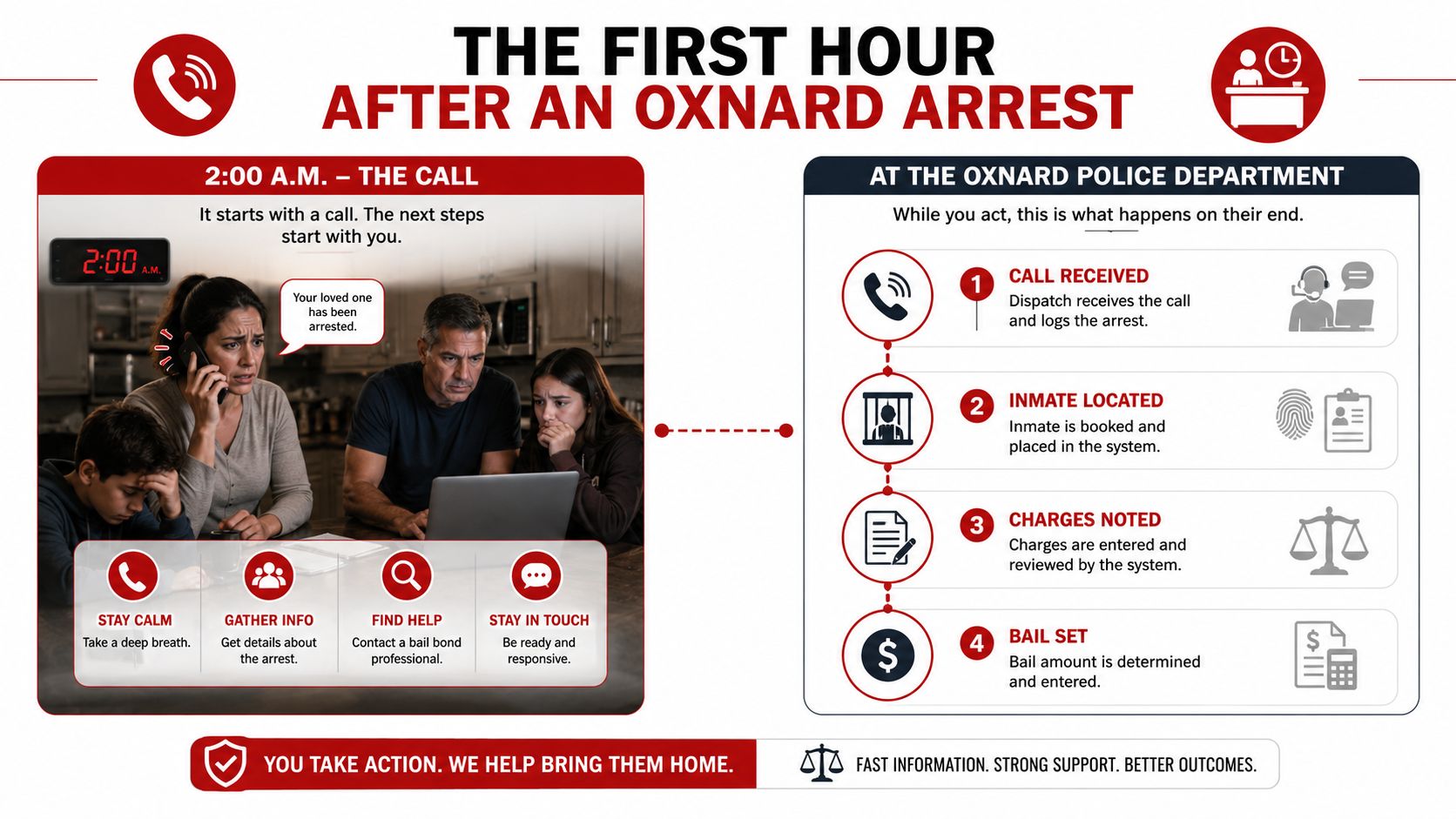
The booking side is already in motion when the family gets the call. The person is being identified, charges are being entered, and the jail is deciding whether the next move is release, transfer, or a longer hold. That timing matters because Oxnard’s holding facility is staffed 24 hours a day, 7 days a week as described in the local jail process information, and a bond posted before transfer usually moves faster than one posted after the person is sent on to the county jail. It’s also worth knowing that not every case requires a bond at all. A judge may grant OR (Own Recognizance) release instead, letting the person out on a signed promise to appear in court, with no money involved. That decision happens at arraignment, so it’s worth asking your agent whether OR is even on the table for the specific charge before assuming a bond is the only path.
Practical rule: don’t spend the first hour arguing about the arrest. Spend it getting the details that let the bond move.
California’s pricing rule is simple, and families should treat it that way. The California Department of Insurance says the consumer cost is most commonly ten percent of the total amount of the bond under state bail bond guidance. That means the premium is fixed, not negotiated based on how stressed the family is or how much the arrest “feels like” it should cost. A $20,000 bail means $2,000 out of pocket, and a $50,000 bail means $5,000.
The mistake is waiting too long to act because people assume there’s plenty of time. In Oxnard, a bond filed at the right facility in time can still produce a release in the 2 to 6 hour range, and Ventura-area providers describe 3 to 5 hours when the bond is posted before transfer to the county system as part of the release workflow. That window shrinks fast when the booking data is incomplete or someone waits until the person has already moved.
The family that wins the first hour usually does three things quickly. They identify the booking location, confirm the charges as stated, and call with the defendant’s full legal name and date of birth ready. That’s not paperwork busywork. That’s how you keep a release from slipping overnight.
What to Gather Before You Call a Bondsman
The fastest calls are the ones where the family already has the basics in front of them. Start with the defendant’s full legal name, date of birth, and booking number if you have it. Then note the arresting agency, the charges as they were relayed, and whether the person is still at the Oxnard Police Department holding facility or has been transferred.
The reason I push this so hard is simple. A bond is filed against a specific booking record, not a vague description of “my son” or “my husband.” If the booking number is off by even a small amount, or the jail location is wrong, the filing can stall while staff verify the record. That kind of mismatch is how a same-day release drifts into the next morning’s queue.
Use the first call to build a clean checklist
If you’re the one making calls, stay focused and take notes. Write down the jail name, the exact charges that were relayed, and whether there’s any transfer pending. If the caller tells you the person is already at Ventura County Main Jail, that changes the posting path. If they’re still at OPD, the family may still have a faster route.
A good bondsman will ask for the same information right away because it lets the agent check the record and decide where to file. The agent is matching the booking details, preparing the bond paperwork, and setting the filing in the right place before the jail accepts it. Families who want to avoid delays should also keep an eye on the timing of the arrest itself. The earlier the call comes in, the better the chance of filing before the transfer line gets busy.
Keep the call short, accurate, and factual. The more guessing you do, the longer the release takes.
For a clean pre-call checklist, use the agency’s basic requirements page at bail bond requirements. Don’t overthink the process. Get the record details first, then let the agent walk you through the rest.
How Posting a Bond Works in Oxnard
The mechanics are simple once you know where the bond goes. Ventura County’s official posting instructions say bail can be posted at the Pre-Trial Detention Facility, 800 South Victoria Avenue in Ventura, and they accept exact cash, cashier’s check payable to Ventura County Superior Court, a bail bond, or credit and debit card through GovPayNet by phone or online according to the county’s bail posting page. That is the county endpoint when the case has already moved beyond the local holding stage.
The fastest path in most Oxnard cases is to post before transfer if the paperwork is ready. The agent can file against the current booking record while the person is still in the local holding process instead of waiting for the next facility to accept and re-enter the inmate. Once transfer happens, you add another layer of processing, and that is where time gets burned.
What the bondsman is doing
A bondsman is not just taking money and disappearing into a phone call. The agent verifies the booking details, prepares the bond paperwork, confirms the facility information, and submits the bond so the jail can process release. The jail then checks the record, matches the bond to the inmate, and moves the person into the release queue.
That queue is where patience gets tested. Families want a promise, but the bottleneck is administrative accuracy. If the booking number is correct, the jail is the right one, and the person has not already transferred, the process usually stays on the short end of the window. If you want the payment side laid out clearly, review the bond payment options guide before you decide how to fund the case.
If the bond is posted before transfer, Ventura-area providers describe the end-to-end timeline as about 3 to 5 hours in the Oxnard workflow description.
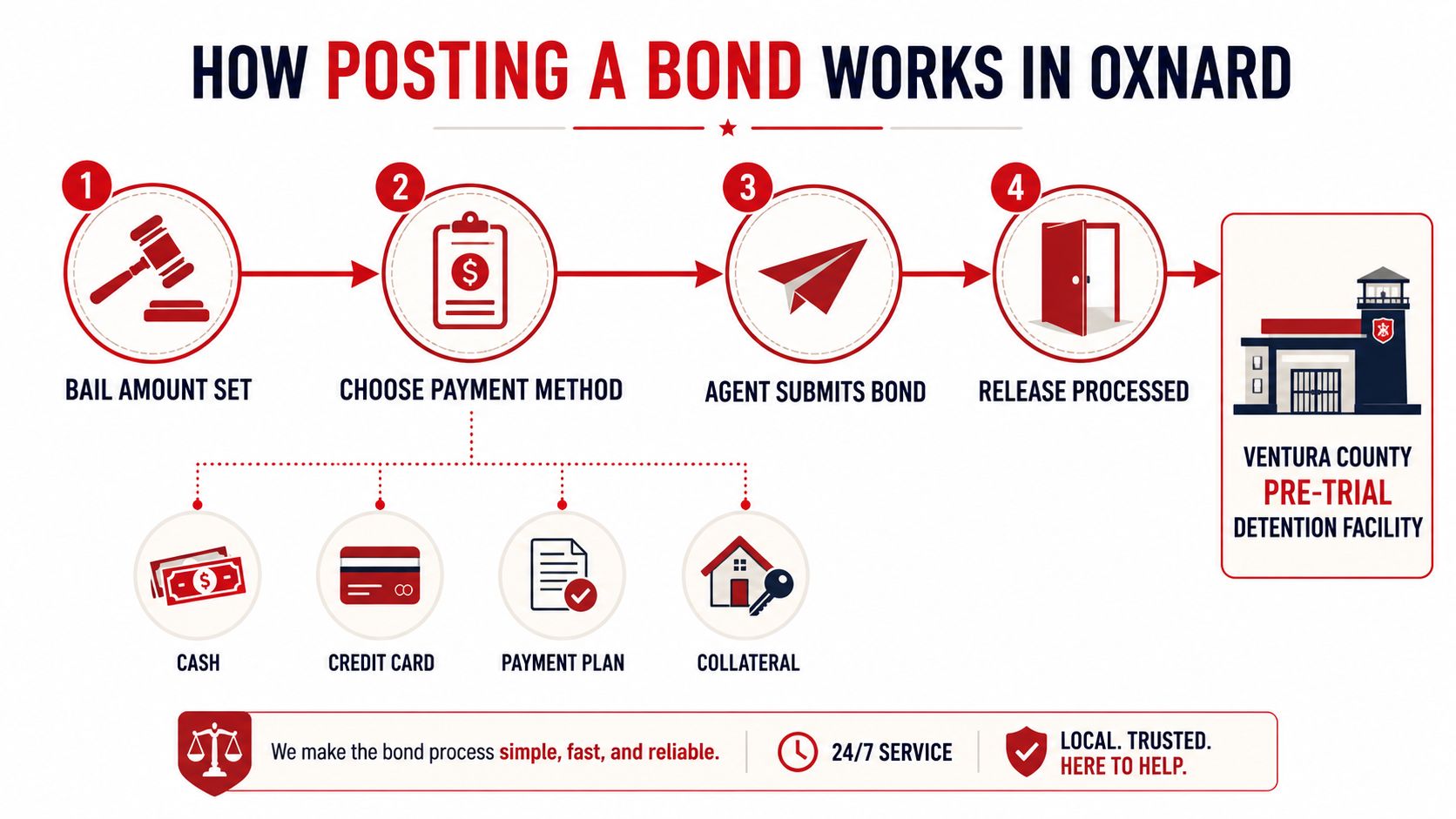
If you are deciding where the bond should be posted, do not guess. Ask whether the inmate is still at OPD or already at the county facility, because that answer determines the speed of everything that follows. The county process is clear, but the first move still matters most.
Paying for the Bond Without a Panic Check
The family question I hear most is blunt. “Do we need the whole amount tonight?” Usually, no. In California, the 10% premium is the standard benchmark, and the premium is non-refundable because it pays for the guarantee that the full bond will be covered if the defendant misses court under the state insurance guidance. That’s the number that matters first, because it tells you what the immediate cash hit is.
A $50,000 bail means a $5,000 premium. That doesn’t mean every family writes a five-thousand-dollar check the same way. It means you need to decide whether you’re paying in cash, spreading the cost out, or using another structure that fits the case and the family’s risk tolerance.
What families usually weigh
- Cash payment: Simple and fast, but it ties up money immediately.
- Payment plan: Lower upfront pressure, but it depends on approval and a clear agreement.
- Co-signer structure: Useful when the defendant can’t qualify alone, but the co-signer takes real responsibility.
- Collateral-backed bond: Common for larger or higher-risk cases, but it puts property or other assets on the line.
Each option changes the pressure point, not the premium rule itself. If the family can’t cover the full amount tonight, the question is what they can support without creating a bigger problem later. A co-signer who doesn’t understand the agreement can become the weakest link in the case.
Don’t sign for speed alone. Sign for a structure you can live with if the case takes months, not days.
For a plain breakdown of those choices, see the agency’s explanation of bail bond payment options. That’s where the hard conversation belongs, before anyone puts a pen to paper. The wrong payment choice can feel easy on the front end and expensive on the back end.
How Bada Bing Handles an Oxnard Case From Call to Release
A late-night arrest in Oxnard starts with location, not theory. The Oxnard Police Department is listed at 251 S. C Street, Oxnard, CA 93030, and the agency serving that area says it responds immediately with 24/7 service, including nights, weekends, and holidays on its Oxnard location page. That matters because a call at midnight follows a different clock than a call during business hours.
The first real step is simple. A licensed agent answers, checks the booking details, and explains the charges in plain English so the family knows what the jail entered and what the bail schedule means for that case. If the person is still at OPD, the bond gets coordinated there first. If the case has already moved, the process shifts to the Ventura County posting point right away.
What a clean Oxnard call sounds like
The family gives the defendant’s full name, date of birth, and booking number if available. The agent checks the record, confirms where the person is being held, and tells the caller whether the case is still in the local release window or already moving toward county processing. Then the paperwork starts, and the family knows exactly what has to be signed and where the bond is going.
A clean call also cuts out delay. The agent asks only for what the jail needs, then matches the bond to the facility’s current holding process. That is the difference between a file that stays on the same-night path and one that slips because someone guessed at the wrong location or handed over incomplete information.
What the bondsman is doing
The bondsman is not setting bail. The jail or court already did that part. The work here is matching the bond to the hold, getting the signatures right, and pushing the paperwork toward the right release desk without missing a step. If the case has already turned into a felony matter, the family should be looking at the details on bail for felony charges and expecting a slower, more exact intake process.
Bada Bing Bail Bonds handles that flow with direct intake, local facility coordination, and release tracking from the first call through pickup. The point is not to sound busy. The point is to keep a family from losing a same-day release because one form was missing, one name was wrong, or the bond went to the wrong jail.
Bail Differences by Case Type in Oxnard
Not every arrest moves through the same release path. The charge matters because the jail’s friction changes, even when the bond is posted quickly. A DUI with no extra complications can move differently than a domestic violence case with a protective order, and a probation violation can stack conditions on top of the base arrest.
The cases that change the pace
- DUI: The bail schedule is only part of the picture. Prior offenses can complicate the release discussion because the case may be treated more seriously by the holding facility.
- Domestic violence: Protective orders and no-contact terms can slow release even after the bond is posted, because the jail has to process the conditions correctly.
- Warrants: Bail may be set differently depending on the warrant record, and that can change how quickly the file clears.
- Probation violations: These cases often carry extra conditions, so the bond is only one part of the release review.
That’s why a bondsman doesn’t set bail. The court or the jail does that part. The bondsman works the local friction around the bail, making sure the paperwork lines up with the hold and the facility’s process. If the case has a protective order or a probation hold attached, speed depends less on the premium and more on whether the jail can process the release conditions without confusion.
The mistake families make is assuming every arrest is just a money problem. It isn’t. Some cases are documentation problems, some are facility-timing problems, and some are both. If you’re trying to understand how that looks in a serious case, the bail for felony charges page is the right place to start, because felony holds tend to expose every delay point fast.
After Release and How to Stay Compliant
Once the door opens, the bond work isn’t over. The agent should keep the defendant’s court date information straight, and the family should treat every reminder like it matters, because it does. Missed court doesn’t just create stress, it can trigger bond forfeiture and put the co-signer on the hook.
The cleanest cases are the ones where everyone knows the calendar. Keep the court date written down, keep the agent’s contact information handy, and check in if the court changes anything. If collateral was used, it stays tied to the agreement until the case is resolved and the bond conditions are satisfied.
Three things that keep a bond from going sideways
- Keep every court date: One missed appearance can create a serious problem for the bond.
- Stay in contact: Quick check-ins help catch changed dates, address issues, or paperwork confusion.
- Protect the co-signer: The co-signer should know exactly what happens if the defendant stops showing up.
The first 24 hours after release matter more than people expect. Get them home, get them fed, get them rested, and get the court date written down somewhere you won’t lose it. People coming out of custody are often hungry, angry, or overwhelmed — that’s normal, not a red flag. A calm first day home does more to keep a case on track than anything in the paperwork.
Collateral return depends on the agreement and on compliance. When the case stays on track, the bond can be resolved the normal way and the collateral return process can move forward. If the defendant disappears or misses court, the family finds out fast that the bond was never a one-time transaction.
For the post-release side of the process, the agency’s what happens after bail is posted page covers the follow-through. The smart move is simple, show up, answer the phone, and keep every promise the bond agreement requires.
If you need Oxnard Bail Bonds done right, Bada Bing Bail Bonds handles the local call, the jail paperwork, and the release tracking without dragging families through jargon. Visit Bada Bing Bail Bonds and get a licensed agent on the line now, because the first hour after an arrest is still the one that decides whether you wait in jail or wait at home.