Your relative calls late at night from a Ventura County jail. There's talk of a missed probation appointment, a failed drug test, or a new arrest, and your first question is whether you can get them home. Before arranging payment or driving to a facility, find out what is keeping them in custody and which court decision comes next.
Table of Contents
- When a Probation Violation Hearing Begins
- How the Probation Process Works
- Proof and Evidence at the Hearing
- Rights and Typical Hearing Procedure
- Possible Hearing Outcomes and Consequences
- Bail and Bonds After a Probation Hold
- Preparing for a Ventura County Hearing
- Final Steps for Families Facing the Hearing
When a Probation Violation Hearing Begins
Suppose a family member is booked after an alleged missed report. You have an appointment reminder on your phone, but the custody information mentions a probation violation. That mismatch is a reason to preserve the message, not proof that either side has the complete story.
An arrest, summary revocation, a probation violation hearing, and sentencing are separate events. California authority recognizes that summary revocation must be followed by a hearing before punishment, with notice and assistance of counsel. The booking entry doesn't settle whether the allegation is true or what the eventual consequence should be. See the California Supreme Court's explanation of probation-revocation procedures.
The following timeline helps separate the family's immediate release question from the later hearing.
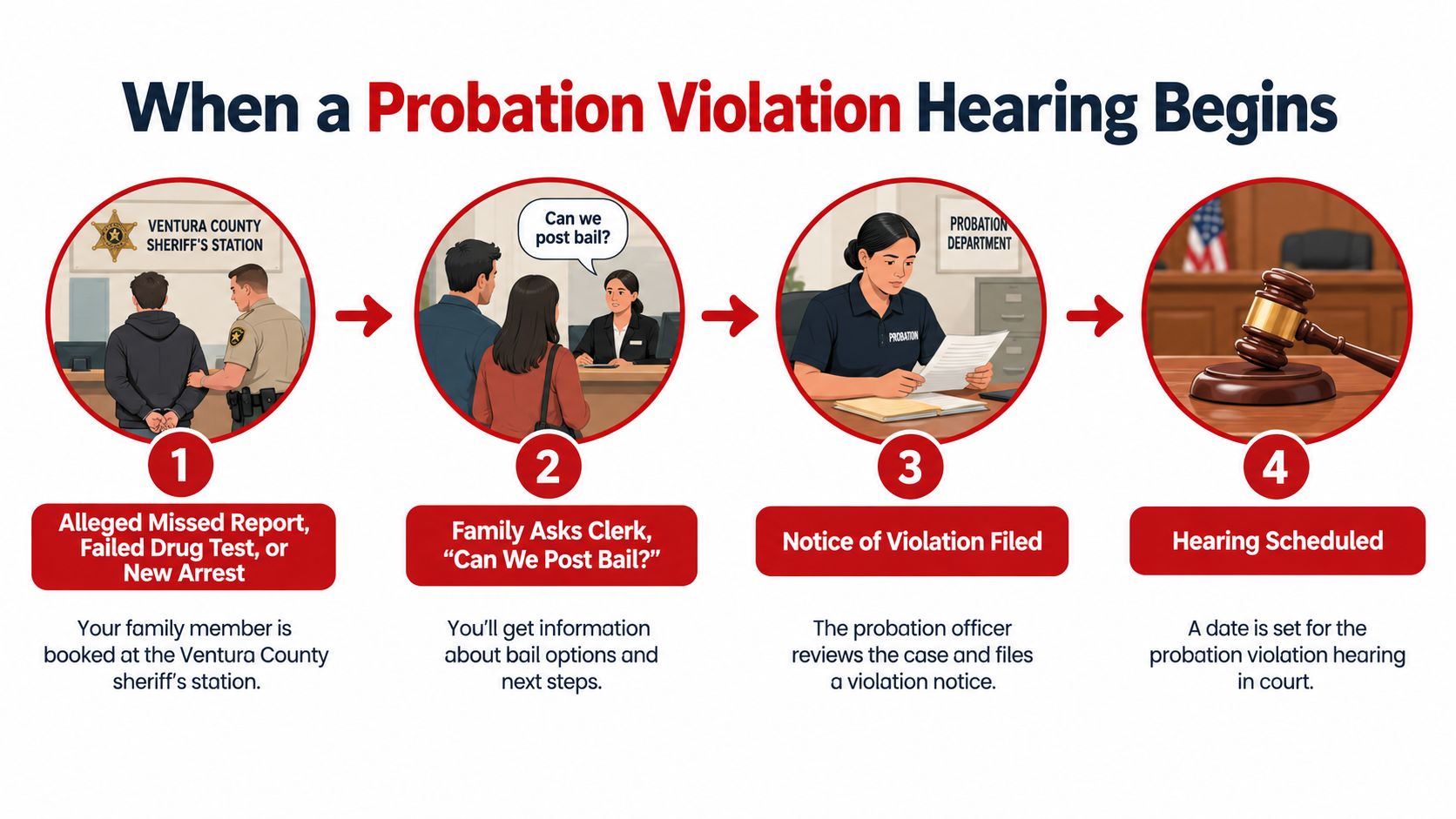
Start with separate questions
Ask the jail or appropriate custody agency about the recorded hold. Ask defense counsel what the allegation means legally and what response is needed.
- Custody question: Is the person held on a probation matter, a warrant, a new charge, or overlapping grounds?
- Court question: What event is scheduled, and will the judge consider release, the alleged violation, or disposition?
- Evidence question: What written condition was allegedly breached, and what records should be preserved?
A guide to warrants for probation violations can help families organize the warrant-related questions. For broader preparation, Brian Hansford Law's resource on working with a criminal defense attorney on probation violations offers context for discussing the allegation with counsel.
Practical rule: Work on release information and hearing preparation at the same time. Don't postpone contacting a lawyer while searching for a bond.
The next question to ask counsel is specific: “What needs to happen before the court can decide this allegation, and can release be addressed sooner?” This is general legal information, not advice about an individual case.
How the Probation Process Works
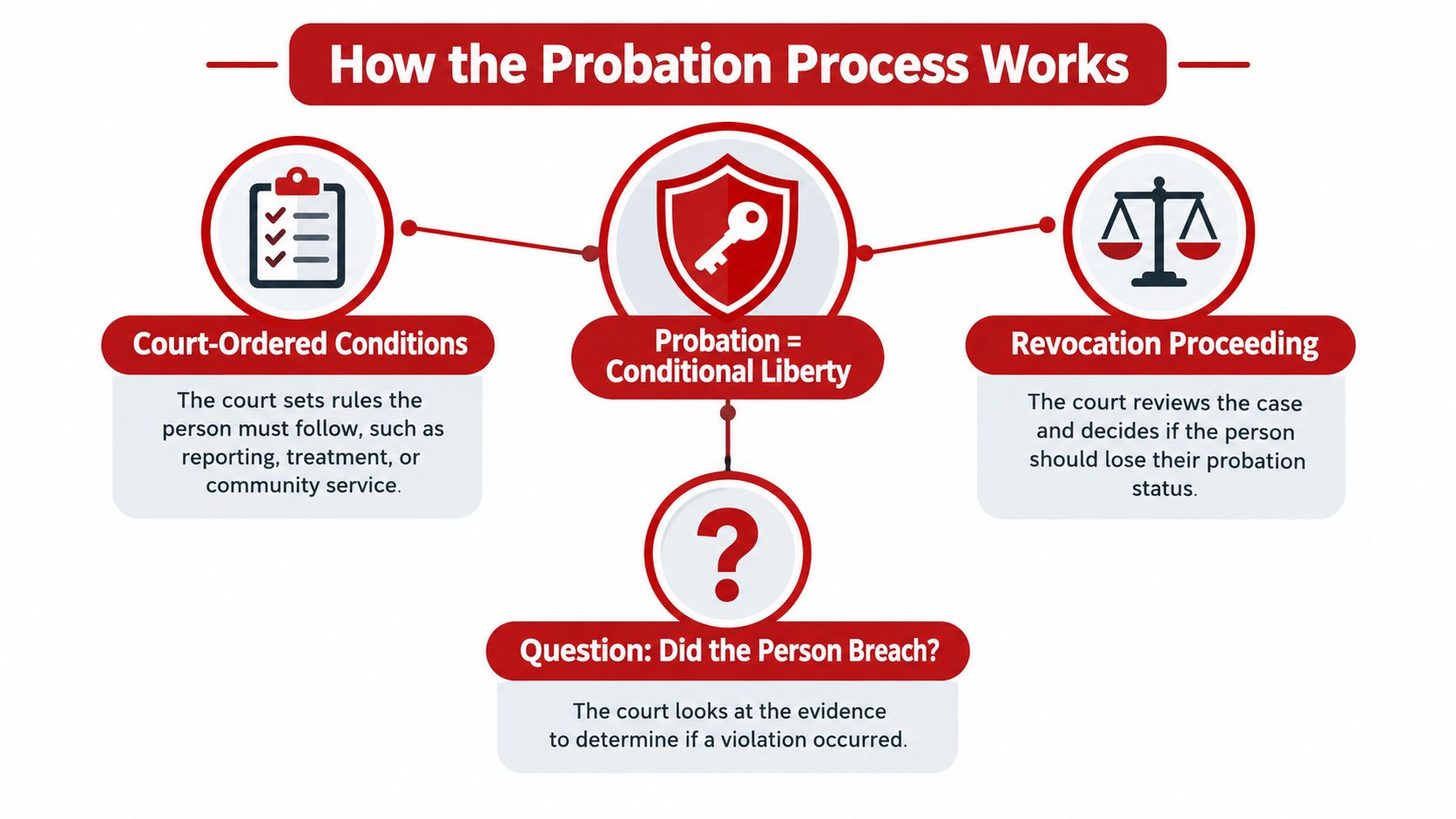
Probation involves conditional liberty. The person remains in the community subject to court-ordered requirements, and a revocation proceeding asks whether those requirements were breached and what the court should do about it.
Think of the distinction between disregarding a traffic instruction and being accused of a separate offense while driving. Both involve conduct, but they raise different questions. Likewise, missed reporting is not the same allegation as a new crime, although either may matter under the person's actual probation order.
This concept map shows the relationship between conditions and revocation review.
Identify the decision being made
The national due-process framework comes from the Supreme Court's 1973 decision in Gagnon v. Scarpelli, which generally describes a preliminary probable-cause hearing followed by a final hearing addressing the violation and whether revocation is appropriate. States implement that framework differently, so families shouldn't assume every appearance will follow an identical sequence. The Gagnon decision explains the distinction between preliminary and final review.
| Decision | What the family should ask |
|---|---|
| Preliminary review | What alleged conduct supports probable cause? |
| Formal hearing | What evidence supports or disputes the claimed breach? |
| Disposition | If a violation is established, what response is legally available? |
The government isn't prosecuting a new criminal charge through the revocation hearing itself. It's seeking consequences tied to the existing conditional release. If there's also a new criminal case, ask counsel how the separate proceedings affect preparation and statements.
For another explanation of the sequence, the video below accompanies the process overview.
Also confirm that the paperwork concerns probation. The distinction between probation and parole in California matters when identifying the supervising authority and applicable process.
Your next question is: “Which written order governs this person, and which decision is on the court's calendar?”
Proof and Evidence at the Hearing
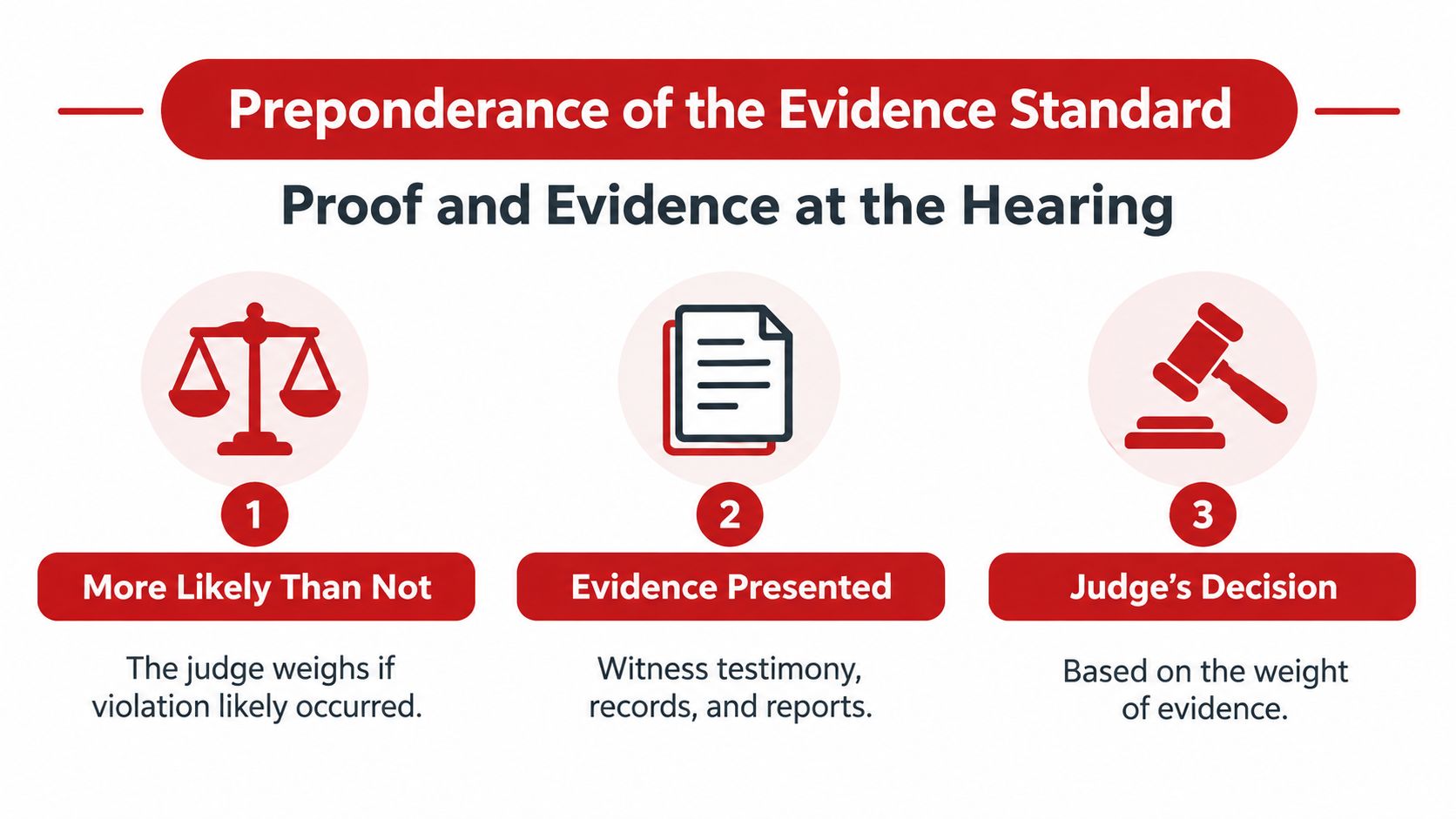
California probation-revocation proceedings generally use preponderance of the evidence, meaning more likely than not, rather than proof beyond a reasonable doubt. That lower threshold doesn't make an accusation self-proving. California's hearing rule describes the preponderance standard, making the reliability and context of the evidence important.
The visual below summarizes the basic weighing process.
Work through the allegation precisely
Consider an alleged missed reporting appointment. A reminder showing a different date could challenge whether the person missed the required appointment at all. A medical record might instead explain why the person couldn't attend, while a message requesting rescheduling could document attempted compliance.
These records serve different purposes. Rebuttal disputes the allegation; explanation supplies context; mitigation addresses the appropriate response. Don't combine them into a general statement that the person tried their best.
Employment records, transportation documentation, treatment enrollment, and communications may help establish a timeline. Their value depends on the condition and disputed issue, not on the size of the document packet. Ask counsel: “Which fact does each record help establish, and what's still missing?”
Review reports without assuming they decide the case
A probation report or officer's testimony may materially influence the hearing. Reliable hearsay may also be considered in some proceedings, but that doesn't mean every secondhand assertion must be accepted without scrutiny.
Counsel should review how information was obtained, whether supporting records exist, and whether the account matches the dates and communications. Families should preserve original messages rather than rewriting conversations from memory.
Organize a response for each alleged condition:
- Exact requirement: Copy the relevant wording from the probation order.
- Claimed breach: Identify the conduct and date alleged.
- Disputed facts: Note what the person contests and the supporting record.
- Explanation: Document barriers, notice problems, or attempted compliance.
- Missing material: Flag reports, test documentation, or communications counsel should request.
- Forward plan: Keep proposed compliance arrangements separate from factual defenses.
For a disputed drug test, for example, ask counsel what underlying records need review before offering an explanation. Don't assume that enrollment in treatment disproves the test result, or that a disputed result makes treatment information irrelevant to mitigation.
The next question isn't whether there's evidence. It's whether the evidence reliably establishes this particular breach of this particular condition.
Rights and Typical Hearing Procedure
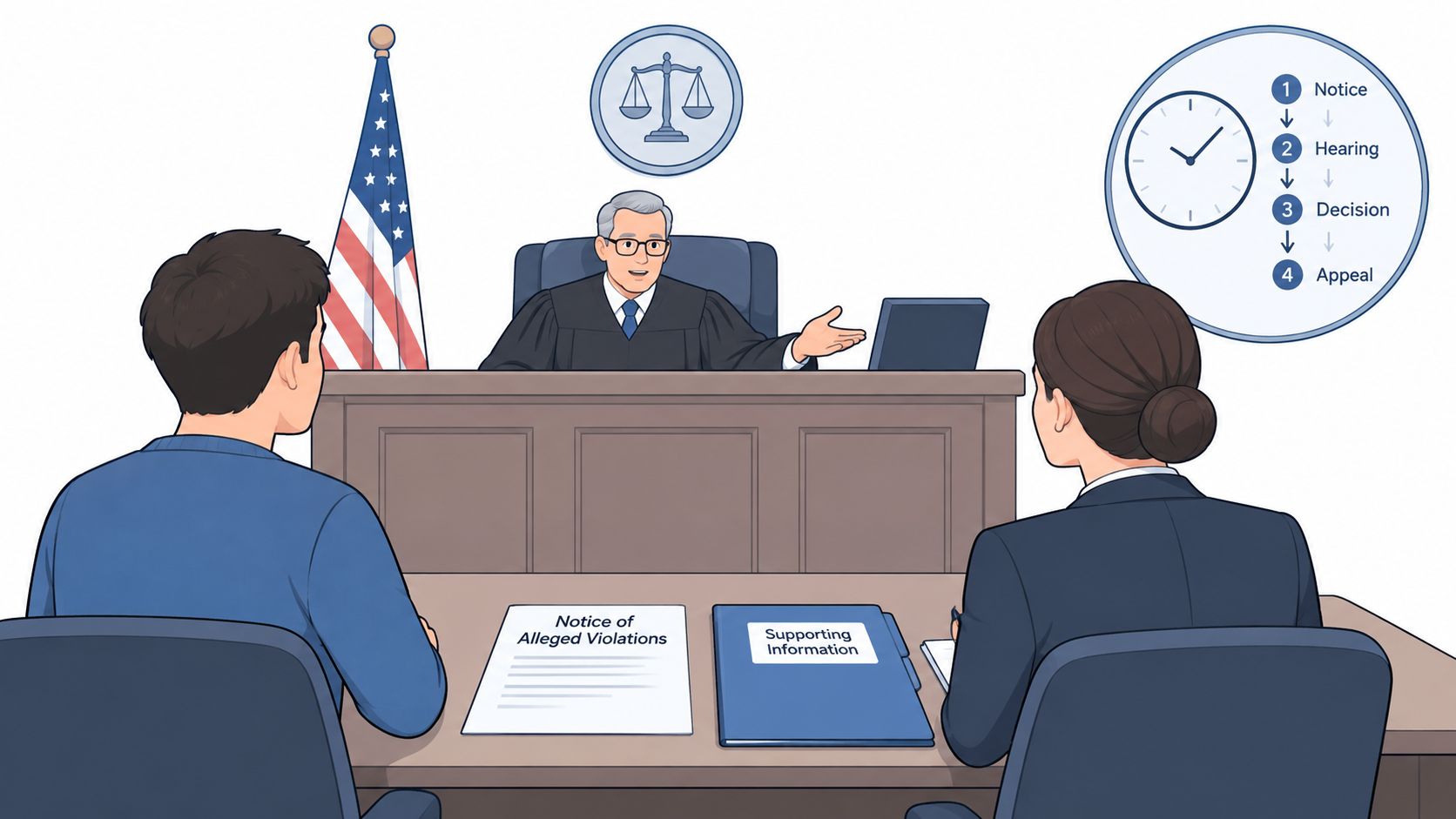
A meaningful hearing begins with knowing what must be answered. Due-process protections include written notice, disclosure of supporting evidence, an opportunity to present witnesses and documents, a neutral decision-maker, and a written explanation supporting revocation. Confrontation and questioning of adverse witnesses are subject to exceptions rather than operating exactly as they do at a criminal trial, as discussed in this review of probation-revocation hearing protections.
The courtroom setting can look familiar even though the legal proceeding differs from a trial.
Before evidence is presented
Counsel should identify the allegations, review available information, and discuss whether the person contests them. The national framework recognizes that legal assistance may be necessary for complex or contested issues or when the person cannot adequately present the case; California's counsel protections must also be considered.
Ask: “Has counsel received the allegation and supporting material, and is there enough time to respond?” A family's possession of some records doesn't establish that the defense has received everything it needs.
During the hearing and decision
The court considers the evidence, permits the applicable opportunities to challenge it, and makes findings. If the court establishes a violation, counsel can address the appropriate disposition and present mitigation. These protections are meaningful, but they don't turn the proceeding into a full jury trial with every trial safeguard.
Don't use a courtroom appearance to improvise explanations that counsel hasn't reviewed. Give the lawyer the records and difficult facts beforehand.
Families can prepare without trying to act as courtroom advocates:
- Request the documents: Ask counsel which notice, report, and supporting records are still needed.
- Confirm attendance: Check with the appropriate court source about the courtroom, appearance format, and attendance requirements.
- Coordinate witnesses: Give counsel contact information and explain what each person knows.
- Reserve legal questions: Direct questions about admissions, objections, witness questioning, and possible consequences to the lawyer.
Before leaving court, ask counsel: “What did the judge find, what order now applies, and what deadline or appearance comes next?” Don't rely solely on a relative's recollection of unfamiliar courtroom language.
Possible Hearing Outcomes and Consequences
A proven violation doesn't dictate a single result. The court's options may include continued supervision, modified conditions, custody-related sanctions, or revocation with incarceration connected to the original sentence. California's overview of probation-violation consequences and mitigation explains why the nature of the breach and the proposed response both matter.
Separate the finding from the remedy
The decision can be understood as a branching path rather than a menu of interchangeable punishments.
| Hearing finding | Issue to discuss with counsel |
|---|---|
| Allegation not established | What order should resolve the allegation, and what happens to related custody? |
| Violation established, supervision remains appropriate | Can existing conditions continue, or should specific requirements change? |
| Violation established, custody sought | What legal authority and case-specific reasons support the proposed custody? |
| Revocation sought | What sentence exposure follows from the original case? |
A documented missed appointment and a disputed failed test require different preparation. In the appointment example, counsel may focus on whether the lapse occurred and what would prevent another one. In the test example, counsel may need to examine the evidence before discussing any appropriate response.
Neither example predicts an outcome. Seriousness, alleged new conduct, risk, supervision history, and the person's demonstrated ability to comply can affect the court's assessment.
Prepare mitigation as its own record
Mitigation shouldn't consist only of asking for another chance. A concrete proposal might identify a treatment provider, a reliable way to attend appointments, a stable place to live, or an accommodation to discuss for a documented limitation.
- Show existing progress: Provide records of treatment participation, completed requirements, or employment.
- Explain actual barriers: Connect medical, housing, or transportation problems to the relevant event.
- Offer workable arrangements: Identify who will provide transportation or how future reporting will be managed.
Ask counsel: “What disposition are we requesting, and what evidence makes that request realistic?” Also ask what conditions would apply afterward so the family doesn't support a plan the person cannot carry out.
For a broader discussion of probation violation consequences, keep the original sentence and current allegation together when reviewing possible exposure. The word “technical” describes a type of alleged noncompliance, not a guarantee of a minor consequence.
Bail and Bonds After a Probation Hold
A probation hold doesn't necessarily follow the ordinary bail process for a new charge. Before asking how much a bond costs, establish whether the custody record reflects a probation hold, a warrant, a separate charge, or a combination. Ask: “Which custody grounds must be resolved before release is possible?”
Ventura Superior Court's published 2024 countywide bail schedule lists felony probation violations as “No Bail.” It describes presumptive booking amounts pending judicial review and separately addresses warrant-based bookings and other categories. That entry shouldn't be treated as a complete answer to what a judge may later order under the applicable law. See the Ventura County bail schedule and booking rules.
California's release framework requires individual review
California Penal Code section 1203.25 addresses release before the formal probation-violation hearing. Under its framework, a person released after the initial hearing generally must receive own-recognizance release unless the court finds by clear and convincing evidence that special conditions are needed to protect the public and reasonably assure appearance.
Cash bail may be imposed only when other reasonable release conditions are inadequate. The statute requires an individualized ability-to-pay determination and bail the person can reasonably afford.
| Probation classification | Statutory custody distinction |
|---|---|
| Misdemeanor probation conduct | Release generally cannot be denied before the formal hearing unless the person violated a court order, including an appearance order. |
| Felony probation conduct | Detention requires clear and convincing evidence that no reasonably available alternative can protect the public and assure appearance. |
These standards explain why a booking notation and a judicial release determination aren't interchangeable. They also explain why “No Bail” doesn't justify assuming every probation matter is permanently ineligible for a bond.
Find out who can authorize the next step
Before paying: Confirm that a bond is authorized, that the amount is current, and that another custody ground won't prevent release.
A bail agent can help verify bond-related information and posting requirements. Defense counsel should address the legal basis for detention, possible alternatives, and whether to seek court review before the formal hearing.
For bail after a probation violation, have the person's identifying information, booking information, case details, and known court orders available. Ask the agent what has been confirmed rather than accepting an estimate as a release authorization.
If you're searching for Ventura County bail bonds, the controlling question is not whether an agency answers. It's whether the court permits a bond in the current custody situation.
Preparing for a Ventura County Hearing
Build a file that someone unfamiliar with the family can understand. Start with the written allegation and probation order, then arrange records by date. Keep a separate page listing unanswered questions instead of filling gaps with assumptions.
Families in Ventura, Oxnard, Camarillo, Port Hueneme, Thousand Oaks, Santa Paula, Moorpark, Fillmore, and Ojai can use the same preparation method. If relatives are traveling from nearby Santa Barbara, confirm the actual holding facility and hearing location before setting out.
Organize the court file
- Conditions and deadlines: Match each allegation to the order and relevant due date.
- Communications: Preserve complete message threads, appointment notices, and attempted contacts.
- Supporting records: Label treatment, work, medical, and transportation documentation by the issue each addresses.
- Practical barriers: Tell counsel about housing instability, disability, language needs, or work conflicts early enough to discuss arrangements.
Ask counsel what should be submitted and what should remain in the preparation file. Avoid discussing disputed facts with investigators without legal guidance.
Confirm hearing information through the appropriate court source, including the case number, department, location, and appearance requirements. A guide to the Ventura County court system can help families orient themselves, but the actual calendar and orders control.
Verify the facility and posting mechanics
The Sheriff identifies the Main Jail at the Ventura Government Center, Todd Road Jail west of Santa Paula, and East Valley Jail in Thousand Oaks. Its posting instructions identify the Pre-Trial Detention facility at 800 South Victoria Avenue in Ventura and the East County facility at 2101 E. Olsen Road in Thousand Oaks as relevant locations for bail-related transactions; the latter is open 24 hours and lists 805-494-8242. Confirm current instructions through the Ventura County Sheriff's bail-posting information.
A facility's ability to accept a bond or deposit doesn't establish that a particular person is legally releasable. Ask: “Can this facility accept the authorized posting, and are any holds unresolved?”
Searches for bail bonds Ventura, bail bonds Oxnard, or bail bonds Thousand Oaks may identify local assistance, but the arrest city alone doesn't tell you where release processing will occur. When contacting 24-hour bail bonds Ventura services, request verified booking and authorization details before arranging travel.
Plan for processing rather than immediate pickup
A county detention-facility inquiry reports that processing often takes six to ten hours, including procedures such as identification, warrant checks, screening, and classification. That's not a guaranteed post-payment release window. See the Ventura County detention-facility inquiry.
When arranging Ventura County Jail bail bonds, ask who will confirm completion and where pickup should occur. Keep transportation flexible until the facility confirms release.
Final Steps for Families Facing the Hearing
Start with the current custody record and the event calendared. Then give counsel the written conditions, allegation, and organized supporting records. Prepare a response to each claimed breach, and keep mitigation separate so the lawyer can address both the facts and any proposed remedy.
Keep responsibilities clear
- Defense counsel: Ask about contested allegations, legal rights, release motions, and possible disposition.
- Custody agency: Verify the holding location, recorded status, and operational instructions.
- Bail agent: Confirm whether an authorized bond can be posted and what documentation is needed.
A bond, when available, addresses custody rather than resolving the probation allegation. A defense lawyer addresses the legal proceeding but cannot guarantee the judge's decision.
Payment, authorization, and physical release are different milestones. Plan pickup around confirmation, not expectation.
Before ending a call, write down what was verified, what remains uncertain, and who will follow up. Urgent legal questions belong with counsel; custody mechanics should be checked with the appropriate agency or a transparent local bonds agency. No one should promise release or a favorable hearing result before reviewing the controlling record.
Bada Bing Bail Bonds offers booking and bail verification, document assistance, and release coordination when the court permits a probation-related bond. Visit the agency to discuss the recorded custody status and posting requirements while your defense lawyer handles the allegation and any request for court review.