Yes, a public intoxication arrest in California can result in bail, but it’s often not the first thing that happens. State law and local booking procedures usually push toward nonfinancial release or civil custody before anyone talks about a bond.
Penal Code 647(f) makes it a misdemeanor to be so intoxicated in public that you can’t care for your own safety or you’re blocking a sidewalk or street. But 647(g) requires officers to consider civil protective custody instead of arrest when the intoxication involves alcohol only. Add in SB10-era prearraignment services, and a lot of these cases never reach a bail schedule at all.
California’s release framework after a 647(f) arrest generally runs: civil protective custody (647(g)) → book-and-release or PAS review under §1320.08 → own recognizance release → cash bail or a surety bond, in roughly that order of likelihood.
Here’s what typically applies:
- Civil protective custody (PC 647(g)): no charge, no bail, if alcohol is the only factor and a bed is available.
- Book-and-release / PAS review: fingerprinted, cited, and released without posting anything.
- Own recognizance (OR) release: a judge or pretrial officer releases you on your promise to appear.
- Cash bail: full amount paid to the jail, refundable if the case resolves as expected.
- Surety bond: a licensed agency posts bail for a nonrefundable premium.
Drug involvement, other pending charges, outstanding warrants, or a facility at capacity can knock civil custody off the table and push you straight into the bail schedule.
Key Takeaways
Most public intoxication arrests in California resolve through civil custody or nonfinancial release rather than cash bail, but priors, drug involvement, or added charges push cases toward the standard bail schedule.
| Point | Details |
|---|---|
| Alcohol-only cases skip bail | PC 647(g) civil protective custody applies when alcohol is the sole factor and space is available. |
| Drugs or extra charges change everything | Civil custody doesn’t apply, pushing the case into standard booking and bail schedule procedures. |
| Say “unaffordable” out loud | The 2026 affordability ruling only helps if you flag the issue at booking or arraignment. |
| Budget beyond the fine | Court fees, programs, and attorney costs often exceed the $1,000 statutory maximum fine. |
| Bada Bing posts bonds fast | Licensed, 24/7 service across Ventura, Santa Barbara, and Orange Counties with flexible financing for qualifying clients. |
Table of Contents
- What Determines Public Intoxication Bail in California
- Where the Conventional Advice Falls Short
- Need Help Posting Bail Right Now?
- Sources
What Determines Public Intoxication Bail in California
Whether you see a bail amount at all usually depends on three things: what substance was involved, whether other charges are attached, and which county booked you.
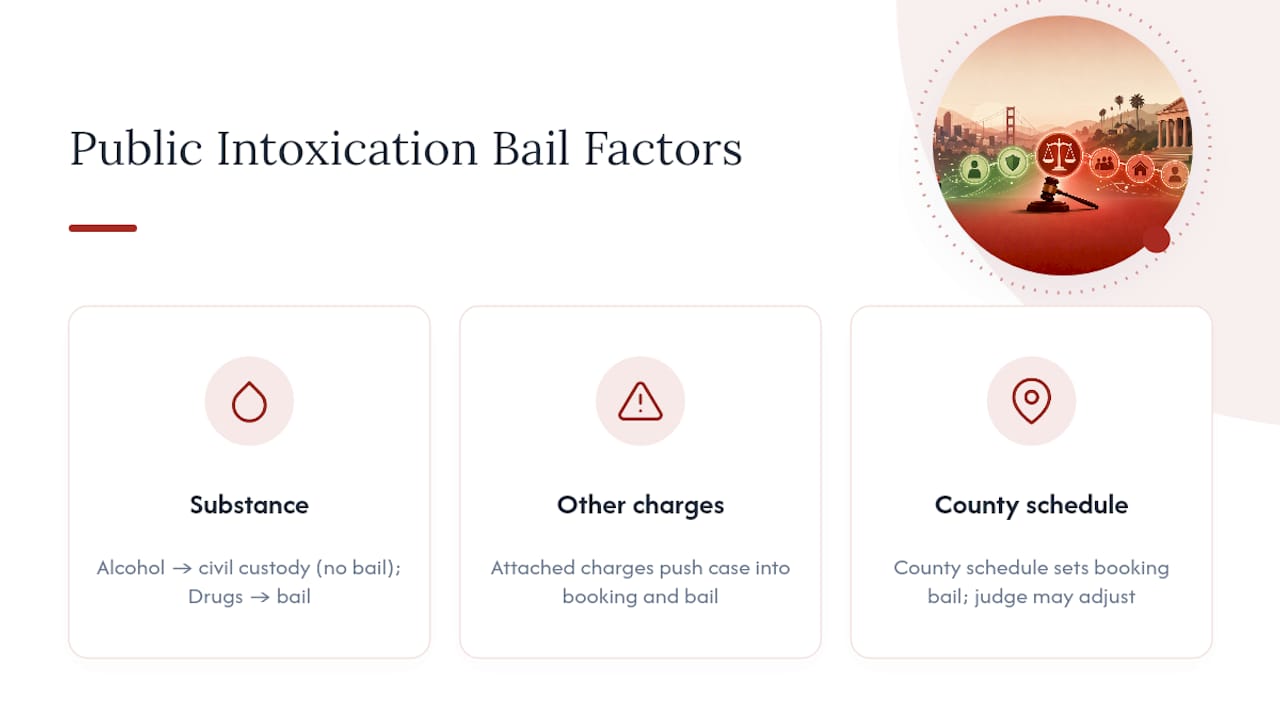
Alcohol-only cases lean hard toward 647(g) civil custody, which sidesteps bail entirely. Drug-related intoxication doesn’t qualify for that alternative, so those arrests are more likely to move into the standard booking and bail process. Each county publishes a uniform bail schedule that jail staff use to set an amount immediately at booking; a judge can adjust it later, usually at arraignment within about 48 hours.
Since a 2026 California Supreme Court decision, courts must set pretrial release amounts a defendant can realistically afford, and prosecutors carry a heavier burden to justify detention. If the schedule amount is out of reach for your family, say so at booking. That flags the case for pretrial affordability review rather than leaving you stuck waiting on a schedule number that assumes you can pay in full.
Prior arrests for public intoxication or a rap sheet with other misdemeanors work against you here. Repeat offenders are less likely to get civil custody or OR release, and judges tend to set higher bail on the theory that the previous cases didn’t change behavior. If you’ve been through this before, a bail reduction motion is often the more realistic path than hoping for OR a second time.
Costs stack up faster than people expect. A surety bond premium runs about 10% of the set bail amount, nonrefundable once the bond is written. Add court fees, penalty assessments, and possibly a mandated alcohol program, and the total cost of a misdemeanor case can exceed the base fine by a wide margin, even when jail time is off the table. PC 647(f) itself caps penalties at six months county jail and a $1,000 fine, but most first-time cases resolve through diversion or informal probation instead. First offenders should ask about pretrial diversion under PC 1001.95 and, later, expungement under PC 1203.4 to keep the arrest from following them.
Timelines vary by county and by how the arrest happened. A straightforward alcohol case with an available sobering center might resolve in a few hours through civil custody, no bail involved. A case with other charges attached, or one that lands during a jail’s busy overnight hours, can mean an overnight stay and a same-day or next-day arraignment before release options firm up. One documented disorderly conduct arrest shows how quickly booking, bail setting, and a first court date can move once a case enters the standard system rather than a diversion track.
Where the Conventional Advice Falls Short
Most explainers treat public intoxication like a straightforward cash-bail case, and that’s the wrong starting point. The statute itself was built around treatment, not punishment. Civil protective custody exists precisely because lawmakers didn’t want every drunk person in America sleeping it off in a jail cell, and it’s the far more common outcome than people assume when alcohol is the only factor at play.
Where the standard advice really breaks down is on the money question. Families panic about bail amounts without asking the one question that actually matters after the 2026 ruling: can we afford this, and did anyone tell the court that? Judges are now required to weigh affordability, but that only happens if it gets raised. Silence at booking gets you the schedule number, no questions asked.
If someone you love has multiple prior public intoxication arrests, don’t assume the playbook that worked last time still applies. Priors change the calculation on OR release and civil custody eligibility. Get ahead of it with a bail reduction request rather than waiting to see what number shows up.
Need Help Posting Bail Right Now?
If civil custody wasn’t an option and bail got set, waiting around isn’t free. A surety bond gets someone out for roughly 10% of the bail amount instead of the full sum in cash, and a family member, friend, or co-signer with steady income can typically sign for it.
Bada Bing Bail Bonds is licensed and available 24/7 across Ventura, Santa Barbara, and Orange Counties, with over 15 years handling exactly these calls at 2 a.m. Flexible financing with a low down payment is available for clients who qualify, and Spanish-language support is offered for families who need it. Have the arrestee’s full name, booking number, and arresting county ready when you call. From there, Bada Bing coordinates directly with local jails and superior courts to move the release along.
For a full walkthrough of how the premium and financing work, see how bail bonds work in California. Ready to move now? Start your application and get someone home tonight.
Sources
- California Code – Penal Code § 647 (Justia)
- California money bail reform decision (The Marshall Project)
- California Penal Code 647(f): Charges, Penalties & Defenses (LegalClarity)
This article is general information, not a substitute for advice from a qualified lawyer. Consult a qualified legal professional about your own circumstances before acting on anything here.