
At 2 a.m., a family member may call from Ventura County Jail after an arrest in Oxnard, Ventura, or nearby. Someone may say, “They’re releasing me without bail,” while the family is still wondering whether to call a bondsman, when pickup can happen, and whether a court date has already been assigned. The phrase sounds reassuring, but it doesn’t mean the case is over or that the person can ignore the court.
“Released without bail” usually means no money is paid upfront for release. It can involve a citation, personal recognizance, an unsecured appearance bond, or supervision with conditions. A person may still need to attend every hearing, follow a stay-away order, check in with pretrial services, or comply with electronic monitoring.
Families in Ventura, Oxnard, Camarillo, Port Hueneme, Thousand Oaks, Santa Paula, Moorpark, Fillmore, Ojai, and Santa Barbara often search for answers before they can reach a lawyer or confirm jail paperwork. This guide explains what the release decision means, how courts assess it, what happens after release, and when local support can still help.
Table of Contents
- When You Hear Released Without Bail After an Arrest
- What Released Without Bail Really Means in California
- How Courts Decide Who Qualifies for Release Without Bail
- Three Common Ways People Are Released Without Bail
- Conditions Compliance and What Happens If You Miss Court
- Practical Next Steps for Families in Ventura County
- Staying Compliant and Getting Support Until Your Case Ends
When You Hear Released Without Bail After an Arrest
A late-night arrest can leave a family working with fragments. A relative may have been stopped by the Oxnard Police Department, booked into Ventura County Jail, and told that release is possible without posting money. Another person may have received a citation and been told to appear in court later. Both situations involve release, but they don’t follow the same process.
The first question is usually, “Do we need bail bonds Ventura right now?” Sometimes the answer is no because the person qualifies for citation release or release on recognizance. Sometimes the person is still being processed, waiting for a review, or facing conditions that haven’t been explained clearly. A release decision can also change if a judge later orders bail, adds conditions, or sets a detention hearing.
Release isn’t the same as dismissal
Being released before trial doesn’t mean the charges disappeared. It means the person can remain in the community while the case moves forward, subject to the court’s instructions. The person may receive a future court date, written terms, or directions from pretrial services.
That distinction matters in Ventura County. A person arrested in Ventura may have a different release path from someone arrested in Oxnard, Camarillo, or Thousand Oaks, even when the allegations appear similar. The arresting agency, charge classification, criminal history, prior court attendance, and local court process can all affect what happens next.
Families often need practical answers immediately:
- Has the person been approved for release?
- Is the release a citation, personal recognizance, or supervised release?
- Where will the person be picked up?
- What court date and conditions appear on the paperwork?
- Can the person leave the county or contact someone involved in the case?
The public arrest and booking process can also create confusion because information may appear before the full release plan is available. Families can use Bada Bing’s recent booking information as a starting point for understanding arrest-related information, but the jail and court remain the proper places to verify official details.
By the end of this guide, you’ll know how nonfinancial release works, why courts attach conditions, what can happen after a missed hearing, and what to verify before deciding whether you need Ventura County bail bonds.
What Released Without Bail Really Means in California
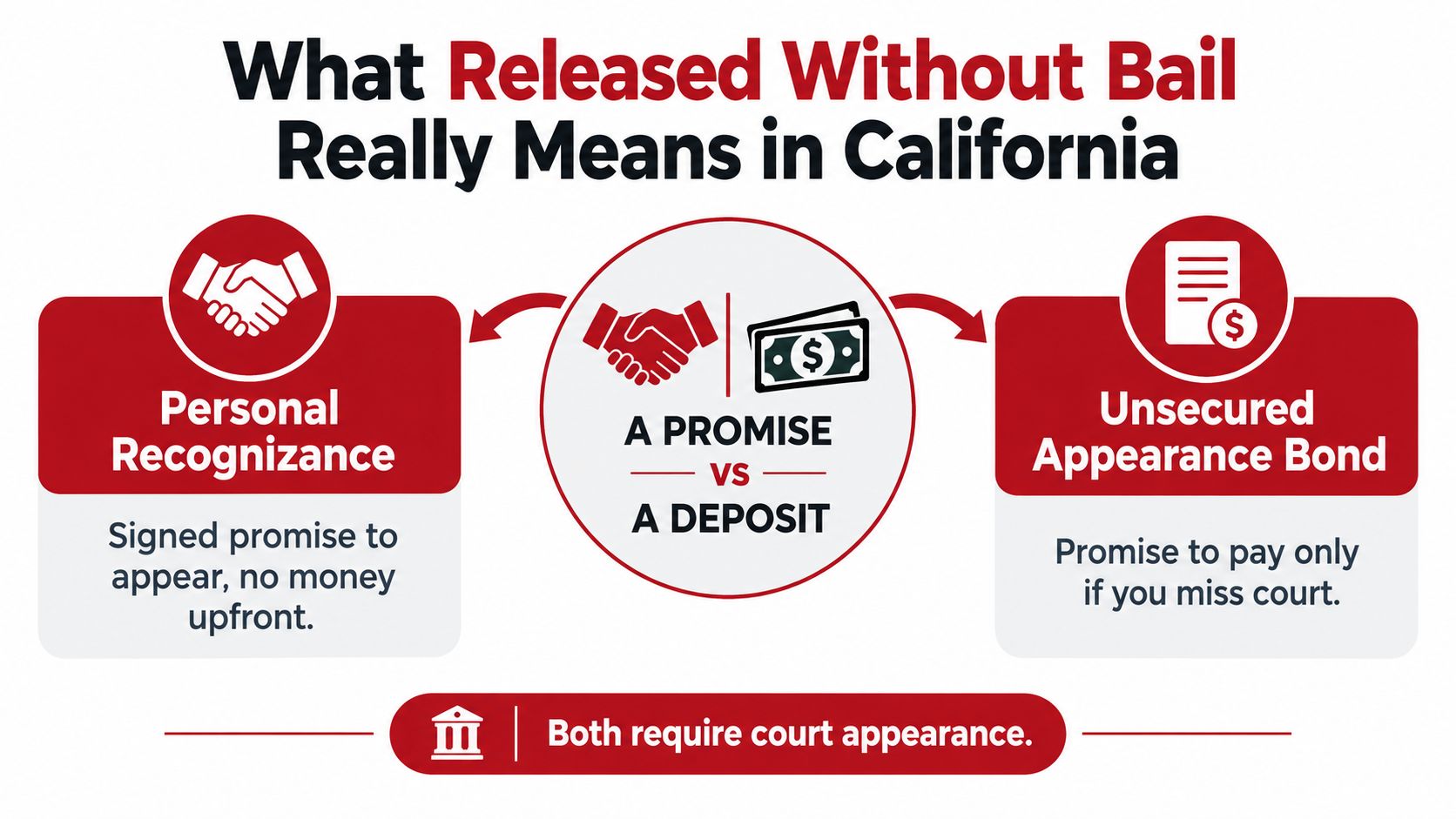
The simplest way to understand released without bail is to compare a promise with a deposit.
A cash bail payment or bond works like a financial deposit tied to release. A nonfinancial release usually relies on the person’s legal promise to return to court. The court doesn’t require money upfront, but the person still accepts enforceable responsibilities.
Two common nonfinancial paths
Personal recognizance, often called ROR or OR, means the person signs a promise to appear. The release doesn’t require money upfront, although the court can impose conditions and can respond to a missed appearance through legal enforcement.
An unsecured appearance bond also allows release without an upfront payment. The person promises to pay a stated amount if they fail to appear, rather than depositing that amount before leaving custody. The distinction is important because an unsecured bond still carries financial consequences even though no money changes hands at release.
The federal system describes release without financial conditions as the default unless the court finds that additional conditions are needed to assure appearance or protect public safety. Pretrial services can evaluate two separate concerns, whether someone may fail to appear and whether someone may engage in new criminal activity during the pretrial period. Federal guidance on release and detention explains that release decisions can include conditions rather than a simple choice between cash payment and detention.
No money upfront doesn’t mean no rules
A person released without bail may still need to:
- Attend scheduled court hearings.
- Keep the court informed of a current address.
- Answer calls or complete check-ins with pretrial services.
- Avoid specific people, places, or conduct.
- Follow travel restrictions or electronic monitoring terms.
California courts also operate within constitutional and statutory rules governing bail, release, and public safety. In practical terms, a judge may use nonfinancial conditions when money alone isn’t the appropriate way to address appearance or safety concerns. The exact terms depend on the case and the court’s order, so families shouldn’t rely on a general explanation instead of reading the release paperwork.
For a plain-English overview of the process, review this explanation of what pretrial release means. If the paperwork says “OR,” “ROR,” “unsecured bond,” or “supervised release,” ask the jail or an attorney to explain the specific obligations before the person leaves.
How Courts Decide Who Qualifies for Release Without Bail
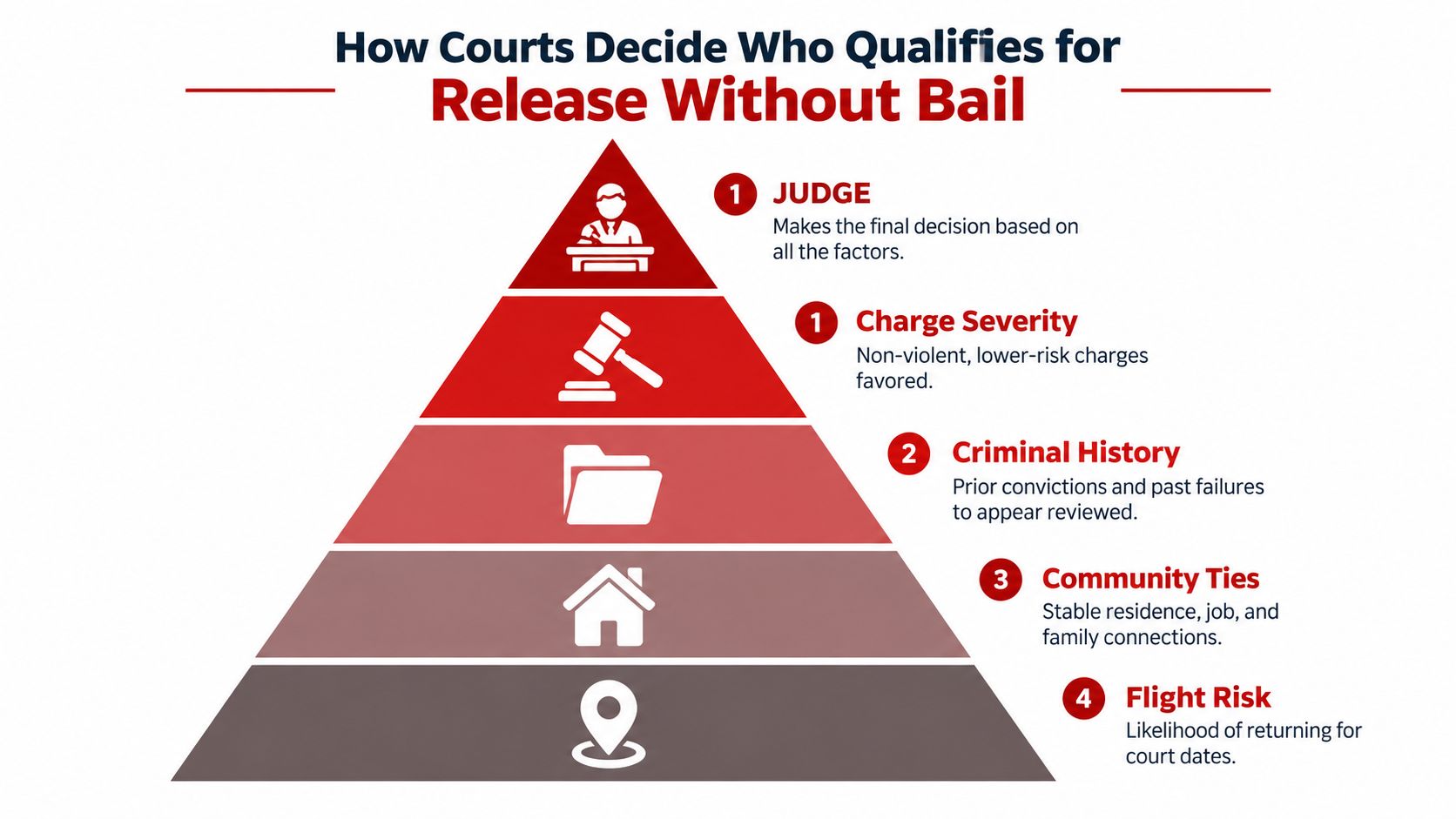
Courts don’t decide eligibility from the charge name alone. A judge may consider the alleged conduct, the person’s history, and the likelihood that the person will return to court and follow conditions.
The factors are combined
Pretrial risk tools can combine charge severity, prior convictions, prior failures to appear, residential stability, employment or caregiver status, substance-use history, and current supervision status. They aren’t meant to reduce a person to one fact. Their purpose is to organize information about two separate risks, nonappearance and new criminal activity during the pretrial period.
A federal instrument described in the research grouped defendants into five risk categories, with observed failure rates of about 3%, 10%, 19%, 29%, and 35% across the categories. The pattern, described in Pretrial Risk Assessment 101, shows why courts often view lower-risk defendants as stronger candidates for release without bail, while higher-risk cases may involve conditions or detention after a hearing.
Why similar cases can produce different outcomes
Two people may face similar charges but receive different release decisions. One may have a stable residence, reliable transportation, and no prior missed hearings. Another may have unresolved warrants, repeated failures to appear, or an existing supervision obligation. The court can view those circumstances differently even when the charge category looks alike.
California bail schedules may provide a starting point for some cases, but a schedule doesn’t guarantee that a person will be released on a particular term. Judicial review, statutory limits, public safety findings, and the facts presented at the hearing can affect the result. Families shouldn’t assume that a listed bail amount automatically tells them whether ROR, supervised release, a bond, or detention will follow.
Risk assessment also requires caution. A tool can inform a decision, but it doesn’t replace a judge’s legal responsibility or an individual’s right to challenge the conditions imposed. The most useful question isn’t, “Is this person low risk?” Ask instead, “What information did the court consider, what conditions were ordered, and what must happen before the next hearing?”
Three Common Ways People Are Released Without Bail
Nonfinancial release can happen at different points in the arrest process. The earlier the decision occurs, the less likely the family is to see a traditional booking-and-release sequence.
| Release Type | When It Happens | Typical Conditions |
|---|---|---|
| Citation release | At the scene or station when the agency issues a citation instead of holding the person for continued custody | Sign or accept the citation, provide information, and appear on the assigned date |
| Release on own recognizance | After booking or court review when the person is released based on a promise to appear | Attend court, keep contact information current, and follow written orders |
| Conditional nonfinancial release | After review when release is allowed but the court or pretrial program requires added structure | Check-ins, reminders, stay-away terms, travel limits, or electronic monitoring |
Citation release
A citation release can feel less serious because the person may never spend an extended period in jail. The citation still functions as a legal instruction. Losing the paper, forgetting the date, or assuming the case was dropped can create avoidable problems.
Own recognizance release
ROR usually means the person signs a promise to appear without paying money at release. The family may still need to arrange transportation, confirm the assigned courthouse, and make sure the person understands every condition.
Conditional release
Conditional release sits between unrestricted personal recognizance and detention. The person may leave custody without money bail, but pretrial services or the court may require contact, reminders, monitoring, or other safeguards.
A clear guide to securing pretrial release can help families understand how release decisions differ from bond posting. That distinction is especially useful when someone is being processed through Ventura County Jail after an arrest in Ventura, Oxnard, Camarillo, or another local city.
Families also ask how long officers can hold someone before release or charges. The answer depends on the circumstances and applicable law, so review this explanation of how long police can hold someone without charges and confirm the current status directly with the jail or a defense attorney.
For a person in Santa Barbara, the same broad categories may apply, but the responsible facility and court instructions can differ. Always identify the actual release document rather than relying on a verbal description such as “no bail.”
Conditions Compliance and What Happens If You Miss Court
The most common misunderstanding is that release without bail means release without supervision. In practice, a person may leave without paying money and still have a schedule of obligations that the court, jail, or pretrial services program expects the person to follow.
Read the conditions before leaving
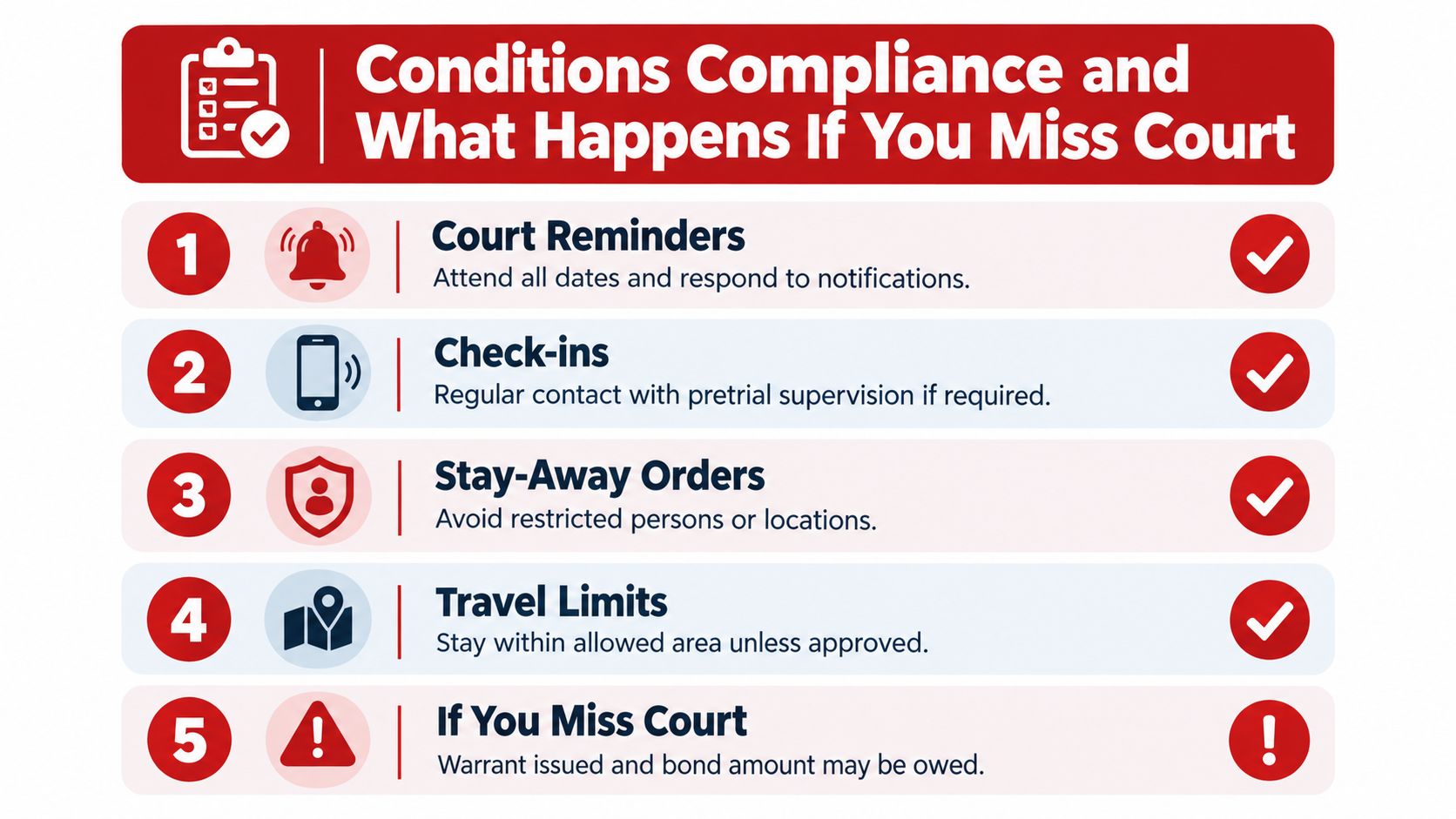
Conditions can include court reminders, scheduled check-ins, stay-away orders, travel limits, and electronic monitoring. A domestic violence case may involve a no-contact or protective order. A case involving substance use may include treatment or testing requirements. The condition must be read exactly as written because casual contact, a visit to a restricted address, or an unapproved trip can create a new problem.
A family member can help by making the obligations visible:
- Court reminders: Put every hearing on a shared calendar and respond to official notifications.
- Check-ins: Confirm the time, method, and location for every required contact with pretrial supervision.
- Stay-away orders: Don’t contact restricted people or visit restricted places, even if the other person initiates contact.
- Travel limits: Ask for approval before leaving an allowed area or changing residence.
- Document storage: Keep the release paperwork, court notices, and supervision instructions together.
A missed hearing can change the situation
If a person doesn’t appear, the court may issue a warrant and take further action. An unsecured bond may also create an amount owed if the person misses court. Release without bail doesn’t erase those consequences because the promise to appear remains a legal obligation.
Pretrial services may track check-ins and other conditions, while the court receives information about compliance. Families should not try to guess whether a missed appointment is excused. Contact the assigned office, defense counsel, or the court as soon as possible, and keep proof of calls, messages, transportation problems, or emergency circumstances.
Practical rule: Treat the first release paperwork like a flight plan. Every date, location, restriction, and required check-in needs a clear answer before the person assumes normal life has resumed.
Support can be simple but deliberate. Arrange a ride, provide a working phone, help with childcare logistics, and check the calendar before each court date. Those steps don’t replace legal advice, but they can reduce the everyday mistakes that lead to missed appearances or alleged violations.
Practical Next Steps for Families in Ventura County
Suppose a relative from Thousand Oaks is booked after an arrest and another family member hears that the person may be released without bail. Start with verification, not assumptions. Confirm the booking through the appropriate Ventura County Jail channel, ask whether the person has been approved for release, and identify whether the status is citation release, ROR, unsecured bond, supervised release, or a pending court decision.
Use a written checklist
Record the following before arranging a ride:
- The person’s full name and booking information.
- The facility handling the release.
- The assigned court and next appearance date.
- Every written condition, including contact, travel, or no-contact terms.
- The expected release window and pickup instructions.
A person arrested in Oxnard may be processed through Ventura County Jail, while an arrest in Ventura, Camarillo, Port Hueneme, Santa Paula, Moorpark, Fillmore, or Ojai may involve different agency touchpoints before the jail record is complete. Santa Barbara families should verify whether the person is being held under Santa Barbara County procedures instead of assuming Ventura County instructions apply.

When a bonds agency can still help
A bonds agency isn’t needed for an approved nonfinancial release. It may still provide practical value when the release decision is unclear, a person remains in custody, or bail is later ordered. A local agent can help explain the difference between release without bail and a financial bond, track information from the jail, clarify what paperwork is still missing, and help a family understand the next step.
That support can matter to people searching for Ventura County Jail bail bonds, bail bonds Oxnard, or bail bonds Thousand Oaks, especially outside normal business hours. A family searching for 24-hour bail bonds Ventura may not yet know whether a bond is necessary, and calling for verification can prevent unnecessary payment or delay.
If bail is later set, California law governs the premium, and families should ask about the total cost, payment arrangements, co-signer responsibilities, and collateral before signing. If the person has just been arrested, this guide on what to do when someone gets arrested provides a practical starting point while you gather official information.
Staying Compliant and Getting Support Until Your Case Ends
Release without bail is a responsibility, not a dismissal. The person remains under the court’s authority until the case ends, and consistent attendance and compliance can prevent a manageable release from becoming a warrant, revocation issue, or new custody event.
Use a short routine:
- Save every court date in two calendars.
- Keep the court and pretrial services informed of address or phone changes.
- Read every condition before acting.
- Ask defense counsel about unclear restrictions.
- Report a missed appointment or emergency promptly.
- Keep copies of all notices and proof of compliance.
A bonds agency can still answer practical questions when bail later applies or when the family needs help understanding release logistics. Bada Bing Bail Bonds operates around the clock, explains the California 10% premium when a bond is required, and provides guidance about payment plans, co-signers, or collateral. It can also provide reminders and check-ins through the case, but it can’t replace a defense attorney or change a court order.
Families should also understand what can happen if the court believes release terms were violated. This explanation of bond revocation can help clarify why a person should respond quickly instead of ignoring a notice or missed date.
If you’re unsure whether someone is approved for release, ask the jail to confirm the status and request the written conditions. If bail is set or the person remains held, contact a local Ventura County agent and defense counsel promptly so the family can make an informed decision.
If your loved one is in Ventura County custody and you don’t know whether bail is required, Bada Bing Bail Bonds can verify the release situation, explain the paperwork in plain English, and provide 24/7 guidance on the next step. Call or visit now with the person’s name, booking details, and facility information so a local agent can help you act without guessing.