Saturday afternoon in a Ventura County kitchen, the radio is playing softly, a dog is resting against someone’s feet, and a mother answers a call from the bondsman. “Good news,” she hears. “The case was stricken off with leave to reinstate.”
Relief arrives first. Her shoulders drop. Then the bondsman explains that the case isn’t completely gone. Her sigh turns into a sharp inhale. The family has moved from celebrating a dismissal to wondering whether the prosecutor can bring the charge back, whether the defendant still has obligations, and what happens to the bail money already paid.
That emotional whiplash is common because stricken off with leave to reinstate sounds final, but often works more like a pause button. The active case is removed from the court’s working calendar, while a path may remain for the prosecution to request its return.
Families usually want four answers within the next couple of days:
- What does this court status mean?
- Why did the judge use it?
- Can the case come back?
- What happens to the 10% bail premium sitting with the bondsman?
If you’re waiting for a loved one’s release or trying to understand a confusing docket entry, inmate release notifications can help you track the practical side while you seek legal advice about the case itself.
Table of Contents
- What Stricken Off With Leave to Reinstate Means
- Why Courts Use It Instead of an Open-and-Shut Dismissal
- How a Prosecutor Puts a Case Back on the Docket
- What This Disposition Does to Bail Money and the Bond
- A Ventura County Timeline You Can Picture
- What Families and Bondsmen Should Do Next
What Stricken Off With Leave to Reinstate Means
A California family may hear this phrase after expecting a case to end. The first reaction is relief, especially when bail has already been posted. Then a new question follows: did the court dismiss the case, or only remove it from the active schedule?
Start with the wording itself. Each part describes a different procedural step.
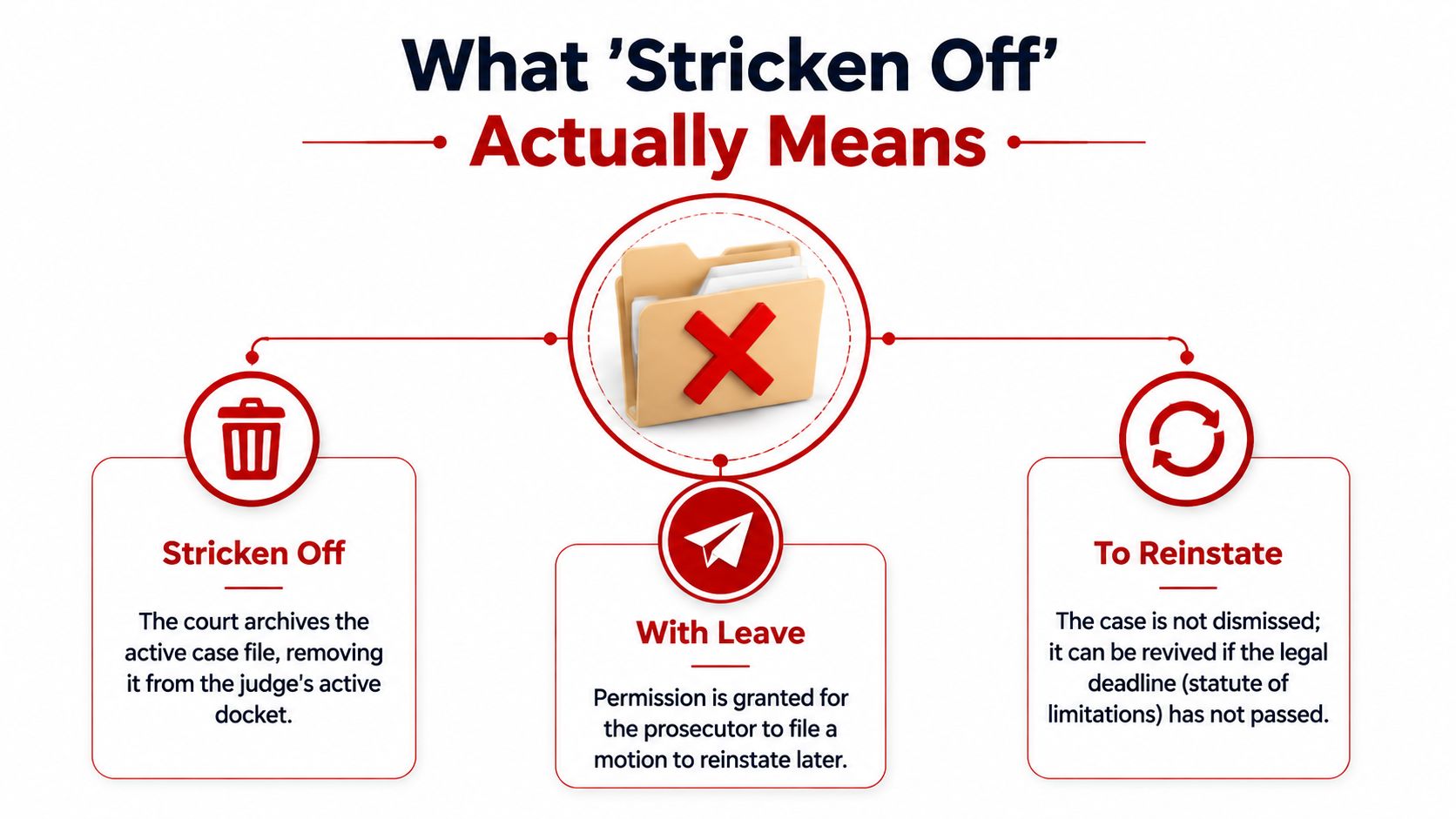
“Stricken off” means the court removes the matter from its active docket. The case is no longer being handled as a regularly scheduled matter at that moment. Like a clerk moving a file from an “open cases” tray into a holding folder, the court places the matter aside rather than treating it as active. A routine appearance may not be immediately scheduled, but the record still exists.
“With leave” means permission remains available. The prosecutor cannot restart the case whenever someone chooses. Instead, the prosecution may ask the court to return the matter to the calendar, subject to the applicable legal deadline and the judge’s ruling.
“To reinstate” means restoring the existing case to the court’s schedule. If the court grants the request, the prosecutor may continue under the same case rather than filing a completely new accusation.
A holding-folder comparison
A repair shop may move a vehicle out of its active work bay because a needed part is missing. The vehicle remains there, and the shop may return it to the bay when the part arrives. The work is paused, not erased.
That comparison helps explain the practical effect. A stricken case is inactive, not necessarily gone. The charge can remain on the court record while the prosecutor decides whether to seek reinstatement within the permitted period. This status does not by itself tell the family whether the prosecution will take that step.
Illinois authority helps explain why the phrase causes confusion. In People v. Bryant, the Illinois Supreme Court stated that an indictment marked “stricken off with leave to reinstate” “remains undisposed of.” That treatment allows the prosecution to return the matter to the docket and continue under the same indictment. The Illinois Supreme Court decision in People v. Bryant provides that procedural foundation.
What the phrase does not mean
This status does not establish innocence. It is not a not-guilty verdict, conviction, acquittal, or clean dismissal under California Penal Code section 1385. It also does not automatically end every issue connected to the charge.
The bail status requires separate attention. Removing a case from the active docket does not, by itself, explain whether the 10% bail premium is refundable, whether the bond remains in effect, or whether the surety has continuing obligations. Families should ask the bondsman and their lawyer to review the order, the docket, and any release conditions together.
California families should obtain the exact order and docket language. Similar wording can operate differently based on the court, the reason for the disposition, and the deadline stated in the order. Court-administration materials describing the abbreviated SOL wording treat it as a case stricken from the docket with permission for charges to be reinstated later. Related materials also show that reinstatement may depend on a stated window. The Illinois court-administration materials describing SOL docket treatment show why that deadline matters.
Practical rule: Treat the entry as inactive until a lawyer confirms whether the legal deadline has passed and whether a reinstatement request remains possible. Ask the bondsman separately what the status means for money already posted and the bond paperwork.
Why Courts Use It Instead of an Open-and-Shut Dismissal
A judge may use this middle-ground disposition when the prosecution isn’t ready to proceed but the court isn’t treating the matter as permanently over. The reasons can be practical: a witness may be unavailable, a report may still be pending, or the complaining witness may no longer be cooperating. None of those facts proves guilt, and none automatically proves that the charge should survive.
The speedy-trial problem
California criminal procedure includes speedy-trial protections, and defense counsel may raise a timing objection when the prosecution hasn’t moved the case forward within the applicable period. The plan of action then becomes difficult for the prosecutor. Continuing the case without a sufficient basis may violate the defendant’s rights, but abandoning the charge permanently may also prevent the People from pursuing it later.
“Stricken off with leave to reinstate” can function as a procedural compromise. The active courtroom schedule stops for the moment, while the prosecutor may preserve a route back if the law and the court permit it. The entry is therefore docket management, not a ruling that the defendant committed the offense.
Illinois decisions help explain the underlying logic. A federal decision reviewed in an immigration context, citing Ferguson v. Illinois, described the proceeding as continuing until the State is barred from reinstating it, with the bar connected to expiration of the applicable speedy-trial period after a demand for trial. That USCIS-reviewed decision discussing reinstatement and speedy-trial finality is Illinois-focused, so a Ventura County family shouldn’t assume its timing rules automatically control a California case.
How the dispositions differ
| Disposition | Case Still Alive | Can Prosecutors Refile | Typical Trigger |
|---|---|---|---|
| Stricken off with leave to reinstate | Usually inactive but potentially pending | The prosecutor may seek reinstatement within the allowed legal window | The case isn’t ready for active prosecution |
| Unconditional dismissal | Generally no active case remains | Depends on the order and governing law | The court ends the matter without reserving a reinstatement path |
| Dismissal with prejudice | No ordinary prosecution on the dismissed charge | Usually barred by the final nature of the order | A legal defect or ruling prevents further prosecution |
| Acquittal | No | No retrial for the same offense, subject to narrow legal exceptions | The fact-finder determines the defendant isn’t guilty |
| Conviction | Yes, for sentencing or post-conviction proceedings | Refiling isn’t the issue | The defendant has been found guilty or entered a guilty plea |
The exact legal effect depends on the jurisdiction and order. A Ventura County defendant should have a criminal defense attorney review the docket rather than relying on a general explanation of an Illinois-origin phrase.
How a Prosecutor Puts a Case Back on the Docket
Reinstatement doesn’t happen because a deputy district attorney makes a private phone call. The prosecutor generally must take a formal step that gives the defense and the judge an opportunity to respond.
The file review comes first
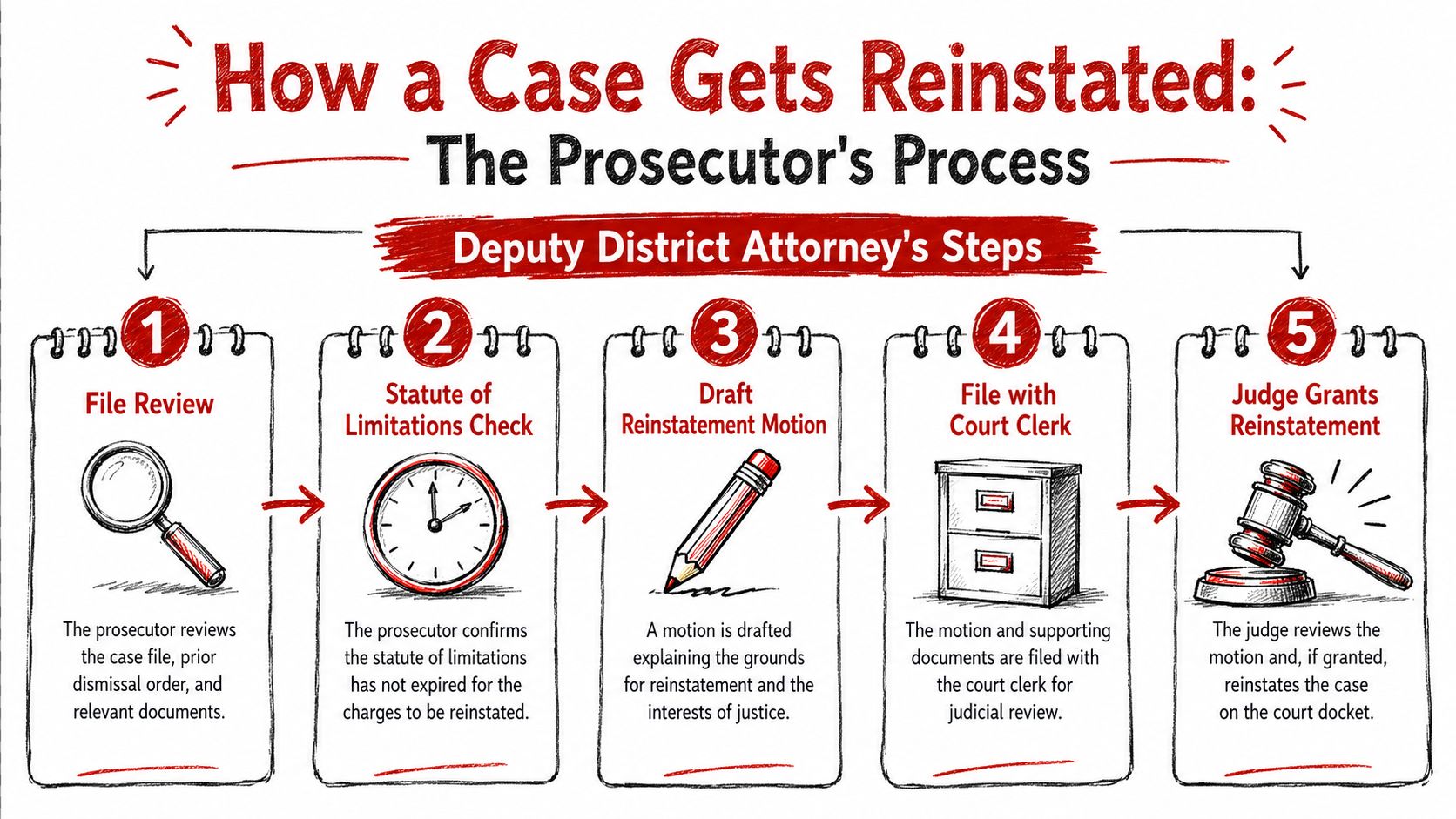
The deputy district attorney reviews the police reports, witness information, reports from forensic personnel, charging documents, and the reason the case was removed from the active calendar. The prosecutor also checks whether the legal deadline still leaves room to request reinstatement.
A simple working outline looks like this:
- Review the file. The prosecutor identifies what prevented the case from moving forward and whether that problem has changed.
- Check the deadline. The prosecutor determines whether the applicable statute of limitations, speedy-trial rule, or court order still permits action.
- Prepare the request. The prosecution drafts a motion, declaration, or other filing asking the court to restore the case.
- File with the clerk. The request becomes part of the court record and is assigned for judicial review.
- Attend the hearing. The judge decides whether reinstatement is legally and procedurally proper.
Notice gives the defense a chance to respond
The defendant and defense counsel need formal notice of the request and hearing. Depending on the circumstances, notice may involve personal service, mailed notice, electronic court notice, or another method authorized by the court. Keeping the defendant’s address current matters because missed notice can create avoidable confusion.
The judge may ask why the case was stricken, why the prosecution wants it restored, whether the request was filed on time, and whether the defendant objects. Defense counsel can argue that the deadline expired, that the prosecutor lacks good cause, or that the defendant’s speedy-trial rights prevent the case from continuing.
Families can monitor the Ventura County court system for general court information, but a court portal doesn’t replace counsel’s review of motions and service. A docket entry may show that something was filed without explaining what legal argument the parties made.
A reinstatement request is a court event, not an automatic revival. The judge still has to determine what happens next.
What This Disposition Does to Bail Money and the Bond
For a family that paid for release, the legal status of the case and the financial status of the bond are related but not identical. A case being removed from the active docket doesn’t automatically tell the surety company that its obligation has ended.
The bond may remain posted and liable while the court preserves a path for reinstatement. The co-signer may still need to keep contact information current, respond to the bondsman, and make sure the defendant attends any future hearing. Collateral pledged to the surety generally remains connected to the undertaking until the company receives confirmation that the bond has been exonerated or otherwise released.
The premium and collateral are separate questions
California’s Department of Insurance explains that surety bail bond charges are most commonly 10% of the total bond amount, and that surety companies file their rates with the state. The California Department of Insurance explanation of bail bond rates also gives the practical example that a $25,000 bond typically carries a $2,500 premium.
That premium pays for the bond service and isn’t automatically refunded because the prosecution later stops using the active calendar. Refund eligibility depends on the contract, the timing, the court’s action, and the surety’s policies. Ask the bondsman to explain the written agreement instead of assuming that a dormant case creates a refund.
Collateral is a different issue. If a family pledged property, a vehicle interest, or another form of security, the release process usually requires confirmation that the bond obligation has ended. A co-signer shouldn’t assume that “stricken off” means the collateral can be collected immediately.
Compare the practical outcomes
| Disposition Type | Bond Still Liable? | Premium Refundable? | Collateral Status |
|---|---|---|---|
| Stricken off with leave to reinstate | May remain active until formally released | Not automatically | May remain held until exoneration or release paperwork |
| Active pending case | Usually yes | Usually not simply because the case continues | Remains subject to the agreement |
| Dismissed with final effect | Liability may end after court confirmation | Depends on the contract and circumstances | Release may begin after confirmation |
| Bond exonerated | No further bond liability | Depends on the contract | The surety can process its release obligations |
The meaning of bail exoneration is the key practical concept. Families should request written confirmation of whether the bond is still active, what event will release it, and which documents are needed to return collateral.
A Ventura County Timeline You Can Picture
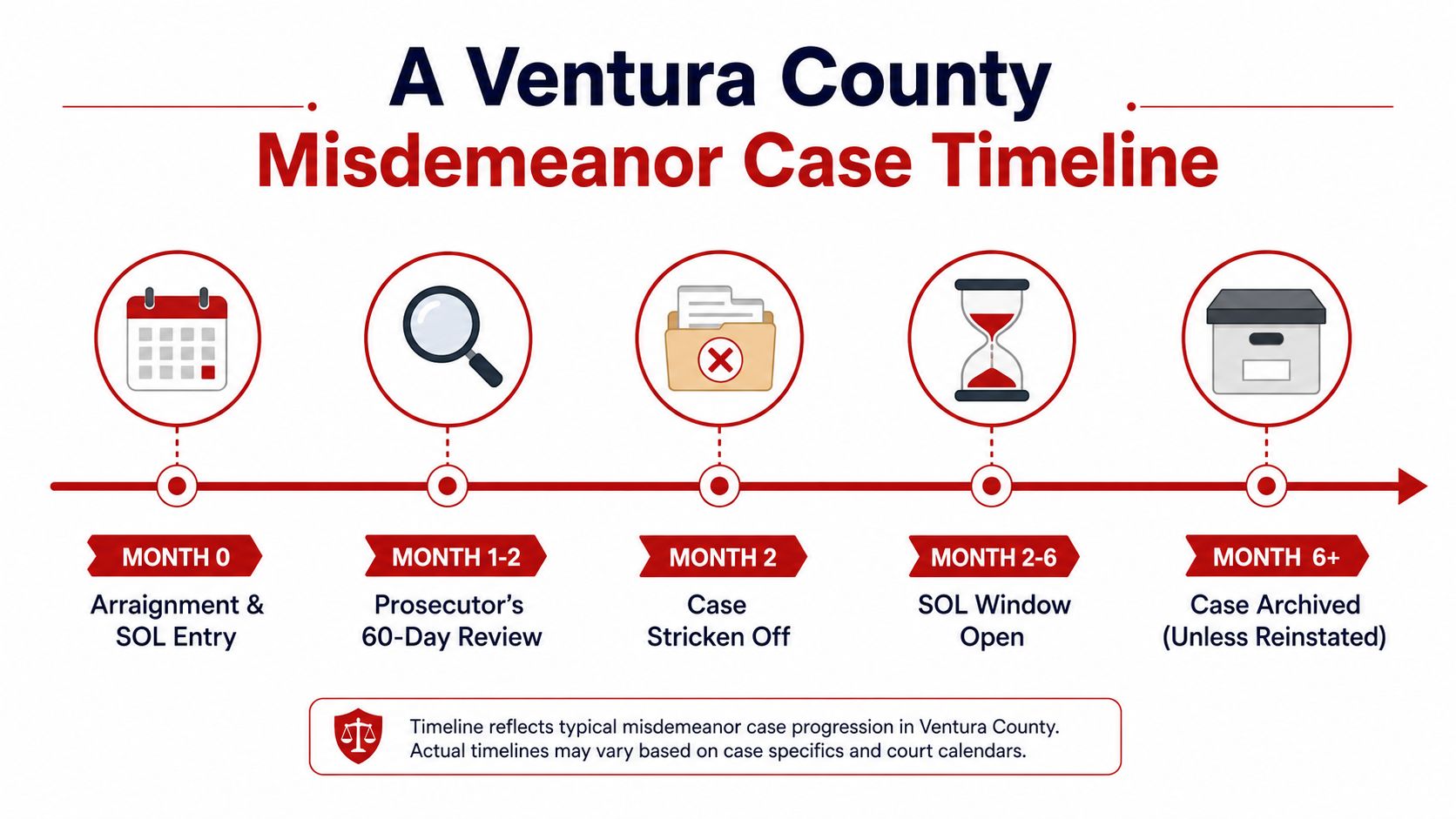
A Ventura County family may feel relief when a misdemeanor case is marked stricken off with leave to reinstate. Then a second worry sets in: the case is dormant, not gone. The defendant may be out of custody on a bond, so the family should treat that bond as active until the surety confirms otherwise.
A sample calendar
- Month 0: At arraignment, the judge enters the SOL disposition on the docket after the prosecution explains that the file needs further review.
- Month 1: The prosecutor reviews reports, contacts witnesses, and checks whether missing information can be obtained.
- Month 2: The prosecution decides whether to request reinstatement before the applicable deadline.
- Month 2 to Month 6: The case remains inactive unless the court grants a reinstatement request. The bond may still remain in place during this quiet period.
- Month 6 and later: If no timely reinstatement occurs, the family asks counsel to confirm whether the matter is legally final and whether further relief is available.
The calendar is an illustration, not a universal Ventura County schedule. The deadline may depend on the charge, the order, prior continuances, statutory rules, and other case-specific facts. A docket label alone cannot establish the controlling date.
The bondsman’s parallel calendar
While the prosecutor reviews the file, the bondsman may monitor the court record, check for a new hearing, and remind the defendant to remain reachable. The family should keep the agreement and every notice together, then report address or phone changes promptly. Those steps help prevent a quiet case from becoming a missed-notice problem.
Jail processing and the court case are separate tracks. If the defendant is arrested on a new matter, the family may need a new bail evaluation even while the earlier case remains dormant. For general custody information, review the Ventura County booking process.
If a new arrest occurs, local posting instructions also matter. Ventura County says bail may be posted at the Pre-Trial Detention Facility at 800 South Victoria Avenue in Ventura, using exact cash, a cashier’s check payable to the Ventura County Superior Court, a bail bond, or a debit or credit card through GovPayNet using PLC #6404. The Ventura County Sheriff’s posting-bail information identifies those options.
What Families and Bondsmen Should Do Next
A California family may feel relief when a defendant is released and no new hearing appears. Then the court status raises a new concern: the case is dormant, not gone. The bond and the case still need follow-up.
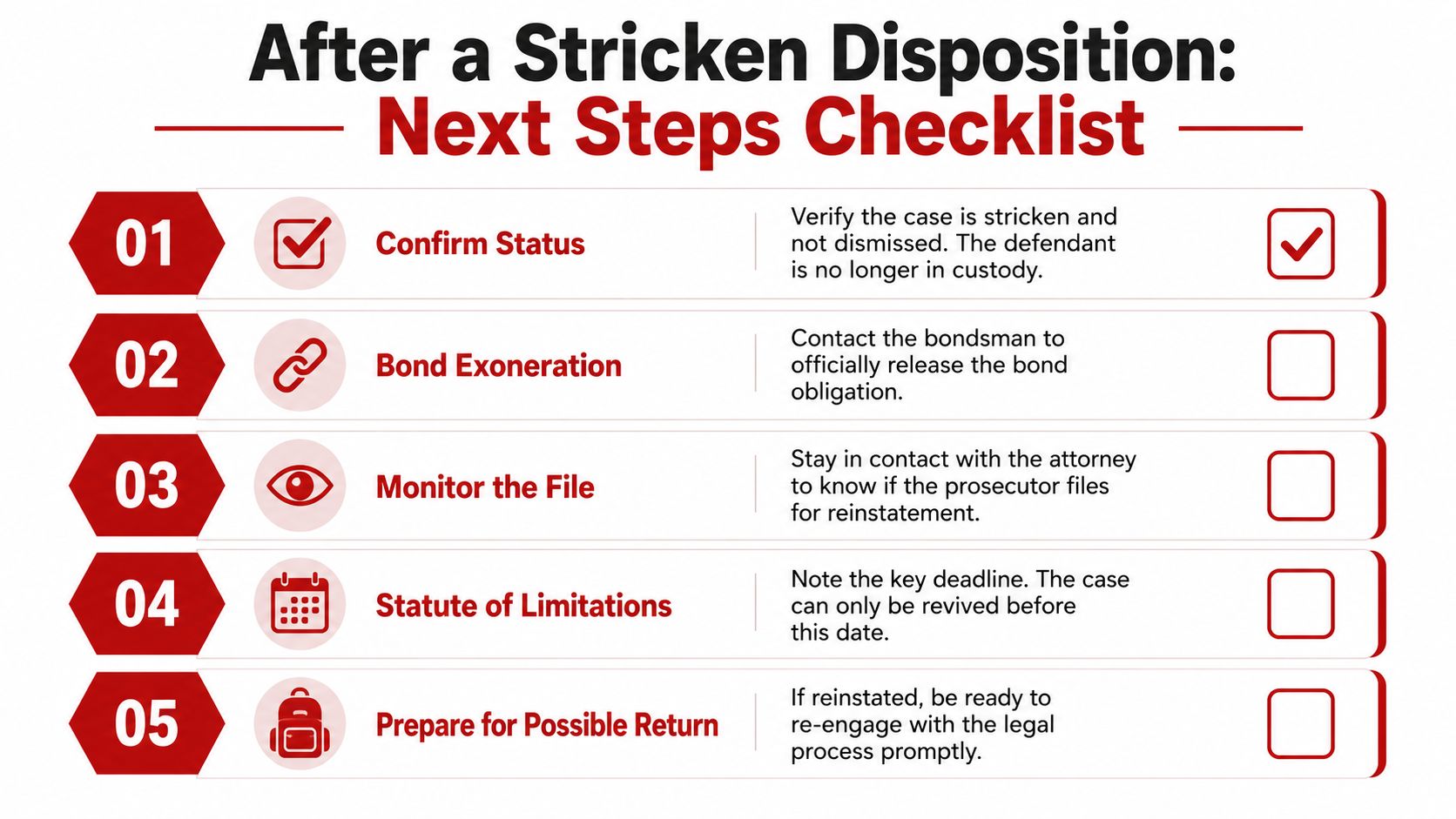
A practical checklist
- Confirm the exact status. Ask the clerk or defense attorney for the docket entry. Check whether it says stricken off with leave to reinstate, dismissed, dismissed with prejudice, or another disposition.
- Keep the paperwork together. Save the docket, bond agreement, payment records, collateral documents, and court notices in one secure place.
- Calendar the legal deadline. Set a reminder before the applicable reinstatement or speedy-trial window closes. The order, defense counsel, or governing law must provide the controlling date.
- Maintain reliable contact information. Give defense counsel and the bondsman current address, phone, and email details so a notice does not go to an old location.
- Ask for written bond information. Confirm whether the bond remains active, whether collateral is still held, and what event releases it. A case being off the calendar does not automatically answer those bond questions.
Know who to call
Call the bondsman about collateral, the bond’s current status, premium questions, payment arrangements, court-date reminders, or a new arrest. For immediate guidance after an arrest, review this step-by-step guide on what to do when someone gets arrested. A local agency can also explain jail posting procedures for families searching for bail bonds Ventura, Ventura County bail bonds, bail bonds Oxnard, or Ventura County Jail bail bonds.
Call a criminal defense attorney about whether the charge is legally final, whether the prosecutor can reinstate it, whether a motion to dismiss is appropriate, and whether sealing or expungement may be available. Legal counsel should answer those questions, while the bondsman explains the financial and custody side.
Families in Ventura, Oxnard, Camarillo, Port Hueneme, Thousand Oaks, Santa Paula, Moorpark, Fillmore, Ojai, and Santa Barbara may also need jail logistics. Ventura Superior Court publishes a local bail schedule stating that presumptive bail applies to warrantless arrestees until a judge reviews the issue. The initial amount may therefore come from the schedule before judicial adjustment.
Release after posting takes processing time. A Ventura County guide states that processing typically takes two to eight hours, depending on facility volume, while another local jail guide describes around-the-clock posting availability. Searches for 24-hour bail bonds Ventura and bail bonds Thousand Oaks often reflect a need for immediate coordination, not a guarantee of instant release.
Bada Bing Bail Bonds offers 24/7 assistance with Ventura County bookings, bond paperwork, court-date reminders, and explanations when a case is stricken off with leave to reinstate. Visit Bada Bing Bail Bonds to speak with a local licensed agent about bond status, collateral questions, and the next practical step.