A family in Ventura gets the kind of call nobody wants. One person has been arrested, the other is scared, and everyone is asking the same question, what order should be filed, and what happens if the wrong one is chosen first? In California, that choice matters because the court routes protection by relationship, age or dependency, workplace risk, or a narrow public-safety trigger, not by one universal form. If you’re trying to understand the types of restraining orders in California, start with the facts of the situation, not the form name.
Table of Contents
- Why the Right Restraining Order Matters in California
- Domestic Violence Restraining Orders DVRO
- Civil Harassment, Elder, and Workplace Violence Orders
- Gun Violence, School Violence, and Other Specialized Orders
- How EPOs, TROs, and Long-Term Orders Work Together
- Restraining Orders and Bail in Ventura County Cases
- Violating a Restraining Order and the Consequences
- How to File the Right Order in Ventura County
Why the Right Restraining Order Matters in California
A worried parent in Oxnard may call it a restraining order, but the court usually begins with a more practical question. What is the relationship, what happened, and who needs protection. If the other person is a spouse, former spouse, dating partner, cohabitant, close relative, or co-parent, the case usually belongs in Domestic Violence Restraining Order territory. If those facts do not fit, the court looks at other tracks, like civil harassment, elder abuse, workplace violence, or a narrower public-safety order.
That routing system exists because California uses a relationship-based taxonomy. The relationship between the people involved controls the petition path, the form set, the venue, and the relief the judge can order, including move-out orders and firearm surrender in domestic violence cases, or no-contact and stay-away terms across categories. The California courts’ self-help page lays out that relationship-first framework in plain terms, and it also shows that the state recognizes several distinct order categories, not one generic filing (California Courts self-help on restraining orders). For a family in Ventura County, that can feel confusing after an arrest, because the facts often overlap and the label on the paperwork does not tell the whole story.
A good way to sort it is to ask four practical questions.
Practical rule: the trigger matters more than the emotion. The court wants the legal relationship, the age or dependency status, the workplace connection, or the firearm-risk context.
A simple screening conversation often sounds like this:
- Is there a close family or intimate relationship? That points toward a DVRO.
- Is the protected person 65 or older, or a dependent adult? That points toward elder or dependent adult abuse.
- Is an employer trying to protect an employee from workplace threats? That points toward workplace violence.
- Is there no qualifying relationship at all? That often points toward civil harassment.
A single incident can still fit more than one category. A breakup can involve threats, stalking, and shared children. A neighbor dispute can become harassment, but if the parties also lived together, the domestic-violence category may be the better fit. A parent in Ventura or Oxnard who is trying to choose the right form is often really sorting out which facts the court uses to route the case, because that choice affects what protection can be requested and how quickly the judge can act.
The distinction between a protective order and a restraining order can help here, especially if you are trying to understand why one situation gets routed one way and another gets sent somewhere else (the difference between a protective order and a restraining order). California also uses a three-stage protection timeline in many cases. An emergency order may come first when danger is immediate, a temporary order can hold things in place until hearing, and a longer order can follow after the judge hears from both sides. The terms sound similar, but each stage does a different job. If you only remember one thing, remember this, the category answers who the order is for, and the stage answers how fast protection starts.
Domestic Violence Restraining Orders DVRO
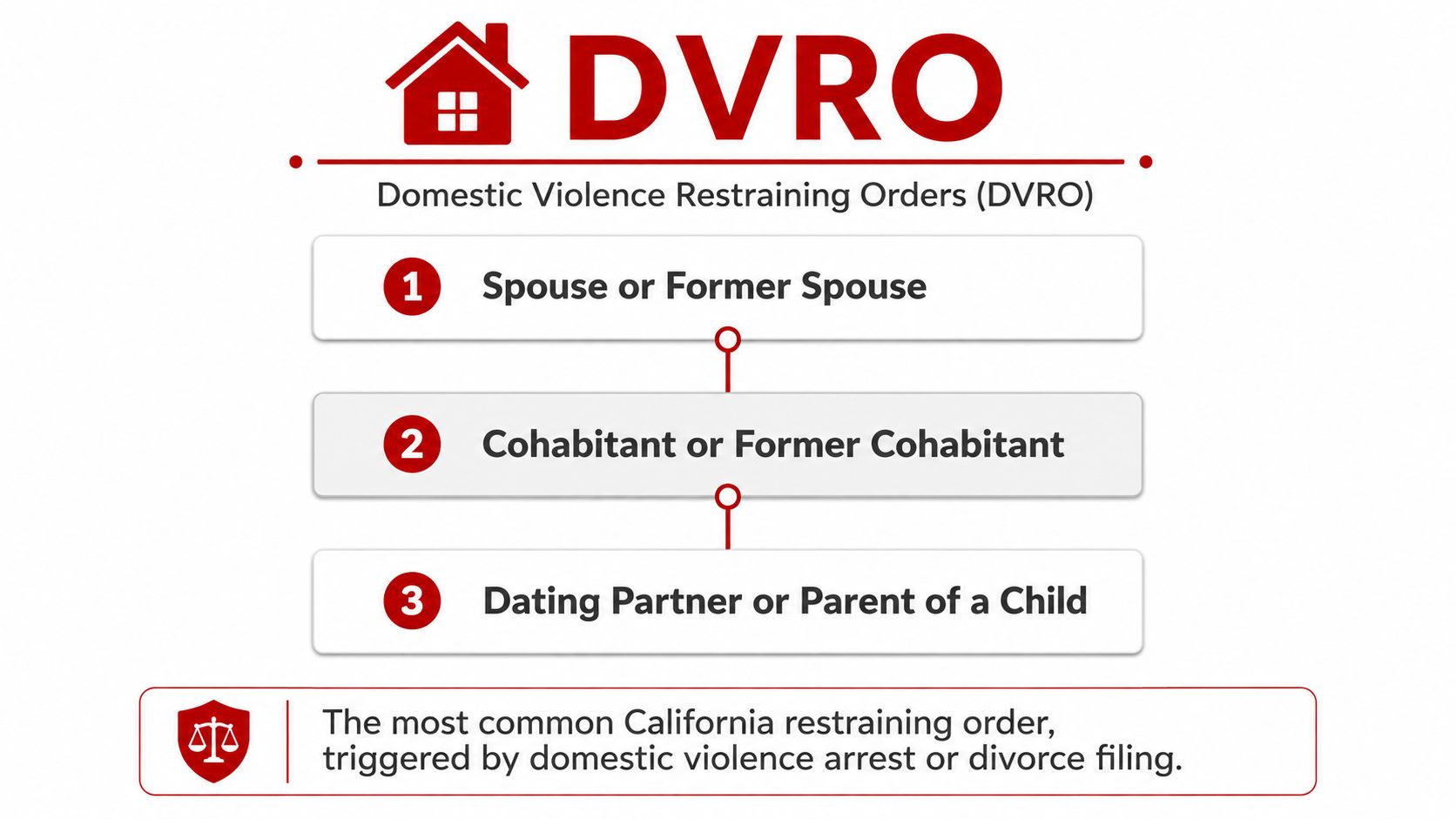
A DVRO is the order individuals typically seek when attempting to obtain protection from an abusive spouse, partner, or family member. In Ventura or Oxnard, that often arises after a breakup, a police call, or a custody dispute that has turned unsafe. California also treats DVROs as a major part of its protection-order system, which is why they appear frequently in family law and criminal cases alike.
Who qualifies and what the court can order
A DVRO applies when the restrained person is a current or former spouse, dating partner, cohabitant, former cohabitant, or a parent of a child in common. California courts explain that a DVRO can include more than a simple stay-away term. It can include no contact, stay-away distances, move-out orders, firearm-related prohibitions, and, in some cases, support obligations if the parties are married or have children together (California Courts DV restraining order page).
That matters because the order can affect everyday life in ways people do not expect. Someone in Ventura County may hear “restraining order” and assume it only means no texts or calls. In practice, it can also affect housing, access to the home, parenting exchanges, and firearms. The firearm issue often surprises people, because the court can attach firearm restrictions as part of the order instead of treating it as a separate warning later.
Conduct also matters. Threats, stalking, repeated unwanted contact, and fear-based behavior can support a DVRO when the relationship fits. For a closer look at what constitutes felony stalking under California law, the conduct may overlap with a criminal case as well as a family court request.
How to read the relationship rule
A DVRO starts with the relationship, then the conduct. If the relationship fits the statute, the court can decide whether the behavior inside that relationship is serious enough for protection.
The quickest way to sort the category is to ask one clean question. Were the two people in a relationship California recognizes as domestic. If yes, the DVRO forms are usually the right place to start. If not, the case usually moves into a different category even if the fear feels just as serious.
California’s earlier statewide research also shows how central domestic-violence orders are to the system overall. On June 6, 2003, there were 227,941 active restraining orders against adults in California, and 72.2% of those orders protected a woman while restraining a man (statewide study). While this data is from 2003, it illustrates the long-standing pattern of how domestic violence restraining orders are distributed across the state. That same study reported that 9.2% of orders documented no firearm restrictions, a reminder that even when the law is broad, the details of each order can vary.
If someone in a Ventura County arrest situation needs help thinking through release conditions alongside the protective-order issue, it helps to look at the relationship rule and the criminal case rule together. A domestic case can involve both.
Civil Harassment, Elder, and Workplace Violence Orders
A neighbor dispute in Ventura, a troubling caregiver situation in Oxnard, and threats at a job site may all need protection, but each one points to a different California petition. That is why civil harassment, elder or dependent adult abuse, and workplace violence orders exist. They all address harmful conduct. They do not all start from the same trigger, and that trigger controls where the case belongs.
Three different triggers, three different petitions
Civil harassment applies when there is no qualifying intimate or family relationship. A neighbor, a roommate, an acquaintance, or even a distant relative can fit here if the relationship does not support a DVRO. The conduct can include threats, stalking, sexual violence, or repeated harassment that keeps someone on edge.
Elder or dependent adult abuse protects someone who is 65 or older or a dependent adult. That category often fits when the harm involves physical abuse, neglect, isolation, or financial abuse. The law focuses on the protected person’s vulnerability, so the filing question is not just who the harasser is, but who is being harmed and why the person needs that extra protection.
Workplace violence follows a different path. An employer files it to protect an employee from credible violence, threats, or harassment at work. The employee usually is not the petitioner. That matters in real life, because a worker in Santa Paula or Moorpark may feel immediate danger at the job site, yet still need the employer to start the court process.
California’s restraining-order categories are organized around those triggers, which is why the right form starts with the facts, not with the label someone prefers. A neighbor conflict is not a domestic violence case just because the people know each other. A caregiving dispute is not civil harassment if the protected person qualifies as a dependent adult. The relationship, age, and work setting point the court to the correct petition.
A quick comparison for non-DVRO cases
| Order Type | Who Can File | Relationship to Respondent | Typical Duration |
|---|---|---|---|
| Civil Harassment | The protected person | No intimate or family relationship | Depends on the order stage and hearing result |
| Elder or Dependent Adult Abuse | The protected person or appropriate representative | No DVRO relationship required, protected person must qualify by age or dependency | Depends on the order stage and hearing result |
| Workplace Violence | The employer | Employer files on behalf of employee | Depends on the order stage and hearing result |
A practical example makes the difference easier to see. If a tenant is threatened by a landlord’s relative, the facts may fall outside DVRO even though the fear is real. If a 72-year-old in Oxnard is being pressured into signing over accounts, elder abuse may be the better filing path. If an employee is stalked at a Santa Barbara storefront, the employer may need to act quickly through the workplace violence process.
The workplace context can also overlap with criminal issues. If the same conduct leads to restraint, confinement, or blocked movement, it may raise separate charges, including how false imprisonment charges relate to restraining order violations. That overlap is one reason families and employers should look at the facts carefully before choosing the petition.
Rule of thumb: if the relationship does not fit DVRO, do not force it. California has other categories for a reason.
Gun Violence, School Violence, and Other Specialized Orders
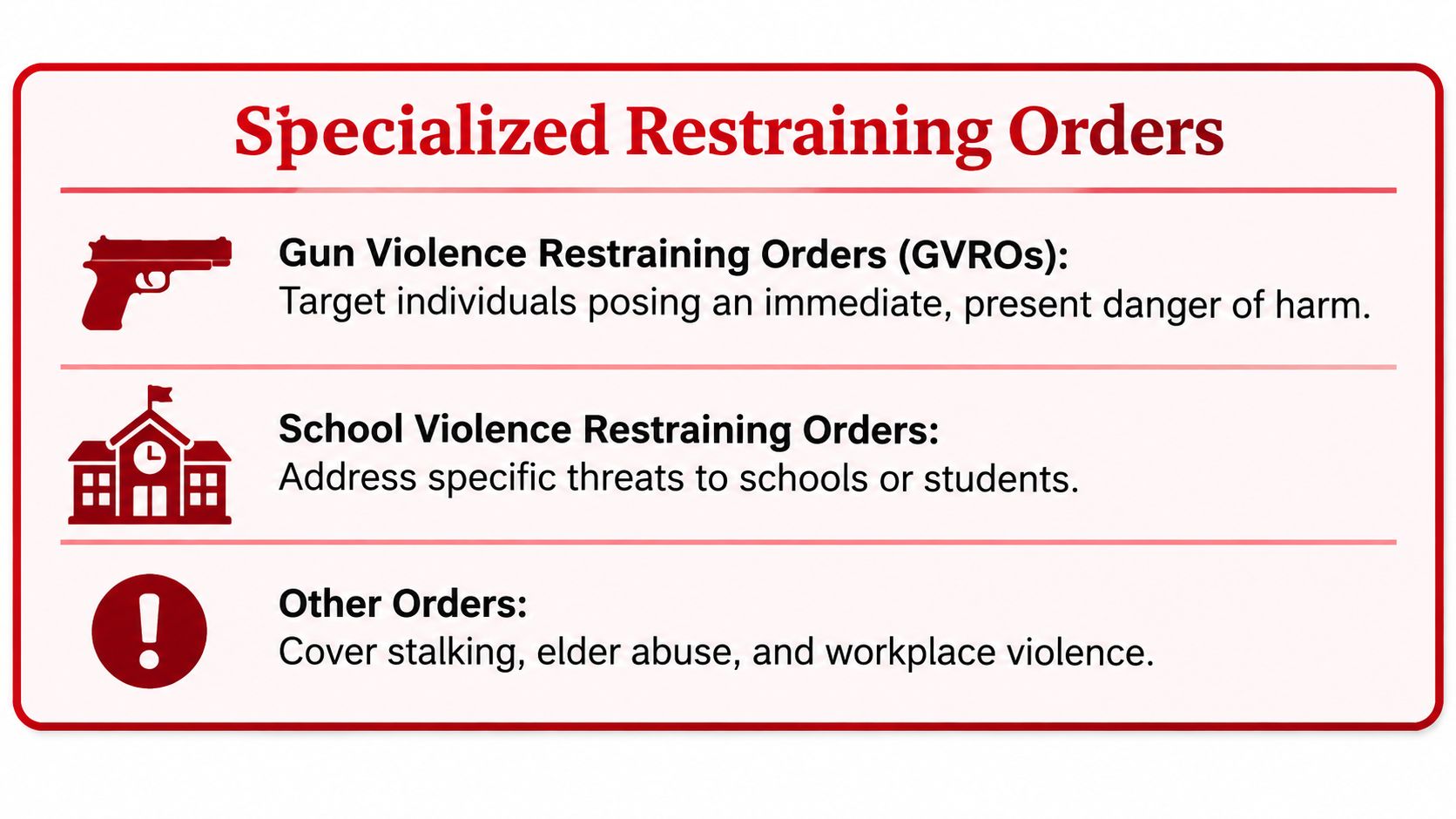
A family in Ventura may be dealing with a threat that does not fit the usual domestic violence or civil harassment labels, yet still needs court protection. California has narrower orders for those situations, including gun violence, school violence, and other specialized public-safety orders. The California Courts outline these categories in their general restraining-order materials, and the reason they exist is simple, the risk itself is different.
A Gun Violence Restraining Order, or GVRO, comes into play when a person is believed to pose an immediate and present danger of harming themselves or others with a firearm. Family members, roommates, and law enforcement can ask for this kind of protection. A Gun Violence Emergency Protective Order can also be requested 24/7 through law enforcement in urgent situations, which means a crisis involving a firearm does not have to wait for ordinary courthouse hours. That route matters in real life, because a dangerous moment in Oxnard or Ventura can develop late at night, on a weekend, or during a holiday.
A School Violence Restraining Order is a different tool. It is used by schools and college administrators responding to a credible threat against a school community or a student. That makes it less like a family dispute filing and more like a safety measure tied to a campus setting, even when the fear behind it feels just as serious.
Understanding how a Gun Violence Emergency Protective Order works helps show why these specialized orders are handled differently from the more familiar civil forms. The process often starts with the risk itself, not with the usual courthouse paperwork flow.
Other specialized options also appear in the California Courts framework, including categories tied to retail crime and juvenile situations. Many families never need those forms, but they explain why a simple list of “the main types” can leave out important protections. The court system has become more specific because the factual triggers are more specific.
A Ventura reader may search for “types of restraining orders in California” and see one set of categories on one page, then a broader set on another. That is not a contradiction. Some explainers focus on the most common civil petitions, while the court system also recognizes narrower orders for firearm risk, school threats, and related public-safety concerns. The core question is the trigger, not the label.
For specialized orders, the timeline can also work a little differently from the standard courthouse path. A firearm-related emergency can begin with law enforcement, which gives the system a way to respond before a judge hearing is scheduled. That makes the early step more immediate than the ordinary filing process people usually picture, and it is one reason these orders deserve their own category.
If the situation involves a gun, a school, or another narrow public-safety threat, the right filing path may be very different from a family, landlord, or neighbor dispute. That is why these orders belong on the same map, even though they are used less often.
How EPOs, TROs, and Long-Term Orders Work Together
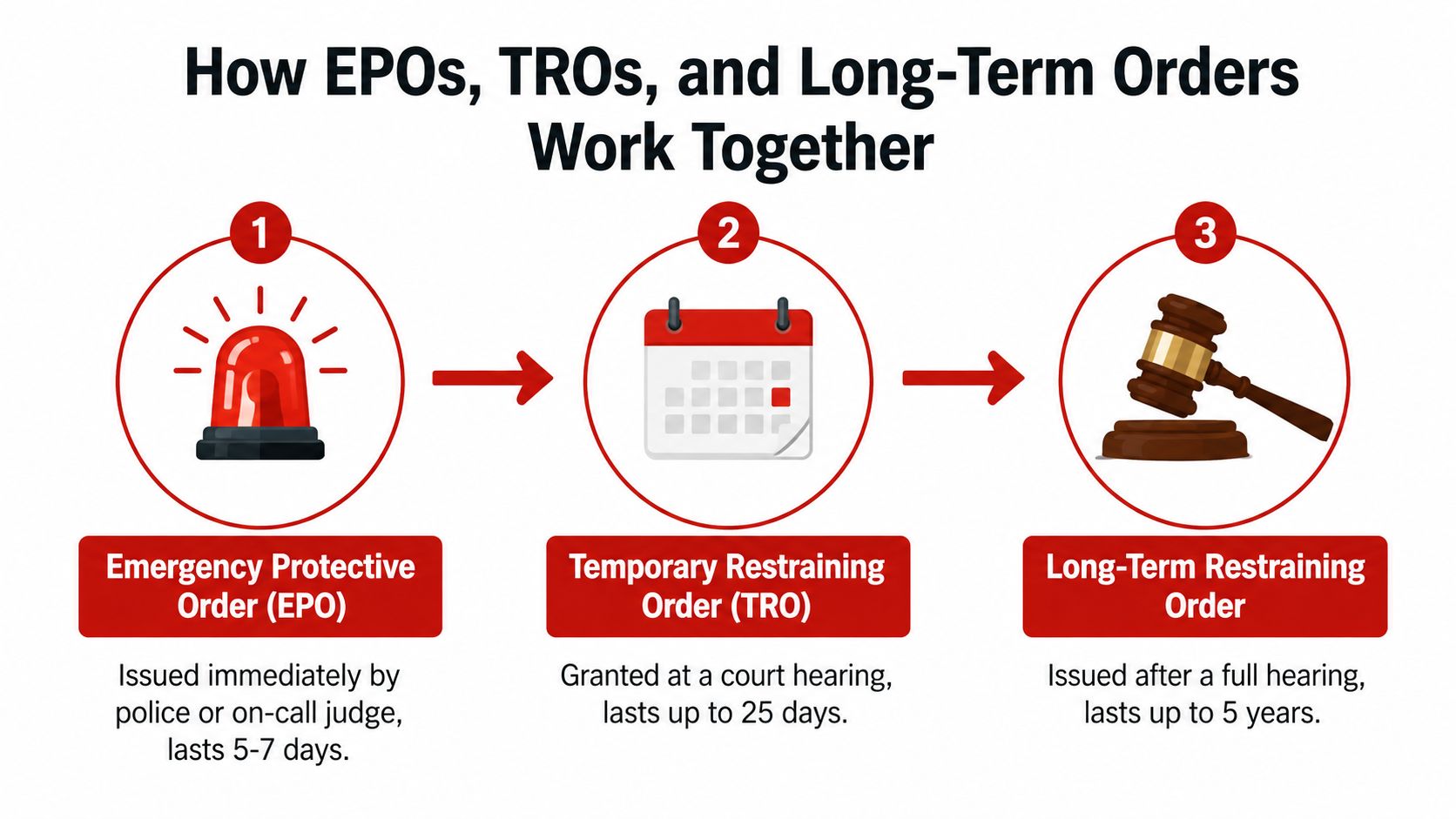
A Ventura or Oxnard family often runs into confusion at the word order. The paperwork can sound similar, but the procedure is what changes. An emergency protective order, a temporary restraining order, and a long-term order are stages in the court process, and each stage has its own deadline, service rule, and hearing step.
An Emergency Protective Order, or EPO, usually starts the process in a crisis. Law enforcement can request it in urgent situations, and it lasts only five business days or seven calendar days, whichever is shorter (Women’s Law on California restraining orders). If you want a plain-English walkthrough of that first step, how emergency protective orders work in California explains why officers use it before the court filing catches up.
A Temporary Restraining Order, or TRO, depends on a court filing and a judge’s review of the request. The person asking for protection has to get the papers to court, and the other side must be served before the hearing goes forward. If service is late or incomplete, the judge may continue the hearing or refuse to make the protection last past the short-term stage.
The hearing is the point where the case either advances or stalls. If the papers are not filed on time, if service is not done correctly, or if the protected person does not keep the court informed, the judge may let the temporary protection expire without turning it into a longer order. That is why the deadlines matter just as much as the allegations.
A long-term order only happens after the hearing, once the judge has heard from both sides and reviewed the evidence. In domestic violence matters, that order can last up to five years (Women’s Law basic orders page). If the hearing is continued, the temporary order may stay in place until the new date, but only if the court keeps it active.
The procedural details matter because skipped steps have real consequences. A judge can only issue a longer order if the request is properly filed, the other side receives notice, and the hearing is reached without a defect that stops the case. A Ventura County parent trying to secure custody, housing, or a safe school pickup plan needs that process to keep moving, or the protection can lapse before the court reaches the merits.
Time matters more than labels when danger is active. The paperwork has to move on schedule, or the protection can run out before the court finishes the case.
For a reader in Ventura County, the clearest way to think about it is this. The emergency step gets the immediate paper in place, the court step tests whether the request was properly served and heard, and the final step depends on a valid hearing record. If one stage is skipped, the next stage may never attach.
Restraining Orders and Bail in Ventura County Cases
A domestic violence arrest in Ventura or Oxnard often starts two tracks at once. One track is the criminal case. The other is the protective order. They move side by side, but they do different jobs, and that is why bail can confuse families.
What can happen at release
A judge can impose a criminal protective order at arraignment, and the bail process can also include a no-contact condition. A person may be released on bail and still be barred from calling, texting, visiting, or otherwise contacting the protected person. Release solves the custody question, but it does not erase the court’s safety rules.
That overlap shows up often in firearm-related protection orders too. Statewide reporting from the California Department of Justice shows that criminal protective orders, domestic violence restraining orders, and emergency protective orders all appear in that mix, which is why one case can trigger both criminal and protective consequences at the same time (California Department of Justice report).
Why contact can trigger a new case
If the restrained person contacts the protected person anyway, that conduct can become a separate criminal problem. California treats violating a protective order seriously, and the conduct can lead to arrest, a new case, and firearm consequences if the order includes a firearm ban. In Ventura County, that is often the point where a release plan starts to fall apart.
The early jail-release process matters because the terms need to be understood before the person walks out. Families dealing with a Ventura County Jail release should know that the paperwork can include restrictions the court expects them to follow right away. Ignoring those terms does not just risk the original case, it can create a second one. If you are trying to understand how domestic violence arrests affect bail amounts in Ventura County, the key issue is how the criminal release conditions and the protective order fit together.
For people sorting out both a release and a protective order, it helps to keep the two lanes separate. The criminal lane decides custody status, bail, and conditions. The protective lane decides contact, distance, and safety rules. When both lanes are active, the safest choice is the one that keeps the person away from the protected party until the court says otherwise.
Violating a Restraining Order and the Consequences
A restraining order is not a suggestion. In California, violating one can become a criminal matter, and the response can move fast. That’s true whether the order came from a family case, a civil case, or a criminal case tied to an arrest.
What usually happens after a violation
Police can arrest on the spot if the facts support it. Prosecutors can file a new case, and the court can treat the violation as a separate offense under California Penal Code 273.6. Depending on the conduct, exposure can be misdemeanor or felony level, especially where violence or repeated violations are involved.
If the order includes a firearm prohibition, the restrained person can also lose firearm access for the duration of the order. That’s not an extra inconvenience, it’s part of the court’s safety structure. People are often surprised by how quickly that consequence attaches once a firearm-related term is in place.
Why Ventura County treats repeat violations seriously
Local law enforcement and the Ventura County District Attorney’s office are likely to view repeated or violent violations as separate evidence of risk. That matters because the new conduct can change how the next hearing, the next bail decision, or the next charging decision is handled. A violation doesn’t just reflect badly on the underlying case, it creates a new factual record.
Don’t test the order because the underlying case is still pending. The violation itself can become the part that changes the whole case.
A practical filing plan in Ventura County usually starts with the clerk’s office or self-help center, then moves to the hearing with any messages, police reports, photos, or witness information the judge may need. If the person who needs protection is trying to keep the case clean and avoid more conflict, the safest course is to follow the order exactly as written until the court changes it.
That step-by-step caution matters because a violation can turn an already stressful court process into two court problems at once. The better move is to treat the order as active from the first minute it’s served or issued, not from the hearing date you wish it had.
How to File the Right Order in Ventura County
Ventura County residents usually start at the Ventura County Superior Court self-help center or the clerk’s office, then choose the form that matches the legal trigger. The form names help a lot here. DV-100 is for DVROs, CH-100 for civil harassment, EA-100 for elder or dependent adult abuse, WV-100 for workplace violence, and GV-100 for gun violence.
A simple filing checklist
- Pick the form that matches the relationship: If the other person is a spouse, former spouse, dating partner, cohabitant, or co-parent, DVRO forms usually fit.
- Bring clear examples: Messages, call logs, photos, incident dates, and police reports can help the judge understand the pattern.
- Ask for temporary protection if needed: If the risk is immediate, the court can review a request for short-term relief while the hearing is pending.
- Plan for the hearing: Be ready to explain who the person is, what happened, and why the facts fit that category.
For families in Oxnard, Camarillo, Thousand Oaks, Santa Paula, Moorpark, Fillmore, Ojai, and Santa Barbara, the filing logic is the same even if the courthouse path differs. Start with the trigger, not the label. That keeps the paperwork from drifting into the wrong category.
If the situation also involves a criminal arrest, someone should ask about coordinating the release conditions with the protective-order terms so the person doesn’t walk out of jail into a violation. That coordination can save a lot of trouble later.
A local family law self-help desk can help with forms, but the person filing still needs to know the category. A DVRO won’t fix a non-family harassment case, and a civil harassment petition won’t fit a domestic violence relationship just because both involve fear. The court wants the facts to match the form.
If you’re overwhelmed, take the process one decision at a time. Identify the relationship, identify the risk, choose the form set, and bring the evidence that shows why protection is needed.
If you or a loved one is dealing with an arrest, a no-contact condition, or the need to move quickly on a release in Ventura County, Bada Bing Bail Bonds can help coordinate the bail side while you sort out the court order side. Visit Bada Bing Bail Bonds to speak with a local team that understands Ventura County Jail bail bonds, fast release timing, and how protective-order conditions can affect the path home.