The phone rings late. You hear a shaky voice, a few broken details, and one line that lands hard: someone you care about has been arrested in Ventura County.
At that moment, most families make the same mistake. They start guessing. They guess where the person was taken, guess what the bail amount might be, and guess how fast release should happen. Guessing slows everything down.
What helps is a simple order of operations. Get the right identifying details, confirm where the person is being held, find out whether bail is already set, and then choose the release method that fits the situation. Ventura County bail bonds can move fast, but speed comes from clean information and realistic expectations, not panic.
Table of Contents
- That First Call from Jail a Practical Guide
- First Actions What to Do Immediately After a Ventura County Arrest
- Decoding the Cost How Bail Amounts and Bond Premiums Are Set
- Securing the Bond The Step-by-Step Process in Ventura
- The Final Step Jail Release Timelines and Pickup Logistics
- Post-Release Compliance and FAQs
That First Call from Jail a Practical Guide
That first call usually sounds the same. The person inside is upset, talking fast, and often doesn't know exactly what happens next. The family member on the outside is trying to write things down while asking five questions at once.
The first job isn't to solve the whole case. It's to slow the moment down enough to capture what matters. Get the full legal name. Get the date of birth. Ask where the arrest happened. If they don't know where they are being held yet, don't panic. Booking and transfers can create a gap between arrest and confirmed custody location.
If the arrest happened in Oxnard or nearby, one of the most useful things you can do is understand what can happen before movement through the system. This short guide on bailing someone out in Oxnard before jail transfer helps families understand that early window.
Practical rule: Write everything down during the first call, even if it sounds incomplete. Small details become useful once someone starts checking booking status.
A lot of people think the only issue is money. At 2 AM, the bigger issue is usually confusion. Families don't know whether bail is already assigned, whether the person is still being booked, or whether release can happen right away. Those are operational questions, and they matter just as much as the dollars.
You don't need to know every legal term tonight. You need the right facts in the right order.
First Actions What to Do Immediately After a Ventura County Arrest
Start with a checklist. Not because it's formal, but because stress makes people forget basics.
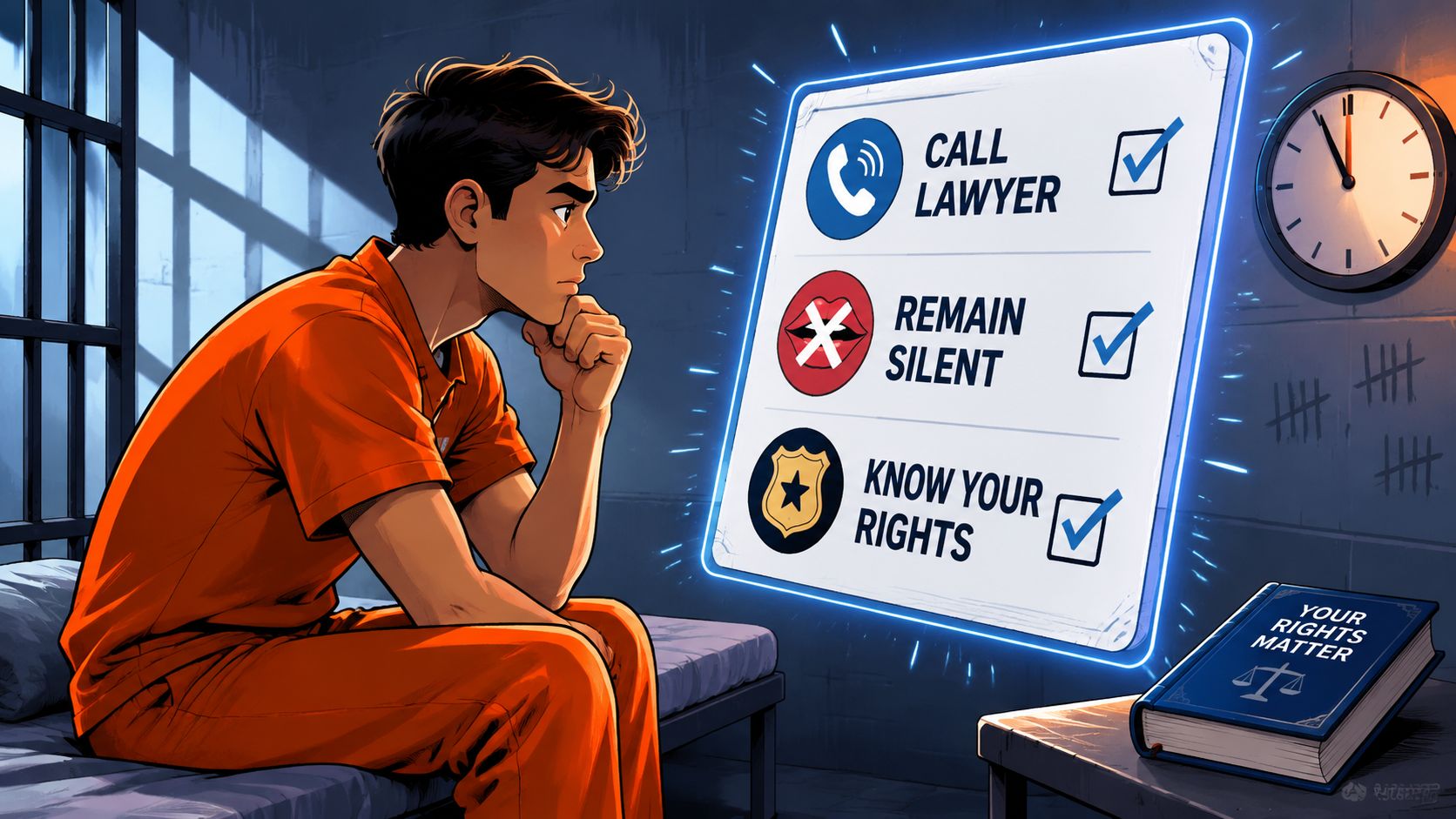
The three details you need first
Before anyone can help effectively, gather these:
Full legal name
Nicknames slow searches. A bondsman or jail staff needs the correct legal identity to avoid pulling the wrong person or finding nothing at all.Date of birth
This helps separate your person from others with similar names. In the middle of the night, one wrong digit can waste a lot of time.Location of arrest
Was it Oxnard, Ventura, Camarillo, Thousand Oaks, or somewhere else in the county? The arrest location often helps narrow down which agency was involved and where booking may be happening.
If you're trying to sort out agency information fast, this Ventura County Sheriff contact page is useful to keep handy.
What happens right after arrest
Families often think there should be instant answers. Usually there aren't. The person may still be in the booking process, and until booking is complete, some information can be delayed or incomplete.
Here's the practical sequence most families should follow:
- Confirm identity first: Make sure you have the exact name spelling and date of birth before calling around.
- Find the holding agency: The arresting agency and the jail location aren't always the same thing.
- Check booking status: If the person hasn't finished booking, release can't happen yet, no matter how ready the family is.
- Ask whether bail is set: Some cases have a schedule-based amount available early. Others may need review.
The fastest calls are the ones where the family says, “I have the full name, date of birth, and where they were picked up.”
What not to do in the first hour
People lose time by doing too much at once.
| Common mistake | What works better |
|---|---|
| Calling multiple people with partial info | Put one person in charge of gathering facts |
| Arguing about the charges | Focus first on booking and bail status |
| Assuming release is immediate | Prepare for waiting, paperwork, and processing |
| Relying on social media rumors | Verify everything through official channels or a licensed agent |
A calm, organized family gets better results than a loud, frantic one. That's not a moral judgment. It's just how the system moves.
One role for the family
Pick one decision-maker. That person should keep the notes, answer return calls, and handle documents if a bond is needed. When six relatives call with six different versions of the same story, everything drags.
Ventura County bail bonds work best when one responsible adult can verify information, sign what needs signing, and stay reachable. If that's you, your main job right now is simple. Be accurate, be available, and keep your phone on.
Decoding the Cost How Bail Amounts and Bond Premiums Are Set
At 2 a.m., families usually hear one number and assume that is what they need to bring in cash. That is where people get blindsided.
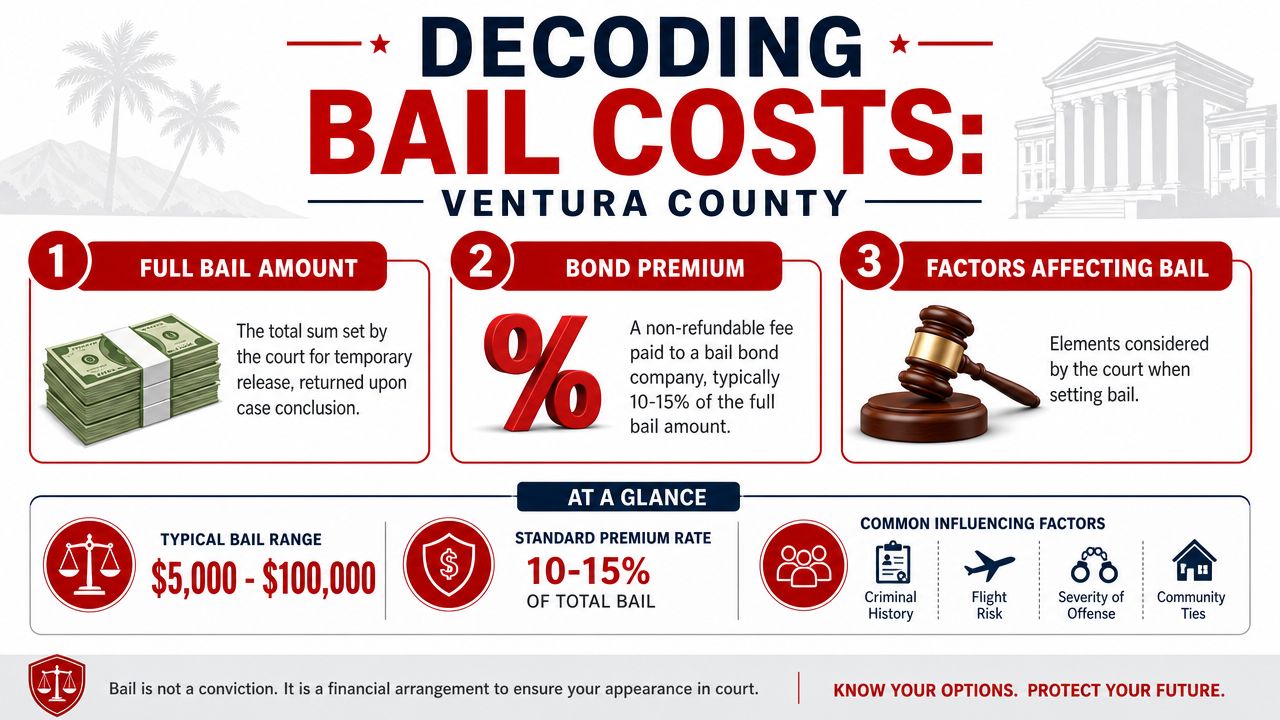
The bail amount is the total security the court sets for release. The bond premium is the fee paid to a licensed bail agent to post that bail.
Where the starting number comes from
In Ventura County, bail usually starts with the county schedule. For example, the schedule sets a presumptive felony bail of $10,000, other misdemeanors at $2,500, and 17(b) misdemeanors at one-half of felony bail, according to the Ventura County bail schedule.
That starting number can climb fast. New charges while already out on bail can mean higher scheduled bail. Certain probation or diversion violations can add more on top. So if a family says, “We were told it was just one charge,” that still may not be the final number showing in custody.
This is one place local experience matters. A case coming through Oxnard may sound straightforward over the phone, then booking reveals a hold, a probation issue, or stacked counts that change the bail figure. Ventura Main has the same problem. Families lose time when they plan around the first rumor instead of the booked amount.
What the family usually pays
In California, the premium is regulated. On many bonds, the consumer cost is 10% of the total bail, plus actual, necessary, and reasonable transaction expenses if they apply. A Ventura County court review also noted that the normal service fee paid by defendants is 10% of the bond amount, according to the Ventura County Superior Court bail review.
So if bail is $10,000, the premium is often $1,000. If bail is $50,000, families are often looking at $5,000 for the bond premium. For a plain-English local breakdown, see how much bail costs in Ventura and Santa Barbara County.
That does not mean every case is identical. The price structure is regulated, but the risk review is still case-specific. On larger bonds, or when the defendant has missed court before, the agent may ask for collateral or a stronger co-signer. That is not a gimmick. It is how the bond gets approved.
The cost question families should actually ask
The better question is not “Who is cheapest?” The better question is “What will I need to post this without delays?”
Ask for clear answers on:
- The exact bail amount currently showing in custody
- The premium due to post the bond
- Any permitted expenses, explained in writing
- Whether collateral is required
- Who needs to sign and how fast they can sign
- How quickly the bond can be posted at Oxnard or Ventura Main once paperwork is done
A fast release often depends less on shaving a few dollars off the conversation and more on getting accurate numbers, one qualified co-signer, and paperwork that can be signed right away. In Ventura County, speed usually comes from clear information and local follow-through, not from guessing what the jail or court might do next.
Securing the Bond The Step-by-Step Process in Ventura
It is 2 a.m. You finally have the bail amount, everyone is asking how fast he can get out, and the answer depends on one thing. How quickly the bond paperwork gets done right, with the right jail, the right signer, and the right booking information.
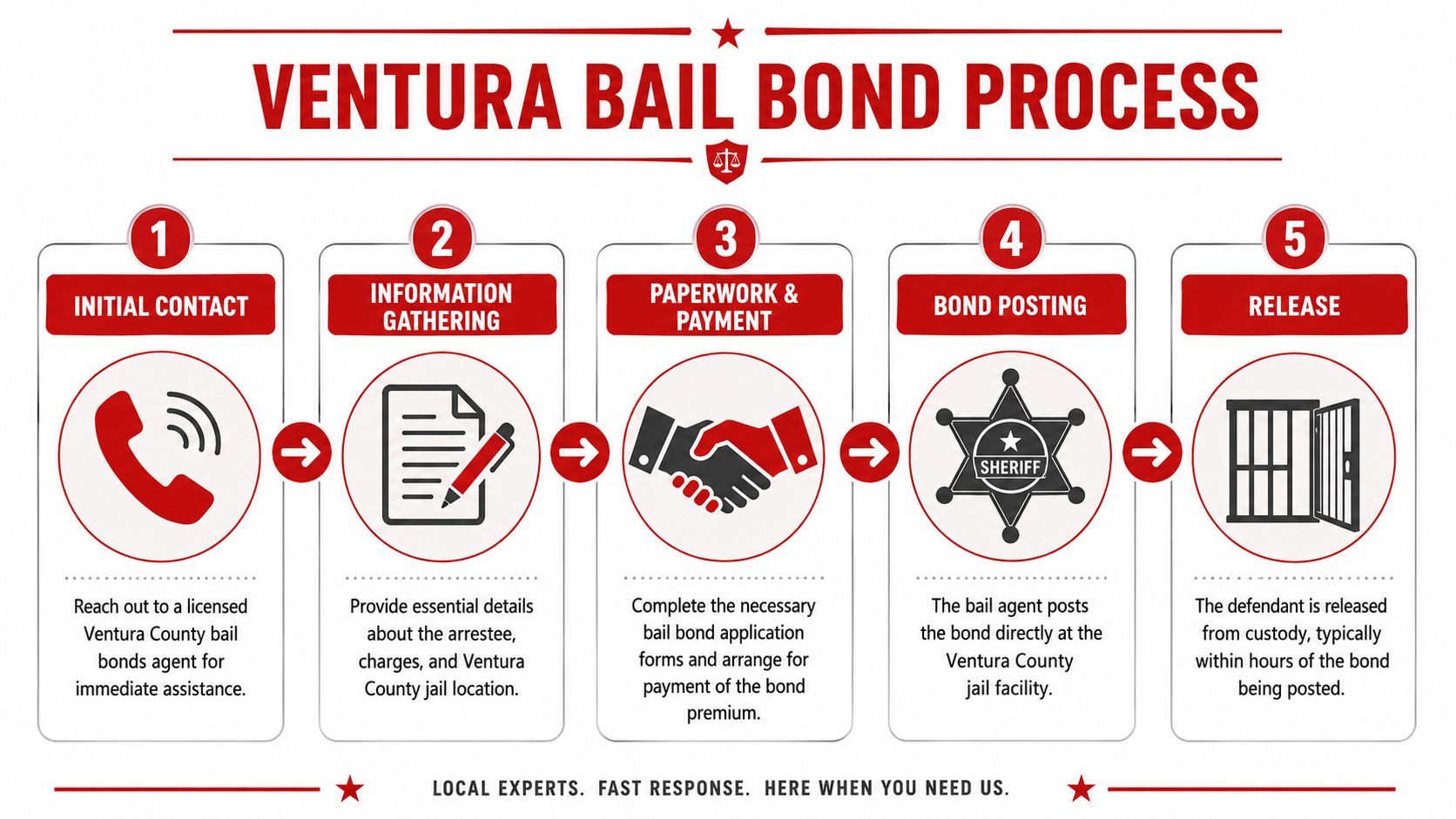
The real workflow from call to posting
In Ventura County, the bond process is usually straightforward. The delays are not. They come from bad booking details, a co-signer who cannot be reached, missing ID, or confusion about where the defendant is being held.
A short intake call starts it. The agent will ask for the defendant's full name, date of birth if you have it, the arresting agency, the jail location, the charges as you understand them, and who will sign. If the person was arrested in Oxnard but transferred, or booked through Ventura Main, that matters. Local handling changes the timing.
Then comes the review. The agent confirms the bail amount in custody, checks for any obvious issues that could slow approval, and identifies the co-signer. The co-signer, sometimes called the indemnitor, is the person agreeing to the bond contract. That person is not taking over the criminal case. That person is agreeing to be financially responsible if the defendant fails to appear or violates the bond terms.
If you want the statewide rules in plain English, this guide on how bail bonds work in California gives the bigger picture. On the ground in Ventura County, speed usually comes down to paperwork, communication, and knowing how the local facilities process releases.
What usually happens, in order
Here is the process families can expect:
| Stage | What usually happens |
|---|---|
| Intake | Agent collects defendant details, jail location, and co-signer information |
| Verification | Bail, custody status, and release eligibility are confirmed |
| Approval | The bond is reviewed based on risk, bond size, and signer strength |
| Signing | Contracts are signed and payment terms are finalized |
| Posting | The bond is delivered to the correct Ventura County facility |
| Waiting | Jail staff process the release on their own timetable |
That looks simple on paper. In real life, one wrong detail can cost hours.
The biggest advantage of working with someone who knows Ventura County is operational, not theoretical. Oxnard processing does not always move the same way as Ventura Main. Some nights the holdup is booking. Other times the bond is ready but the jail has not cleared the person for release yet. Families hear "the bond has been posted" and think the person is walking out now. Usually there is still a wait.
What the co-signer is really agreeing to
This is the part families rush through, and it is where problems start later.
A co-signer should expect to provide ID, contact information, and basic financial background. The agency may ask where you work, how long you have lived at your address, and whether you can stand behind the bond agreement. On a larger bond, or when there is a history of missed court, the questions get stricter. That is normal.
A co-signer also needs to understand the practical risk:
- You must stay reachable. If the defendant misses court or disappears, the phone rings to you.
- You may be asked for collateral. Some bonds need it. Some do not.
- The premium is usually not refunded. Families need to understand that before signing.
- Your information has to be accurate. Bad addresses, fake references, and half-answers slow approval or kill the deal.
Ask direct questions before you sign. Ask what happens if the defendant misses court. Ask when collateral is returned, if any is required. Ask who needs to appear or sign, and whether that can be done remotely or in person that night.
Sign only after you understand the risk, the cost, and what you have to do if the defendant stops cooperating.
A short explainer can help if you're more visual:
Payment plans and practical access
Families often assume the process stops if they do not have the full premium sitting in a checking account. Sometimes it does. Sometimes it does not.
Approval for a payment plan depends on the bond amount, the charge, the defendant's history, and the strength of the co-signer. Agencies may offer structured payments, ask for more documentation, or require collateral on larger or riskier bonds. Bada Bing Bail Bonds handles payment plans, co-signer arrangements, and collateral discussions as part of that approval process.
The families who get through this fastest usually do four things well:
- Choose one co-signer and stick with that person
- Keep identification and requested documents ready
- Give the exact jail or booking details, not guesses
- Answer risk questions accurately the first time
Changing signers in the middle, hiding prior failures to appear, or giving the wrong facility wastes time. In Ventura County, getting someone out fast is rarely about talking more. It is about getting the right information to the right person, early.
The Final Step Jail Release Timelines and Pickup Logistics
Families often think the hard part ends when the bond is posted. It doesn't. Posting the bond starts the release process. It doesn't complete it.
That final window is where frustration builds. People expect a door to open right away, then hours pass, phones die, and everyone starts assuming something went wrong. Usually, what's happening is internal jail processing.
Why release isn't instant
Ventura County Sheriff says bail can be posted with cash, cashier's check, bail bond, or credit/debit card through GovPayNet by phone or online on the Ventura County Sheriff posting bail page. That matters because a family may have more than one payment route available.
But payment method isn't the whole story. The bottleneck is often administrative. Staff still has to process the release, confirm holds, complete internal steps, and physically move the person out.
If you're trying to set realistic expectations, this guide on how long release from Ventura County Jail takes is worth reading.
Ventura Main Jail versus local agency holding
Operationally, families should expect different rhythms depending on where the person is being held. A main jail release and a local police department handoff don't always move the same way.
What matters in real life:
- Booking status: If booking isn't complete, release can't happen yet.
- Internal workload: Busy periods slow everything down.
- Shift changes: Staff transitions can add waiting time.
- Outstanding holds: Another issue on the record can delay release even after bond is posted.
If the bond is posted and the person still isn't out, don't assume failure. Assume processing until someone confirms otherwise.
How to handle pickup without making the night worse
The family side of release is simple but often mishandled. One car is usually better than three. One pickup contact is better than a group text with ten people asking for updates.
Bring what the released person may need first, not what you wish you had thought of later:
- A charged phone or charger
- Basic clothing if needed
- A calm ride home
- A plan for where they sleep that night
- A reminder not to talk endlessly about the case in public
Some people come out exhausted, angry, embarrassed, or disoriented. Don't press for a perfect explanation in the parking lot. Get them home. Get paperwork organized. Make sure they know where their court information is going to be kept.
Direct posting can make sense in some cases. A bond can make more sense in others, especially when the family needs help with paperwork, coordination, and timing. The wrong move is assuming the only issue is paying something online. The system still has to finish the release.
Post-Release Compliance and FAQs
A lot of families relax the minute the jail door opens. That is usually when the next problem starts.
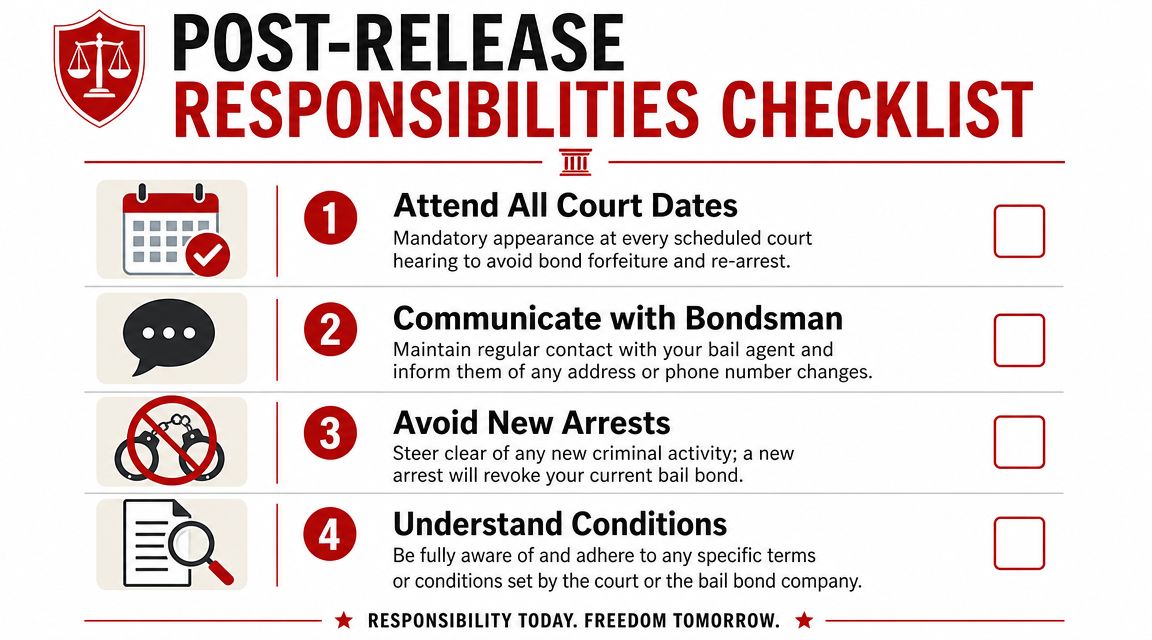
What matters after release
Once someone is out, the bond is still active until the court exonerates it. That means the defendant has to appear, follow any release terms, and stay reachable. It also means the co-signer has a job now. Keep track of paperwork, answer calls from the bond company, and do not ignore mail from the court or attorney.
Families get into trouble here because the crisis feels over. It is not over. It has shifted from getting someone out of Ventura County custody to keeping them out and protecting the money or collateral tied to the bond.
As noted earlier, Ventura County has long treated bail obligations as serious financial matters. Families should do the same.
A short compliance checklist
- Go to every court date: A missed appearance can trigger a bench warrant and put the bond at risk.
- Keep contact information current: If the defendant or co-signer changes phone numbers or address, report it right away.
- Stay out of new trouble: A new arrest can freeze progress on the original case and create new bond problems.
- Keep every document together: Save receipts, bond papers, court slips, and any release conditions in one folder.
- Ask before traveling: Do not assume county-to-county or out-of-state travel is allowed.
One good habit fixes a lot of avoidable mistakes. Put every court date in a phone calendar and on paper, then make one adult responsible for checking both.
Release is the handoff point. From there, missed calls, missed court, and bad assumptions are what cost families money.
Frequently asked questions
Is the premium refunded if the case gets dismissed
Usually no. In California, the premium paid for a bail bond is generally not refunded just because the case ends well for the defendant.
When does collateral come back
Collateral usually comes back after the bond is exonerated by the court. That can take time. If property papers, titles, or other security were pledged, keep copies and ask the bond company what they need before release of that collateral.
What if someone misses court by accident
Treat it like an emergency. Call the defense lawyer and the bond company the same day. In Ventura County, fast action matters because a missed court date can turn into a warrant problem before the family understands what happened.
Can the defendant travel after release
Sometimes. It depends on the court's conditions and the bond agreement. Ask first, especially if the person wants to leave Ventura County or California.
Should the co-signer keep checking in if nobody has called
Yes. Quiet does not always mean clear. Hearing dates get continued, notices get mailed to old addresses, and small communication failures turn into expensive ones.
If you are the co-signer, keep the file, keep your phone on, and keep asking questions until you know the next court date and any release conditions.
If you need immediate help sorting out Ventura County bail bonds, Bada Bing Bail Bonds handles booking verification, paperwork, co-signer questions, payment arrangements, and release coordination for families trying to get someone home without making costly mistakes.