
If you’re standing outside a Ventura or Oxnard jail at 2 a.m., phone in one hand, keys in the other, the whole system feels too big and too fast. You want one clean answer, who’s in custody, what the bail is, where the first court date lands, and whether you need a bondsman before sunrise. The Ventura County court system moves on those questions, not on the panic around them, and the families who get ahead of the paperwork usually get ahead of the delay.
The county’s criminal legal pipeline is heavy, and that matters the moment a booking happens. Ventura County devoted 43% of its total general fund spending to the criminal legal system in 2021, equal to $535.5 million, with the largest share going to law enforcement, then detention and probation, then judicial expenses (Vera Institute fact sheet). That is the backdrop for every late-night arrest, every arraignment, and every bond decision families have to make fast.
Table of Contents
- What Happens Between an Arrest and the First Court Date
- Structure of the Ventura County Superior Court
- Courthouse Locations, Hours, and How to Reach the Right Clerk Window
- How a Criminal Case Moves Through the System
- Civil, Family, and Traffic Cases in Ventura County
- Bail, Bonds, and the First 24 Hours After Booking
- Finding Dockets, Judges, and Records Online
- Practical Next Steps for Defendants and Families
What Happens Between an Arrest and the First Court Date
At 2 a.m. in Oxnard, the family usually starts with the same broken questions. Where is he? Which jail? Can someone post bail tonight? The arrest comes first, then booking, then the wait for a bail amount or release decision. That’s the point where the Ventura County court system starts shaping the case, even if nobody has seen a courtroom yet.
The county’s jail and court pipeline is large enough that arrest-to-release decisions matter immediately. In 2021, Ventura County averaged 1,320 people in county jails, 63% of the jail population was pretrial, and law enforcement made 27,019 arrests with 27,641 county jail admissions (Vera Institute fact sheet). Those numbers explain why the first hours after booking are so important, because the person in custody is already moving through a system built around bail timing and court appearance obligations.
Practical rule: don’t wait for a perfect plan. Confirm custody status, booking number, and bail amount first, then decide whether to use cash, a bond, or counsel.
The first court date is usually the first formal checkpoint, not the last chance to influence the outcome. If a family delays on paperwork, misreads the jail location, or waits too long to get a licensed agent involved, they lose time they don’t get back. If you need a plain overview of what happens after an arrest, start with this local explanation, then use it to organize your next call.
A good move at this stage is simple. Find the charges, write down the booking details, and stop guessing about release timing. Families in Ventura, Oxnard, Camarillo, Port Hueneme, Thousand Oaks, Santa Paula, Moorpark, Fillmore, Ojai, and even Santa Barbara end up in the same place, trying to move one person from booking to court without wasting a night.
Structure of the Ventura County Superior Court
A family can walk into the wrong office, wait at the wrong window, and lose half a day before anyone even looks at the paperwork. That happens because the Ventura County Superior Court is organized by division, and each division handles a different slice of the case load. Start by putting the case in the right bucket before you go near the courthouse.
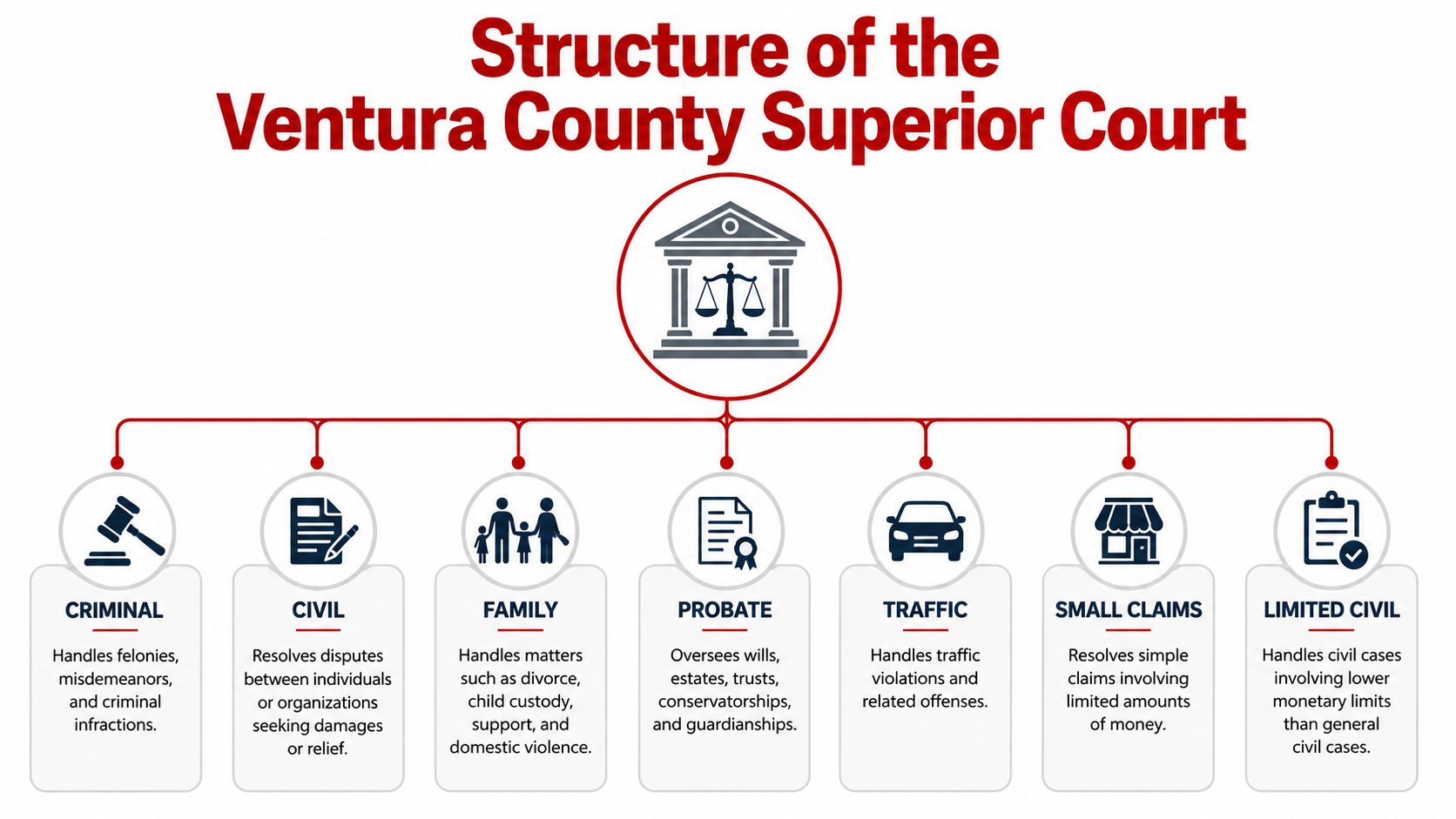
What each division handles
Criminal cases cover arrests, arraignments, pleas, pretrial hearings, trials, and sentencing. Traffic cases handle infractions and related court payments. Family matters cover divorce, custody, support, and protective issues. Probate handles estates and guardianship-related matters. Civil matters cover disputes between people or businesses, while small claims is the simplified route for lower-value disputes. Juvenile cases are handled separately because the rules, privacy concerns, and timelines are different.
The court’s own overview says the system processes large volumes of filings and dispositions every year (Ventura Superior Court overview). That kind of workload is why families cannot afford to guess at the right department or show up with the wrong form. A simple mistake can turn into another trip, another wait, and another missed window.
If the clerk window does not match the division, you are in the wrong line.
Clerk offices, self-help centers, jury services, and courtroom staff all sit inside the same courthouse system, but they do different jobs. A family dealing with an arrest or a sudden court date usually needs process help first, not a lecture on legal theory. The public defender, self-help staff, and the clerk each solve a different problem, and none of them replaces knowing exactly which division is handling the case.
Courthouse Locations, Hours, and How to Reach the Right Clerk Window
A family gets the arrest call, grabs papers, and heads for the courthouse before sunrise. At that point, the only thing that matters is getting to the right building and the right window without wasting a day. For criminal and traffic matters, Ventura County uses three primary facilities, and each one handles a different slice of the work. The Hall of Justice in Ventura at 800 South Victoria Ave., the East County Courthouse in Simi Valley at 3855-F Alamo Street, and the Juvenile Justice Center in Oxnard at 4353 E. Vineyard Ave. each serve different parts of the workflow (Ventura County criminal and traffic information). Show up at the wrong building, and you lose time before security even becomes the issue.
The walk-up windows do not run the same way at every courthouse. In Ventura, criminal and traffic payment windows run Monday through Friday from 8:00 a.m. to 4:30 p.m.. In East County, the windows are open only Monday and Tuesday from 8:00 a.m. to 4:30 p.m.. At the Juvenile Justice Center, the clerk’s office and telephone hours are Monday through Friday, 8:00 a.m. to 4:00 p.m., except holidays. Families who call after hours or arrive late usually learn the hard way that court hours follow court business, not family schedules.
That is why the clock matters. A person who assumes every courthouse works like a county office will end up making a second trip. Payment windows, filing windows, and clerk availability all follow the courthouse calendar, and those windows close faster than people expect.
What to do before you leave home
- Match the case type first. Criminal, traffic, juvenile, family, civil, and probate do not all use the same counter.
- Check the venue before driving. Ventura, Simi Valley, and Oxnard each handle different matters.
- Arrive early. Security screening and line traffic can eat into short window hours fast.
- Bring the right documents. A bail receipt, booking number, or case number saves a second trip.
For criminal and traffic matters, the Hall of Justice is the first stop most families hear about. If you are dealing with a juvenile case, Oxnard is the building that matters. If you are standing at a clerk window with a payment or filing, the only question that counts is whether you are at the right counter for the right division. When you are not sure what happens at the next court stage, start with a clear explanation of what happens at an arraignment, then match that stage to the courthouse window you need.
How a Criminal Case Moves Through the System
A criminal case in Ventura County does not move in a straight line, but it follows a familiar path. Arrest and booking come first, then arraignment, then the pretrial phase, and finally trial or sentencing. Families get turned around when they treat each hearing like a brand-new matter instead of one file moving through the system.
The pace is tight because the court is carrying a heavy load with limited bench time. Court materials describe judges and commissioners handling over 3,000 filed cases per bench officer, one of the highest case-to-bench-officer ratios in California. That kind of pressure shows up in crowded calendars, continuances, and hearings that move faster than families expect.
The criminal timeline in plain English
Arrest and booking start the process. The jail records the person, the charges are identified, and release options start to take shape.
Arraignment is the first formal appearance. The court reads the charges, the defendant enters a plea, and the pace of the case starts to show. If counsel has not been retained yet, that hearing is often where a case gets its first delay or its first hard turn. For a plain walk-through of that stage, use this guide before the court date hits.
Pretrial motions and plea discussions come next. Lawyers exchange information, challenge weak points, and decide whether the case is likely to settle or head toward trial. This is the phase that looks quiet from the hallway and feels messy inside the file.
Trial or sentencing closes the loop. If the case does not resolve earlier, the court hears the evidence or imposes sentence after a plea or conviction.
The defendant who knows the next hearing’s purpose walks into court calmer and makes better decisions.
That calm matters. The lawyer conversation and the bail conversation both need to happen early, because the families who wait until the last minute usually lose time they cannot get back.
Civil, Family, and Traffic Cases in Ventura County
Ventura County court traffic is split by case type, and that split matters more than people expect. Civil disputes are about money, property, or obligations between parties. Family cases deal with custody, support, divorce, and other relationship orders. Traffic matters usually run through citation notices, payment deadlines, and appearance dates. The same courthouse system handles all of them, but the right move in one lane can waste time in another.
Family cases are where people get stuck in procedure while the core issue sits in the background. The statewide self-help plan makes clear that help for unrepresented litigants is a major public-trust issue, and that the calendars with the heaviest share of self-represented litigants often get the least court attention California self-represented litigant action plan. In Ventura, family-court guidance also points to limited procedural visibility, uneven language access, and no public rubric for mediator recommendations, so plain-English guidance is not a luxury. It is what keeps a family from missing a step that could have been handled cleanly the first time.
Traffic cases are simpler on paper and still easy to mishandle. A missed payment, a missed notice, or the wrong courthouse window can turn a small citation into a larger problem. Jury duty sits in the same courthouse machinery, and Ventura court materials show how much routine court traffic runs through that system Ventura Superior Court overview. The point is plain, ordinary court business moves people through the same clerks, calendars, and notices, even when the case itself is minor.
Practical rule: if the matter affects a child, money between family members, or a traffic citation, do not assume the criminal desk can solve it.
Here is the clean way to sort it out. Criminal cases deal with custody, bail, pleas, and sentencing. Family cases deal with orders, mediation, and evidence disputes. Civil cases deal with claims and defenses. Traffic cases deal with notices and fines. Once you know the lane, you stop losing time in the wrong hallway.
For families trying to figure out release timing after a booking, the first call should start with the jail clock, not the court lobby. A good place to get a feel for how that timing works is Ventura County inmate release times and bail information.
Bail, Bonds, and the First 24 Hours After Booking
Bail is a release decision tied to the case, not a reward for good behavior. Under California law, the standard bail bond premium is capped at 10% of the full bail amount, which is what a Ventura County bail bonds conversation starts with (California Department of Insurance). That cap is important because it keeps the premium tied to the face amount of the bail, not to how desperate the family feels at 3 a.m.
The bond decision usually comes down to three paths. Cash bail means paying the amount directly if the court or jail allows it. Release on recognizance means the court releases the person without posting bail, but that is not available in every case. A bail bond is used when the family wants release moved forward without paying the full amount up front. A licensed agent verifies the booking, confirms the bail amount, coordinates the paperwork with the jail, and tracks the release window until the person walks out.
What to have ready before you call
- Booking number and jail location. Without them, the agent has to hunt for the file.
- Exact charges. Bail strategy depends on what the person was booked for.
- A working phone line. Release moves faster when the family can answer questions immediately.
- Paperwork from any attorney. If counsel is already involved, the bond process should align with that plan.
For families trying to understand release timing in Ventura County, this local release guide helps bridge the gap between booking and actual pickup. That gap is where most stress lives. The jail has its own pace, and the courthouse has its own calendar, so a bond agent’s job is to push paperwork through both without creating a new delay.
This is also where the right legal help matters. A public defender may be the right fit if the defendant qualifies and can’t afford retained counsel. A private defense attorney makes more sense when the family needs immediate case review, motion practice, or a strategy built around the facts. A bail agent and a lawyer do different jobs, and families often need both.
Finding Dockets, Judges, and Records Online
If you need to confirm a hearing date before you drive to Ventura, start online, but do not assume the screen gives you the whole story. The court’s online tools help with calendars and official records, and the IT unit supports systems for monitoring court calendars, tracking official records, tracking exhibits, and generating state-mandated statistical data (Ventura court information technology). That helps, but it does not mean every detail is public or ready the moment you look.
Some records still require an in-person or written request, and the court says it will not process search requests by phone. It also charges $15 per search request and limits how many names you can include in one request (Ventura online case inquiry). For families under pressure, that makes the search itself a slowdown if they do not know exactly what to ask for.
The deeper problem is record depth. Some case information is not available online, and transcript access is harder to count on across California because recent reporting says Ventura County’s full-time court reporter ranks reportedly dropped 60% in five years, while more than 70% of family, civil, and probate proceedings statewide have no verbatim record at all. That makes hearing reconstruction, appeals, and simple fact-checking harder when a family needs to know what happened in court.
Comparing Support Options After an Arrest in Ventura County
| Resource | Best For | Cost | Limits |
|---|---|---|---|
| Self-help center | Basic forms and procedural guidance | Low-cost or no-cost | Does not replace legal strategy |
| Public defender | Qualified defendants who need appointed counsel | Available when eligible | Eligibility and caseload limits apply |
| Private attorney | Faster case review and tailored defense | Paid representation | Cost varies by lawyer and scope |
| Bail agent | Posting a bond after booking | Premium capped by law at 10% | Handles release, not the whole defense |
If you need to check whether a person is in custody or verify a case, use the court’s inmate search path first, then confirm the details with the court or jail. A local bail professional can help with release logistics, but they cannot replace the records you need to protect the next hearing.
Practical Next Steps for Defendants and Families
The first 24 hours decide more than people want to admit. Confirm where the person is being held, write down the booking number, identify the charges, and get the bail amount if one has been set. Then decide whether the right move is cash bail, a bond, or immediate counsel before the arraignment.
If the person is in Ventura or Oxnard, move fast on the basics. Check the custody location, ask whether release conditions are attached, and tell the family member or defendant not to guess about court dates. If the case has a protective order, a no-contact condition, or a pending family matter tied to the arrest, that changes the next conversation immediately.
What to bring to the first court date
- Photo identification. The court and counsel need to know who’s in the room.
- Any bond paperwork. Bring receipts, bond documents, or release instructions.
- Witness contact information. Don’t wait until the hearing to collect it.
- A written timeline. Short, factual notes beat a vague memory under pressure.
If you miss a court date, the problem gets worse fast, so read this guide on missed court appearances and treat it seriously. The court system does not slow down because a family is overwhelmed. It expects the next appearance, and it expects the paperwork to be in order.
The Ventura County court system is a working pipeline, not a single decision point. A family that keeps the right phone numbers, the right documents, and the right expectations about timing usually does better than one that waits and hopes the hallway will explain itself.
If you need release help tonight, Bada Bing Bail Bonds handles Ventura County bail bonds with fast response, plain-English guidance, and 24/7 coordination for the booking and release process. Visit Bada Bing Bail Bonds to get help with Ventura, Oxnard, and nearby county cases before the next court deadline catches up.