A warrant for probation violation is a judge-authorized order that can lead to immediate arrest anywhere in California, even when the alleged breach is only technical. In the federal supervision system, violation hearings occurred at an overall rate of 16.9%, with rates ranging from 16.2% to 18.4% across the reported five-year period, so this is a working part of supervision, not a rare event (U.S. Sentencing Commission report).
You may be reading this after a late-night call from a spouse, sibling, or friend who was stopped, arrested, and taken to jail. The immediate questions are practical: Where is the person? What caused the warrant? Will the court set bail? How fast can the person get out? In Ventura County, the answers usually involve the warrant record, the Pre-Trial Detention Facility, the violation hearing, and a licensed bail bondsman who can work while the family is still trying to understand what happened.
Table of Contents
- A Late-Night Call That Changes Everything
- What a Warrant for Probation Violation Actually Means
- Common Triggers in California Cases
- How a Probation Violation Becomes a Warrant
- Arrest and Booking in Ventura County
- The Violation Hearing and Possible Outcomes
- How Bail and Bail Bonds Work on a Violation Case
- What to Do Next and How a Local Bondsman Helps
A Late-Night Call That Changes Everything
At two in the morning, a woman in Oxnard called after her brother failed to come home from work. He’d been at his house earlier that night. Then sheriff’s deputies arrived, confirmed his identity, patted him down, and took him to the Ventura County Pre-Trial Detention Facility. His phone was gone. His car was still outside. The family had no clear explanation beyond the phrase “probation violation warrant.”
That call creates a particular kind of panic. Nobody knows whether the alleged violation was a new criminal accusation, a missed probation appointment, a failed test, or something buried in an old court order. Someone starts searching the internet. Someone else calls relatives. The person who answers the jail phone may not yet have complete booking information, and the family often doesn’t know whether to wait, call a lawyer, or arrange bail.
Start with the facts you can verify. Get the person’s full legal name and date of birth, confirm the booking location, ask whether the hold is tied to a probation case, and identify the issuing court. Don’t assume the person is facing a new criminal case because law enforcement made an arrest. A probation hold can arise from an alleged breach of an existing sentence.
Families also need to understand the sequence. The warrant authorizes the arrest. Booking places the person into the jail’s intake process. The court then addresses release, the alleged violation, and possible consequences. A clear explanation of what happens after an arrest can help organize the first few frantic calls.
The rest of this guide focuses on California practice with special attention to Ventura, Oxnard, Camarillo, Port Hueneme, Thousand Oaks, Santa Paula, Moorpark, Fillmore, Ojai, and Santa Barbara. It covers what triggers the warrant, what happens at the Ventura facility, how a violation hearing works, and how Ventura County bail bonds fit into the response.
What a Warrant for Probation Violation Actually Means
A probation violation warrant is a written order authorizing a peace officer to arrest someone when a judge or authorized official has found sufficient grounds to believe that person broke a probation condition. In California, the warrant can be served during a traffic stop, at home, at work, or during any other law-enforcement contact anywhere in the state.
That makes it different from a summons. A summons tells the person to appear in court. It doesn’t, by itself, direct officers to take the person into custody. A bench warrant generally concerns a failure to appear or another courtroom-related problem, although court records and local terminology can overlap. California county guidance describes a probation violation as potentially leading to a bench warrant, and local court instructions tell people with active warrants to check court records, contact counsel, appear at the issuing court, or surrender according to proper guidance (Los Angeles County probation FAQs).
Think of the distinction this way. A summons is the school calling a parent and saying, “Bring your child in to discuss a rule violation.” A warrant is the school directing an authorized person to take the child to that meeting. A bench warrant is closer to an arrest after the student skipped a required court appearance.
Practical rule: Don’t treat a probation warrant like a message you can ignore until convenient. It can appear in law-enforcement systems before anyone reaches the front door.
The underlying allegation still matters. A new offense, missed reporting, drug-test issue, travel violation, unpaid financial obligation, or prohibited contact may produce very different arguments at the hearing. The warrant only starts the custodial process. It doesn’t decide the final outcome.
Probation conditions also vary by state. Someone comparing systems should remember that Texas rules aren’t California rules, but a plain-language resource on Texas felony probation conditions explained can illustrate how specific supervision terms become enforceable obligations.
Common Triggers in California Cases
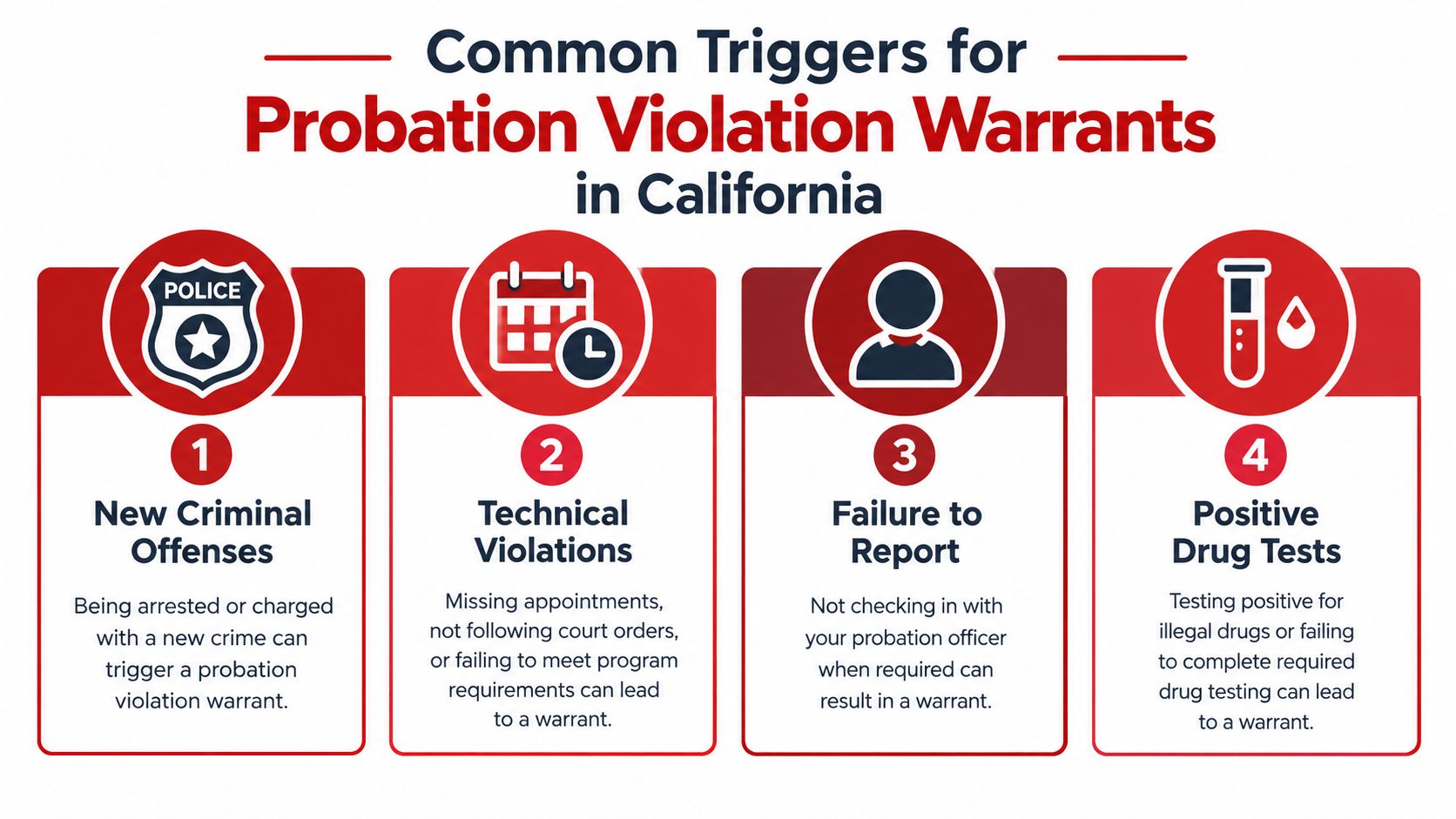
California probation officers don’t need a new conviction before asking the court to address an alleged violation. The practical trigger is usually a report, record, or event that suggests the person hasn’t followed a written condition.
New criminal conduct
A fresh DUI allegation, domestic incident, theft accusation, or other new case can prompt immediate attention from probation. The new matter and the probation case remain separate, but the facts can affect release and sentencing decisions in both proceedings. A protective order connected to the new case may also create a separate problem if the probationer contacts someone the court ordered them to avoid.
Missed reporting and appointments
A missed check-in is easy for families to underestimate. Probation may require office visits, phone contact, address updates, employment information, classes, or other scheduled compliance. Repeated nonappearance can lead the officer to seek court action, particularly when the person doesn’t respond to notices.
A failure to appear in a related court matter can create its own warrant issue. Families often ask what “FTA” means after seeing the term in a record. This plain-language explanation of FTA in law enforcement helps distinguish a missed court appearance from the alleged probation breach.
Drug and alcohol testing
A positive or missed drug or alcohol test can be treated as a violation, even without a new criminal charge. Records may include laboratory results, alcohol-monitoring readings, attendance sheets, or a probation officer’s written account. The exact condition and testing protocol control the argument, so don’t assume that every disputed result has the same consequence.
Travel and other conditions
Leaving Ventura County without written permission, relocating without approval, failing to pay restitution, skipping an ordered program, or violating a stay-away condition can all matter. Technical violations surprise families because the conduct may not be criminal by itself. The person can still face custody while the court decides whether the violation happened and what response is appropriate.
The important question is not only “What did the person do?” It’s also “What did the probation order require, and what record supports the allegation?”
How a Probation Violation Becomes a Warrant
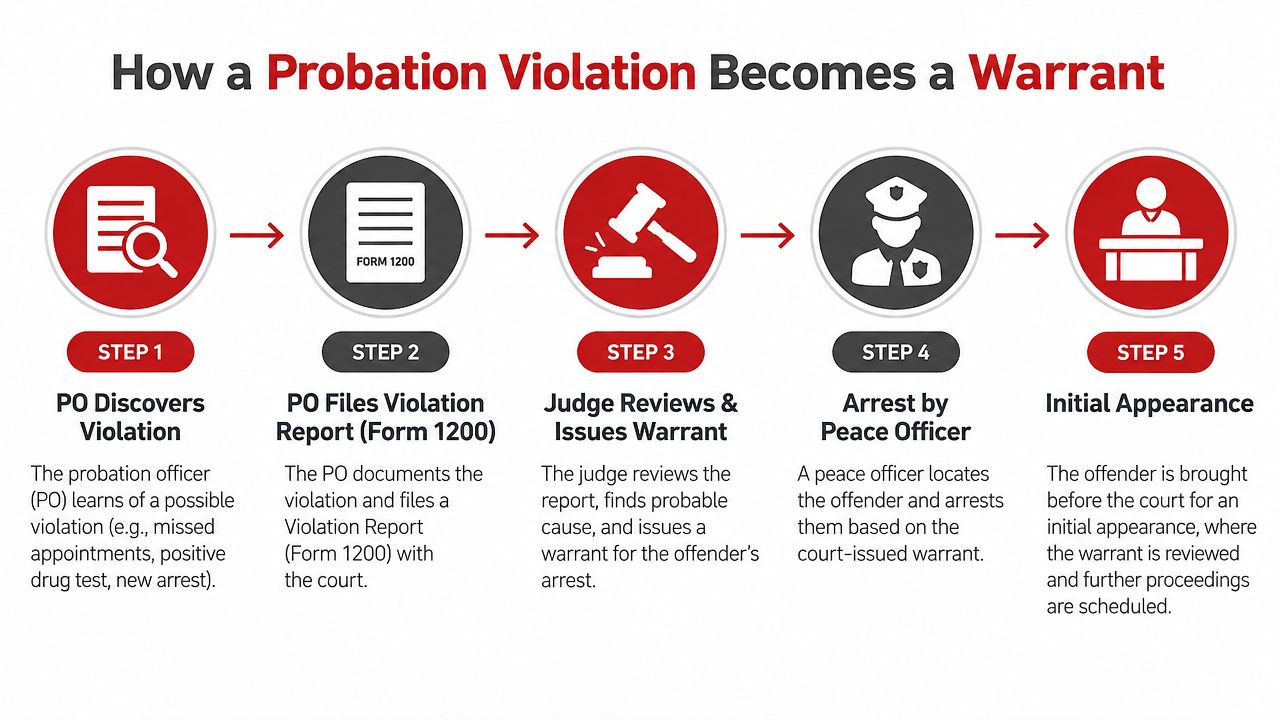
The process usually begins when the supervising agency learns about a possible breach. In Ventura County, that may involve the Ventura County Probation Agency, a law-enforcement report, a test result, a missed appointment record, or information from a related court case.
The working sequence looks like this:
- The officer documents the alleged violation. The report may identify the condition, date, conduct, and supporting records. In some cases, a written affidavit or petition includes police reports, test results, witness contacts, attendance records, or a new case number.
- The matter goes to a judge or magistrate. The court considers whether probable cause or reasonable grounds support the allegation. This is a screening standard, not the beyond-a-reasonable-doubt standard used to convict someone at a criminal trial.
- The court authorizes a warrant or summons. A summons may be appropriate when the court believes it can secure the person’s appearance without immediate custody. A warrant is more likely when the court is concerned about flight, danger, failure to respond, or another need for arrest.
- Law enforcement enters and serves the order. Once the warrant is active in the relevant systems, an officer can arrest the person during a lawful encounter.
- The person goes through booking and appears before the court. Release, bail, counsel, and the alleged violation are handled through the court process.
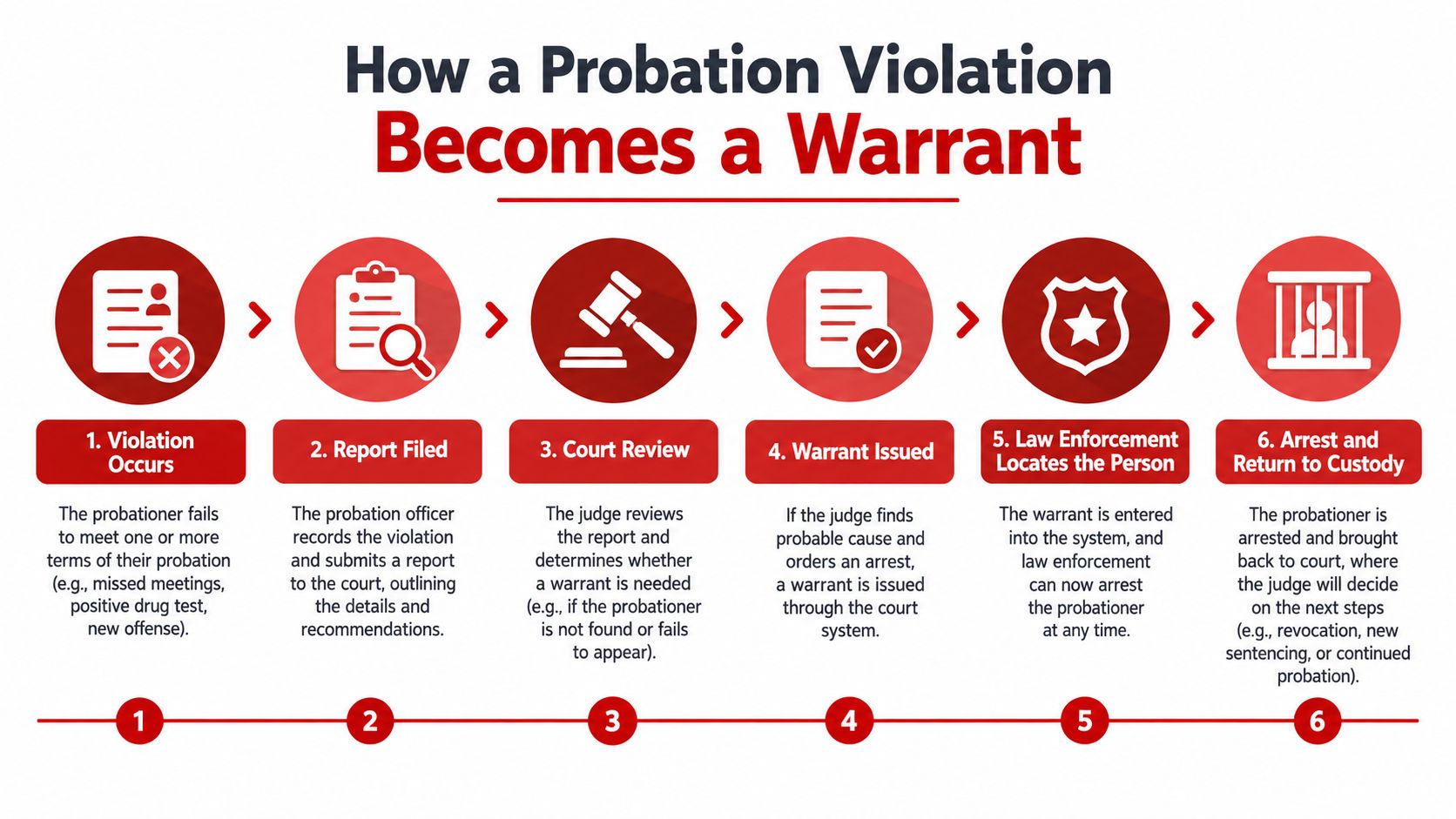
California procedures can differ by county and case type. The technical pattern remains probable-cause review, judicial authorization, arrest, and a violation hearing. Federal guidance adds a major timing rule. For federal probation and supervised release, after September 13, 1994, Congress allowed revocation after the supervision term expired if the court issued a warrant or summons alleging the violation before expiration (Federal revocation guidance). That rule shows why the issuance date can matter as much as the original end date.
If you’re unsure whether a warrant exists, use the court and sheriff channels or a warrant check resource rather than relying on an old paper notice.
Arrest and Booking in Ventura County
The arrest may happen in an ordinary moment. A deputy can serve the warrant during a traffic stop. Police may encounter the person at work, at home, or during another call. Once the officer confirms the active order, the person is taken to the Ventura County Pre-Trial Detention Facility at 800 South Victoria Avenue, Ventura.
Booking is controlled and repetitive. Staff document the arrest, photograph the person, take fingerprints, inventory personal property, and complete medical screening. Suicide screening is part of the intake process. The phone, wallet, keys, and other property are stored according to facility procedure until release or transfer.
Families often wait while the jail completes classification and clearance. The exact wait depends on the warrant, the person’s medical status, the facility’s workload, and the court calendar. An in-custody hearing may be scheduled within a few business days, but nobody outside the jail should promise a precise release or hearing time before the booking record is confirmed.
What the family should ask
Keep a written record of every call and request:
- Booking location: Confirm whether the person is at the Pre-Trial Detention Facility or another facility.
- Case information: Ask for the issuing court, case number, warrant type, and listed bail information.
- Property and phone access: Ask what the person can retrieve and when the next phone opportunity may occur.
- Court timing: Confirm whether an appearance has been scheduled and whether counsel can appear.
A probation arrest may be recorded as a probation hold or violation matter rather than a completely new criminal arrest in every public record. That distinction doesn’t make the custody less serious, and the family should still verify the actual booking status. People who need to understand what public booking images may show can review a general guide on finding a mugshot online, but the official jail and court records control.
The safest approach is to treat booking as a logistics problem. Use the jail’s published information, speak with a defense attorney, and follow the facility’s instructions. A clear overview of the jail booking process can help families avoid losing time over assumptions.
The Violation Hearing and Possible Outcomes
A violation hearing isn’t a second criminal trial. The prosecutor or probation side generally must prove the alleged violation by a preponderance of the evidence, meaning the court must find it more likely than not that the person broke a condition. The judge considers the probation order, officer reports, records, testimony, and any explanation or challenge presented by defense counsel.
The possible result depends on the breach and the person’s history. A missed appointment with prompt correction presents a different picture from a new violent allegation, repeated drug-test failures, or conduct suggesting the person won’t comply. The court may continue probation, add treatment or reporting requirements, impose electronic monitoring, order a custody commitment, or revoke probation and impose a previously suspended sentence when authorized.
National experience shows why families shouldn’t rely on a single prediction. A research summary reports that, in one multi-county study, violations ending in revocation ranged from 10% to 87%, reflecting substantial local variation (probation conditions research summary). That range isn’t a forecast for Ventura County. It does show why the judge, allegation, compliance record, and local procedure matter.
| Outcome | What the Judge Typically Orders | Custody Impact |
|---|---|---|
| Continued probation | The person remains on the existing terms, sometimes with a warning | No additional custody beyond the current detention |
| Modified conditions | Added classes, treatment, reporting, testing, or monitoring | May involve short custody or release with stricter terms |
| Short custody commitment | A defined period in custody followed by continued supervision | The person serves the ordered custody before release |
| Revocation | Probation ends and an authorized suspended sentence may be imposed | Custody can become substantially more serious |
Counsel matters because the court needs a usable resolution, not just an explanation. Bring proof of completed classes, treatment enrollment, employment, stable housing, payments, and prior compliance. A character letter won’t erase a violation, but organized evidence can help the judge evaluate whether supervision can be repaired.
How Bail and Bail Bonds Work on a Violation Case
Bail on a probation violation isn’t automatic. The judge may deny bail, set a higher amount than the original case, or impose conditions designed to protect the public and secure the person’s appearance. The court considers the alleged conduct, the person’s record, prior appearances, the underlying case, and whether release would create a serious risk.
When bail is available, California commonly uses a 10% premium for a surety bond. Under California’s bail system, a $25,000 bail amount typically carries a $2,500 nonrefundable fee, and surety companies file their rates while agents must charge the filed rate (California Department of Insurance overview). That premium is different from cash bail posted directly with the court.
Cash bail and surety bonds
Cash bail means the family posts the full amount through an approved jail or court channel. A surety bond involves a licensed bondsman guaranteeing the bail amount to the court in exchange for the lawful premium. The signer may also need to provide financial information, a co-signer, or collateral when the bond is large or the risk assessment calls for it.
Ventura County lists several accepted methods at the Pre-Trial Detention Facility, including cash in the exact amount, a cashier’s check payable to the Ventura County Superior Court, a bail bond, and card payment through GovPayNet or by phone using PLC #6404 (Ventura County Sheriff’s bail instructions). The facility accepts bail posting 24/7, and published local instructions also identify cash, cashier’s checks, certified checks, money orders, cards, and bail bonds as possible methods (Ventura County jail information).
Families searching for 24-hour bail bonds Ventura, Ventura County Jail bail bonds, bail bonds Oxnard, or bail bonds Thousand Oaks should call before guessing the amount. A licensed agent can verify whether bail is authorized, confirm the booking, explain the premium, and identify any co-signer or collateral issue. Administrative work such as batch skip tracing workflows belongs to the broader identity and contact-verification world, but a bail call should begin with the official booking and warrant information.
For a case-specific overview, see probation violation bail.
What to Do Next and How a Local Bondsman Helps
If someone has been arrested on a warrant for probation violation in Ventura County, move in a sensible order. Panic wastes time. A focused response gives the attorney, jail, and bondsman the information they need.
First steps
- Call a defense attorney. Choose counsel who handles probation violations and can appear at the arraignment, challenge the allegations, request lower bail, or seek release on own recognizance when the facts support it.
- Confirm the booking. Use the Ventura County Sheriff’s inmate information system or the jail’s official contact channels. Verify the full name, date of birth, booking location, case number, issuing court, and bail status.
- Call a licensed bondsman. Have the case number ready. Ask whether the warrant is bailable, what the lawful premium is, what payment options are available, and whether a co-signer or collateral is required.
- Gather compliance records. Collect proof of reporting, treatment, classes, testing, employment, housing, restitution payments, and any approved travel or address documents.
Don’t ignore the warrant, skip the hearing, or drive while you know an active warrant may exist. Don’t contact an alleged protected person in violation of a no-contact order. Don’t argue the facts with jail staff. Save those arguments for the attorney and the court.
Bail bonds in Ventura can help with the release logistics, but release is only the first responsibility. The person must attend every hearing, report as ordered, comply with testing and treatment, obey protective orders, update probation about address or employment changes, and keep proof of every completed requirement.
Bada Bing Bail Bonds handles probation violation and bench-warrant matters across Ventura, Oxnard, Camarillo, Port Hueneme, Thousand Oaks, Santa Paula, Moorpark, Fillmore, Ojai, and Santa Barbara, with agents available around the clock to verify booking details, explain the bond, coordinate paperwork, and discuss payment plans, co-signers, or collateral where applicable. Families can contact Bada Bing Bail Bonds now for a direct review of the warrant and release options.