Posting bail means giving a court-approved financial guarantee so someone arrested can leave custody while the case keeps moving. In U.S. felony cases, money bonds were set in 53% of cases in 1990 and 70% by 2006, which is why bail can decide whether your loved one sleeps at home tonight or stays in jail while the paperwork moves forward (NCSC pretrial research brief).
If you're staring at a late-night call from Ventura County, that's the part that matters right now. Posting bail is a bridge to freedom, not a final result, and the difference between those two things is where families get caught off guard.
Table of Contents
- The Real Meaning of Posting Bail in Ventura County
- From Arrest to Booking at the Ventura County Jail
- How the Ventura County Bail Schedule Sets the Price
- Cash Bail Versus Surety Bonds in California
- Release Conditions and the Reality of Conditional Freedom
- What to Expect When Calling a 24-Hour Bail Bonds Agency
- Navigating the First 24 Hours After an Arrest
The Real Meaning of Posting Bail in Ventura County
When someone gets arrested, families usually want the same answer first, what does posting bail mean, and how fast can it happen. In plain English, it means putting up money or another court-approved guarantee so the person can leave custody while the criminal case continues. It does not mean the case is over, and it does not mean the court has decided guilt or innocence (NCSC pretrial research brief).
Posting bail works as a release mechanism with conditions attached. The court wants the defendant to show up, follow orders, and return when required, which is why bail exists at all. If you want a deeper walk-through of the California process, this California bail overview is a useful companion to the Ventura County specifics.
Why the distinction matters at 2 a.m.
A stressed family member often hears “bail is set” and assumes the door opens right away. It doesn't. Bail is the start of the release process, not the finish line, and that delay is where the practical reality lives.
Practical rule: bail gets a person out of custody only if the court's conditions are satisfied and the facility accepts the paperwork.
That matters because a defendant can be eligible for release and still remain inside if the financial condition isn't met. Historically, U.S. courts leaned heavily on money-based release, which is why so many families still run into the same wall when they're trying to bring someone home.
From Arrest to Booking at the Ventura County Jail
A DUI stop in Oxnard, a domestic call in Camarillo, or a warrant pickup in Thousand Oaks doesn't end at the curb. The person usually goes through pre-booking, then intake, then the county jail process before anyone can even think about release. Families often imagine a fast handoff, but the actual path is slower and more procedural.
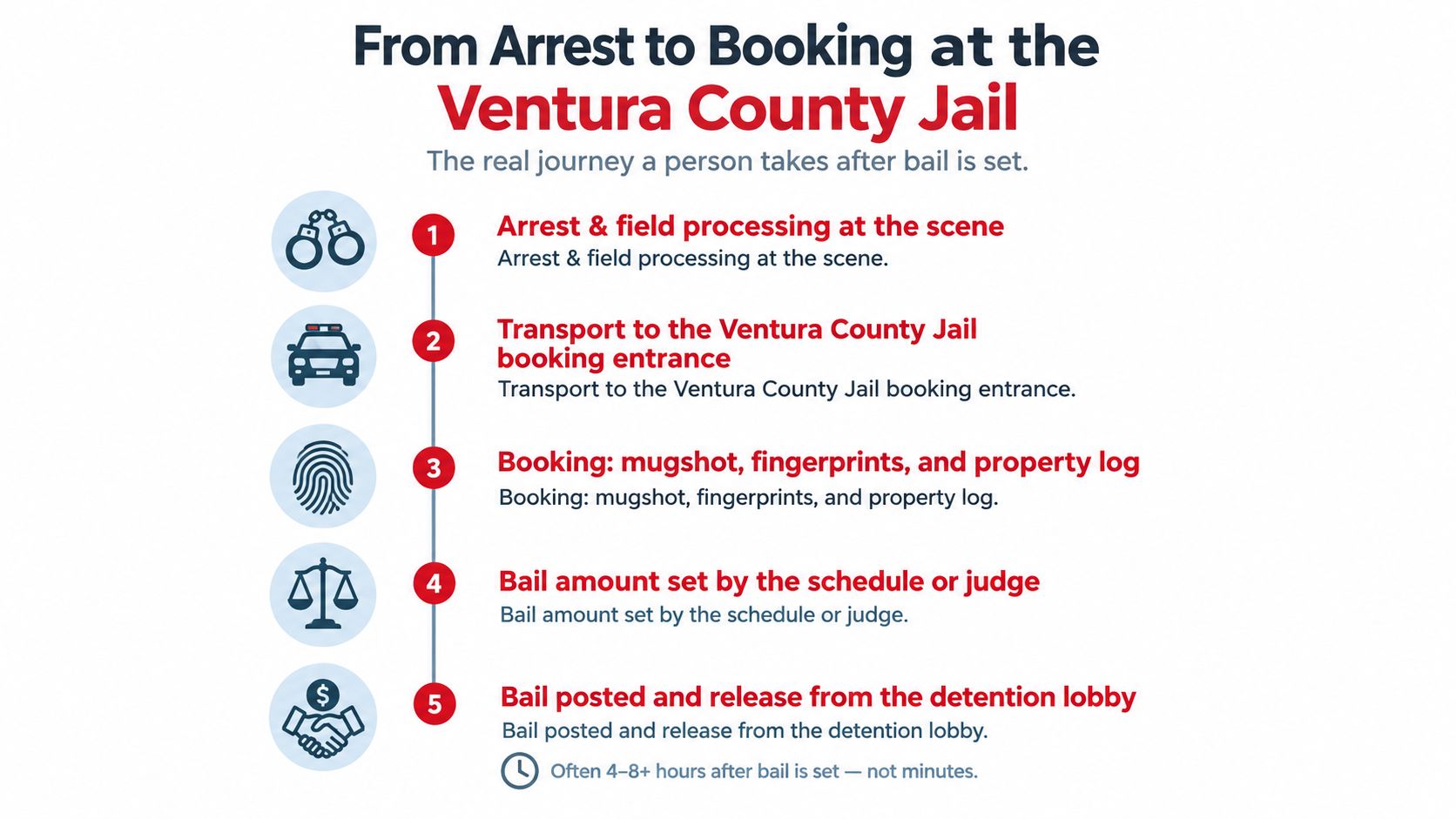
The county's detention process can take six to ten hours even after bail has been arranged, because adults first go through pre-booking steps like recording identifying information, securing evidence, and running criminal-background checks (Ventura County inquiry report). That's why families who call expecting “he should be out in 20 minutes” usually end up frustrated. The delay isn't always about the bond, it's often about the jail's workflow.
What actually happens inside the process
The person is identified, searched, documented, and checked against records before release can move forward. If the facility is busy, if transport is delayed, or if a case needs extra review, the clock keeps running. For families trying to understand the booking path in more detail, this Ventura County booking process page is the right place to start.
The practical takeaway is simple. Bail doesn't bypass booking. It only gives the person a path out once the jail finishes its side of the process.
How the Ventura County Bail Schedule Sets the Price
At 2 a.m., a family may hear a bail amount before anyone has explained how it was calculated. In Ventura County, the first figure usually comes from a countywide bail schedule adopted under California Penal Code §1269b, before a judge reviews the case. The Ventura County bail schedule provides the local starting point, rather than a single statewide price.
For offenses the schedule does not list, Ventura County sets bail at $10,000 for felonies, one-half of the felony amount for eligible Penal Code §17(b) misdemeanors, and $2,500 for other misdemeanors (Ventura County bail schedule). The amount may change based on whether the arrest involved a warrant and whether prosecutors classify the offense under a felony or misdemeanor subdivision.
Why local differences matter
A call about Ventura bail bonds or Ventura County bail bonds needs the exact charge, warrant status, and booking information. The arrest story alone is not enough. Classification, alleged enhancements, and other aggravating factors can affect the scheduled amount, so similar arrests may produce different starting figures.
The schedule also does not guarantee that release will happen immediately. Jail staff still must confirm the charge, verify the booking record, and accept the payment or bond. A correction to the booking information can create another delay, especially during a busy intake period.
Local reality: the bail schedule sets the starting point. The final amount depends on the charge, the county's procedures, and whether a judge changes it.
A warrant arrest may follow different instructions from a fresh roadside arrest. Before arranging bail bonds in Oxnard, Thousand Oaks, or elsewhere in Ventura County, confirm the booking location, listed charge, warrant details, and current bail amount. Those details determine which payment route can effectively move the release forward.
Cash Bail Versus Surety Bonds in California
Families usually face a blunt choice, pay the whole amount directly to the court, or use a licensed bail agent to post a surety bond. In California, a commercial bail bond generally means the agent guarantees the full bond amount, while the consumer pays a premium commonly set at 10% of the bond value instead of depositing the full amount personally (California Legislature bond analysis).
That means a $50,000 bond commonly produces a $5,000 premium before permitted transaction expenses (California Department of Insurance). The premium is generally nonrefundable, while direct cash bail is held by the court and handled separately under court rules.
Cash and surety side by side
| Feature | Cash Bail (Paid to Court) | Surety Bond (Bail Bondsman) |
|---|---|---|
| Who gets the money first | Court | Court, through the agent's guarantee |
| Upfront cost | Full bail amount | Commonly 10% premium |
| Refundable | Depends on court outcome and compliance | Premium is generally nonrefundable |
| Best fit | Families with liquid funds | Families who need to avoid paying the full amount at once |
A lot of midnight calls turn into practical decisions, not legal theory. For families who want a plain-English explanation of the guarantee side of the process, the surety bond meaning page can help before they commit to anything.
The right choice often comes down to timing and available cash. If the bond is large, families may also need collateral or a co-signer, but the central distinction never changes. Cash bail pays the court directly, while a surety bond gets the release process moving without requiring the full amount in hand.
Release Conditions and the Reality of Conditional Freedom
Posting bail does not mean free and clear. It means the court is allowing pretrial release under rules the defendant has to follow, and those rules can be strict (U.S. District Court pretrial services). Travel limits, electronic monitoring, curfews, drug testing, counseling, reporting requirements, and firearm restrictions can all be part of the release.
That's especially important in domestic violence cases, where a no-contact order or protective order can keep someone from returning home even after the bond is posted. Families sometimes hear “he's bailed out” and assume everyone can go back to normal. They can't. The home, the phone, and even the commute route may all be part of the court's restrictions.
What happens if the rules are broken
Missing court can trigger a bench warrant, and violating release terms can lead to detention even when bail was posted successfully. The bond is there to secure compliance, not to erase the case. Once the defendant breaks the rules, the court can revoke release and move the person back into custody.
Practical rule: the safest release plan is the one the defendant can actually follow every day, not just on paper.
Families should treat the release order like a checklist. Know the dates, know the restrictions, and don't assume a small violation is harmless. It usually isn't.
What to Expect When Calling a 24-Hour Bail Bonds Agency
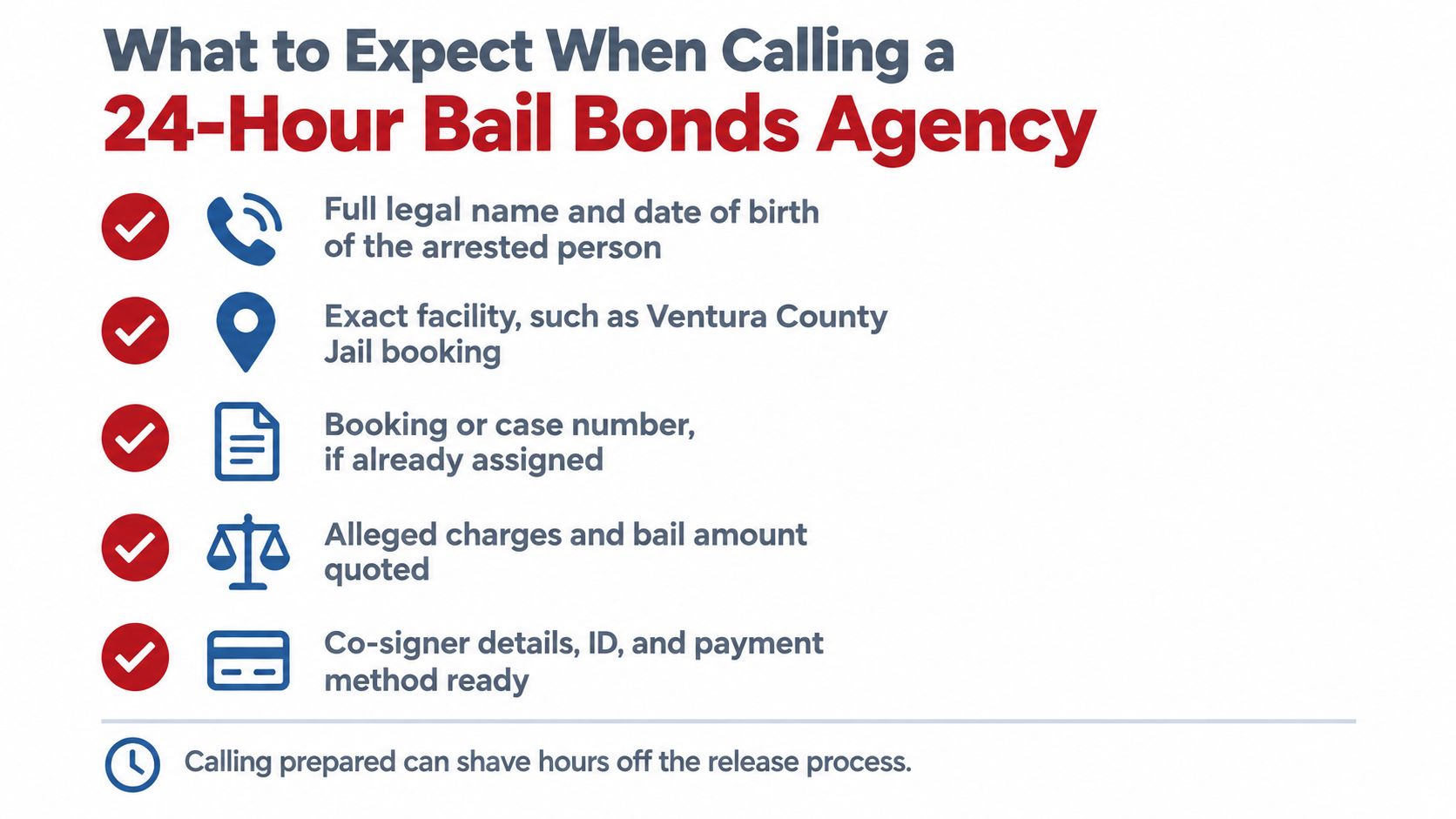
If you're calling at 3 a.m., have the basics ready before the conversation starts. That means the person's full legal name, date of birth, booking number if you have it, the facility, and the charges if they've already been relayed. The faster the agent can verify the booking, the faster the paperwork can move.
The Ventura County Sheriff identifies the East County Jail at 2101 E. Olsen Road in Thousand Oaks as a 24-hour booking and housing facility that accepts bail bonds and deposits for people held in Ventura County Sheriff custody (Ventura County Sheriff). That matters because bail bonds Thousand Oaks calls often hinge on the exact facility, not just the city name. Ventura County Jail bail bonds also depend on whether the person is at the Main Jail, East County Jail, or another booking location.
What speeds things up
- Full legal name and date of birth, so the booking can be matched fast.
- Exact facility, since the same person can't be handled the same way everywhere.
- Booking or case number, if the jail has already assigned one.
- Charge and quoted amount, so there's no confusion about the set amount.
- Co-signer details and payment method, because paperwork stalls when those aren't ready.
A calm, organized call usually beats a panicked one. If you're comparing 24-hour bail bonds Ventura options, the person on the other end should be able to verify the booking, explain the charge in plain language, and keep the process moving without judgment. One option families may encounter is Bada Bing Bail Bonds, which posts surety bonds and coordinates the jail paperwork after booking is confirmed.
Navigating the First 24 Hours After an Arrest
The first day is about control, not perfection. Get the booking information, confirm where the person is being held, and don't assume the release will happen the same hour the bond is arranged. Ventura County's processing time, the county schedule, and the facility's workload all shape how fast the person walks out.
Use a simple order of operations. First, verify the arrest and location. Second, confirm the amount and whether the court has already changed it. Third, decide whether cash bail or a surety bond makes more sense for the family's situation. Fourth, make sure the release conditions are understood before the person leaves custody.
A short checklist for the family
- Secure the exact court order, not a rumor about the amount.
- Record every court date immediately, then store them in more than one place.
- Read every release condition carefully, especially travel limits and no-contact terms.
- Confirm who is paying what, since the bond premium and the court amount are different.
- Ask what happens next, including when the jail expects the paperwork to be processed.
If you need a second set of eyes on court paperwork or release conditions, a legal-information tool like LegesGPT can help you organize the questions before you call counsel or a bondsman. It's not a substitute for the jail or the court, but it can make the first conversation more focused when everything feels chaotic.
Posting bail is only the start. The main job is getting the release posted correctly, getting the person out safely, and keeping the case on track until the bond is exonerated and any collateral can be returned.
If you need help right now, Bada Bing Bail Bonds can verify the booking, explain the Ventura County bail schedule, and move quickly on a surety bond for families in Ventura, Oxnard, Camarillo, Thousand Oaks, and nearby cities. Visit Bada Bing Bail Bonds to get the process started and speak with a local agent who can help you through the first call, the jail paperwork, and the release window.