At 2 a.m., the phone rings and nobody can explain where your family member went. The parole officer may have reported a violation, a warrant may already be active, or a traffic stop may have turned into a booking at the Ventura County Main Jail. The immediate questions are simple but urgent: Is this just a warning, can the person come home, and what happens when you violate parole in California?
A parole hold can move quickly, and a regular bail bond may not solve the entire problem. Families in Ventura, Oxnard, Camarillo, Port Hueneme, Thousand Oaks, Santa Paula, Moorpark, Fillmore, Ojai, and Santa Barbara need to separate the parole process from any new criminal case, identify the exact hold, and get accurate information before signing paperwork or assuming release is available.
Table of Contents
- What Parole Really Means and Why Violations Are Treated So Seriously
- Technical Violations Versus New Crimes and Why the Distinction Matters
- How a Parole Violation Unfolds Minute by Minute
- California Hearings, Deadlines, and What Gets Decided
- Bail, Bond Premiums, and Whether You Can Get Out on a Parole Hold
- How a Local Ventura County Bail Bondsman Changes the Outcome
- Two Real-World Scenarios That Play Out in Ventura County
- Your First 24 Hours and Common Questions Families Ask
What Parole Really Means and Why Violations Are Treated So Seriously
Parole is conditional release after a person has served part of a state or federal prison sentence. The person lives in the community, but the release comes with rules enforced by a parole agent or supervising authority. Probation is different. A court generally imposes probation instead of sending someone to prison, while parole follows imprisonment and depends on continued compliance. For a plain-language comparison, review probation versus parole in California.
Think of parole as a revocable job offer. The person has freedom to work, live with family, and rebuild a routine, but the offer comes with a long list of conditions. Missing a required check-in, failing a drug test, leaving an approved area, or contacting a restricted person can give the parole authority a reason to take action.
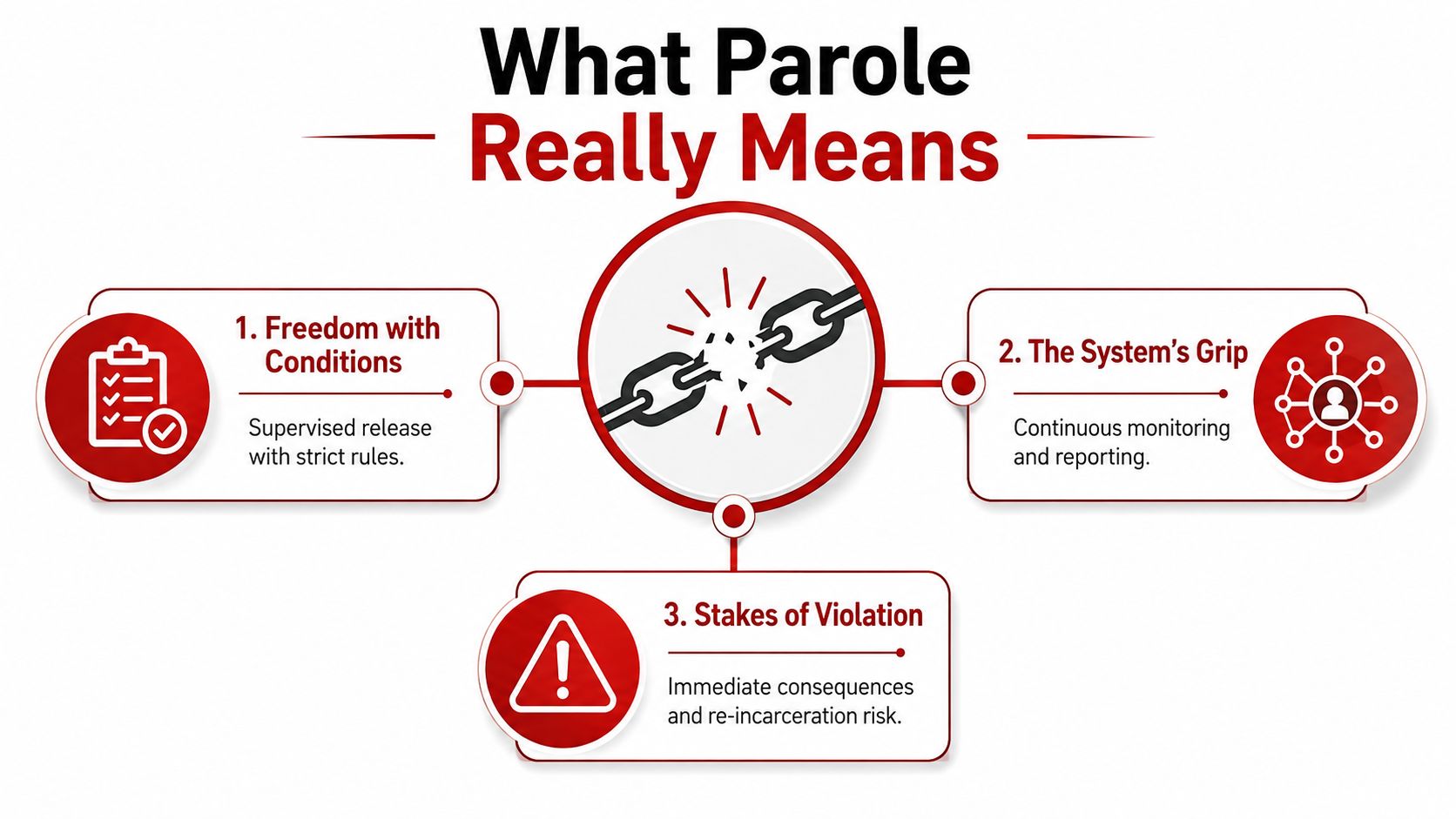
The system treats a violation seriously because parole isn’t an ordinary promise between two private parties. It is a release arrangement backed by correctional authority. Once an agent believes the person has breached a condition, the agent may document the conduct, request a warrant, or use a summons process. The person can then face custody while the authorities decide whether the allegation should lead to a sanction or revocation.
The practical risk is reincarceration, not merely a warning. Pew reported that about 425,000 parole exits occurred in the United States in 2016, and 30% were unsuccessful, with 27% of all parole exits ending in incarceration. Pew also estimated that nearly 350,000 supervision failures each year resulted in prison or jail terms. These figures appear in Pew’s analysis of probation and parole systems.
Practical rule: Treat the first notice of a suspected violation as a custody problem until the parole agent or jail confirms otherwise.
That doesn’t mean every allegation ends with prison. It means families should act immediately, preserve hospital, employment, treatment, travel, and prescription records, and avoid assuming that a technical violation is harmless. Timing matters because the first communication often determines whether the family understands the hold before the person is transferred, booked, or placed on a hearing calendar.
Technical Violations Versus New Crimes and Why the Distinction Matters
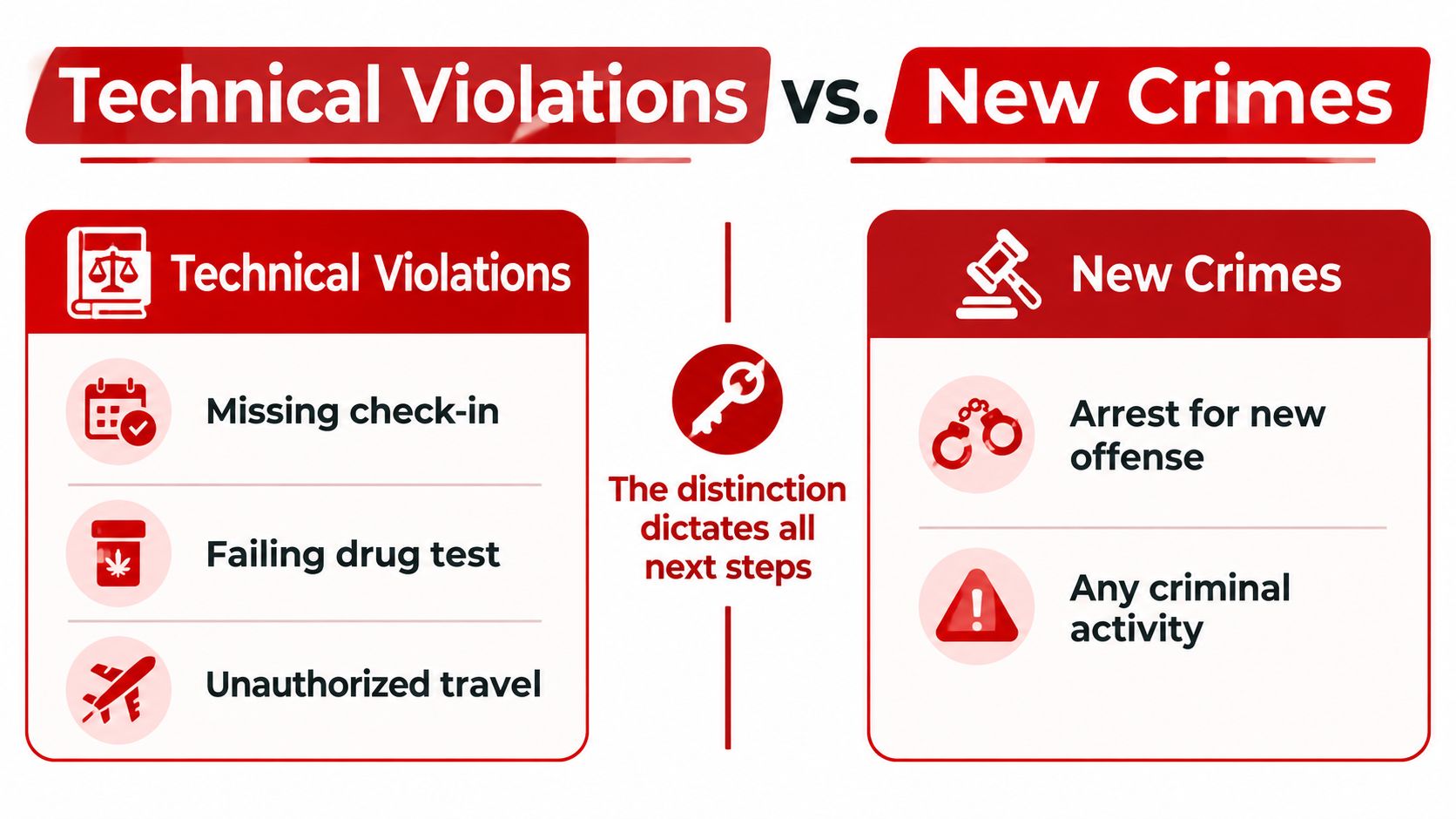
The first question is what kind of violation is alleged. Most cases fall into one of two categories, and the category affects the evidence, the hearing strategy, and the possibility of additional criminal charges.
Technical violations
A technical violation breaks a supervision condition without necessarily involving a new criminal charge. Common examples include:
- Missed check-in: The person doesn’t report to the parole office as directed.
- Failed drug test: The test indicates prohibited drug or alcohol use.
- Unauthorized travel: The person leaves an approved area without permission.
- Curfew breach: The person is away from the approved residence at the wrong time.
- Restricted contact: The person communicates with someone on a no-contact list.
- Prohibited possession: The person possesses a firearm or another restricted item.
A missed Friday appointment after a hospital visit may still be reported as a violation, but hospital discharge papers, admission records, and a prompt call from counsel can change how the agent evaluates the conduct. A positive test involving a prescribed medication also requires documentation, not an argument made from memory.
Technical violations can lead to custody even when prosecutors don’t file a new criminal case. The National Academies distinguishes these violations from new crimes because technical violations concern supervision terms, not necessarily criminal conduct. Its discussion of community supervision and revocation is useful for understanding why a person can face a parole hearing without a new conviction.
New-offense violations
A new-offense violation involves alleged criminal activity while the person is on parole. A new DUI, domestic violence arrest, drug charge, theft allegation, or felony arrest can create two problems at once:
- The new criminal case, with its own booking, bail, court dates, and defense.
- The parole matter, with its separate hold, probable-cause review, and possible revocation.
An arrest isn’t the same as a conviction, but it can still trigger parole action. The parole authority may rely on police reports, test results, witness statements, or other preliminary information while deciding whether custody and a revocation hearing are warranted.
Research summarized by the National Academies shows why families shouldn’t assume parole agents act only after a new conviction. A technical violation can be enough to start the process. For an additional plain-English overview of the subject, Ticket Shield on parole violations provides background on supervision breaches and possible consequences.
The distinction also matters for bail. A new charge may carry a listed bail amount, while a pure technical parole hold may not be solved by posting a bond. Families should identify both the criminal booking status and the parole hold status before paying anything. If the person also missed a court date, review what missing court can mean because that warrant may create another obstacle.
How a Parole Violation Unfolds Minute by Minute
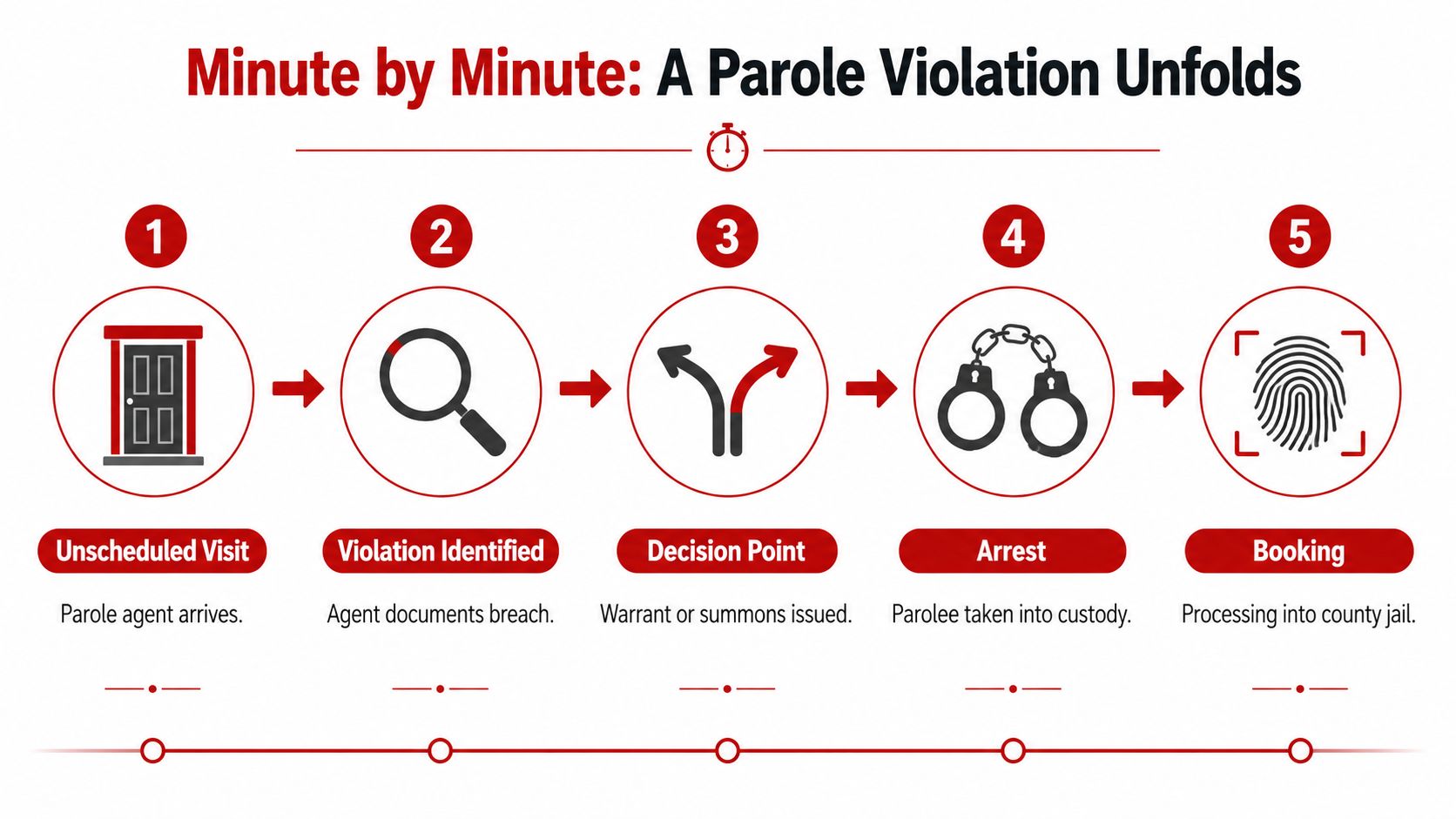
A family may learn about the arrest only after the process is already underway. A parole agent can arrive unannounced at home or work, review a failed test, receive a police report, or document a missed appointment. The agent then chooses whether to seek a warrant, issue a summons, or use a less formal response.
The custody sequence
The operational sequence usually follows these steps:
- The agent investigates. The parolee may be questioned, asked for records, or confronted with the alleged breach.
- The agent selects a custody path. A summons requires an appearance. A warrant permits authorities to take the person into custody.
- Officers make the arrest. The arrest may occur at home, at work, during a traffic stop, or elsewhere.
- The person is transported. In Ventura County, booking commonly occurs at the Pre-Trial Detention facility at 800 South Victoria Avenue in Ventura, according to the Ventura County Sheriff’s Office bail information.
- The jail completes intake. Staff search, fingerprint, photograph, screen, and classify the person before determining the next custody step.
Booking takes time. Crowding, medical screening, mental-health screening, classification decisions, and transfer instructions can all delay the process. The jail’s physical booking time may also differ from the time an inmate locator displays the record. An empty online search does not prove that no arrest occurred.
Families should also understand the difference between a parole hold and ordinary bail. A parole hold is an administrative detainer that can run alongside a new criminal case. Posting bail on the new charge may address that charge, while the person remains in custody because the parole authority continues the hold.
Ask three direct questions: Has the person been booked, what charges or warrants appear in the record, and is an active parole hold blocking release?
Gather the booking name, date of birth, arrest location, parole agent’s name, available case number, prescription information, hospital records, and proof of residence or employment. For the next practical steps, review how Ventura County processes bookings and releases. A signed bond does not always produce immediate release when another hold remains active.
California Hearings, Deadlines, and What Gets Decided
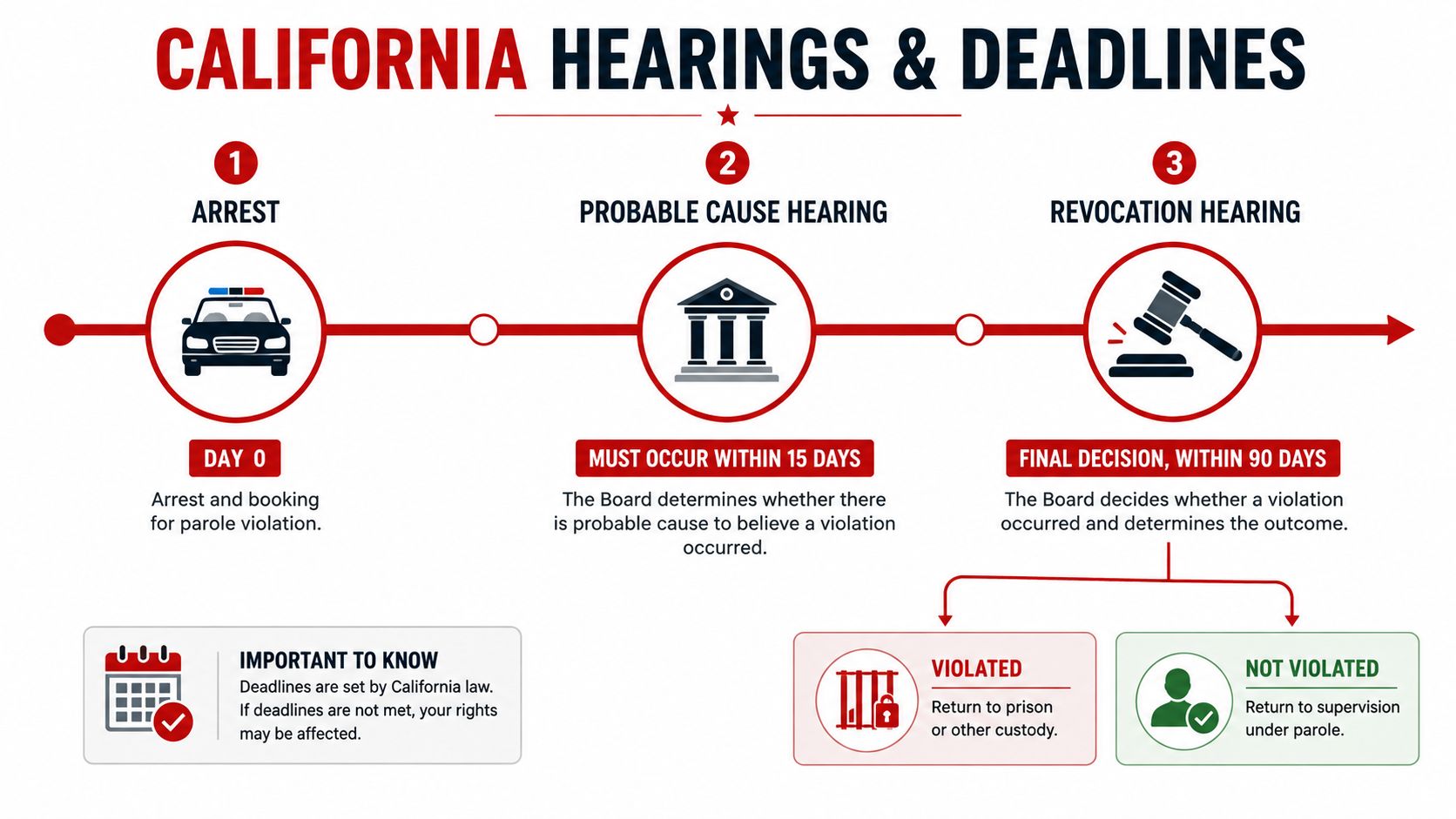
California’s parole revocation process has two stages. The first asks whether reasonable grounds support the alleged violation. The second reviews the evidence in greater detail and decides whether parole should be revoked, continued, or reinstated with conditions.
The probable-cause hearing
Under California Penal Code section 3044, a probable-cause hearing must occur no later than 15 days after arrest for a parole violation. This hearing is not a final trial. The decision-maker applies a lower threshold than proof beyond a reasonable doubt and considers whether the allegation has a reasonable factual basis.
A defense attorney can challenge unreliable reports, identify missing context, and submit records that weaken the allegation. Families should start collecting those records immediately, including messages, appointment records, treatment documents, and proof of compliance.
The hearing serves as an early screening point. If the evidence does not support continued proceedings, the case may move toward release or another resolution. If probable cause is found, the matter proceeds toward the evidentiary revocation hearing.
The evidentiary revocation hearing
California law requires the evidentiary revocation hearing no later than 45 days after arrest, according to the cited text of Penal Code section 3044. Federal rules use different timelines, including a local revocation hearing within 65 days of retaking and an institutional hearing within 90 days, as provided in 28 C.F.R. section 2.102. Do not use federal deadlines to predict a California case.
At this hearing, the decision-maker evaluates testimony, records, reports, and other evidence. Counsel may challenge the allegation, cross-examine witnesses when permitted, explain mitigating facts, and request reinstatement with modified conditions instead of full revocation. The result can range from continued supervision to a return to custody.
For federal context, the Department of Justice reported that almost 28% of roughly 60,000 closed supervised-release cases in fiscal year 2021 ended in revocation, while just over 30% of about 57,000 cases in fiscal year 2022 did so. Among those federal revocations, incarceration occurred in approximately 99% of cases, with average sentences of 9.7 months in 2021 and 9.5 months in 2022, according to the Department of Justice report%20-%20DOJ%20Report%20on%20Resources%20and%20Demographic%20Data%20for%20Individuals%20on%20Federal%20Probation.pdf). Those federal figures provide context, not a prediction for a California parole matter.
Families should track every deadline, hearing notice, transfer, and attorney contact. Ventura County’s court system can help identify the local court setting for a related criminal case. The parole hearing remains separate, so confirm both calendars and ask which authority controls the person’s custody.
Bail, Bond Premiums, and Whether You Can Get Out on a Parole Hold
The answer depends on what caused the custody. If the person faces a new criminal charge, that charge may carry a bail amount. If the person has only a technical parole violation, traditional bail may not apply at all. The parole authority controls the hold, and a bondsman cannot erase an administrative detainer by filing a regular surety bond.
Separate the charge from the hold
Ask the jail whether the person has:
- A new criminal case: This may have a bail amount, court date, and release terms.
- A parole warrant or hold: This may keep the person in custody even after bail on the new case is posted.
- A court warrant: A missed appearance or older case may create another barrier.
- No listed bail: The person may need a parole decision rather than a bond.
That distinction prevents the most expensive misunderstanding in a parole arrest. A family can post bail on the new charge and still receive a call saying the person isn’t being released because the parole hold remains active. Before paying, confirm whether the bond addresses the actual reason the person is still held.
California bond costs
California law sets the standard bail bond premium at 10% of the total bail amount, as described in the cited California bail explanation. A $50,000 bail commonly means a $5,000 premium, not payment of the full $50,000 bond amount. Review the meaning of bail revocation before assuming that an existing bond continues after a new arrest or violation.
Cash bail requires payment of the full amount under the applicable jail procedure. A surety bond uses a licensed bail agency and a premium, while own-recognizance release depends on a court or agency decision and isn’t guaranteed. Payment plans, co-signers, and collateral may be available depending on the bond and the agency’s underwriting requirements.
Ventura County says bail may be posted at the Pre-Trial Detention facility at 800 South Victoria Avenue in Ventura. Independent jail guidance states that Ventura County Main Jail bail can be posted 24/7, including nights, weekends, and holidays, using cash, certified funds, money orders, or credit or debit payment options. Confirm current facility procedures before traveling because the release process can change.
A local 24-hour bail bonds Ventura agency can move quickly on the part it controls. It can verify the booking, confirm the criminal bail amount, prepare paperwork, and coordinate delivery with the jail. That may shorten avoidable waiting, but it cannot guarantee release while a parole authority continues to hold the person.
How a Local Ventura County Bail Bondsman Changes the Outcome
The first 24 hours are where families either gain control of the situation or lose time. At Ventura County Main Jail, the person may be waiting through intake, medical screening, classification, a warrant check, and confirmation of the parole detainer. Calling a 24-hour bail bonds Ventura office gives the family one operational contact instead of forcing relatives to guess which agency controls the next step.
A local bondsman should verify the booking before discussing payment. The basic workflow is straightforward:
- Confirm the person’s identity and booking location.
- Separate the parole hold from any new criminal charge.
- Verify the listed bail and applicable release conditions.
- Explain the 10% California premium in plain English.
- Review co-signer, payment-plan, and collateral requirements.
- Coordinate documents with the jail and track the release window.
That service is different from legal representation. A bondsman doesn’t replace defense counsel or argue the revocation case. The bondsman’s role is to handle the bond and release logistics while the parolee and family obtain legal advice about the underlying allegation.
Don’t sign a bond before you know what it covers. Ask whether the paperwork addresses a new criminal charge, a warrant, or only a scheduled court appearance.
Bada Bing Bail Bonds can verify booking details, explain charges and bail schedules, coordinate paperwork with local jails, and provide payment plans, co-signer options, and collateral solutions when available. The agency handles matters including DUI, domestic violence, drug offenses, theft, warrants, probation violations, and white-collar charges. It also provides court-date reminders and compliance guidance after release.
That local familiarity matters across Ventura County and nearby Santa Barbara County. A call from Oxnard, Camarillo, Port Hueneme, Thousand Oaks, Santa Paula, Moorpark, Fillmore, or Ojai may involve a booking location, court venue, or transfer that isn’t obvious to someone outside the area. Families searching for Ventura County bail bonds, bail bonds Oxnard, Ventura County Jail bail bonds, or fast bail bonds Ventura should focus on accurate booking verification, transparent fees, and a real person answering at night.
Two Real-World Scenarios That Play Out in Ventura County
A family in Oxnard learns that its relative missed two parole check-ins after a hospitalization. The parole officer issues a warrant, and the person is arrested during a traffic stop near Camarillo. A new charge has workable bail, but the parole hold blocks release, so posting the bond doesn’t bring the person home. The family waits through the hearing calendar, and the violation ends in a 90-day revocation.
The lesson is not that every missed appointment produces the same result. The lesson is that medical records should reach the parole agent and defense counsel immediately. A hospital admission, discharge paperwork, medication list, and proof of attempted communication can give the decision-maker context that a bare violation report won’t show.
A different family in Santa Barbara County learns that a parole agent flagged a positive drug test. No new criminal charge is filed. The agent agrees to a stabilization plan, and the family quickly coordinates treatment, housing support, and communication with counsel. A 24-hour local bondsman helps determine whether any separate criminal bail exists, while the parole team considers reinstatement with modified conditions.
These outcomes aren’t guaranteed, and the examples don’t replace legal advice. They show why response speed, documentation, and direct communication matter in Ventura, Santa Barbara, Thousand Oaks, and the surrounding communities. The same category of technical violation can lead to very different next steps depending on the facts, the agent’s response, and whether the family acts before the person misses another deadline.
Your First 24 Hours and Common Questions Families Ask
A loved one may be sitting in the Ventura County Main Jail while the family is still trying to confirm what happened. Start with the booking record, not rumors. Call the facility, ask whether a parole hold is active, and find out whether a separate criminal case has a bail amount. Then contact defense counsel or appointed counsel and gather hospital, treatment, prescription, work, residence, and travel records.
Ask the parole agent which condition is alleged, whether a warrant exists, and whether a hearing date has been set. Ask the jail whether booking and classification are complete, where the person is housed, and whether the hold blocks release. Check the official Ventura County custody roster after allowing for booking delays.
Keep identification, medical records, medication proof, and counsel’s contact information ready. Do not encourage the parolee or a family member to sign factual admissions without legal advice. If a new charge carries bail, call a bondsman and confirm whether posting that bond addresses only the criminal hold. On a parole hold, the jail or parole authority may still refuse release. The bail premium rule applies to the criminal bond, not automatically to the parole hold.
How long can a parole hold last without a hearing?
California law provides a probable-cause hearing no later than 15 days after arrest and an evidentiary revocation hearing no later than 45 days after arrest under Penal Code section 3044. Transfers, notice problems, and separate criminal cases can affect the practical schedule. Track each date and request confirmation rather than relying on informal estimates.
Can a violation become an informal sanction?
It can. Depending on the facts and the supervising authority’s decision, the response may include additional reporting, treatment, tighter conditions, or another sanction instead of full revocation. That option is not automatic, particularly after repeated allegations or a new criminal case.
What rights exist at the probable-cause stage?
The parolee receives an initial review focused on whether a reasonable basis supports the alleged violation. Counsel should examine the allegation, identify missing context, and present reliable records when appropriate. This hearing does not decide the final revocation outcome.
Can a violation affect immigration or a later sentence?
The consequences depend on the person’s record, charge, immigration status, and case posture. Before making statements or accepting a disposition, consult an attorney who handles the relevant criminal and immigration issues. A lawyer can assess how the arrest, custody, alleged violation, or revocation fits the person’s specific cases.
Parole holds require fast, organized action. Record the booking time, preserve documents, identify the criminal bail separately, and ask directly whether release is possible while the parole hold remains.
If a loved one is held on a new charge alongside a parole violation, Bada Bing Bail Bonds offers 24/7 booking verification, clear premium explanations, payment-plan and co-signer options, and coordination with Ventura County facilities. Call to confirm whether bail is available, then ask specifically whether a separate parole hold will remain after the bond is posted.