
The phone rings after midnight. A son, spouse, brother, or friend says they've been arrested, and then you hear the phrase that makes everything feel worse: no bond warrant.
At that point, most families ask the same questions. Can we pay something right now? Can a bail agent get them out tonight? Is this just a mistake in the computer? In California, the hard answer is that a no-bond warrant usually means there is no immediate money-based release option until a judge reviews the case. That doesn't mean the situation is hopeless. It means the path is different, slower, and more court-driven than a standard bail-out.
What matters right now is understanding what happens next, especially in Southern California where booking, transport, weekends, and court calendars can change the first couple of days in custody. If you're still trying to locate your loved one, start with this guide on how to find an arrested loved one in Camarillo. Then focus on the next decision in front of you.
Table of Contents
- That Call in the Middle of the Night
- No Bond Warrants vs Other Warrants
- Why Would a Judge Issue a No Bond Warrant
- How to Check for a Warrant in Southern California
- The First 72 Hours After a No Bond Arrest
- Your Legal Options for Resolving a No Bond Warrant
- How a Bail Bonds Agency Can Support Your Family
That Call in the Middle of the Night
When families search what is a no bond warrant, they usually aren't doing academic research. They're standing in a kitchen, whispering so they don't wake the kids, trying to figure out why someone they love can't be released.

A no bond warrant is a court-issued arrest warrant that tells law enforcement to take someone into custody without allowing immediate release on bail. The person stays in jail until a judge reviews the case. That is different from bond not set, which usually means bail hasn't been determined yet, as explained by Esfandi Law's overview of no-bail warrants.
That difference matters more than people realize. If a warrant has a bail amount attached, a family can often start solving the release problem right away. If it's no bond, the jail can't fix it, a clerk can't fix it, and a bail bonds agent can't bypass it with paperwork or payment.
Practical rule: If the hold is no bond, stop asking, “How much is bail?” and start asking, “When is the judge review, and who is handling the court side?”
In Southern California, that first night is usually a blur of booking questions, inmate searches, and bad information from panicked relatives. The most useful thing you can do is slow down, confirm where the person is being held, and find out which court issued the warrant. Once you know that, the next steps become clearer.
No Bond Warrants vs Other Warrants
A lot of confusion comes from people using the word “warrant” like it means one thing. It doesn't. Some warrants lead to a quick bail process. Some lead to a court date. Some lead to a hold where nobody walks out until a judge says so.
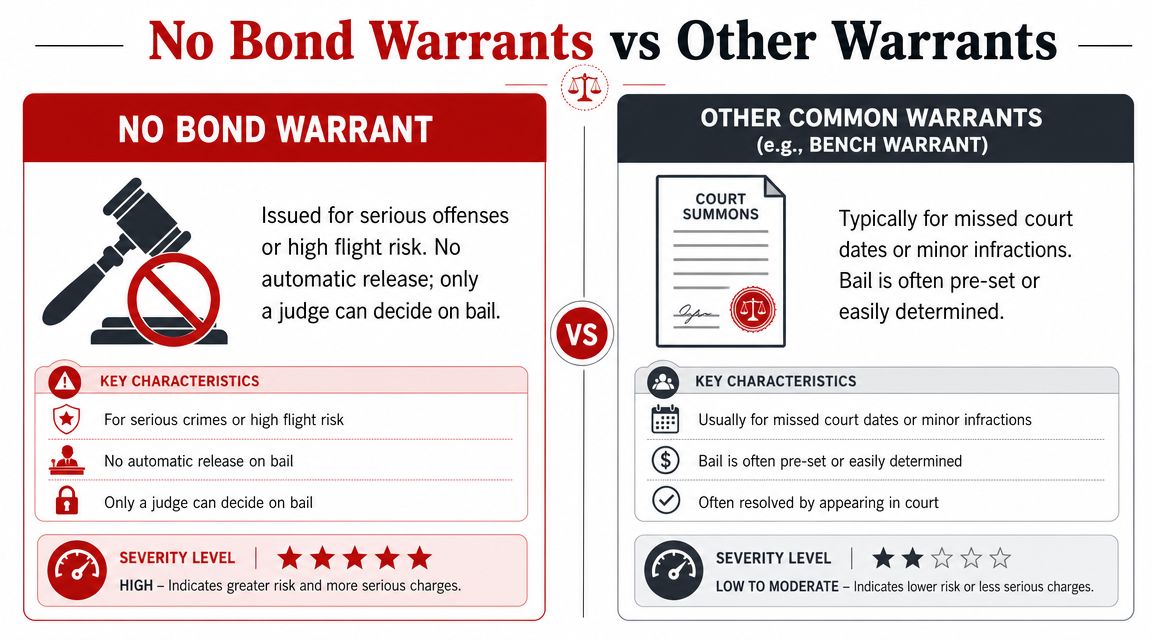
If you want a broader breakdown of warrant categories, this guide on bench vs. Ramey vs. arrest warrants helps sort out the labels families hear from deputies, clerks, and attorneys.
The definition that matters at booking
The biggest practical difference is simple. Can the person be released before seeing a judge, or not?
A standard arrest warrant may come with a bail amount or fall under local scheduling rules. A bench warrant often comes from missing court. A no-bond warrant can attach to different situations, but the common thread is that the court has decided immediate release isn't available.
One more point matters here. Some warrants are explicitly marked no bond. Others are silent on bail. In practice, that can create confusion because some jurisdictions treat a warrant with no bail amount listed like a no-bond hold, while others require a later court process to set bail, as discussed in Hornsby's explanation of warrant procedure and bail silence.
Warrant types at a glance
| Warrant Type | Can You Bail Out Immediately? | Common Reason |
|---|---|---|
| No-bond warrant | Usually no | Court wants custody first and judicial review before any release |
| Bench warrant | Sometimes, but not always | Missed court appearance or disobeyed a court order |
| Standard arrest warrant | Often depends on bail status | New criminal allegation supported by probable cause |
Bench warrants deserve special attention because they're common and families often underestimate them. Failure-to-appear warrants are treated as a form of bench warrant, and one study cited by EBSCO reported that about 22% of defendants released prior to trial had bench warrants issued against them for failing to appear, discussed in the UK government bulletin on failure-to-appear warrants and related criminal procedure context. When a court adds a no-bond condition to that kind of warrant, the consequences become much more immediate.
Here's a short explainer on the operational side of no-bond warrants:
A missed court date and a no-bond hold are not the same problem. The missed date caused the warrant. The no-bond status controls the release.
Why Would a Judge Issue a No Bond Warrant
Families usually want to know whether the judge is trying to punish the person. Sometimes that's how it feels from the outside. In practice, the court is usually focused on control, attendance, and safety.
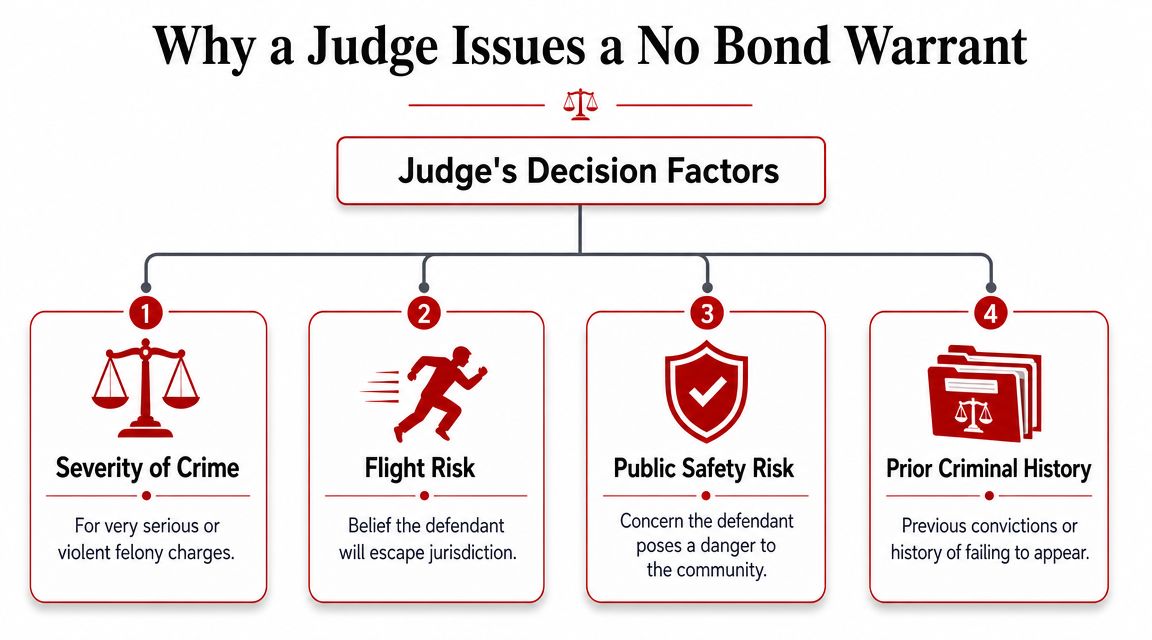
What the court is looking at
Judges typically move toward no bond when they believe release should be restricted until they can look at the person directly in court. In California cases, families often hear this after an alleged probation violation, an accusation that someone absconded, or a case the court sees as higher risk.
Common reasons include:
- Flight concerns. If the court thinks the person won't come back voluntarily, it may require custody first.
- Public safety concerns. If the allegation involves violence or facts the court views as dangerous, judges tend to be cautious.
- Probation or supervision issues. A person already under court supervision starts from a weaker position if the judge thinks they ignored conditions.
- Repeated noncompliance. Missing court, breaking release terms, or failing prior reporting requirements can all affect the judge's decision.
In probation matters, a no-bond designation is often used when the court believes the person absconded or poses a risk, though an attorney can still ask for a bond hearing and argue for release conditions, as noted in Blackburn & Betts' discussion of no-bond probation-violation warrants.
What families often get wrong
The court doesn't always see “good family support” the way a family sees it. Telling the judge someone has a job, a parent nearby, or kids at home can help, but it won't erase a history the court views as unstable or noncompliant.
That's why angry calls to the jail rarely do anything. The jail is following the court order. The better approach is to gather the information an attorney can use: proof of residence, employment details, treatment participation if relevant, and anything that shows the person is reachable and manageable on release.
The question isn't whether your loved one is a good person. The question is whether the court believes they'll appear and follow conditions if released.
How to Check for a Warrant in Southern California
If you think there may be a warrant, don't rely on rumors, social media, or what someone “heard from a cousin at the courthouse.” Get clean information first.
Start with the basics
You'll usually need the person's full legal name and date of birth. In Southern California, families often start by checking county court or law enforcement records, then confirming custody status through the jail if an arrest has already happened. For agency contact points in Ventura County, use this Ventura County law enforcement contact page.
Work carefully. Similar names create a lot of confusion, especially with common last names.
A practical order looks like this:
- Confirm identity details. Get the exact legal spelling, date of birth, and any known middle name.
- Check the likely county first. Start where the person lives, works, or last appeared in court.
- Separate court status from custody status. A person can have a warrant and not yet be booked. They can also be booked in a different facility than the arresting agency.
- Write down case numbers and court names. That information saves time when you speak to counsel or a bail agent later.
If you find a warrant
Don't ignore it and hope it goes away. Don't assume a routine traffic stop will stay routine either.
Also don't march into a station for “just a quick explanation” without legal advice. In no-bond situations, the smarter move is usually to talk with criminal defense counsel first, especially if there may be a surrender strategy, a motion, or a court appearance that can be coordinated.
If the warrant appears to be out of Los Angeles, Ventura, Santa Barbara, or a nearby county, the next critical question is which court issued it and whether the matter involves failure to appear, a probation issue, or a new criminal allegation. That tells you what kind of hearing you're likely headed toward.
The First 72 Hours After a No Bond Arrest
This is the part most families need. Not the definition. The timeline.
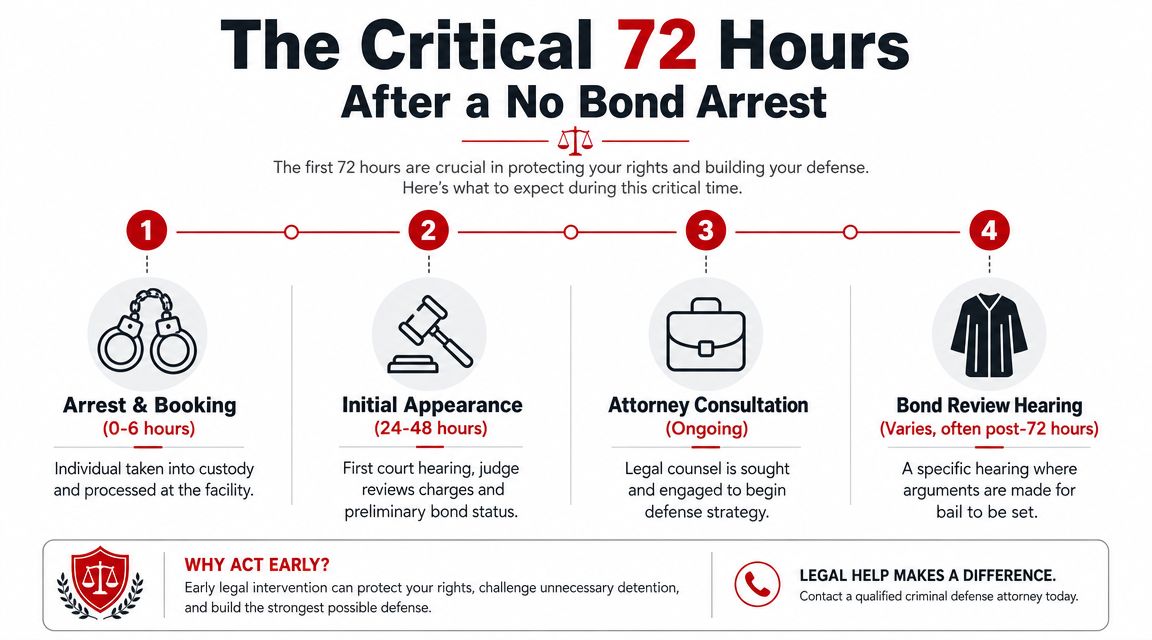
What usually happens first
After arrest, the person is booked, searched, processed, and held. If the warrant is no bond, they usually remain in custody pending court review. That can mean waiting for the issuing court's next session, and weekends or holidays can make the wait feel much longer for families, a practical issue highlighted in this video discussion of what happens after arrest on a no-bond warrant.
In Southern California, the first phase is often a series of delays that feel personal but aren't. Transport has to happen. The file has to match the warrant. The court calendar has to move. If the arrest happens late at night or near a weekend, people can sit and wait longer than the family expected.
A lot of relatives call a bail office during this window asking for an immediate bond post. If the court hasn't authorized release, there is nothing to post yet. That doesn't mean the call is wasted. It means the purpose of the call changes. You're not buying release that night. You're preparing for the moment release becomes possible. This guide on how bail works in Ventura County can help you understand what changes once bail is set.
What helps and what wastes time
What helps:
- Finding the exact holding facility. Not just the arresting city.
- Identifying the issuing court. That determines where the hold gets addressed.
- Getting counsel involved early. Especially if a hearing needs to be requested or monitored.
- Preparing basic release logistics. ID, co-signer availability, money access, transportation, medication issues.
What wastes time:
- Arguing with jail staff about fairness. They can't override the warrant.
- Calling multiple bail agents for a lower rate before bail exists. There is no bond to shop yet.
- Relying on partial information from third parties. Wrong case numbers send families in circles.
- Assuming the first appearance solves everything. Sometimes it does. Sometimes it only starts the process.
What to remember: In a no-bond case, the first win is not “getting bailed out tonight.” The first win is getting in front of the right judge with the right information.
Your Legal Options for Resolving a No Bond Warrant
No bond doesn't mean no options. It means the options are legal and procedural, not retail and immediate.
The real path forward
The central player here is usually a criminal defense attorney. In California practice, counsel may be able to request a hearing, challenge the continued no-bond status, present release conditions, or seek a different form of custody decision from the court.
What works depends on the reason for the warrant.
If the problem is a missed court date, the strategy often centers on showing the court why the person should now be trusted to return and comply. If the problem is probation, the focus may shift toward stability, compliance history, treatment, residence, and whether there's a manageable set of release terms the judge can accept.
Possible legal moves can include:
- A bond hearing request if the court will consider setting bail
- A motion attacking the hold where the warrant or no-bond status can be challenged
- A surrender strategy coordinated through counsel in cases where arrest hasn't happened yet
- An argument for supervised or conditional release instead of money bail in the right case
Possible outcomes after court review
The judge may keep the no-bond hold in place. That happens. Families need to be emotionally ready for it.
But the court may also set bail, modify conditions, or allow some form of release after hearing argument from counsel. Sometimes the result is a straightforward bail amount. Sometimes it's a tighter structure with reporting terms, stay-away orders, treatment requirements, or another condition the court believes reduces risk.
The key trade-off is speed versus preparation. Families often want the hearing immediately, but a rushed hearing without the right facts can go badly. In many cases, better paperwork, verified addresses, employer letters, and a coherent release plan matter more than raw emotion in the courtroom.
How a Bail Bonds Agency Can Support Your Family
A bail bonds agency cannot remove a no-bond hold. That's the honest answer, and families deserve the honest answer.
What a bail agent can do is step in the moment a judge sets bail, explain the release mechanics in plain English, and help the family avoid losing more time after the court finally opens the door.
When a bail agent can help
Once bail is set, speed matters. The agency verifies the booking details, confirms the amount, prepares the indemnity paperwork, explains the cosigner role, and coordinates with the jail on posting and release timing.
California also has one practical advantage for families trying to budget. Bond premiums are set by law at 10% of the total bail, which means the core premium structure is known in advance. That lets families focus on logistics instead of guessing what the base premium should be.
This is also where preparation pays off. If you already know who will cosign, what identification they have, and how the premium will be handled, the release process usually moves more smoothly than if the family starts figuring that out after the hearing.
How to prepare before the judge sets bail
A good family checklist is simple:
- Choose one decision-maker. Too many relatives giving conflicting instructions slows everything down.
- Gather cosigner documents. Government ID, contact information, and anything else the agency may need.
- Be ready for collateral questions. Larger or higher-risk bonds may involve additional security arrangements.
- Stay reachable. When the court sets bail, delays often come from missed calls, not paperwork.
- Know who you'll call. One option families use in Southern California is Bada Bing Bail Bonds and its overview of working with a trustworthy bail company.
Warrants are not rare side issues in the justice system. A report from the Research Network on Misdemeanor Justice estimated 7.8 million outstanding warrants in the United States in 2016, and the same press material noted that warrant arrests made up a meaningful share of arrests in some cities, especially where there was no new charge, according to the Data Collaborative for Justice warrant report press release. The practical lesson is straightforward. The faster a family responds in an organized way, the better chance they have of controlling the damage instead of reacting to it.
A calm bail agent is often most useful not as a magician, but as the person who's ready the second the court changes the status from no bond to bail set.
If your family is dealing with a no-bond arrest in Ventura, Los Angeles, Santa Barbara, or nearby Southern California counties, Bada Bing Bail Bonds can help you verify booking details, explain what happens once bail is set, and stay ready to move as soon as the court allows release. When the situation is moving fast and nobody is speaking plain English, having a licensed local agency on standby can make the next step a lot clearer.