A protective order is a court or law-enforcement order designed to protect someone from threats, harassment, stalking, abuse, or physical harm. In California, it typically appears as an emergency, criminal, or civil order with enforceable no-contact and stay-away conditions.
A family may be trying to understand those words while a loved one is being booked in Oxnard, Ventura, Camarillo, or another nearby community. The arrest, the bail decision, the release conditions, and the protective order can arrive as separate parts of the same stressful night. They’re connected, but they aren’t interchangeable.
Table of Contents
- What Happens Right After an Arrest in Ventura County
- The Main Types of Protective Orders in California
- How Protective Orders Affect Bail and Release Conditions
- Duration, Renewal, No-Contact Rules, and Firearms Restrictions
- Ventura County Protective-Order Filing and Court Logistics
- Realistic Ventura County Scenarios and Compliance Mistakes
- What Families Should Do Next After a Protective-Order Release
What Happens Right After an Arrest in Ventura County
A call comes in late at night. Someone has been taken into custody, the family doesn’t know the charge, and another person may have mentioned a protective order. The first practical question is often whether the person can come home. The more important question is what rules will apply if release happens.
A protective order is a legal directive intended to protect a person from threats, harassment, stalking, abuse, or physical harm. It may require the restrained person to avoid contact, stay away from a home or workplace, leave a shared residence, or stop threatening conduct. In California, the order may be connected to an emergency response, a criminal case, or a separate civil proceeding. California Courts explains the main protective-order categories and their legal effect.
The first release questions
Arrest processing generally moves through booking, charge evaluation, and bail setting or another release decision. A family contacting a bail bonds Ventura agency, searching for Ventura County bail bonds, or looking for 24-hour bail bonds Ventura help usually needs basic facts first:
- Booking status: Confirm where the person is being held and whether the booking has been completed.
- Charge information: Ask what charge or warrant appears in the jail record, recognizing that early information can change.
- Bail status: Determine whether bail has been set, whether release is possible on another basis, and what paperwork remains.
- Order information: Find out whether an emergency protective order, criminal protective order, or civil order is active.
Families often start with the jail booking process because release timing depends on the facility’s records and procedures. A bond agent can help coordinate paperwork and explain the release process, but the agent can’t cancel, interpret, or rewrite a court order.
The safest mental model is simple: bail addresses custody; a protective order addresses conduct after or during release. Posting a bond may move the person out of jail, but it doesn’t erase no-contact, stay-away, firearms, or other written conditions.
The Main Types of Protective Orders in California
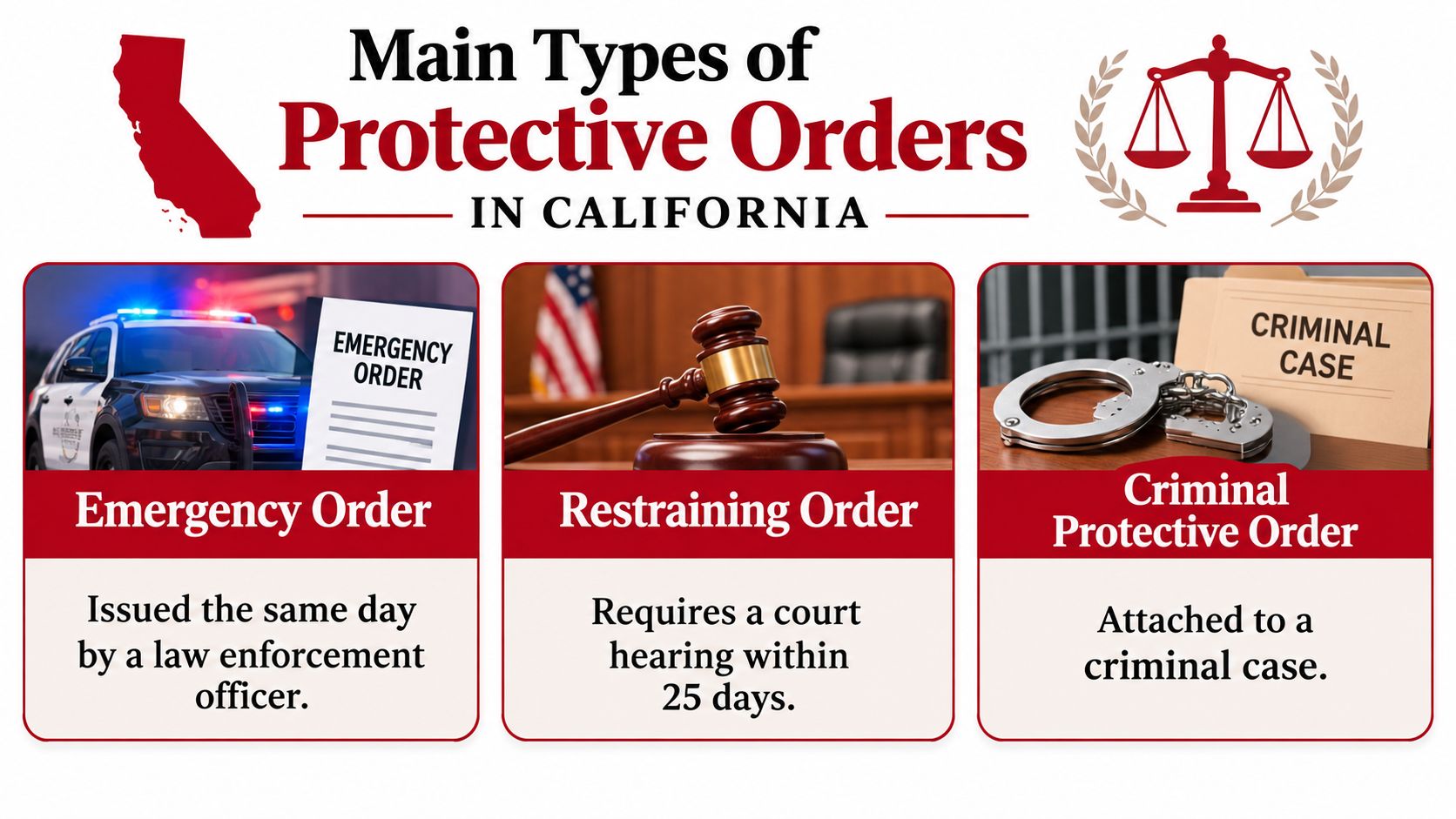
The label matters because it tells you who issued the order, how fast it can take effect, and what usually happens before release paperwork is finished. In California, families usually run into three main categories of protective orders, and they can overlap. That is why one arrest can produce more than one active set of restrictions.
An Emergency Protective Order, or EPO, is the fast one. A responding officer asks a judge for it during an immediate incident, including after hours, and it is meant to hold the line for a short period while the protected person decides whether to seek a longer order. In practice, this is often the first order a family hears about, sometimes before anyone has sorted out bail, housing, or property access. It is temporary by design, but it still needs to be followed exactly while it is in effect.
A Criminal Protective Order, or CPO, comes through the criminal case. If prosecutors file charges, the court can issue terms to protect an alleged victim or witness while the case moves forward. From a release standpoint, this is often the order that causes the most confusion. People assume getting out of custody settles the issue. It does not. The criminal case can keep the order in place, and the written terms control contact, distance, residence access, and other day-to-day decisions until the court changes them.
A civil restraining order starts with a person filing through civil or family court, not through the arrest itself. In Ventura County, a domestic violence restraining order applies to qualifying relationships such as spouses, former spouses, current or former dating partners, people who lived together in more than a roommate arrangement, people who share a child, and certain close relatives. Someone outside those categories may need a civil harassment restraining order instead, as Ventura County Superior Court distinguishes domestic-violence and civil-harassment orders. For a fuller comparison of the categories, see our guide to types of restraining orders in California.
Comparing the practical effect
| Order type | Who starts it | When it commonly appears | What families should remember |
|---|---|---|---|
| Emergency protective order | Law enforcement requests it from a judge | During an immediate emergency | It provides short-term protection |
| Criminal protective order | A criminal court issues it | After charges or during a criminal case | It can continue while the case proceeds |
| Civil restraining order | An individual files in court | When someone seeks separate civil or family protection | It can exist alongside a criminal order |
One person can face both a criminal protective order and a civil restraining order at the same time. The wording may differ. The expiration dates may differ too. Read each page carefully and follow the strictest written terms until the court says otherwise.
When unwanted messages, online posts, or repeated digital contact are part of the dispute, document them with these privacy dispute letter tips and bring the record to your attorney. The letter does not change a California protective order, but good records often matter.
How Protective Orders Affect Bail and Release Conditions
Bail and a protective order do different jobs. Bail or a bail bond addresses whether a person is released from custody. A protective order controls what that person may do after release. The two systems can operate at the same time.
A person released from Ventura County Jail may have to follow criminal case release conditions and the protective order’s written requirements. That can include no contact with a protected person, staying away from a residence, avoiding a workplace, or following a specific exchange arrangement. Posting bail doesn’t suspend those terms, and a bail bondsman can’t grant permission that the court hasn’t written into the order.
What the bond process can and can’t do
A family searching for Ventura County Jail bail bonds or bail bonds Oxnard often wants to know whether arranging release will resolve the entire situation. It won’t. A bond provider may verify booking information, explain the paperwork, coordinate with the jail, and help the family understand the expected release sequence. The provider cannot remove a criminal protective order, change a civil restraining order, or approve contact with the protected person.
California law also recognizes that release conditions can include more than money. In certain probation-violation proceedings, Penal Code section 1203.25 allows conditions such as a protective order, GPS monitoring, electronic monitoring, alcohol-use detection, telephone reporting to probation, and search or seizure by a probation or peace officer. The statute provides that bail may not be imposed unless the court finds by clear and convincing evidence that other reasonable conditions are inadequate, and it requires an individualized cash-bail amount based on ability to pay when bail is imposed. Read California Penal Code section 1203.25.
Practical rule: Treat the release paperwork and the protective order as separate documents. Keep both available, and follow the stricter written restriction when the wording is unclear until qualified legal guidance is obtained.
The right response after release is not to test the boundary. If the order creates a problem involving children, housing, employment, or property, the person should ask the issuing court or a qualified lawyer about modification. More detail on domestic-violence release issues is available in this guide to domestic-violence bond conditions.
Duration, Renewal, No-Contact Rules, and Firearms Restrictions
The written dates matter. A protective order isn’t an informal warning that ends when emotions settle or when an arrest is resolved.
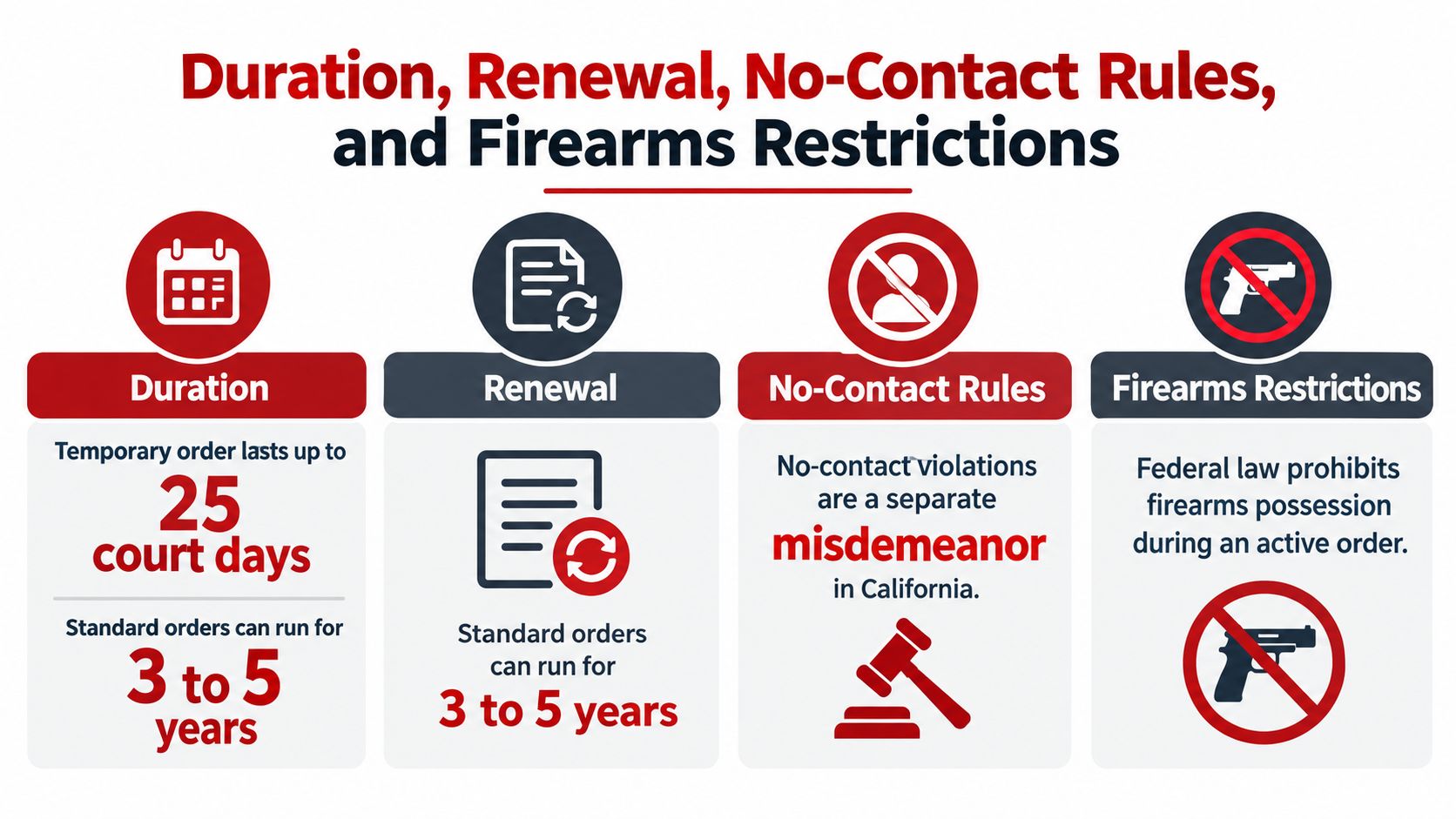
A temporary domestic-violence restraining order can be issued quickly, often without the other party present initially. California court guidance states that the hearing must occur no later than 21 days after issuance, or 25 days when the court finds good cause for additional time. After notice and a hearing, a domestic-violence restraining order may last up to 5 years. California Courts explains temporary-order hearings and long-term duration.
California law permits renewal for 5 or more years or permanently, at the court’s discretion. A renewal request may generally be filed during the 3 months before expiration, and renewal doesn’t require proof of a new act of abuse since the original order was issued. The expiration date on the filed order controls, not a verbal statement that the parties have reconciled.
Contact, residence, and family arrangements
A court may prohibit contact, require a person to stay away, order someone out of a shared residence, or prohibit harassment, stalking, threats, or harm. Child exchanges and property retrieval can have separate written exceptions, but the existence of children or shared belongings doesn’t create an automatic exception.
A protected person’s invitation generally doesn’t erase the order. A friendly text, a message sent through a relative, an unplanned school pickup, or a visit to collect property can still create risk if the order prohibits that conduct. Use only written exceptions and approved third-party or supervised exchanges when the order specifies them.
Firearms and ammunition
California domestic-violence restraining-order materials generally prohibit a restrained person from owning, possessing, purchasing, receiving, or attempting to acquire firearms, ammunition, or specified firearm parts while the order is active. The person generally must sell, store with a licensed dealer, or surrender prohibited items to law enforcement within 24 hours of receiving the order, then provide required proof or receipts to the court. California’s DV-130 materials explain firearm and ammunition restrictions.
That restriction can apply even before the criminal case is resolved because the protective order is a separate civil or criminal-court directive. Private transfers are not a substitute for following the lawful disposition process. Families should preserve receipts, proof of surrender, and the order itself.
Ventura County Protective-Order Filing and Court Logistics
A Ventura County family may have two matters moving at once. The criminal and bail process may involve the Hall of Justice, while protective-order filings and assistance go through family-law resources.
Domestic-violence restraining-order documents may be submitted electronically through the court’s designated emergency email process. Most filings can be submitted through eDelivery Monday through Friday from 8:00 a.m. to 4:00 p.m., excluding holidays. A person filing in person goes to Room 210 of the Ventura Courthouse at 800 South Victoria Avenue in Ventura and presents the original plus two copies of each form. Request-for-Order hearings are scheduled Mondays, Tuesdays, and Wednesdays at 8:30 a.m. in Courtrooms 31, 32, 33, and 35. Ventura County Family Law lists filing and hearing logistics.
A local example
Suppose an arrest occurs in Oxnard and a family member begins searching for bail bonds Oxnard. The bond process may focus on booking confirmation, bail status, signatures, and jail release procedures. Separately, the protected person may need to file or respond to a family-law matter, while a criminal court handles any CPO connected to the case.
Residents in Ventura, Oxnard, Camarillo, Port Hueneme, Thousand Oaks, Santa Paula, Moorpark, Fillmore, Ojai, and nearby communities can seek help through the Ventura County Family Justice Center. The center provides assistance Monday through Friday from 8:00 a.m. to 5:00 p.m. After-hours assistance is available through Ventura County 2-1-1, and emergencies should be reported to 911. The Ventura County court system information can help families separate court locations and responsibilities.
The criminal and traffic department is at the Hall of Justice, 800 South Victoria Avenue, Ventura, California 93009. Its payment windows operate Monday through Friday from 8:00 a.m. to 4:30 p.m., excluding holidays, while the criminal and traffic lobby accepts filings from 8:00 a.m. to 4:00 p.m. The East County Courthouse is in Simi Valley at 3855-F Alamo Street. Those locations don’t mean a bond agent can modify a protective order.
Realistic Ventura County Scenarios and Compliance Mistakes
A person arrested after a dispute in Thousand Oaks may post bail that night and believe the case is behind them. If the release paperwork and CPO prohibit contact, sending a “just checking in” message can create a new problem. The correct response is to read the order, identify permitted exceptions, and ask about formal modification rather than relying on a conversation with the protected person.
A shared child creates another common trap. A parent in Camarillo may assume that school pickup is automatically allowed because the child needs transportation. Unless the order provides an exception or an approved exchange method, the parent should not improvise. A third-party exchange, supervised arrangement, or court-approved process may be required by the written terms.
Firearms create a separate compliance risk. A family in Santa Paula may try to hand a prohibited firearm to a relative for safekeeping, but the order’s lawful surrender or storage requirements control. Document the permitted disposition and retain proof for the court.
Research summarized by the National Institute of Justice found violation rates ranging from roughly 20% to 70% across studies, and reported that stalking was associated with more violations, averaging 18 among those reporting stalking compared with seven among those reporting violations without stalking. The same research reported that approximately 22% of urban women were not served with an order compared with about 55% in rural areas. The National Institute of Justice summarizes protective-order enforcement research.
A protective order is a legal boundary, not a guarantee of immediate physical safety or a substitute for emergency services.
If someone believes an order was violated, they should preserve messages, call records, photographs, or other relevant material and report an emergency to 911. If the issue is a confusing condition, contact the issuing court or a qualified lawyer. A bond agent can help with release logistics, not legal interpretation.
What Families Should Do Next After a Protective-Order Release
Once release is being arranged, slow the process down enough to verify the documents. The family should obtain the filed order, confirm service and expiration dates, identify every protected person and location, and note each written exception. The same review should cover criminal release paperwork, because a CPO and bail conditions may impose different requirements.
For firearm restrictions, document lawful surrender or storage and keep the receipts or proof required by the court. Don’t rely on a relative’s assurance that an informal transfer is acceptable.
The Ventura County Family Justice Center and the court’s Family Law Division can help identify the appropriate local resource. Emergencies belong with 911. Families can also use a written emergency contact planning resource to organize important numbers and responsibilities without placing contact burdens on a protected person.
A bail agent may help confirm release timing, coordinate with the jail, and provide court-date reminders. That support doesn’t change the order. For a practical explanation of the release sequence, review what happens after bail is posted.
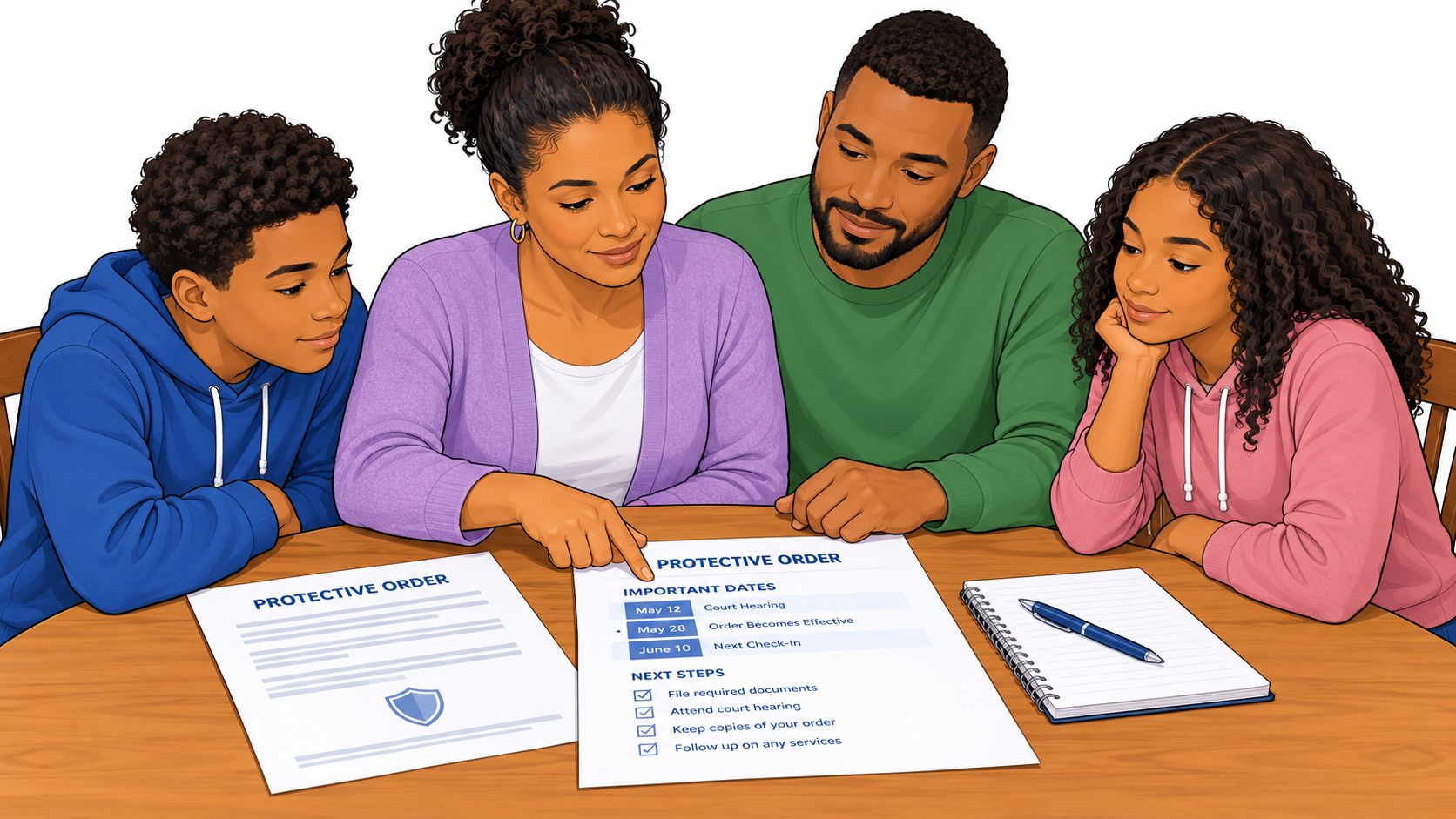
The safest next step is to keep communication factual, follow every written condition, and direct modification questions to the issuing court or qualified legal counsel. Families in Ventura County can arrange release help while treating protective-order compliance as a separate responsibility.
Bada Bing Bail Bonds provides 24/7 assistance with booking verification, bond paperwork, jail coordination, release timing, and court-date reminders for families handling arrests in Ventura, Oxnard, Camarillo, Thousand Oaks, and surrounding communities. If a protective order is involved, contact Bada Bing Bail Bonds for release-process support while obtaining qualified guidance on the order’s terms.