A white-collar felony isn’t one single charge. It’s a category of generally non-violent, deception-based felonies, such as fraud and embezzlement, pursued for financial gain, and core offenses can carry maximum sentences ranging from 5 years to 30 years, depending on the statute.
You may be reading this after a late-night call from a spouse, parent, employee, or friend who was arrested over alleged fraud, forgery, identity theft, or missing business funds. The person may have no history of violence, yet the word felony immediately raises questions about jail, bail, court, employment, and the family’s finances.
For someone in Ventura, Oxnard, Camarillo, Thousand Oaks, Santa Paula, Moorpark, Fillmore, Ojai, Port Hueneme, or Santa Barbara, the first practical issue is often release from custody. The legal definition matters, but so does knowing how Ventura County sets bail, what a bond premium means, and why release timing can depend on booking and jail procedures rather than the absence of violence.
This guide explains the category in plain English, shows how prosecutors usually build these cases, and connects the charge to the next steps families face through Ventura County Jail bail bonds and local court procedures. If someone has just been arrested, a practical first reference is this guide on what to do when someone gets arrested, while remembering that only a criminal defense lawyer can advise on the defense itself.
Table of Contents
- Introduction to White Collar Felonies and Why Families Search for Answers
- Understanding What a White Collar Felony Really Means
- How Prosecutors Prove White Collar Felonies
- Common White Collar Felony Examples You Should Recognize
- Bail and Sentencing for White Collar Felonies in California
- How Bail Bonds Work for White Collar Cases in Ventura County
- Next Steps After a White Collar Felony Arrest in Ventura County
Introduction to White Collar Felonies and Why Families Search for Answers
A family member might say, “They arrested him for embezzlement,” or, “The detective mentioned fraud and forgery.” Those words describe different offenses, but families often group them under the phrase white-collar felony because the alleged conduct involves money, records, property, or a position of trust rather than a physical confrontation.
That distinction can make the arrest feel confusing. The person may have been a manager, bookkeeper, business owner, professional, or someone with access to accounts and customer information. Instead of a visible incident at a street location, the investigation may involve bank records, invoices, emails, electronic accounts, contracts, or transactions that occurred over time.
Practical rule: The phrase “white-collar felony” tells you the general category. The charging document tells you the specific legal offense.
The next questions usually come quickly. Has the person been booked into Ventura County Jail? Has bail been entered? Is the amount on the county schedule, or does a judge need to review it? Can a family member use bail bonds Ventura services, and what information will the agent need?
Those questions have concrete answers, but they depend on the booking status, the charge, the bail schedule, and any court order. A non-violent allegation doesn’t automatically mean the person will be released without bail, and it doesn’t guarantee that the process will be immediate. Jail staff must verify the booking, accept the paperwork, process the bond, and complete the release procedure.
Families often feel pressure to make a decision before they understand the difference between paying the full bail amount and arranging a bond. The safest approach is to separate the issues: first identify the exact charge, then confirm the bail amount, then compare the available payment and release options while obtaining legal advice about the criminal case.
Understanding What a White Collar Felony Really Means
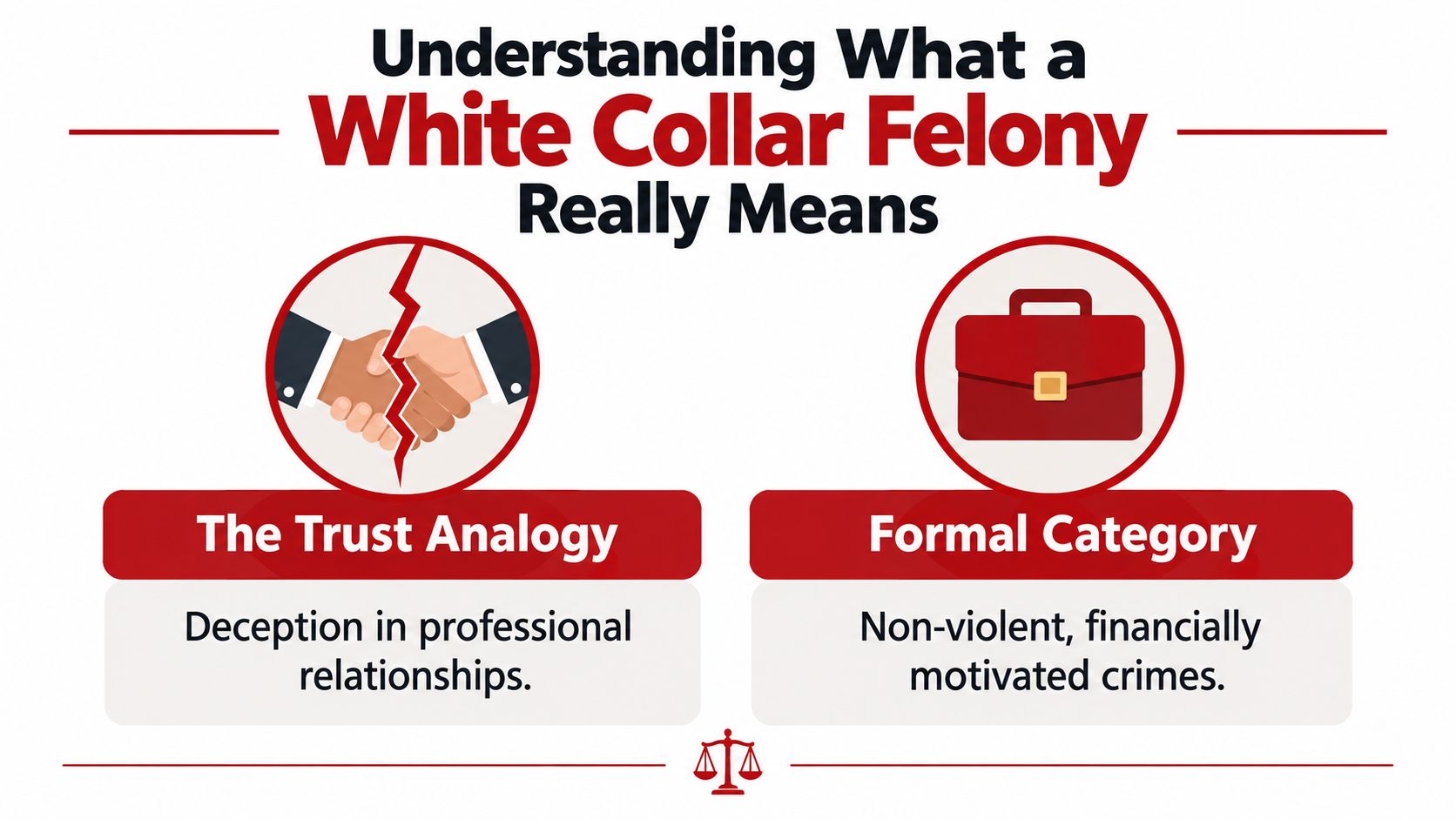
Start with a simple trust analogy. A person receives access to business funds, customer information, company property, or financial records for a legitimate work purpose. If prosecutors later allege that the person used that access to deceive someone or obtain money, the alleged wrongdoing centers on trust and deception, not on force.
The phrase is a category label, not usually the name of one standalone offense. The FBI describes white-collar crime as generally non-violent conduct involving deceit, concealment, or violation of trust for financial gain, including public corruption, health care fraud, mortgage fraud, securities fraud, and money laundering. The term was reportedly coined in 1939 by sociologist Edwin Sutherland. The FBI’s explanation of white-collar crime provides that historical and definitional context.
The category and the actual charge
Think of the phrase as an umbrella. Under it may be a fraud charge, embezzlement charge, forgery charge, computer crime, identity-theft allegation, or theft offense. The prosecution still has to file and prove a particular statute, and that statute controls the elements, possible classification, bail treatment, and sentencing exposure.
This is why two cases that sound similar in everyday conversation can produce different legal outcomes. One may involve a single disputed transaction, while another may allege concealed accounting entries, multiple victims, or use of a financial institution. The label alone doesn’t answer whether the case is a felony, what bail will be set, or what sentence could follow a conviction.
Why jurisdiction changes the answer
States don’t use the category in exactly the same way. Florida, for example, treats white-collar crime as a group of felony types that can include fraud, theft, computer crimes, forgery, and elder exploitation. Florida law can escalate the offense to a first-degree felony when the conduct affects 20 or more victims or targets the state and involves at least $50,000. Florida’s statutory provision illustrates why location and statute matter.
For a Ventura County arrest, the relevant questions are California questions. Ask which Penal Code section is listed, whether the charge is filed as a felony, whether multiple counts are alleged, and whether the court has imposed conditions beyond the initial bail setting.
How Prosecutors Prove White Collar Felonies
A white-collar case often develops through documents rather than a dramatic physical scene. Prosecutors may examine emails, contracts, accounting entries, payment histories, login records, recorded statements, and transaction patterns to determine whether ordinary business activity was part of a deceptive plan.
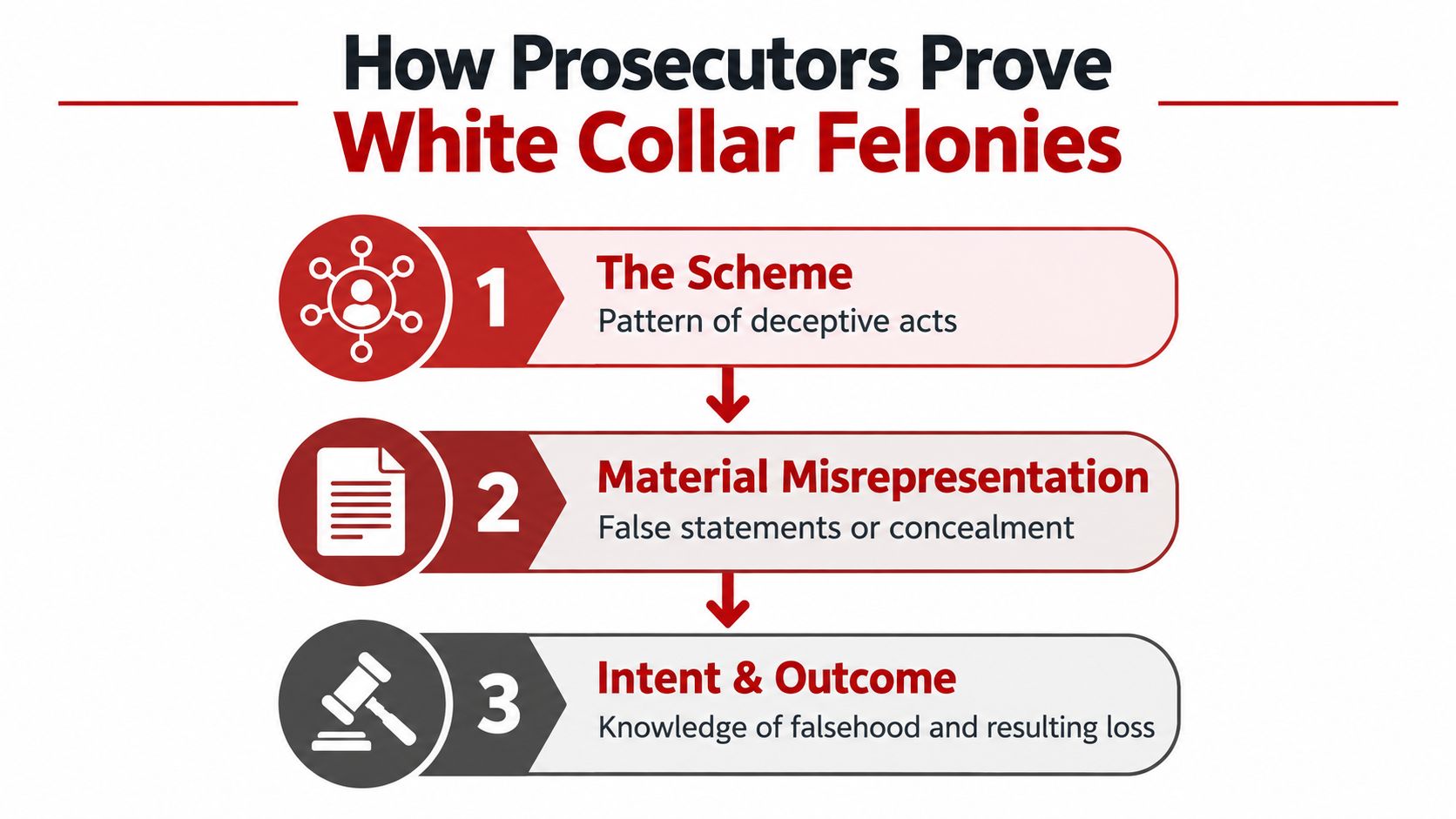
The proof structure generally asks several connected questions. Was there a scheme or plan? Did someone make a material misrepresentation, conceal a material fact, or omit information where disclosure mattered? Did the person act with intent to defraud? Did a victim suffer harm, or was financial harm reasonably foreseeable?
Why records can matter more than appearances
A transaction that looks innocent by itself may look different when placed beside other entries. An email may show knowledge of a false statement. A ledger adjustment may suggest concealment. A series of payments may help prosecutors argue that the conduct was planned rather than accidental.
That doesn’t mean a spreadsheet or email proves criminal intent by itself. The prosecution must connect the evidence to the required mental state and offense elements. The defense may challenge whether the person knew the information was false, had authority to act, intended to deprive someone of property, or caused the alleged loss.
Investigators may also rely on forensic accounting. Accountants can trace funds, compare records, identify irregular entries, and calculate the loss figure prosecutors may present. For a family trying to understand the investigation, that explains why these cases can move slowly and why a person may be questioned about records created long before the arrest.
Subpoenas and early caution
A subpoena can require a person or organization to produce documents or appear for testimony. It isn’t the same as a conviction, and receiving one doesn’t answer whether criminal charges will follow. Anyone who receives a subpoena should discuss it with a lawyer before responding, preserving records and avoiding casual explanations that could later be misunderstood. A plain-language resource on what a subpoena looks like can help families recognize the document, but legal advice remains case-specific.
The white-collar defense proof structure emphasizes the importance of scheme, material deception or concealment, intent, and harm. It also explains why documentary trails can become central to the case and why substantial financial harm may increase sentencing exposure.
Common White Collar Felony Examples You Should Recognize
The easiest way to understand the category is to compare the alleged conduct with the factor that may drive felony treatment. Fraud usually focuses on a deceptive statement or scheme. Embezzlement adds the question of whether property was entrusted to the person who allegedly took or misused it. Forgery centers on creating, altering, or using a false document, while computer and identity-related offenses may focus on access, information, or digital conduct.
In California theft-related cases, the $950 threshold can be central. Sources state that when the amount involved exceeds $950, the matter is typically charged as grand theft and can be a felony. The Ventura County bail schedule explanation discusses that threshold in the local context.
| Charge Type | Typical Conduct | Felony Driver |
|---|---|---|
| Fraud | Allegedly using false statements, concealment, or a deceptive plan to obtain money or property | The statute, intent, loss, and circumstances |
| Embezzlement | Allegedly misusing property or funds entrusted through a job or relationship | The property value, alleged intent, and charging decision |
| Forgery | Allegedly creating, changing, or using a false record or signature | The document, intended use, and applicable statute |
| Identity theft | Allegedly using another person’s identifying information for an improper purpose | The conduct, affected person, and specific California law |
| Computer crime | Allegedly accessing, altering, obtaining, or using digital information improperly | The type of access, information, and alleged harm |
| Grand theft | Allegedly taking property above the relevant California threshold | Amount, circumstances, and whether the charge is filed as a felony |
Labels don’t tell the whole story
A charge can involve more than one theory. An alleged misuse of company funds might produce embezzlement, grand theft, and forgery counts if prosecutors believe records were altered or false checks were used. An online scheme might involve fraud, identity theft, and computer crime allegations at the same time.
Businesses investigating suspicious transactions may use specialized resources, including this fraud audit for mid-market firms, to understand internal controls and preserve information. That kind of audit isn’t a substitute for criminal defense, but it shows why financial records and access histories often become important before a case reaches court.
Catfishing also creates confusion because the word describes behavior rather than one universal charge. Whether it becomes criminal depends on what the person allegedly did, such as obtaining money through deception, using another person’s identity, or making threats. Families seeking a general starting point can review whether catfishing is a crime, then identify the exact statute in the booking record.
Bail and Sentencing for White Collar Felonies in California
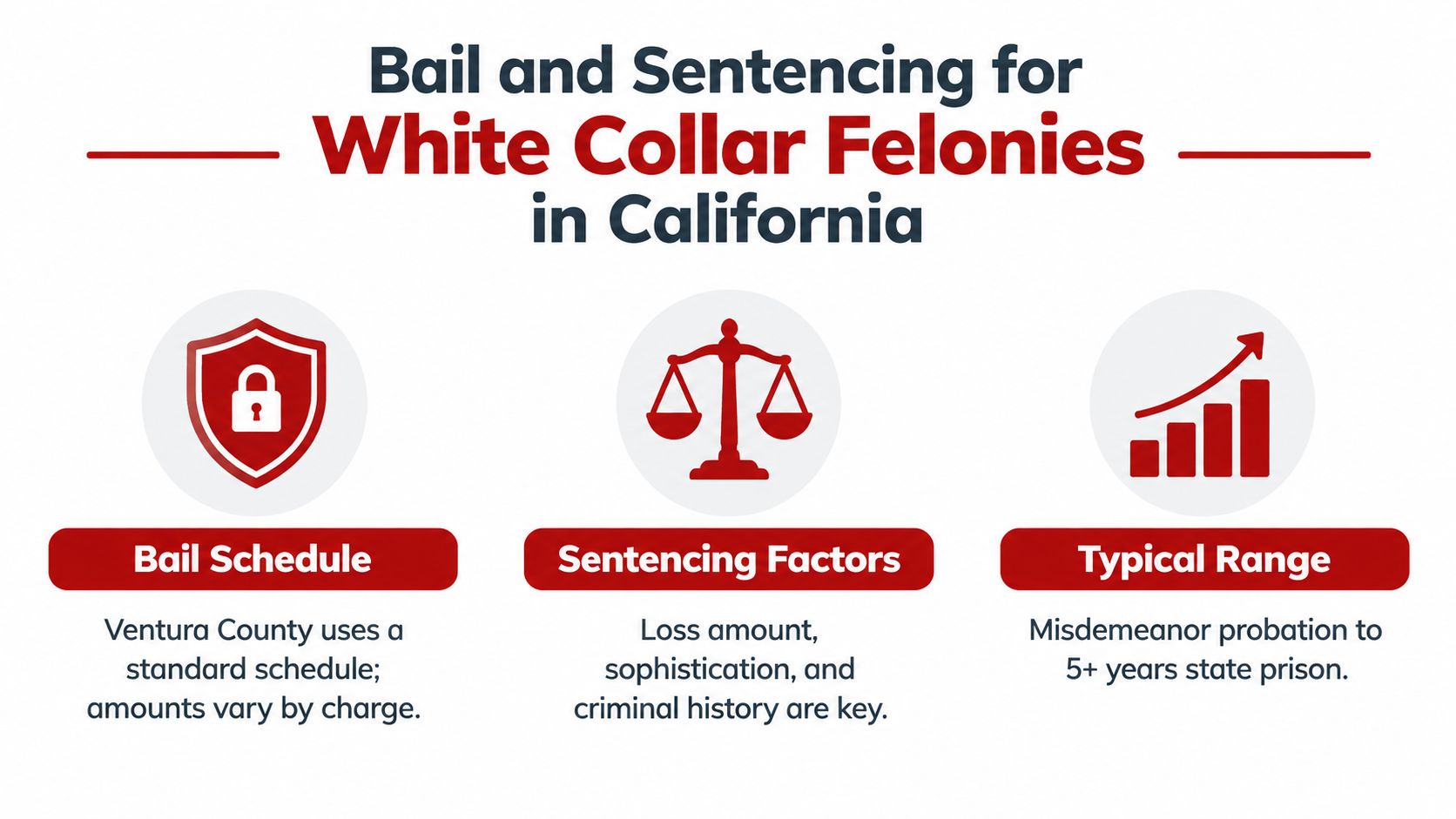
California bail begins with the charge and the applicable local process, not just with whether the alleged conduct was violent. Under California Penal Code section 1269b, when a person is arrested without a warrant and hasn’t appeared before a judge, bail is set according to the county’s uniform bail schedule. Ventura Superior Court explains that its countywide schedule operates as the presumptive amount until judicial review. Ventura Superior Court’s fee and bail schedules provide the local reference.
That creates a practical sequence for a family:
- Confirm the booking. Verify that the person is in custody and identify the listed charge.
- Check the presumptive amount. The schedule may provide the initial figure before a judge reviews the case.
- Ask about court review. A judge can consider the case and release conditions during judicial proceedings.
- Choose a release method. The family may evaluate full cash bail or a licensed bond arrangement.
- Track conditions. Release can include court dates and other requirements that must be followed.
Why financial cases can carry serious exposure
Sentencing exposure can increase based on the alleged loss amount, the number of victims, and whether a financial institution or government program was affected. Core white-collar statutes may carry maximum sentences from 5 years to 30 years, with bank fraud reaching 30 years under the cited overview, while some tax and securities offenses have lower statutory caps. The Justia overview of white-collar crime penalties also identifies fines, restitution, disgorgement, and asset forfeiture as possible consequences.
Those are statutory maximums, not predictions of what will happen in a particular case. A lawyer must evaluate the precise statute, counts, evidence, criminal history, loss calculation, plea discussions, and sentencing rules.
Tax-related accusations create another common misunderstanding. Families often ask whether you will go to jail for owing, but owing money and committing a criminal tax offense aren’t identical questions. The person needs individualized advice before speaking with investigators or making assumptions about the likely outcome.
For the bail side, families can review information about bail for felony charges while counsel addresses the criminal allegations. Release and defense are connected in timing, but they are separate decisions.
How Bail Bonds Work for White Collar Cases in Ventura County
A family arranging 24-hour bail bonds Ventura services usually starts by confirming that the person has been booked into Ventura County Jail. The agent needs the person’s identifying details, booking information, listed charges, and the bail amount if it has been posted. For people in Ventura, Oxnard, Camarillo, Port Hueneme, Thousand Oaks, Santa Paula, Moorpark, Fillmore, or Ojai, the same basic verification step helps prevent delays caused by calling before the booking is visible.

California’s bond premium is fixed by law at 10% of the total bail amount, and it generally isn’t refundable. For example, $20,000 in bail requires a $2,000 premium to a bondsman. California Penal Code section 1269b provides the cited rule and example.
Cash bail or a bond
With full cash bail, the family provides the entire bail amount through the approved jail or court process. With a bond, a licensed agent posts the required guarantee, and the family pays the lawful premium while meeting the agreement’s obligations. Depending on the circumstances, the family may also discuss payment plans, a co-signer, or collateral for a larger or more complex bond.
White-collar cases can require extra coordination because booking information, charge descriptions, and bail figures may not be complete immediately. A bail bonds Ventura County provider can explain what has been confirmed, what still needs verification, and which documents the signer should prepare. Release timing depends on the jail’s processing window, staffing, paperwork, and court status, so no responsible agent should promise an exact pickup time.
A local agency may also assist families searching for bail bonds Oxnard, Ventura County bail bonds, or Bail Bonds Thousand Oaks, including calls made outside ordinary business hours. Bada Bing Bail Bonds offers verification, paperwork coordination, payment-plan discussions, co-signer options, collateral solutions, and court-date reminders for people dealing with white-collar allegations.
The video below gives families another plain-language overview of the bond process.
For Santa Barbara residents or families coordinating from outside the county, the key is still the same: identify the facility, verify the booking, confirm the bail figure, and ask what must happen before release. A bond can address custody, but it doesn’t resolve the underlying charge or replace a defense lawyer.
Next Steps After a White Collar Felony Arrest in Ventura County
A white-collar felony is a broad category, so begin with the exact accusation rather than relying on the label. Confirm the booking location, listed Penal Code sections, bail amount, and next court event. Don’t discuss the facts of the case with investigators, employers, or other involved people without first obtaining advice from a criminal defense attorney.
For the release decision, gather identification, the person’s full name and birth details, booking information, and contact details for the person who can sign the bond. Ask whether Ventura County Jail has completed booking, whether the bail schedule applies, whether a court appearance is pending, and what payment or collateral terms are available.
A useful family checklist is:
- Verify custody: Make sure the person is booked before arranging paperwork.
- Confirm the amount: Ask for the current bail figure and whether judicial review may change it.
- Protect communication: Keep conversations about the allegations private and direct legal questions to counsel.
- Plan compliance: Record court dates, follow every release condition, and keep the bondsman informed of address or contact changes.
White-collar cases can feel intimidating because the evidence may span records, accounts, and business relationships. Clear information about bail won’t answer every defense question, but it can help your family make a careful release decision without treating the legal label as the whole story.
For a confidential, round-the-clock starting point, Bada Bing Bail Bonds can verify Ventura County custody information, explain the lawful premium, discuss payment plans or collateral, and coordinate paperwork for release. Contact the agency when a loved one is booked in Ventura, Oxnard, or a surrounding community so you can understand the next bail step clearly and prepare for court compliance.