Bail jumping is a separate crime when someone is released on bond and intentionally misses court. In California, it also puts the person’s freedom, the bail bond, and any collateral at risk fast, and the bond premium can be exactly 10% of the total bail and is nonrefundable once release happens.
If you’re reading this because a loved one missed court in Ventura, Oxnard, Camarillo, Port Hueneme, Thousand Oaks, Santa Paula, Moorpark, Fillmore, Ojai, or Santa Barbara, you’re probably getting a flood of calls and half-answers. The judge may issue a warrant quickly. The bond can be in danger. And if you signed for Ventura County bail bonds, this is no longer just the defendant’s problem.
Families usually ask the same thing first. Was this just a mistake, or is this bail jumping? The answer matters because the law treats an unavoidable absence very differently from a willful no-show. In real life, that difference affects whether the court sees a problem that can be fixed or a broken promise that deserves punishment.
For anyone dealing with bail bonds Ventura, Ventura County Jail bail bonds, or fast bail bonds Ventura situations, the most important move is speed. Silence makes everything worse. Local knowledge matters too, because bail issues in Ventura County often turn on county schedules, courtroom practices, and how fast someone gets in front of the right judge.
Table of Contents
- A Missed Court Date and a Warrant
- Bail Jumping vs Failure to Appear in California
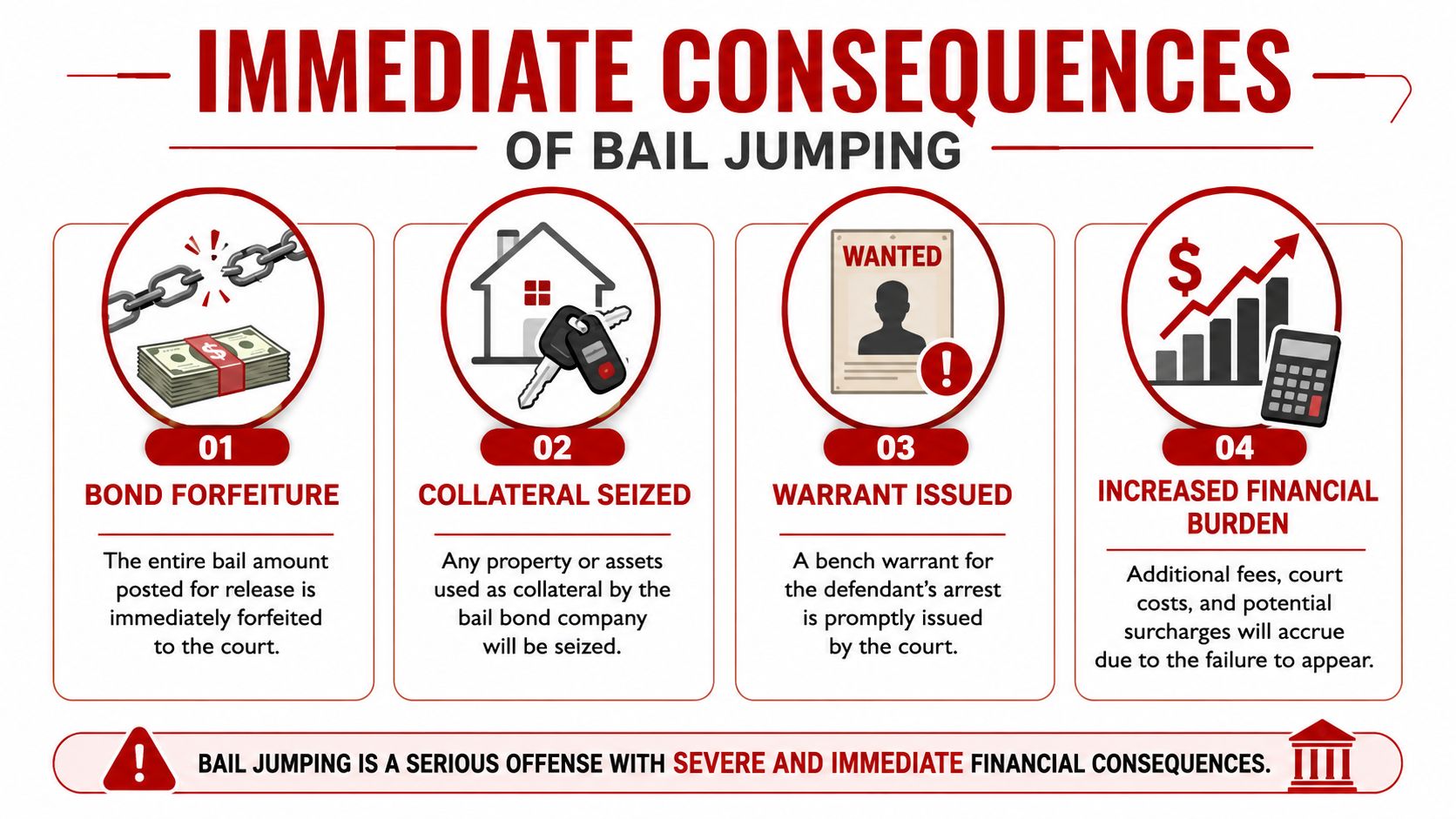
- The Immediate Consequences for Your Bail Bond and Collateral
- Legal Penalties for Bail Jumping in Ventura County
- Common Defenses and How to Mitigate the Damage
- How Fast Bail Bonds in Ventura Can Help
- Frequently Asked Questions About Bail Jumping
- Can someone be charged with bail jumping if they never actually left jail?
- Does the co-signer automatically lose everything?
- If the original case gets dismissed, does the bail jumping problem disappear?
- Can the court give bail again after a missed appearance?
- What should the family do first in Ventura County?
- Is this different from ordinary bail bonds questions in Ventura?
A Missed Court Date and a Warrant
It usually starts with a phone call that makes your stomach drop. Your son, spouse, brother, or friend was supposed to be in court this morning, and now nobody can reach them. By the time the family starts comparing notes, someone says the word “warrant,” and panic takes over.
A missed court date can come from confusion, bad advice, fear, or a real emergency. But when someone is out on bond and knowingly decides not to show, the problem moves into bail jumping territory. That’s more serious than a simple scheduling mistake, and it can trigger consequences that hit both the defendant and the person who signed the bond.
In Ventura County, time matters right away. Courts don’t reward waiting to see if this blows over. If a loved one missed court, you need to find out whether a bench warrant has been issued, whether the bond is at risk of forfeiture, and whether there’s still a window to act before the damage gets worse.
The first calls should be practical
Start with facts, not assumptions.
- Confirm the court date: Look at the bond paperwork, court reminder, attorney notice, or minute order.
- Find out where the case is pending: Ventura cases may move through local courtrooms differently than cases in Santa Barbara or Los Angeles County.
- Check what happens after a missed hearing: This guide on what happens if you miss court is a useful starting point for the immediate fallout.
Practical rule: Don’t let the defendant “hide for a day or two” while the family figures it out. Delay usually makes the warrant problem worse, not better.
People searching for 24-hour bail bonds Ventura or bail bonds Oxnard are often already in the middle of this exact situation. The fastest path is usually the calmest one. Verify the missed date, contact counsel, and get ahead of the court before law enforcement gets there first.
Bail Jumping vs Failure to Appear in California
What is bail jumping? In plain English, it means a person was released on bond and then intentionally and willfully failed to appear as required. Under federal law, bail jumping is a distinct offense, and similar state statutes follow the same core idea. The prosecution must prove the person knew about the specific court date and chose not to appear, not merely that they were absent. That distinction is explained in this discussion of bail jumping under 18 U.S.C. § 3146 and similar state rules.
That intent element is where families often get confused. Courts don’t treat every absence the same way. A hospital admission, lack of notice, or a clerical mix-up is different from deciding not to go because the person is scared, using drugs, or hoping the case will somehow disappear.
What makes bail jumping different
The practical difference is simple. Failure to appear describes the event. Bail jumping focuses on a willful breach of release.
If someone missed court because they never got notice, the defense will try to show there was no knowing choice to skip. If someone had the date, knew the courtroom, and stayed away anyway, that’s the kind of fact pattern that supports a bail jumping allegation.
For families dealing with Ventura County bail bonds, this difference affects every next step. It affects warrant strategy, bond risk, and how much sympathy the court is likely to have when the person finally comes back.
Bail Jumping vs. Failure to Appear at a Glance
| Factor | Failure to Appear (FTA) | Bail Jumping |
|---|---|---|
| Core issue | The person did not show up to court | The person did not show up and did so willfully after release on bond |
| Intent required | May involve mistake, lack of notice, or unavoidable circumstances | Requires proof the person knew about the date and chose not to appear |
| Relationship to the original case | Can complicate the existing case | Can create a separate criminal problem on top of the original case |
| Effect on bond | Puts the bond at risk | Puts the bond at risk and makes the breach look much more serious |
| Typical family concern | “How do we fix this?” | “How do we fix this and protect the bond, collateral, and co-signer?” |
If you’re also trying to sort out what kind of warrant might be involved, this breakdown of bench warrants, Ramey warrants, and arrest warrants helps clarify what families are dealing with after a no-show.
The release date issue families miss
One point almost nobody explains clearly is when “release” starts. People often think release happens only when the defendant physically walks out of custody. That isn’t always how the law sees it.
A Wisconsin bail jumping analysis notes that under Wisconsin Statute §946.49, release can be defined by the signing of bond documents, not physical departure, which means violations of conditions can happen before the person ever leaves custody. That legal nuance is outlined in this review of felony bail jumping and when release begins.
Missing court is the obvious version of bail jumping. Violating a release condition can also create trouble sooner than most families expect.
That matters because bond conditions aren’t just paperwork. Once release conditions apply, the court expects compliance.
The Immediate Consequences for Your Bail Bond and Collateral
The legal issue gets most of the attention. The financial hit is what usually shocks the family.
The first hard truth is the premium. In California, the legally mandated maximum bail bond premium is exactly 10% of the total bail amount, and bond contracts state that premium is nonrefundable once release occurs, even if charges are dismissed or the case changes later. That’s explained in this California overview of how bail bond costs work and why the premium is earned on release.
What the co-signer loses first
If the bail was set at $50,000, the premium in California can be $5,000, and that premium isn’t coming back after release. If the defendant then jumps bail, the co-signer may suddenly be dealing with exposure tied to the rest of the bond amount as the bond falls into forfeiture trouble.
This is the part many families in Ventura, Camarillo, and Oxnard don’t see coming. They think the money they paid was the whole risk. It wasn’t. The premium bought the bond. It did not erase the defendant’s duty to appear, and it did not erase the co-signer’s obligations under the contract.
If you signed for someone, the court date is your problem too. Not morally. Contractually.
In day-to-day Ventura County Jail bail bonds work, this is why agents push reminders, check-ins, and direct contact. A missed hearing can put everyone on the edge of a much larger loss.
What happens to collateral
Collateral is there to protect the bonding company if the defendant doesn’t comply. That can mean cash, a vehicle, jewelry, or property documents on larger bonds. If the bond is jeopardized and the defendant doesn’t come back into compliance, the company can move against that collateral under the agreement.
Families should pull the paperwork immediately and review:
- What was pledged: Cash, title, deed interest, or other assets.
- Who signed: One co-signer or several relatives.
- What default terms apply: The contract usually spells out when the company can act.
- What options exist before seizure: Sometimes fast action by the defendant can still reduce the damage.
If you need a plain-English breakdown, this guide on what can be used as collateral helps families understand what’s really on the line.
A second California source, a UCLA review of bail contracts, notes that the premium is nonrefundable even if the arrest was false, charges are dismissed, or bail is later reduced because the fee is treated as earned upon release in the contract structure described there: UCLA Devil in the Details review of California bail bond contracts.
Legal Penalties for Bail Jumping in Ventura County
A missed court date doesn’t just threaten the bond. It can put the defendant in front of the Ventura County Superior Court facing a new problem while the original case is still alive.

When a judge believes the person willfully failed to appear after release, the court can issue a bench warrant and treat the conduct as more than a simple procedural slip. In practice, that means the defendant may face the original charge, a harder path back to release, and a much less favorable view from the court on future compliance.
Why local Ventura County rules matter
Ventura County isn’t just operating on broad California concepts. Local bail mechanics matter. The Ventura County Superior Court’s 2024 Bail Schedule sets a base bail of $2,500 for standard misdemeanors and $10,000 for 17(b) misdemeanors, and it adds $5,000 or $10,000 enhancements for offenses committed while the defendant is already on probation or diversion. Those local rules are laid out in the court’s 2024 Ventura County bail schedule.
That local detail matters because a missed court date often doesn’t happen in a vacuum. Many defendants already have probation issues, pending conditions, or prior compliance concerns. When those facts are on the table, local schedules and judicial discretion can push the financial pressure higher.
Ventura-area offense-specific bail amounts can also vary sharply. A local Ventura County bail listing notes fixed amounts that can reach $100,000 for offenses such as manslaughter, stalking, mayhem, and DUI, while probation violations may show a Nil base bail in that listing. That local snapshot appears here: Ventura County offense and bail examples from Camarillo coverage.
What this does to the original case
A defendant who comes back after bail jumping usually returns with less credibility than they had before. Judges may see them as a flight risk. Prosecutors may take a harder line. Future release requests can become much tougher.
The court process also gets more crowded. There may be a warrant issue to address, a bond issue, and the underlying criminal matter all at once. That’s why local counsel matters in Ventura, Thousand Oaks, Santa Paula, Moorpark, Fillmore, Ojai, and nearby Santa Barbara courts.
A short overview of the court side of this problem is below.
Common Defenses and How to Mitigate the Damage
Not every missed appearance proves bail jumping. Some cases have real defenses. Others don’t have a full defense, but they do have mitigation that can keep the outcome from getting worse.
Defenses that may matter
The strongest defense themes are usually grounded in proof, not explanations.
- Lack of notice: If the defendant didn’t receive proper notice of the hearing, the willful-intent element becomes harder to prove.
- Medical emergency: A genuine emergency backed by records can matter. A vague story usually won’t.
- Court or clerical error: Wrong date, wrong courtroom, or bad notice can change the analysis.
- Custody elsewhere: If the defendant was incarcerated in another jurisdiction, that may explain the absence.
These are not do-it-yourself arguments. They need documents, timing, and someone who knows how the local judge is likely to view them.
Bring proof, not promises. A discharge paper, booking record, or dated notice mismatch does more than an apology ever will.
What to do the same day
The best mitigation step is immediate action. Not tomorrow. The same day.
- Call the defense attorney first: The lawyer needs to know before the next hearing gets missed too.
- Contact the bond company: The co-signer should not wait for a forfeiture notice to start asking questions.
- Gather documents: Hospital papers, custody records, text messages, court notices, and travel records if they matter.
- Get the defendant ready to surrender if necessary: Voluntary return often looks better than being picked up later.
- Ask whether the bond needs reassumption: In some cases, the next issue isn’t just the missed date. It’s whether the bond can remain in place after the breach. This page on bail bond reassumption in Ventura and Santa Barbara explains that part of the process.
Families make the biggest mistake when they go silent because they’re embarrassed. Courts see missed appearances every day. What changes outcomes is whether the defendant responds quickly and credibly once the problem is discovered.
How Fast Bail Bonds in Ventura Can Help
When families search for fast bail bonds Ventura, 24-hour bail bonds Ventura, or bail bonds Oxnard after a missed court date, they usually need more than a price quote. They need someone who knows the jail, the court, and the timing pressure.

A local agent can help the family understand whether the bond is in forfeiture danger, what paperwork matters most, and how to coordinate with defense counsel. For Ventura County Jail bail bonds, local familiarity matters because release timing, courtroom habits, and warrant handling aren’t abstract issues. They affect what you do in the next hour.
Why local bail agents change the outcome
Data from the American Bail Coalition shows that defendants released on a bail bond are 28% less likely to fail to appear than similar defendants released on their own recognizance, and when they do fail to appear, they are 53% less likely to remain at large for extended periods. That data appears in the Coalition’s review of pretrial release performance and appearance outcomes.
That matches what experienced families notice in the field. When a bond company stays in contact, reminds the defendant, and pushes quick correction after a missed date, the person is more likely to get back in front of the court instead of drifting deeper into warrant status.
What families should have ready
If you’re calling a local bond office in Ventura, Port Hueneme, Camarillo, or Santa Barbara, have these details ready:
- Defendant’s full legal name
- Date of birth if available
- Case number or court location
- The missed hearing date
- Any paperwork tied to the bond
- Any emergency proof that explains the absence
For families who need a local starting point, this page on a Ventura County bail bondsman with fast help is the kind of resource that makes the next phone call more productive.
Frequently Asked Questions About Bail Jumping
Can someone be charged with bail jumping if they never actually left jail?
Sometimes the key issue is legal release, not whether the person physically walked out. As discussed earlier, release can attach to bond paperwork and conditions sooner than people think, depending on the governing law and facts.
Does the co-signer automatically lose everything?
Not automatically, but the risk becomes real fast. The premium paid for the bond is already earned upon release under California bond contracts, and collateral can be threatened if the defendant doesn’t come back into compliance.
If the original case gets dismissed, does the bail jumping problem disappear?
No. Bail jumping is treated as a separate issue from the original accusation. A dismissal of the underlying case does not automatically erase what happened after release.
Can the court give bail again after a missed appearance?
Sometimes yes, sometimes no. It depends on the original charge, the reason for the no-show, the defendant’s record, and how the judge views future compliance. In Ventura County, local court practice matters a lot.
What should the family do first in Ventura County?
Get accurate facts the same day. Confirm the missed date, contact the attorney, review the bond paperwork, and act before the situation turns into an arrest at home, work, or during a traffic stop.
Is this different from ordinary bail bonds questions in Ventura?
Yes. Routine bail bonds Ventura questions are about release. Bail jumping questions are about damage control after release, especially for the co-signer, collateral, and warrant.
If your family is dealing with a missed court date, a threatened bond, or a warrant in Ventura, Oxnard, Camarillo, Port Hueneme, Thousand Oaks, Santa Paula, Moorpark, Fillmore, Ojai, or Santa Barbara, Bada Bing Bail Bonds can help you move fast. Their licensed agents handle Ventura County bail bonds around the clock, explain California bail rules in plain English, and help families understand what happens next before the problem gets more expensive or harder to fix.