You’re on the phone late at night, and the person on the other end sounds scared. They tell you the jail gave them a bail amount that feels impossible, and you’re trying to figure out whether this is normal, whether it’s fair, and whether anyone can get them out tonight. That’s the moment most families start asking what is excessive bail, because they don’t need a lecture, they need a clear answer and a real plan.
The short answer is this, excessive bail is bail set higher than what’s reasonably necessary to make sure the person comes back to court. It’s not supposed to be punishment. It’s supposed to be a court appearance guarantee, and when the amount is wildly out of line with that purpose, the Constitution gives you a real issue to raise. In Ventura County, Santa Barbara County, and nearby jails, that matters right away because every hour in custody adds pressure on the family and the case.
Table of Contents
- That Shocking Phone Call About a High Bail Amount
- Defining Excessive Bail The Constitutional Rule
- How Bail Is Actually Set in Ventura County
- Red Flags That a Bail Amount Might Be Excessive
- Your Practical Steps to Challenge High Bail
- How a Ventura Bail Bonds Agency Provides Immediate Help
- Navigating the Process After Release in Ventura County
That Shocking Phone Call About a High Bail Amount
A family member gets booked, you answer a call from jail, and the first thing you hear is a number that feels unreal. Maybe the charge sounds minor to you. Maybe the amount is bigger than a month’s rent, a car payment, and savings combined. That’s when panic sets in, because the jail doesn’t care whether your family is prepared for it.
That fear is normal, but don’t confuse shock with helplessness. A high number is not automatically illegal, and it’s not automatically fair either. The question is whether the amount is more than necessary to make sure the person returns to court, because that’s the constitutional line that matters under the Eighth Amendment constitution.congress.gov.
If you’re in Ventura, Oxnard, Camarillo, Port Hueneme, Thousand Oaks, Santa Paula, Moorpark, Fillmore, Ojai, or Santa Barbara, speed matters as much as the legal argument. Families usually need two things at once, a plan to get the person out and a way to challenge a number that feels off.
Practical rule: If the bail amount feels disconnected from the charge, the person’s record, or the person’s ties to the area, treat it as a problem worth reviewing immediately.
The hard part is that jail doesn’t wait for legal theory to resolve itself. That’s why families start with immediate release options first, then deal with whether the amount was excessive. In real life, those two tracks often move at the same time.
Defining Excessive Bail The Constitutional Rule
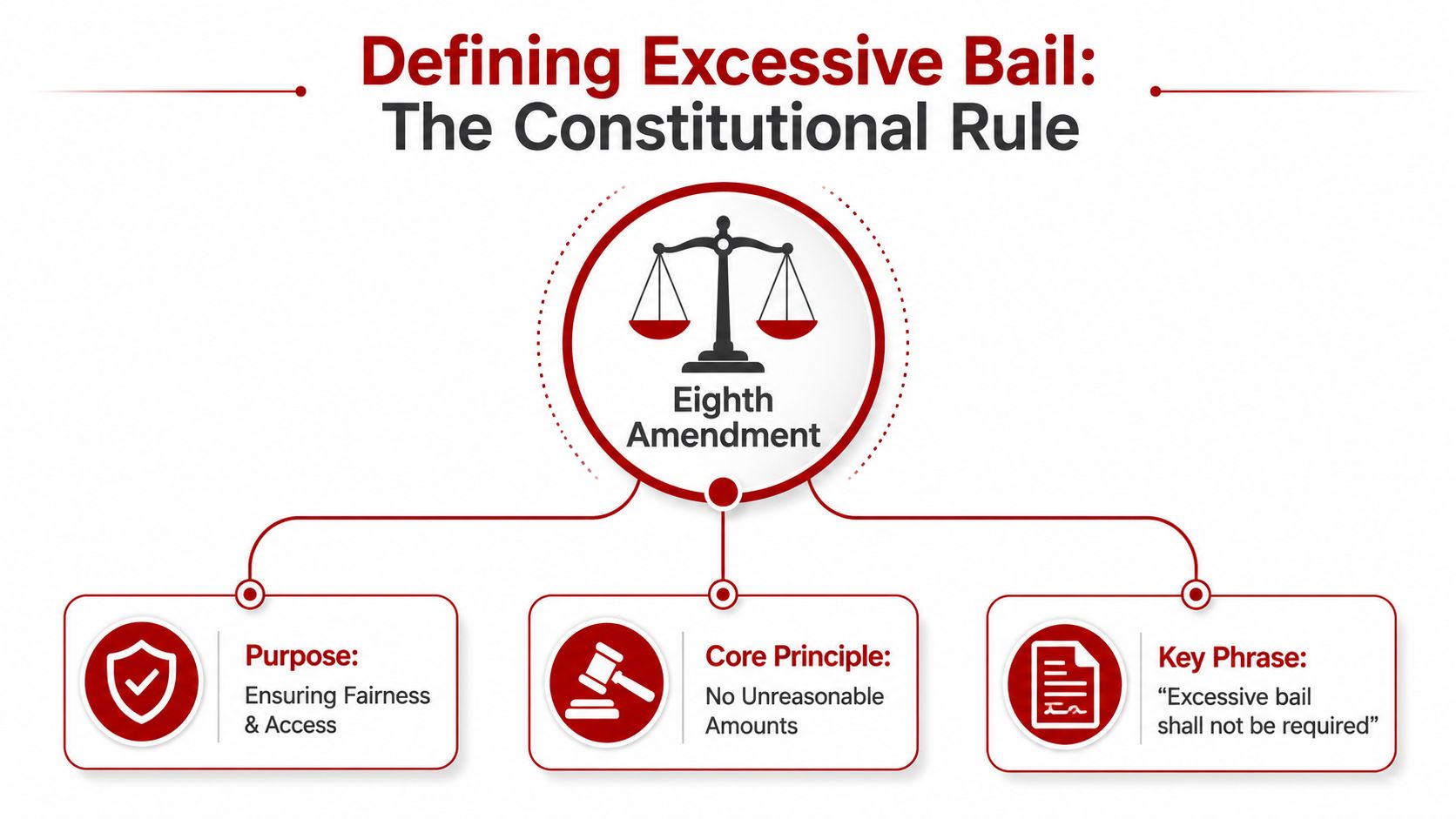
A bail amount can feel arbitrary when you first hear it, but the constitutional rule is straightforward. The Eighth Amendment says, “Excessive bail shall not be required” constitution.congress.gov. That means the government can set bail, but it cannot set it higher than needed to make sure the defendant returns to court.
Bail works like a security deposit for a lease. A landlord can ask for a deposit to protect against damage, but demanding a huge sum with no connection to the actual risk would be unreasonable. Bail follows the same basic logic, except the concern is court appearance, not property damage.
What the rule really means
A judge has to connect the amount to a real need. If the only purpose is to secure appearance, the amount should not go beyond what is needed for that purpose law.justia.com. That is why two people facing the same charge can get different bail amounts. The law looks at whether the number makes sense for that specific defendant, not whether it feels high in the abstract.
There is no fixed dollar cap that automatically makes bail excessive in every case. Courts look at the charge, community ties, prior compliance, available resources, and flight risk nolo.com. A bail amount becomes a constitutional problem when it stops serving as a release condition and starts working like detention by price.
If you want the basics of how bail works before you call a bondsman, review Learn the basic mechanics of bail.
The point of bail is appearance in court, not punishment before trial.
That matters in Ventura County because families often see a large number and assume it proves danger or guilt. It does neither. It is a release condition, and when the amount is set too high, the constitutional objection is real.
How Bail Is Actually Set in Ventura County
In Ventura County, bail usually starts with a local schedule for common charges, then moves to a judge’s decision when the case is more serious or the facts call for a closer look. The first number a family hears is often only the starting point. It is not the final answer.
What judges weigh
Judges look at the seriousness of the charge, the person’s community ties, prior compliance, financial resources, and flight risk. Those factors matter because they show whether the amount is connected to the actual purpose of bail, which is getting the person back to court. If someone has a stable home, steady work, and family in the area, a very high number is harder to defend.
A poor compliance history changes the picture. So do facts that point to a real flight risk. In those cases, a higher amount is easier to justify because the court is making a release decision based on risk, not handing out punishment. The question is whether the number is more than the case calls for.
Review the Ventura County bail schedule
Why the first number can mislead families
A bail schedule does not tell the full story. It cannot capture every detail about a person’s job, home, children, or record. That is why a family should not treat the booking number as the last word, especially when the amount seems out of step with the facts.
Good habit: Write down the charge, booking location, and bail amount exactly as given. Then compare that amount with the person’s local ties, work history, and prior court behavior before deciding whether to push for a reduction.
If the case involves Ventura County Jail bail bonds, Oxnard, or another local facility, the paperwork has to be handled right away. The schedule may explain where the number started, but the person’s actual situation is what shows whether that number is fair or too high.
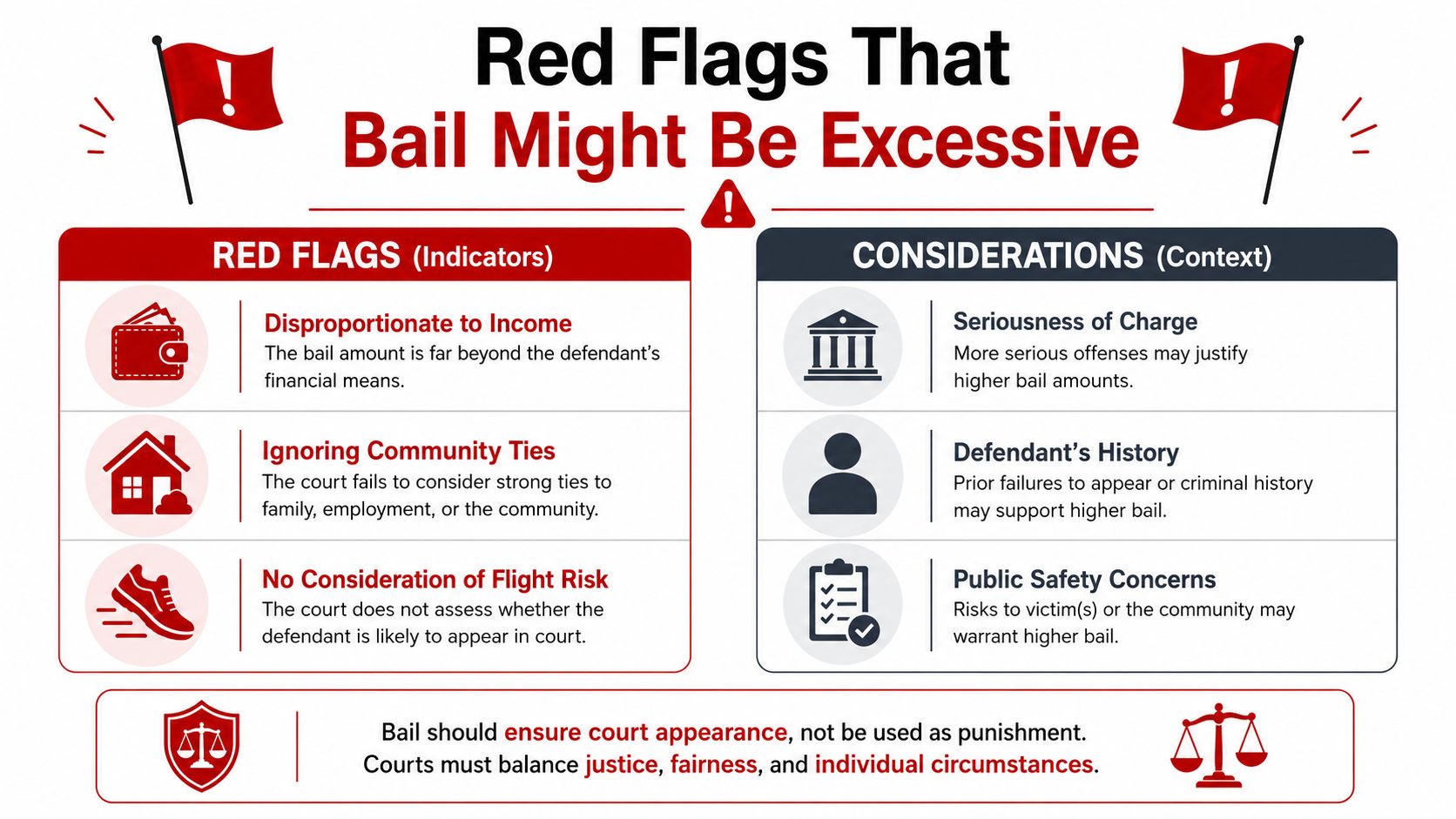
Red Flags That a Bail Amount Might Be Excessive
A bail amount should match the reason bail exists, making sure the person returns to court. When the number looks more like punishment than a release condition, families should pay attention right away.
A first-time, non-violent case with strong local ties should raise questions if the amount feels disconnected from the actual risk. A person with a long record, missed court dates, or facts suggesting flight may face a tougher number. The issue is simple, the amount has to fit the case, not just the charge.
Signs the number may be out of line
- Disproportionate to the person’s means: If the amount is so high that it works like a detention order, that is a red flag.
- Weak connection to flight risk: If the person has deep local ties, steady work, and a stable address, a massive figure needs a real explanation.
- No clear relation to the charge: A number that looks copied from a broad schedule without case-specific thought deserves scrutiny.
- No room for practical release: If the amount leaves no realistic path to release for a low-risk person, the bail may be excessive.
California families have every reason to look closely at those warning signs. Human Rights Watch reported that California’s median bail amount was $50,000, more than five times the median bail for the rest of the country, and that overall bail levels in California rose by an average of 22% from 2003 to 2013. The same HRW report said over 63% of people in California county jails had not been sentenced because they could not afford bail.
That state-wide pattern matters on the ground in Ventura County. Families often see a number and know, immediately, that it is too high for the situation. In domestic violence cases, the charge and protective-order issues can complicate release, so read this local bail amount guide before you assume the first number is final.
Your Practical Steps to Challenge High Bail
Start with one goal, show the court that the amount is more than necessary to secure a court appearance. That does not mean making an emotional plea. It means building a clean record that explains why the number is too high for this person and this case.
Start with the motion, then support it
The usual path is procedural. A defendant asks for a bail reduction hearing, presents evidence, and asks the court to lower the amount. If the judge turns it down, the next step may be appellate review. Speed matters, and so does paperwork.
Families should gather the facts right away.
- Pay stubs or income proof: These show what the family can realistically handle.
- Employer letters: These help show the person has work to return to.
- Proof of residence: Utility bills, lease papers, or mail can show strong local ties.
- Family contacts in the area: This helps establish community roots.
- Court history or compliance records: If the person has shown up before, that matters.
Practical rule: Do not wait until the hearing to hunt for paperwork. Start collecting proof the same day, because the court is more likely to act on a clean, organized package.
The legal standard is functional, not fixed. Bail is excessive when it is set higher than what is reasonably needed to secure the government’s interest, usually the person’s appearance in court. If you can show the person is low-risk and rooted in the community, you are speaking directly to that standard, as described earlier and in a bail reduction hearing guide.
Use the hearing for facts, not emotion
Judges respond to concrete details. Tell the court where the person lives, who depends on them, where they work, and how they handled past cases. Keep it direct and honest. If the amount is too high, the record has to show why.
A short, organized presentation works better than a long speech.
Bring the strongest facts first. If the person has steady work, a stable address, and a history of showing up, put those points at the front of the request. If there are gaps, address them plainly instead of trying to cover them up. Courts pay attention to credibility, and families lose ground when the story is vague.
A local bondsman can also help the family stay focused while the legal issue is being addressed. The immediate job is release. The challenge to the amount can keep moving after that.
How a Ventura Bail Bonds Agency Provides Immediate Help
A bail challenge can take time, and jailed families usually don’t have time. That’s where a local bondsman becomes practical, not theoretical. A Ventura County bail bonds agency can move fast, coordinate with the jail, and work toward release while the legal fight over the amount continues.
In California, the usual premium is 10% of the total bail, which means families don’t have to come up with the full amount to get the process moving. That difference is huge when someone is sitting in Ventura County Jail or another local facility and the clock is working against them. For a worried family, fast bail bonds Ventura is not a slogan, it’s the difference between sleeping at home and staying on the phone all night.
What that help looks like in practice
A bondsman verifies the booking, explains the charge and bail amount in plain English, prepares the bond paperwork, and coordinates with the jail. The family may also be able to use payment plans, a co-signer, or collateral depending on the bond size and risk. That’s how bail bonds Ventura and bail bonds Oxnard searches usually turn into actual release, not just more confusion.
See common bond types and jail posting basics
The point isn’t to ignore whether bail is excessive. It’s to stop the detention problem first. Once the person is out, the family can keep fighting the amount with a clearer head and less pressure.
Bada Bing Bail Bonds is one local option that handles these cases and coordinates with jail paperwork quickly. That matters when a family needs 24-hour bail bonds Ventura support and can’t wait for normal business hours. The value is simple, someone answers, checks the booking, and pushes the release process forward.
Why local speed matters
Local knowledge saves time. Ventura County Jail, nearby police departments, and surrounding courts all move on their own timelines, and a bondsman who knows the routine can reduce wasted calls and confusion. In a pretrial case, every delay makes the situation harder for the family.
The modern move away from cash bail is changing the conversation, but for now, many families still need a workable release path tonight. That’s where a local agency fits. It bridges the gap between a constitutional right and an actual jail release.
Navigating the Process After Release in Ventura County
Once the person is out, the job is not over. They still need to make every court appearance, follow all release conditions, and stay in touch with the bail agent. If someone co-signed, that person has real responsibility too, because the bond depends on compliance.
Missed court dates create bigger problems fast. The family should keep the next court date written down, set reminders, and save every notice from the court or the agent. That’s especially important in Ventura County and Santa Barbara County, where one missed appearance can unravel everything the family worked to get done.
A good local agency stays involved after release, not just at booking. Court date reminders and regular check-ins help keep the bond in good standing and reduce avoidable mistakes. That support matters because families are already under enough stress without trying to track every deadline alone.
The cleanest outcome is simple, the person gets released, shows up, and resolves the case without new problems. If you’re dealing with a high bail amount right now, don’t sit on it. Call Bada Bing Bail Bonds for immediate help, get the release process moving, and ask for clear guidance on the next court date before you hang up.