Felony stalking is a repeated pattern of unwanted contact, surveillance, or threats that makes a reasonable person fear for their safety, and 14 states treated stalking as a felony on the first offense while 34 states treated it as a felony on the second offense and/or when aggravating factors were present. In practice, that means a case can turn serious fast when there’s a prior history, a protective-order violation, a weapon, technology tracking, or a credible threat of harm.
If you’re reading this at 2 a.m. because someone in your family just got arrested in Ventura County, stop guessing and start acting. Felony stalking charges don’t usually mean “one bad text.” They usually mean a pattern, and that pattern can keep a person in custody unless you move quickly, ask the right questions, and deal with bail the right way.
Table of Contents
- Understanding Felony Stalking in Plain English
- Legal Elements That Make Stalking a Felony
- Felony Stalking vs Misdemeanor Stalking
- California Penalties and Sentencing for Felony Stalking
- Common Defenses Against Felony Stalking Charges
- The Bail Process for Felony Stalking in Ventura County
- Your Action Plan After a Felony Stalking Arrest
Understanding Felony Stalking in Plain English
A family gets the call late at night. The deputy says the arrest was for stalking, maybe after repeated texts, showing up at work, or using a phone to track somebody’s movements. The first reaction is usually the same, disbelief, then panic, then confusion about whether this is “just a misunderstanding” or something much bigger.
Felony stalking starts with conduct that keeps going after the other person has made it clear they want no contact, and the charge becomes a felony when aggravating facts are in the mix, such as prior convictions, a protective-order violation, threats, or other serious risk factors. California courts and Ventura County law enforcement do not treat that like a simple relationship dispute.
The legal baseline matters because stalking is a crime in every U.S. state, and some states handle it under harassment laws while others use separate stalking statutes. The Office for Victims of Crime notes that every state has a stalking law, which is why these cases get serious attention from the start, including at the bail stage. For a quick comparison point on how felony charges can overlap with other restraint-based accusations, see this guide on false imprisonment.
Practical rule: if the accusation involves repeated contact, a clear demand to stop, and more contact anyway, the case is moving toward felony territory faster than most families realize.
Stalking also tends to last. Federal victim data reported an average duration of 1.8 years, which shows why courts treat it as an ongoing pattern instead of a one-time event. Judges, prosecutors, and bondsmen focus on escalation, documentation, and whether the conduct created real fear rather than a momentary annoyance.
In Ventura County, that matters immediately after the arrest. Families usually want to know two things right away, how serious the charge is, and how fast release can happen. Those answers depend on how the arrest report reads, whether there was a prior order or prior case, and whether the accusation points to ongoing contact that looks intentional rather than accidental.
Legal Elements That Make Stalking a Felony
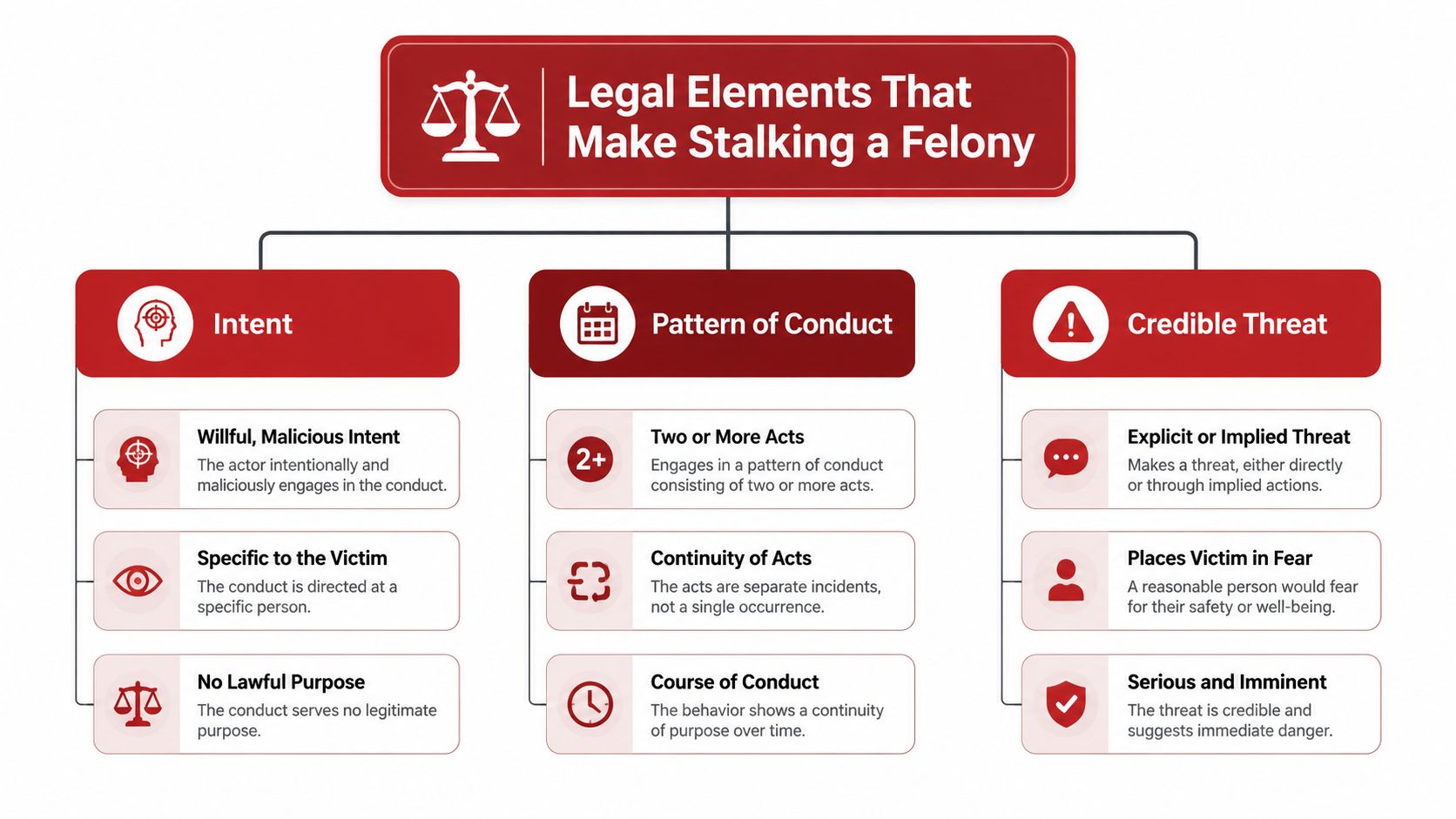
A felony stalking arrest usually turns on three facts, intent, a repeated pattern of conduct, and a threat that makes fear reasonable. Prosecutors do not need a dramatic confrontation in a parking lot to make that case. They need to show repeated, unwanted conduct that crossed the criminal line, which is why digital records, call logs, screenshots, and location data often matter just as much as eyewitness testimony when a family is trying to get someone out on bail in Ventura County.
The course of conduct requirement
The NIJ overview describes stalking as a course of conduct, meaning repeated behavior on at least two occasions, not a single incident. That can include following, repeated contact, or threats that would make a reasonable person fear harm. Washington’s statute shows how this works in practice, because it covers intentionally and repeatedly following, contacting, tracking, or monitoring someone after notice not to do so, and it can also reach use of an electronic tracking device without consent (Washington RCW 9A.46.110).
That repeated-pattern requirement is where families get blindsided. A single angry message usually will not carry the same weight as a stack of texts, repeated drive-bys, workplace appearances, and a deleted location-sharing app. Put those together, and the case starts looking like a stalking file, not a breakup dispute.
The aggravating facts that push it into felony territory
The biggest jump happens when there is a protective-order violation. For details on how these orders work, see our guide comparing protective orders and restraining orders. A prior stalking or harassment conviction, a weapon, a retaliation motive, or a vulnerable victim can also push the case into felony territory. The Department of Justice says a federal stalking or cyberstalking case can become a felony when the accused travels across state, foreign, or tribal lines with intent to kill, injure, harass, or place someone under surveillance, and the conduct causes fear of serious bodily injury, death, or substantial emotional distress. The DOJ also states that two or more prior convictions for stalking or violating a protection order can make the offense a felony (DOJ summary).
Digital evidence now drives these cases. The NIJ overview explains that modern stalking cases often involve in-person conduct, electronic communication, and device-based location tracking, which means phones, apps, cloud records, and device forensics can matter more than old-school surveillance alone. If the evidence sits on a phone or in a location log, defense counsel needs to move quickly before anything disappears.
When the state can show repeated contact plus a real fear response, the case stops looking like a misunderstanding and starts looking like a public-safety issue.
Felony Stalking vs Misdemeanor Stalking
The same behavior can land in two different buckets depending on history and aggravation. That’s why families get blindsided. One judge sees repeated unwanted communication and files it one way, another judge sees the same facts plus a prior order violation and files it as a felony.
The cleanest way to think about it is this, misdemeanor stalking usually involves the same basic pattern but without the heavier aggravating facts, while felony stalking adds danger, repetition, or legal defiance. California is specifically identified in statewide compilations as allowing stalking to be charged as either a felony or a misdemeanor, and that split affects bail exposure, no-contact terms, and how aggressively the case gets handled (California stalking compilation).
| Factor | Misdemeanor Stalking | Felony Stalking |
|---|---|---|
| Conduct pattern | Repeated unwanted contact or monitoring | Repeated conduct plus aggravating facts |
| Protective order issue | May be absent | Often present or violated |
| Prior history | Often none | Prior stalking or related conviction may matter |
| Threat level | Lower or less specific | Credible threat, weapon, or strong fear factor |
| Bail impact | Usually lower exposure | Usually higher exposure and tighter release conditions |
A second California reference notes that Penal Code section 646.9 is widely summarized as carrying up to 5 years in prison and a fine of up to $1,000, with restraining-order violations able to enhance penalties (California sentencing summary). That’s a different world from a minor misdemeanor cite-out. It changes how fast families need to act, and it changes how cautious a jail or court will be about release.
If you want the legal difference framed even more plainly, this breakdown of felony versus misdemeanor charges is the right companion piece. The important part is not the label, it’s the consequence. Felony status means more power for the prosecution, more restrictive release terms, and more pressure on the family to get organized immediately.
California Penalties and Sentencing for Felony Stalking
California treats stalking as a serious offense because the law focuses on fear, repeated conduct, and escalation. Prosecutors can push a case into felony court when the facts show more than ordinary harassment. Families need to understand the issue. The charge is not about whether the contact was unwanted. It is about whether the court sees a pattern that put someone in danger.
What the charge can trigger
A felony stalking case can lead to prison exposure, a criminal record, protective-order consequences, and release conditions that tighten fast once a judge reviews the file. In domestic-violence-related cases, the court can also issue no-contact orders that affect where the accused can live, who they can speak to, and how they get home after release. Those limits matter in Ventura County because a bond gets someone out of custody, but it does not erase the restrictions that stay in place under the court order.
California bail laws also matter. In California, bond premiums are set by law at 10% of the total bail, which is why the bail number on paper and the cash a family needs are not the same thing. That is why families in Ventura often need to act quickly to secure a bail bond after the arrest.
Why collateral issues make these cases harder
Felony stalking often comes with protective-order complications, and those can block or slow release if the court thinks contact risk is still active. If the judge sees a repeated pattern, the court may respond with tighter conditions, especially when the alleged victim is a spouse, partner, co-parent, or witness. In some cases, that also affects whether a family can co-sign, whether collateral is required, and how fast the bond can be processed.
Ventura County families should focus on the next practical steps. If the arrest happened in Ventura, Oxnard, Camarillo, Port Hueneme, Thousand Oaks, Santa Paula, Moorpark, Fillmore, Ojai, or Santa Barbara, the release problem is still the same. Get the booking details, confirm the bail amount, and avoid any contact that could make the situation worse. A bond gets the person out, but the case still moves forward under California law and court order.
Common Defenses Against Felony Stalking Charges
Not every stalking arrest ends in a conviction, but don’t kid yourself, these cases are rarely beaten by attitude alone. A strong defense starts with a hard look at intent, identity, the number of incidents, and whether the evidence proves a true threat rather than anger, bad judgment, or protected speech. Defense lawyers in Ventura County know that a shaky file can fall apart, but only if the defense starts digging early.
The defenses that actually matter
Lack of intent is a real defense when the contact was accidental, misunderstood, or not aimed at frightening anyone. Mistaken identity matters when messages, phone numbers, accounts, or tracking data were misattributed. Insufficient evidence of a credible threat is another big issue, because not every rude or obsessive message is a criminal threat.
Digital evidence can cut both ways
Screenshots are helpful, but they are not the whole story. Metadata, account access, deleted messages, device-sharing, and location history can all change what a text thread means. That’s why a defense attorney should look at the full digital picture instead of relying on a few cherry-picked messages.
Straight answer: if the case depends on social media posts, texts, or tracking data, the defense needs to examine who sent what, when it was sent, and whether the state can prove the accused actually controlled the account or device.
First Amendment issues can also matter when communications are broadcast, political, or not directed to a specific person. But don’t assume speech protections will save the case. Judges care about whether the communication was aimed at the alleged victim, whether it was repeated, and whether the words were intended to intimidate or terrorize. Families should ask any defense lawyer two things right away, what evidence proves a course of conduct, and what evidence proves fear rather than annoyance.
The Bail Process for Felony Stalking in Ventura County
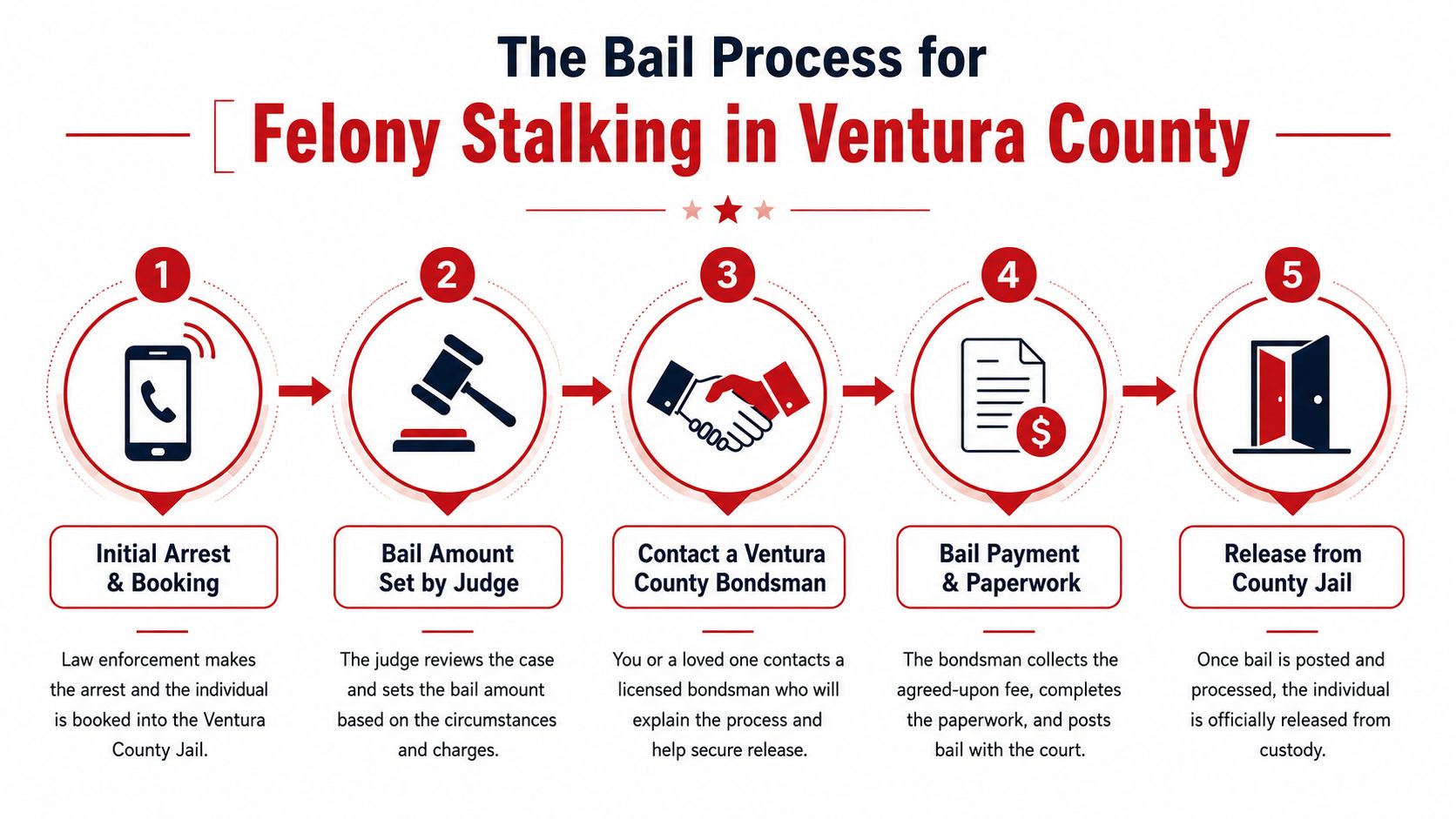
A felony stalking arrest in Ventura County starts moving the moment the booking process begins. The person is fingerprinted, photographed, processed, and entered into the jail system before bail can be posted. If the case carries a protective-order flag, a warrant, or another hold, release can slow down even when the family is ready to post.
What families should do first
Start with the booking information, the jail location, the case number if you have it, and the exact charge. That gives the bondsman or attorney enough detail to verify the bail schedule and spot any release issues. If you need the mechanics of bond posting for serious cases, this guide on bail for felony charges explains the process clearly.
Then call a licensed bondsman who answers after hours, because these arrests rarely happen at a convenient time. A good agent will confirm the booking, explain the bond premium, and tell you whether anything in the file could slow release. Families searching for Oxnard bail bonds, Ventura County Jail bail bonds, or fast bail bonds Ventura usually need those answers immediately, not tomorrow morning.
What can delay release
Holds, warrants, protective orders, and unresolved court conditions can all slow the process. Sometimes the bond is ready before the jail is ready to release. Sometimes the bond is fine, but a no-contact condition requires extra paperwork before the inmate can walk out.
Speed matters. Accuracy matters just as much. A rushed or incomplete bond packet can waste hours, so get the booking data right, verify the charge, and keep your phone close because the jail or the bondsman may need a signature, ID, or co-signer confirmation before release can happen.
Your Action Plan After a Felony Stalking Arrest
Do not waste the first few hours. Call a licensed bail bondsman, get the booking details, and bring in a criminal defense lawyer as early as possible. If there are messages, call logs, screenshots, GPS records, or protective-order papers, save them now, because the evidence trail matters from the start.
This guide on what happens after an arrest is useful if you need the basic post-arrest sequence in plain English. The biggest mistake families make is waiting, then trying to fix everything after the jail has already imposed conditions or after contact with the alleged victim has made things worse.
Best move: follow every release condition exactly. One bad call, one text, or one missed court date can turn a bad night into a deeper legal problem.
Felony stalking cases are serious, but panic makes them worse. Stay organized, keep contact limited, and make sure the person released understands the court date, the no-contact terms, and the risk of forfeiting bail if they disappear.
Bada Bing Bail Bonds helps families move fast when a felony stalking arrest turns into a Ventura County Jail problem, with clear answers, 24/7 availability, and local know-how that can save precious time. If you need help now, visit Bada Bing Bail Bonds and get an agent on the phone before the delay turns into another problem.