It’s 2 a.m., and your phone is lighting up with a call you didn’t expect. Someone you care about is in custody somewhere in Ventura County, and now every minute feels expensive, confusing, and way too quiet. The first thing many people do is start talking, calling random numbers, or trying to explain the whole story to anyone who’ll listen. That usually wastes the most important window.
What matters right now is simple. Keep the situation calm, keep the facts straight, and move toward the next decision that helps release, not the one that feels good in the moment. Arrests are common enough that this isn’t a rare crisis, and the numbers show how broad the problem is across DUI, drug, and property cases, not just violent crime. Vera’s arrest analysis says an arrest happens every three seconds in the United States, with an estimated 10.5 million arrests per year, and the FBI’s 2019 data shows 10,085,207 arrests nationwide, led by drug abuse violations (1,558,862), driving under the influence (1,024,508), and larceny-theft (813,073) (Vera’s arrest trends findings).
That’s why the question of what to do when arrested matters for everyday families in Ventura, Oxnard, Camarillo, Port Hueneme, Thousand Oaks, Santa Paula, Moorpark, Fillmore, Ojai, and Santa Barbara. The first move is usually not arguing, and it’s not trying to outtalk the process. It’s getting through the first minutes without making things worse, then using the booking window, the jail call, and the first hearing the right way.
Table of Contents
- What to Do in the First Minutes After an Arrest
- How to Protect Your Rights at the Scene and in Custody
- What Happens Between Arrest and Booking in Ventura County
- How to Secure Release Through Bail and Ventura County Bail Bonds
- How Domestic Violence and Protective Orders Change What to Do
- Staying Compliant After Release and Ready for Court
What to Do in the First Minutes After an Arrest
The first minutes after an arrest are about control, not explanation. If you keep your voice low, your hands visible, and your movements slow, you reduce the chance of turning a manageable stop into a bigger problem. I have seen people in Ventura County make things harder by talking over the deputy, reaching for something without asking, or trying to argue the case on the spot. That is the wrong window for persuasion.
The cleanest move is plain and steady. Stay where you are told to stay, follow the physical directions that are given, and do not make sudden moves. Whether the arrest starts on Victoria Avenue during a DUI stop, in Oxnard on a property case, or in Camarillo on a warrant pickup, the scene is not the place to prove innocence.
Practical rule: the less you say, the less you hand over later.
People often think a long explanation will fix a misunderstanding. In practice, it can become volunteered statements, partial answers, or a roadside version of a written statement. Once those words leave your mouth, they can show up again in booking, charging, and the hearing that follows. If you want a plain-English walk-through of the next steps, what happens after you get arrested lays out the Ventura County flow from arrest through release.
Keep your focus on the next move, not the argument you wish you could win in the moment. A deputy or officer may treat the arrest as routine, but the person in custody is usually dealing with shock, confusion, and a lot of noise all at once. You do not need to match that pace. You need to slow your own side of the situation down.
What not to do
- Don’t resist physically: Even a small struggle can turn a simple arrest into a bigger case.
- Don’t argue innocence at the scene: Save that for counsel and the court process.
- Don’t volunteer explanations: Short, calm silence is safer than trying to “clear it up.”
- Don’t consent casually: A search request is not something to agree to just because you’re stressed.
That is the discipline that helps the rest of the process go better. If you keep your head and your words tight in the first minutes, you make it easier for family, counsel, and a bail agent to handle the booking window, the jail call, and the release steps that follow.
How to Protect Your Rights at the Scene and in Custody
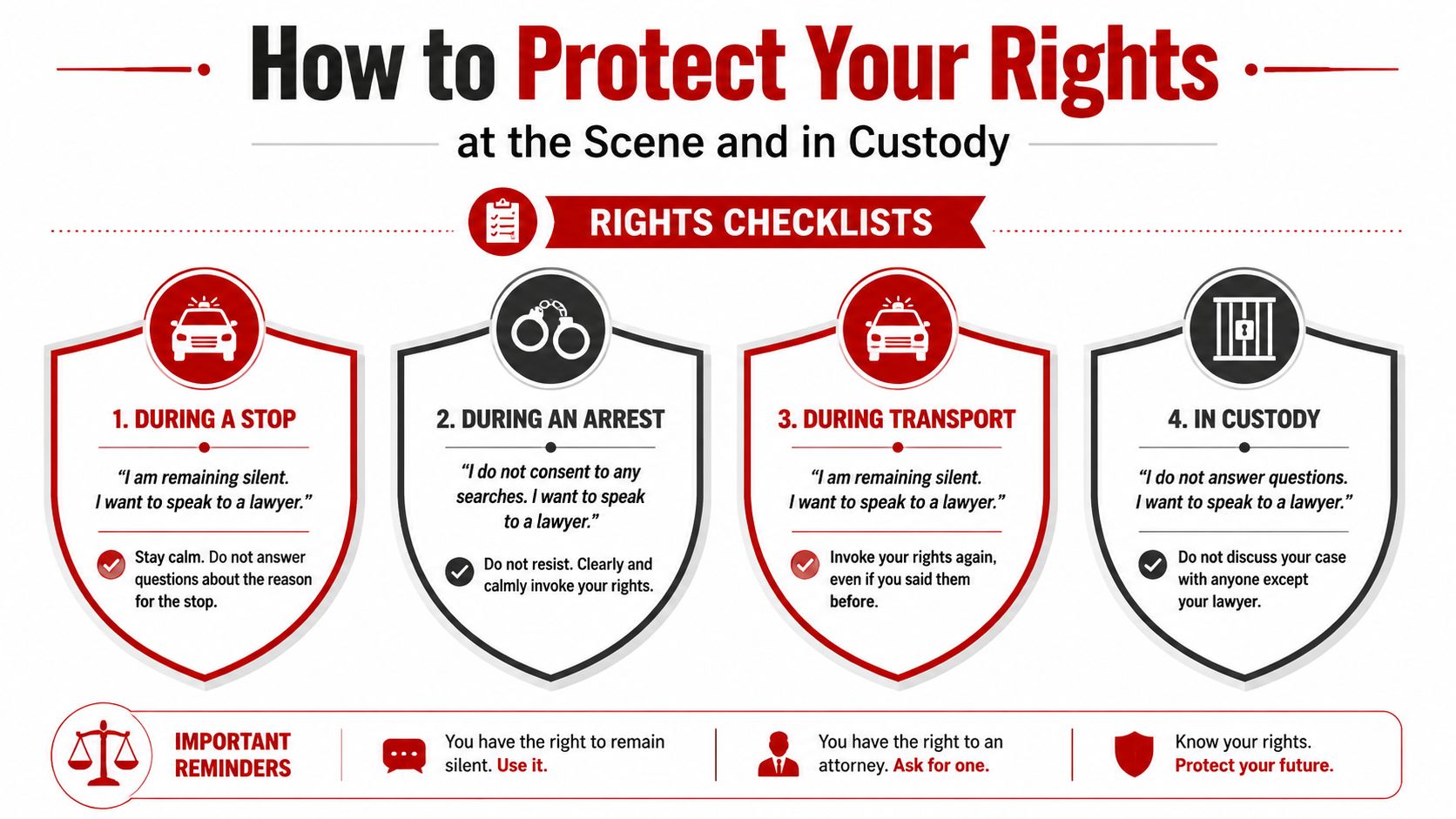
Say the script out loud once, then stop. “I am invoking my right to remain silent.” “I want a lawyer.” Those words are direct, and they keep the focus where it belongs. After that, give only the basic identifying information you are required to provide, and nothing extra.
Stay disciplined under pressure. It makes the next steps easier. If an officer keeps asking questions, do not fill the silence with explanations, guesses, or a promise to clear things up later. Legal guidance also says not to physically resist and not to consent to searches, because statements and consent given under stress are hard to undo later, as noted in a summary of practical arrest rights guidance.
Use silence on purpose
Silence works only if you keep it clean. Do not bargain, do not offer a partial story, and do not say, “I’ll explain if you let me call someone.” That kind of talk can still become a statement, even if you meant it as cooperation.
If the stop turns into an arrest in Oxnard, Ventura, or Camarillo, get the officer’s name and badge number if you can, and ask whether you are under arrest and why. That kind of basic record helps later when details start to blur. The county defender guidance also recommends writing down everything that happened as soon as you are able, which is good advice because memory gets messy fast (arrest rights guidance).
Don’t sign first and think later
Paperwork moves fast in custody, and that is where people get trapped. If a form involves a search, a statement, or anything you do not understand, wait for counsel before you sign. People often sign because they want the process to move along, not because they understand what the form does.
A person in custody also has the right to contact a lawyer, friend, or family member, and the New York State Bar Association says that phone-contact right applies while the person is in police custody (NY State Bar arrest rights). The ACLU’s arrest guidance adds that after arrest or booking, you have the right to a phone call within a reasonable amount of time and says to say nothing except your name until you speak with a lawyer (ACLU arrest guidance).
Short custody script: “I’m not answering questions. I want a lawyer. I’d like to make my phone call when I’m allowed.”
Document while it’s still fresh
As soon as it is safe, write down names, badge numbers, patrol car details, times, witnesses, and any injuries. Those notes matter later if there is a motion, a complaint, or a bail dispute. A memory from the next day is never as strong as a note from the same night.
If the arrest started as a traffic stop in Ventura or a warrant contact near Port Hueneme, keep the record tight. Do not add guesses. Write down what you saw, what was said, and what happened in order, then use a warrant check resource if you need to confirm whether an outstanding issue may already be in play.
What Happens Between Arrest and Booking in Ventura County
The gap between handcuffs and the first clear answer is where families lose the most time. The person is already in motion, being transported, searched, fingerprinted, entered into jail records, and then queued toward the first hearing. Booking time is not the same in every case. Workload, nighttime staffing, medical screening, and classification issues can all slow the process.
That delay matters because release planning usually cannot start in a meaningful way until the custody record exists. Families do better when they stay organized from the outside, keep the arrest details straight, and avoid flooding the jail with mixed information. The fastest calls I get usually come from one person who has the full legal name, date of birth, and the best arrest details before anyone starts dialing around.
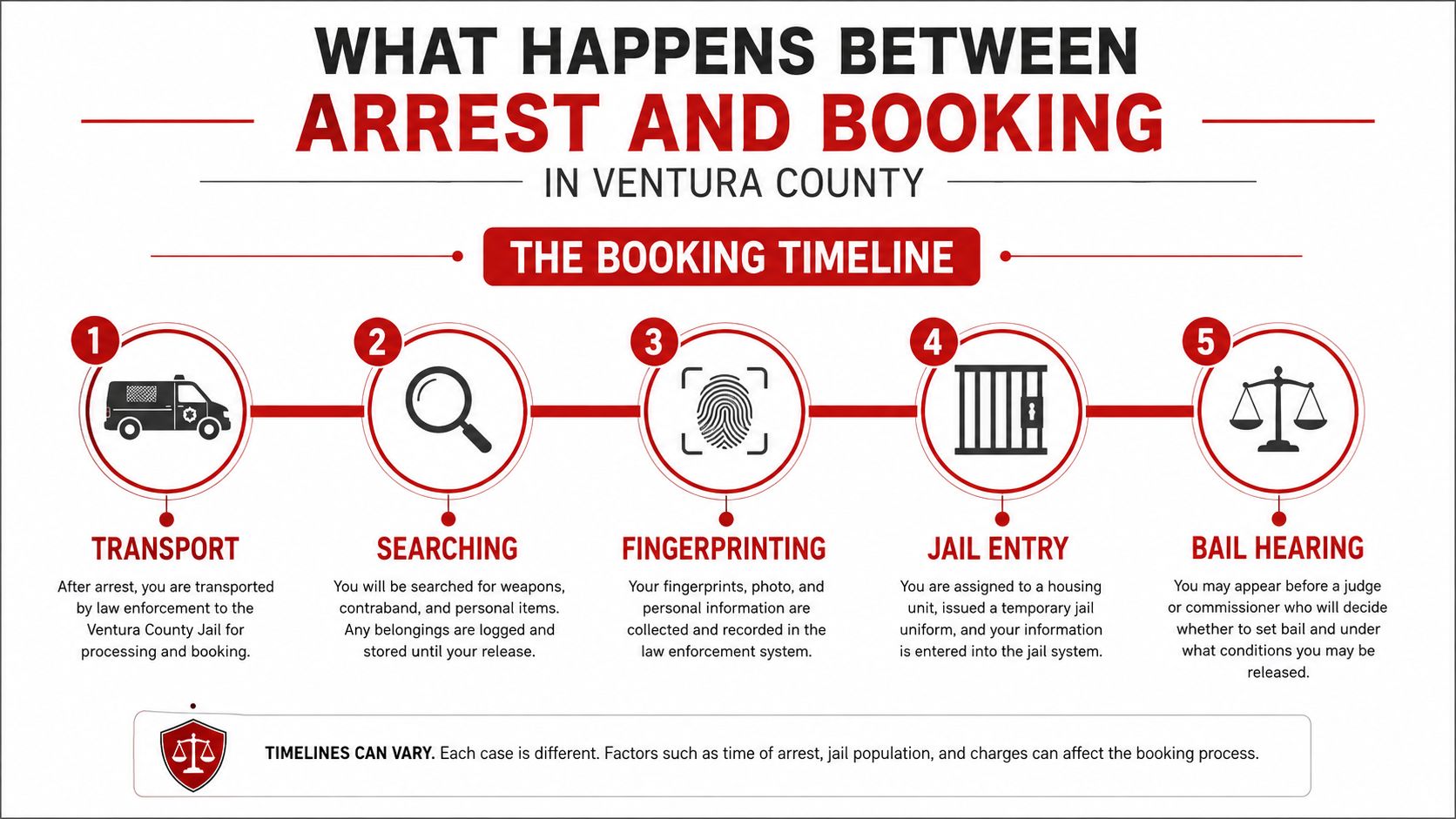
The outside timeline families can track
First comes transport. The person leaves the scene and heads to the jail or holding facility. Then comes searching and inventory, where personal property is logged and the facility starts controlling access.
Fingerprinting and entry into the jail system come next. That record is what lets release work begin in a real way, because the booking details have to exist before anyone can move on bail, custody status, or the first court step. The final stage is the first hearing, where release conditions and bail get addressed.
LegalaidNYC’s overview of arrest expectations and first hearing notes that the post-arrest custody stage is where initial processing, charging, and the first court hearing start to shape release opportunities and pretrial risk. Families should treat those early hours as active time, not waiting time.
What helps from the outside
- Confirm custody quickly: Don’t wait all night hoping someone will turn up on their own.
- Keep one caller in charge: Too many callers create crossed wires and bad information.
- Save the case details: Full name, date of birth, arrest location, and any charge information help move things faster.
- Avoid phone chains: One accurate call beats ten confused ones.
If you are trying to understand Ventura County Jail bail bonds, this is the point where the process becomes real. The booking number, facility location, and court path all shape how release can happen. A local agent can only move as fast as the custody record allows, which is why the booking process guide is useful as soon as the record starts showing up.
How to Secure Release Through Bail and Ventura County Bail Bonds
Money is usually the first hard stop. A family may have cash ready, or it may be looking at a felony amount that makes paying the full bail unrealistic. That gap is why the choice between cash bail and a bond matters so much in real life.
Prison Policy Initiative reports that more than 400,000 people in the U.S. are currently detained pretrial, 69% of people in city and county jails are being held pretrial, the median bail bond for a felony is $10,000+, and the annual national cost of pretrial detention is about $13.6 billion (pretrial detention research). Those figures do not tell one family what to do, but they show why release often depends on a bondsman, a co-signer, or collateral.
Cash bail and bond are not the same thing
Cash bail means paying the court the full amount. If the case ends properly and the person shows up when required, that money is generally handled through the court process. A bail bond is different. A bondsman posts the bond so the person can be released without paying the entire bail amount up front.
In California, families usually focus on the 10% bond premium. For many people, that is the difference between doing nothing and getting out the same night. The choice also involves timing, paperwork, and whether the facility accepts the bond quickly.
What usually speeds release
A clean bond package moves faster than a messy one. That means the arrested person’s full legal name, correct date of birth, known charges, and verified custody status need to be ready before the paperwork starts. If the case is a DUI, a theft arrest, a warrant pickup, or a probation matter, the same basic rule holds, but other holds or court timing can slow the release window.
Real-world trade-off: paying attention to the paperwork at the start usually saves hours later.
A local 24-hour agent can verify booking, coordinate the jail paperwork, and keep track of the release window while family members wait at home or near the facility. In Ventura, Oxnard, Thousand Oaks, Camarillo, Port Hueneme, Santa Paula, Moorpark, Fillmore, Ojai, and Santa Barbara, that speed matters because the person who answers first often becomes the person who gets release moving first.
If you’re comparing payment routes, the local how to pay for bail guide is a useful starting point. Bada Bing Bail Bonds is one local option for Ventura County bail bonds, and families often use a local agent for the same practical sequence they are dealing with at midnight, confirm custody, explain the charge, complete the bond, and track release.
How Domestic Violence and Protective Orders Change What to Do
Many people assume bail ends the problem, but protective orders can keep shaping what happens after release. In domestic violence cases, the release may come with strict no-contact terms, and breaking those terms can lead to a new arrest quickly.
California’s protective-order guidance says not to contact or try to find the protected person, and legal-aid arrest guidance warns not to interfere with witnesses or discuss the case broadly (California protective orders). That matters because the fastest way to turn a release into a new problem is to use family members, friends, or social media to pass messages.
Who should communicate
Pick one point person. That person can handle the bond conversation, gather paperwork, and keep the rest of the family from sending mixed messages. Nobody else should be texting the protected person, showing up at the home, or “checking in” through a third party unless counsel says it’s allowed.
One clear voice keeps things from getting worse. It also helps the jail, the attorney, and the bond agent work from the same facts instead of chasing separate versions of the story.
What families often get wrong
They think a bond solves the legal problem, so they call the protected person to calm things down. That is the mistake that causes trouble. A phone call meant to help can become a violation if there’s a no-contact order, and the consequences can be immediate.
- Release can still be possible: Bail and protective orders can exist at the same time.
- Contact can still be prohibited: The person may be out, but still not allowed to reach out.
- Third-party messages can still matter: A message through someone else can create risk.
For families dealing with this in Ventura County, the safer move is to keep every case-related conversation off the phone with the detained person. Let the lawyer or the bond agent handle the logistics. If you need a plain-English overview of order types, the local restraining order guide helps separate the paperwork from the actual restrictions.
Staying Compliant After Release and Ready for Court
The first day out can still go sideways fast. Release is when the case shifts from urgency to ongoing discipline, and the details matter. Court dates, check-ins, travel limits, and conduct rules all need attention, because the family that stays organized usually sees fewer surprises later.
A missed court date or ignored condition can create a bigger problem than the arrest itself. Keep the paperwork, keep the reminders, and keep communication open. If you need a plain explanation of the risk, the local guide on what happens if you miss court lays out what can happen when someone does not show up.
A practical release checklist
Start with the calendar. Write down every court date, enter it in the phone, and put it somewhere a trusted family member can see it too.
Keep the bond paperwork together. Save the receipt, the agreement, and every contact number that came with the release.
Read every restriction line by line. Travel limits, contact rules, alcohol conditions, and stay-away terms are not places to guess.
If plans change, call early. A missed deadline or broken condition is easier to address before it turns into a warrant or a bond problem.
Keep the bond file in one place. If the case closes cleanly, that paperwork is what helps return collateral and finish the file.
For Ventura County bail bonds families, that follow-through is part of the job, not a side note. The same local process that helps with DUI, domestic violence, drug, theft, warrant, and white collar arrests should also include reminders and compliance until the case ends. That is the difference between getting someone out and helping them avoid re-arrest.
If your goal is fast verification, plain-English answers, and a local team that works nights and weekends, call Bada Bing Bail Bonds as soon as custody is confirmed. The sooner the booking details are checked, the sooner release planning can start, and in Ventura County that timing can make the difference between a long night and a faster homecoming.