
It’s late, your phone keeps ringing, and someone you love has just been taken into custody. You may not know whether they’re at the Ventura County Pre-Trial Detention facility, still being transported from Oxnard, or waiting for booking in another part of the county. The first instinct is usually to call everyone, drive to the jail, or start explaining what happened. Those reactions can waste time and create new problems.
The right response is calmer and more organized. Protect the arrested person’s legal position, confirm where they’re being held, collect the booking details, and address release as soon as the facility can process it. This guide focuses on what to do when someone gets arrested in Ventura County, including Ventura, Oxnard, Camarillo, Port Hueneme, Thousand Oaks, Santa Paula, Moorpark, Fillmore, Ojai, and Santa Barbara.
Table of Contents
- The First Hour After an Arrest in Ventura County
- Understanding the Booking Process and Bail Schedule Timing
- What Information to Gather Before Calling a Bail Bondsman
- Comparing Release Options Under California Law
- Bail Bond Costs and Payment Structures in California
- Post-Release Compliance and Court Date Management
The First Hour After an Arrest in Ventura County
It’s close to midnight in Oxnard. A family member calls and says your brother was arrested after an argument. Nobody knows the exact charge, the arresting agency, or whether he has reached the jail. One person wants to drive to the police station, another is calling relatives, and someone else is leaving messages for the arrested person.
Stop and assign one person to gather facts. Everyone else should stay out of the way.

Start with rights and basic facts
In England and Wales, an arrested person has the right to free legal advice at the police station, including access to a duty solicitor available around the clock. Police custody rules also require an appropriate adult to protect the interests, rights, and welfare of children or vulnerable detainees, as explained in the official custody rights guidance. California procedures differ, but the practical advice is consistent: the person in custody should avoid discussing the facts of the case and request a lawyer.
Jail calls and messages may be recorded or monitored. Don’t ask the arrested person to explain the incident, identify witnesses, or discuss what anyone should say. Tell them to remain respectful, provide basic identifying information when required, request counsel, and stop talking about the case.
At the same time, write down:
- Full legal name: Include spelling variations if the name may have been entered incorrectly.
- Date of birth: This helps the jail distinguish people with similar names.
- Likely arrest location: Note whether the arrest occurred in Ventura, Oxnard, Camarillo, Thousand Oaks, or another city.
- Arresting agency: This may be a city police department, the sheriff, or another agency.
- Approximate arrest time: It helps the bail agent and family track transport and booking.
- Possible charges: Use only what you know. Don’t guess.
Practical rule: Don’t try to intervene at the scene. Once officers have made the arrest, arguing roadside rarely helps. Your job is to protect communication, locate the person, and prepare for the next custody step.
Arrests in Ventura County don’t all reach the jail at the same speed. A person arrested in Port Hueneme, Santa Paula, Moorpark, Fillmore, or Ojai may still be in transport while someone arrested near central Ventura is already entering the county system. Booking also takes time, so an online search may show nothing immediately.
If you need help confirming the custody location, use this guide on how to find someone arrested. Then contact a 24-hour bail bonds Ventura service early, even if the bail amount hasn’t appeared. An experienced agent can start verifying the arrest, explain what information is still missing, and prepare paperwork while the jail completes its intake.
Understanding the Booking Process and Bail Schedule Timing
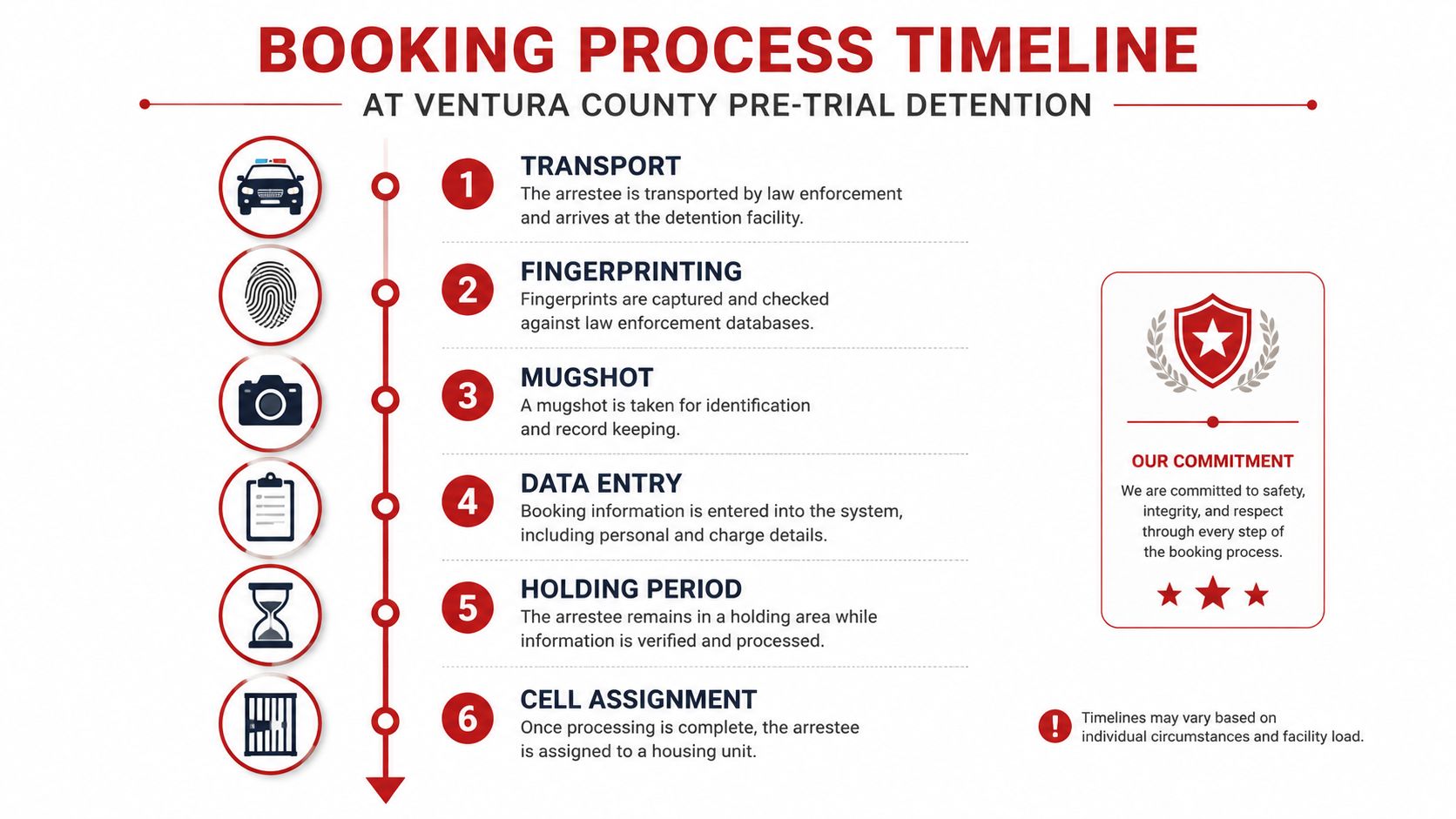
Booking is the administrative gate between arrest and release. At the Ventura County Pre-Trial Detention facility at 800 South Victoria Avenue in Ventura, staff process the person into custody, record identifying information, take fingerprints and a photograph, classify the charges, and assign the person to the appropriate holding area or housing location.
The process can slow down when several arrests arrive together, when medical screening is required, or when classification staff need additional information. A missing booking record doesn’t necessarily mean the person wasn’t arrested. It may mean transport, intake, data entry, or verification isn’t complete.
Follow the booking trail
Use this order:
- Confirm the arresting agency. Ask whether the person was arrested by a city agency or county personnel.
- Check the county custody information. Search using the exact legal name and date of birth where available.
- Call with the right identifiers. A bail agent can often verify a booking more efficiently when you provide the name, birth date, agency, and approximate arrest time.
- Ask what is pending. The delay may involve fingerprints, medical clearance, charge classification, bail entry, or a court review.
- Don’t assume “no bail listed” means no release. It may mean the system hasn’t completed the booking stage.
California Penal Code section 1269c creates an important timing rule. If no order changing bail is issued within eight hours after booking, the defendant is entitled to release upon posting the amount in the applicable bail schedule, as provided by the California Legislature’s text of section 1269c.
That rule matters because the clock starts after booking, not necessarily at the moment officers make the arrest. A family that calls early can prepare documents, identify a co-signer, and be ready when the scheduled amount becomes available.
Know what can change the timeline
The eight-hour rule doesn’t eliminate every delay. A judge or magistrate may issue an order changing bail, the charge may require additional review, or the facility may need to complete release processing after a bond is accepted. The person may also remain held under a separate legal or administrative restriction.
For a charge-by-charge explanation, review the Ventura County bail schedule. Don’t rely on a family member’s estimate from a text message. The court sets the bond amount, and the current booking record controls what the jail will accept.
What Information to Gather Before Calling a Bail Bondsman
A bail agent can move faster when the first call contains usable information. “He was arrested somewhere in Ventura” is a starting point, not a complete intake. The more precisely you identify the person and facility, the less time the agent spends correcting basic details.
Build a clean intake sheet
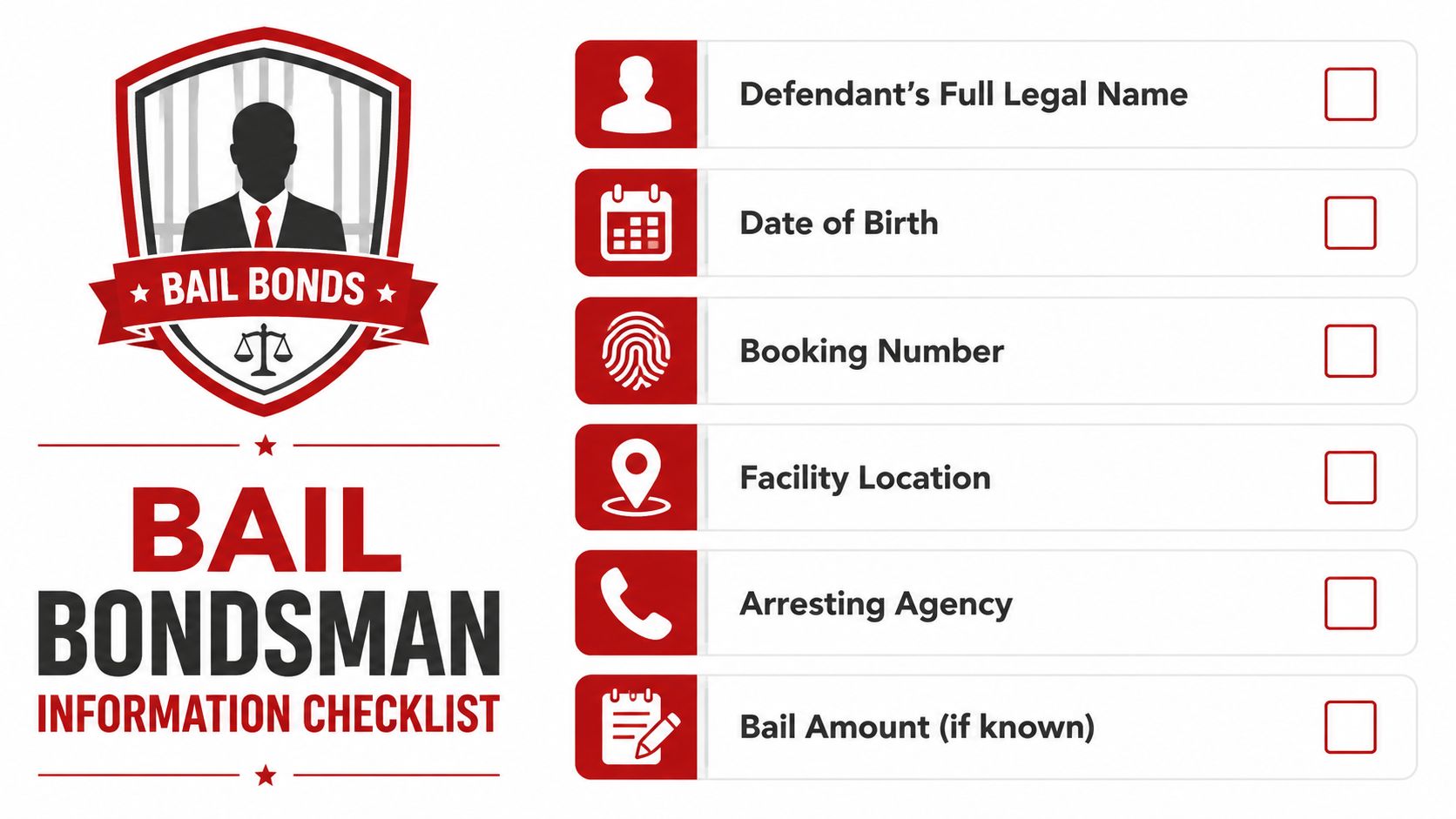
Write the information in one place before calling:
- Defendant’s full legal name: Use the name on government identification if possible.
- Date of birth: This is one of the fastest ways to separate similar names.
- Booking number: Provide it as soon as the jail publishes or confirms it.
- Facility: Identify whether the person is at the Ventura County Pre-Trial Detention facility or another location.
- Arresting agency: Record the agency that made the arrest, not merely the city where it happened.
- Charges: Include the wording shown in the booking information.
- Bail amount: Add it if the jail or court has posted one.
- Co-signer contact information: Have the proposed signer’s phone number, address, and identification available.
If the arrest happened in Camarillo but the person was transported through another facility, don’t assume the arrest city tells you where to post bail. Verify the current custody location first. The same rule applies to arrests connected to Santa Barbara, Thousand Oaks, or an outlying Ventura County community.
Prepare for the agent’s questions
The agent will need to verify who is signing the agreement, how the premium will be paid, whether collateral may be required, and how to reach the defendant after release. Answer directly. Don’t hide prior bail obligations, warrants, or uncertainty about the address, because incomplete information creates avoidable delays later.
If several relatives are coordinating calls, choose one point of contact. A clear communication chain prevents duplicate applications and conflicting answers. Families that already manage high-volume legal calls may also find practical guidance in resources covering top legal intake call center providers, especially when staff must capture accurate names, dates, and urgent case details.
For a more complete preparation list, review the bail bond requirements. The agent can explain what applies to this booking, but the family should gather identification and payment information before the paperwork arrives.
Comparing Release Options Under California Law
Families usually face three possible paths: cash bail, a bail bond, or release on the person’s own recognizance. The right choice depends on the court’s order, the available funds, the urgency of release, and the conditions attached to the case.
The court sets the bond amount. A bail agent doesn’t decide whether the bond is high or low. The amount may come from the applicable county schedule unless a judge changes it, and certain cases receive special treatment.
| Release Option | Cost to Family | Speed of Release | Availability | Refund Policy |
|---|---|---|---|---|
| Cash bail | Full court-set amount, plus any accepted transaction costs | Can proceed when the facility accepts verified payment | Available when the court and facility permit cash posting | Return depends on court disposition and applicable rules |
| Bail bond | Premium and permitted transaction expenses under the written agreement | Can proceed after approval, paperwork, and facility processing | Available when a licensed surety arrangement is accepted | Premium generally isn’t treated like a refundable court deposit |
| Own recognizance | No bail payment, although conditions still apply | Depends on court or custody approval | Available only when authorized by the releasing authority | No cash bail deposit to return |
Cash bail
Cash bail may make sense when the family can provide the full amount without disrupting rent, payroll, or emergency savings. The payment goes through the authorized court or jail process, and the payer should keep every receipt and document.
Cash doesn’t guarantee immediate exit. Staff still need to verify the payment, complete the release paperwork, and finish facility processing.
Bail bonds
A bail bond lets the family avoid tying up the entire court-set amount. The signer enters a contractual obligation with the surety and pays the lawful premium and any disclosed expenses. This route often makes practical sense when speed matters or when paying the full amount would create a severe financial strain.
Own recognizance release
Release on own recognizance doesn’t mean the case disappears. It means the person is released without a financial bond, subject to the court’s requirements. The court may consider appearance, safety, community ties, and compliance history when deciding whether this option is available.
Domestic-violence cases require special attention. California guidance states that pre-arraignment release can be restricted to money bail for offenses involving domestic violence, meaning non-financial release may not be available before arraignment under the cited protocol summary. California Penal Code section 1270.1 also permits a judge or magistrate to increase bail above the scheduled amount for certain bailable felony offenses or misdemeanor violations of a domestic-violence order when a sworn officer provides the required declaration. Read the California pre-arraignment release protocols before assuming an ordinary release option applies.
Bail Bond Costs and Payment Structures in California
California pricing is regulated, so families should ask for a written explanation before signing. The California Department of Insurance states that bail agents must charge the filed rates approved for the surety company. The consumer cost is most commonly ten percent of the total bond amount, plus actual, necessary, and reasonable expenses connected to the transaction, according to the California Department of Insurance bail bond guidance.
That doesn’t mean every family’s total obligation looks identical. The premium is tied to the bond amount, while payment arrangements, co-signer qualifications, and collateral depend on the transaction and the surety’s underwriting requirements. Ask the agent to identify each charge before authorizing the bond.
What families should ask before signing
Request clear answers to these questions:
- What is the premium? Confirm how the lawful rate applies to the total bond.
- What expenses are included? Ask for actual, necessary, and reasonable transaction expenses in writing.
- Is a payment plan available? Clarify the required initial payment, installment dates, and consequences of late payment.
- Who must co-sign? Ask whether the signer needs income, property, identification, or a local address.
- Will collateral be required? Larger or higher-risk bonds may involve collateral, and the agreement should explain release conditions.
- What happens if the case changes? Ask how dismissal, reduction, surrender, or a court order affects the bond and collateral.
The Ventura County Sheriff’s Office accepts several posting methods at the Pre-Trial Detention facility at 800 South Victoria Avenue in Ventura. These include cash in the exact amount, cashier’s checks payable to the Ventura County Superior Court, bail bonds, and credit or debit card payments through GovPayNet or by phone using PLC 6404, as stated in the Ventura County Sheriff’s bail posting information.
For out-of-county matters, payment instructions can differ. The sheriff’s information also distinguishes checks for another jurisdiction, so don’t send a cashier’s check to the wrong court.
Families comparing options can review this explanation of how much bail bonds cost. Don’t sign under pressure without understanding the premium, payment schedule, collateral terms, and obligations if the defendant misses court.
Post-Release Compliance and Court Date Management
Release is not the end of the emergency. It starts a compliance job that belongs to the defendant, the co-signer, and the defense team.
Bail functions as a compliance instrument, not merely a payment. Conditions may include scheduled check-ins, travel restrictions, protective or no-contact orders, drug testing, program attendance, and court appearances. The person must read every page of the release paperwork and ask counsel about anything unclear.
Protect the bond after release
Use one calendar and one responsible person to track every date. Store the bond agreement, release paperwork, court notices, attorney contact information, and program instructions together.
- Court attendance: Arrive as directed and confirm the date with counsel.
- Reporting: Complete every required check-in on time and keep proof.
- Contact restrictions: Treat a no-contact order as a strict mandate. Don’t call, text, visit, or send messages through relatives unless the court changes the condition.
- Travel rules: Ask before leaving the permitted area, even for work or family obligations.
- Programs and testing: Follow instructions for DUI programs, anger-management requirements, or drug testing when ordered.
Missing a reporting date or ignoring a no-contact order can lead to a warrant or re-arrest. The official bail guidance on release conditions reinforces the practical point that release remains tied to attendance and compliance.
Keep the paperwork, not just the phone number. If a dispute arises about a check-in or payment, records matter.
Families that struggle to track changing legal dates can consult this resource on legal deadline management advice. For a practical explanation of the next steps after a bond is posted, review what happens after bail is posted.
If someone has just been booked in Ventura, Oxnard, Camarillo, Port Hueneme, Thousand Oaks, Santa Paula, Moorpark, Fillmore, Ojai, or Santa Barbara, contact Bada Bing Bail Bonds for 24-hour intake, booking verification, transparent payment options, and coordination with the jail. Visit Bada Bing Bail Bonds now so an agent can help you organize the next step instead of losing valuable time to confusion.