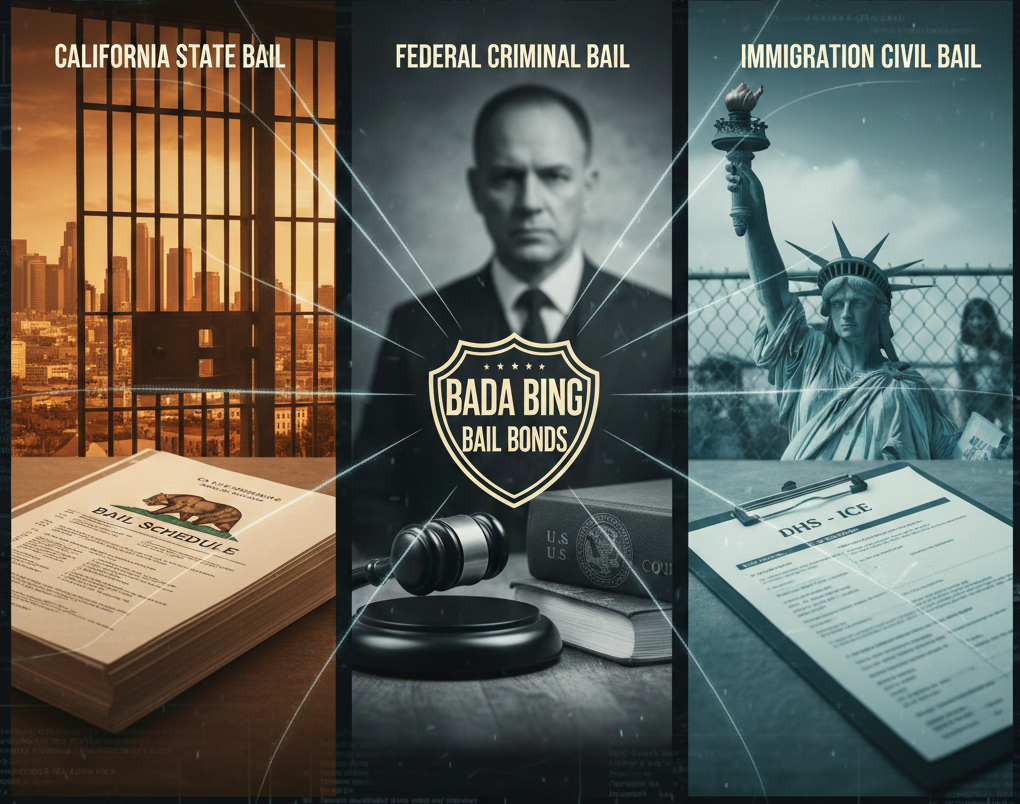
When you’re looking to get someone out of custody, “bail” isn’t a one-size-fits-all term. In California, the legal system is split into three distinct “kingdoms”: State, Federal, and Immigration. At Bada Bing Bail Bonds, we believe an informed client is an empowered one. Here is an in-depth look at how these systems differ—from the licenses we carry to the specific laws that govern your freedom.
1. Licensing: Not All Bondsmen Are Created Equal
Many people assume that a bail license is universal. In reality, the credentials required to operate in state vs. federal courts are significantly different.
State Bail License (California Department of Insurance): To post bail in a California county jail (like Los Angeles, Orange, or Riverside), an agent must be licensed by the California Department of Insurance. This requires 40 hours of specialized “Power of Arrest” training, passing a state exam, and maintaining a $1,000 surety bond.
Federal & Immigration Qualifications: There is no “federal bail license” per se; however, to write federal or immigration bonds, an agent must be backed by a corporate surety company that is on the U.S. Department of the Treasury’s Circular 570. This list identifies companies authorized to write “federal obligations.”
Pro Tip: Always ask your bondsman if they are “Treasury Listed.” If they aren’t, they cannot legally help you with a federal or ICE case.
2. The Immigration System: A World of Its Own
Immigration bail is entirely separate from the criminal justice system. While state and federal cases deal with crimes, immigration bonds deal with civil administrative matters under the Department of Homeland Security (DHS).
The Immigration Bail Schedule
Unlike the California State Bail Schedule, which is based on the severity of a crime, the Immigration Bond amount is determined by ICE (Immigration and Customs Enforcement) or an Immigration Judge.
Minimums: By law, the minimum amount for an “Immigration Delivery Bond” is $1,500, but in practice, they often range from $5,000 to $25,000+.
The Eligibility Gap: Not everyone is eligible for a bond. Certain individuals are subject to “Mandatory Detention” based on their past criminal record or how they entered the country.
The “Clean Hands” Requirement: To post an immigration bond, the person paying (the “obligor”) must be a U.S. citizen or Legal Permanent Resident (Green Card holder).
3. Comparing the Three Systems at a Glance
| Feature | California State | Federal (Criminal) | Immigration (Civil) |
| Governing Law | CA Penal Code | Bail Reform Act of 1984 | Immigration & Nationality Act |
| Who Sets Bail? | County Bail Schedule | Federal Magistrate Judge | ICE Officer or Immigration Judge |
| Release Type | 10% Surety Bond | Signature or Secured Bond | Delivery or Voluntary Departure |
| Agency in Charge | County Sheriff | U.S. Marshals | ICE / DHS |
| Collateral | Often optional | Highly required (Real Estate) | Cash or Corporate Surety |
4. Why “Dual Custody” Is Your Biggest Risk
A common pitfall in California is the “ICE Hold.” This happens when a person is arrested for a state-level crime, but because of their status, ICE places a “detainer” on them.
The Danger: If you post a state bail bond without checking for an ICE hold, your loved one won’t be released to you—they will be transferred directly to an immigration detention center. You could end up paying for a state bond and still be stuck behind bars awaiting an immigration hearing.
Expert Advice: Before you pay a dime, let Bada Bing Bail Bonds run a status check to ensure there are no federal or immigration holds that could complicate the release.
Trust the Experts at Bada Bing Bail Bonds
Navigating the intersection of state, federal, and immigration law requires more than just a license—it requires experience. We understand the nuances of the Nebbia Hearing, the Treasury List, and ICE Form I-352.
Are you dealing with an ICE hold or a federal warrant? I can provide you with a specific checklist of documents you’ll need to prove your “clean money” for a federal Nebbia hearing.
Don’t let a mistake ruin your family’s traditions. We are the most trusted bail bond agency in [Ventura], known for our fast, discrete, and professional service.
Call us today at [805-910-9842] for a free consultation. We’re open 24/7, including Christmas and New Year’s.
Frequently Asked Questions: Co-Signing Bail Bonds
Q: What is the risk of co-signing a bail bond? A: The primary risk is financial. If the defendant fails to appear in court and cannot be located, the co-signer is responsible for paying the full face value of the bail to the court. Additionally, the co-signer is responsible for the non-refundable bail premium and any recovery costs incurred if the defendant skips bail.
Q: Can a co-signer get their money back? A: The 10% premium paid to a bail agent is a non-refundable fee for the service of posting the bond. However, if you provided any cash or property as collateral, that will be returned to you once the defendant’s case is fully resolved and the bond is exonerated by the court.
Q: Does co-signing a bail bond affect your credit score? A: Simply signing a bail bond does not typically show up on your credit report or affect your score. However, if you fail to pay the agreed-upon premium or if the bond goes into forfeiture and the debt is sent to a collection agency, your credit score will be negatively impacted.
Q: Can I withdraw as a co-signer after the bond is posted? A: Yes. If you have reason to believe the defendant will not go to court or is engaging in illegal activity, you can request that the bail bonds company “surrender” the bond. This will return the defendant to custody and release you from future liability, though you may still be responsible for fees incurred up to that point.
Q: How long is a co-signer responsible for a defendant? A: A co-signer’s responsibility lasts for the duration of the legal case. Once the judge “exonerates” the bond (usually at sentencing or when charges are dropped), the financial obligation to the court ends.