Finding out there is a warrant for your arrest is a terrifying experience. Whether you heard it from a friend or saw the flashing lights in your rearview mirror, the legal jargon can be overwhelming. In California and Texas, law enforcement uses different types of warrants depending on the situation.
At Bada Bing Bail Bonds, we believe knowledge is power. Understanding the difference between a Bench Warrant, a Ramey Warrant, and a standard Arrest Warrant can help you take the right steps to protect your freedom.
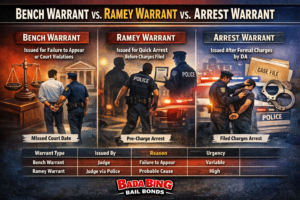
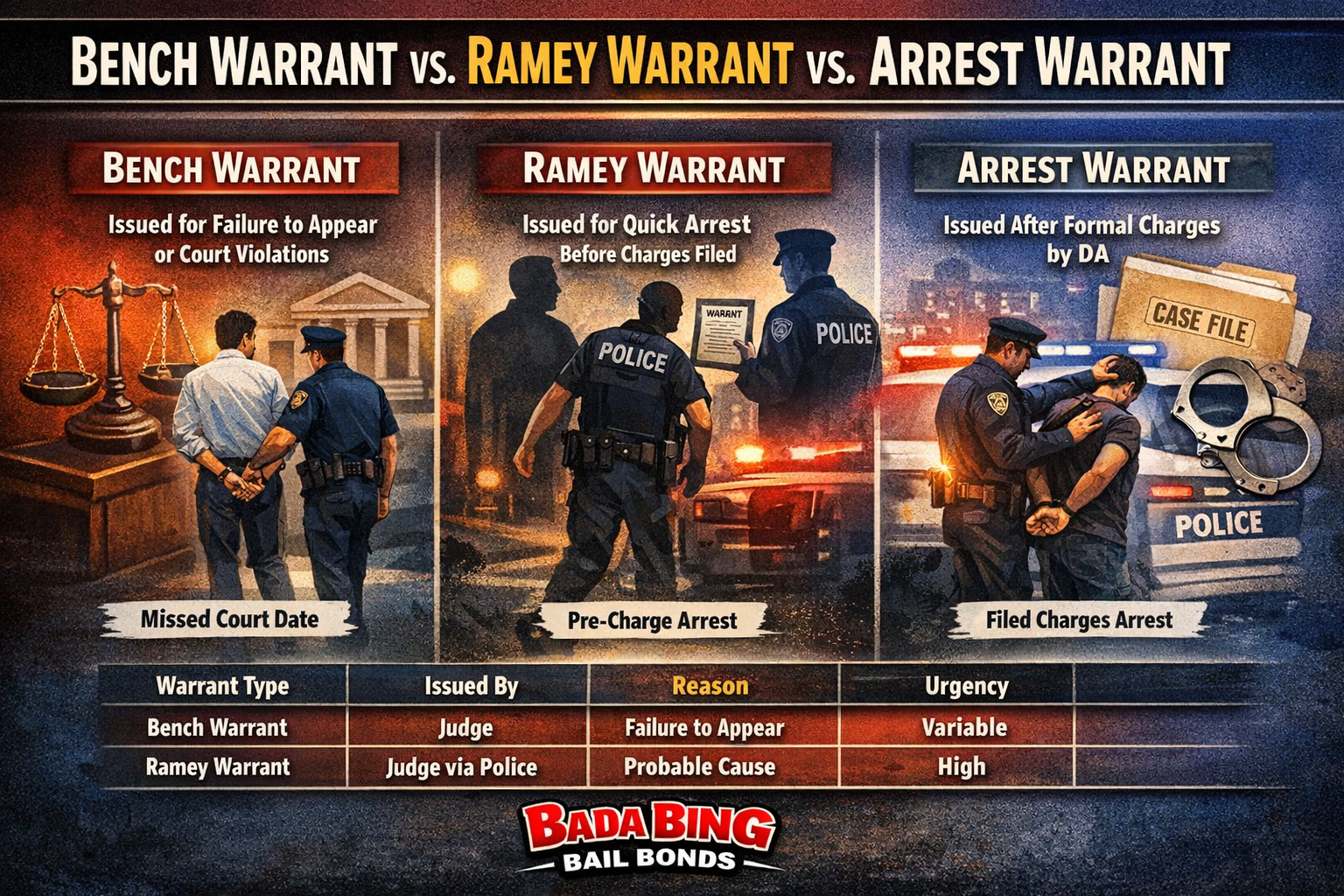
An arrest warrant is the most common type. It is typically issued after a law enforcement agency (like the police or sheriff) investigates a crime and presents evidence to a District Attorney.
How it works: The DA files formal charges, and a judge signs the warrant based on “probable cause.”
Purpose: To bring a person suspected of a crime into custody to answer to those charges.
Key Detail: These are usually the result of a completed investigation where formal charges are already on the books.
Unlike a standard arrest warrant, a Bench Warrant isn’t usually about a new crime. Instead, it’s about a “failure to comply” with the court’s rules.
How it works: A judge issues this “from the bench” (hence the name) when you fail to show up for a scheduled court date, fail to pay a fine, or violate a court order.
Purpose: To compel you to appear in court.
Key Detail: Police don’t usually go door-to-door looking for bench warrants, but if you get pulled over for a broken taillight, that warrant will pop up, and you will be taken to jail.
A Ramey Warrant is a specific type of arrest warrant used primarily in California. It is unique because it allows police to bypass the District Attorney.
How it works: Police go directly to a judge with a “declaration of probable cause” before formal charges are filed.
Why it’s used: Law enforcement often uses Ramey warrants when they want to make a “speedy arrest”—often on weekends or after hours—to prevent a suspect from fleeing or destroying evidence.
Key Detail: Because the DA hasn’t reviewed the case yet, a Ramey warrant often means the police are still gathering evidence and may want to interrogate you immediately upon arrest.
Quick Comparison Table
| Feature | Arrest Warrant | Bench Warrant | Ramey Warrant |
| Issued By | Judge (via DA) | Judge (from the bench) | Judge (directly via Police) |
| Reason | Formal criminal charges | Failure to appear/comply | Probable cause (pre-charge) |
| Urgency | Standard | Variable | High (often after hours) |
| Bail Possible? | Yes | Yes | Yes |
What Should You Do If You Have a Warrant?
If you suspect there is a warrant out for your name, do not wait for the police to come to you. A “walk-through” or voluntary surrender is often the best way to handle the situation. This allows you to arrange your bail before you go into custody, significantly shortening the time you spend behind bars.
Why Choose Bada Bing Bail Bonds?
We are available 24/7 to help you navigate the system. Whether it’s a failure to appear or a complex Ramey warrant, we provide:
Fast, Discreet Service: We get you out so you can get back to your life.
Flexible Payment Plans: We work with your budget.
Expert Advice: We know the local court systems inside and out.
Don’t let a warrant hang over your head. Call Bada Bing Bail Bonds today at [Your Phone Number] for a free warrant check and immediate assistance.
Frequently Asked Questions: Co-Signing Bail Bonds
Q: What is the risk of co-signing a bail bond? A: The primary risk is financial. If the defendant fails to appear in court and cannot be located, the co-signer is responsible for paying the full face value of the bail to the court. Additionally, the co-signer is responsible for the non-refundable bail premium and any recovery costs incurred if the defendant skips bail.
Q: Can a co-signer get their money back? A: The 10% premium paid to a bail agent is a non-refundable fee for the service of posting the bond. However, if you provided any cash or property as collateral, that will be returned to you once the defendant’s case is fully resolved and the bond is exonerated by the court.
Q: Does co-signing a bail bond affect your credit score? A: Simply signing a bail bond does not typically show up on your credit report or affect your score. However, if you fail to pay the agreed-upon premium or if the bond goes into forfeiture and the debt is sent to a collection agency, your credit score will be negatively impacted.
Q: Can I withdraw as a co-signer after the bond is posted? A: Yes. If you have reason to believe the defendant will not go to court or is engaging in illegal activity, you can request that the bail bonds company “surrender” the bond. This will return the defendant to custody and release you from future liability, though you may still be responsible for fees incurred up to that point.
Q: How long is a co-signer responsible for a defendant? A: A co-signer’s responsibility lasts for the duration of the legal case. Once the judge “exonerates” the bond (usually at sentencing or when charges are dropped), the financial obligation to the court ends.
Don’t let a mistake ruin your family’s traditions. We are the most trusted bail bond agency in [Ventura], known for our fast, discrete, and professional service.
Call us today at [805-910-9842] for a free consultation. We’re open 24/7, including Christmas and New Year’s.